
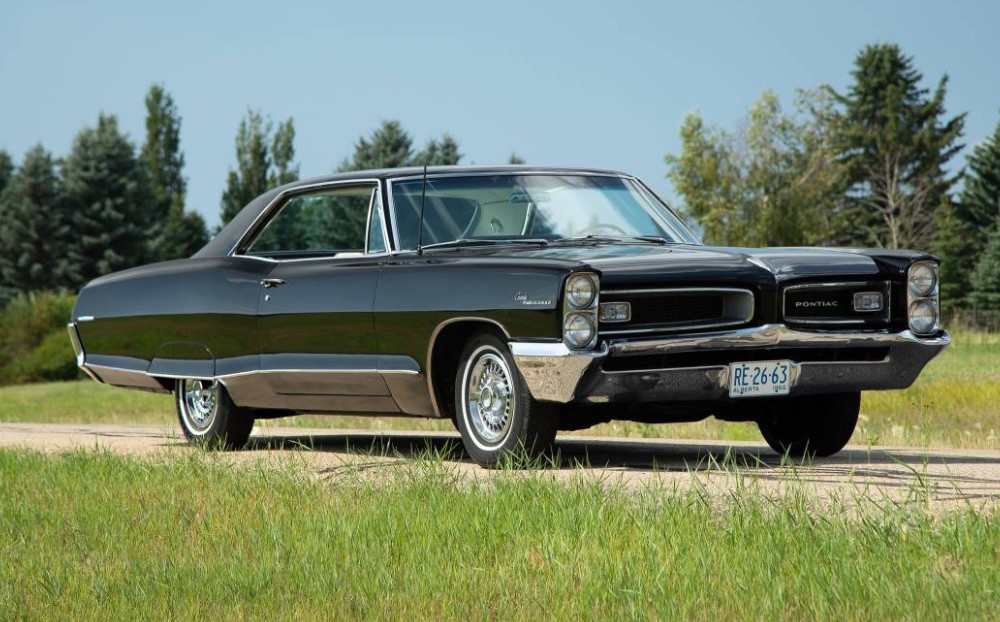
The Parisienne was a Pontiac built in Canada, utilizing a Chevrolet drivetrain. It was akin to the U.S. Catalina, and the Grande Parisienne was modeled after the Bonneville (or was it the Grand Prix?). The seller’s beauty is from 1966 and wears a 35-year-old restoration that seems to have held up well. This two-owner Pontiac from north of the border is available here on craigslist for $21,500 (is that USD or CDN?). Another nifty score from Barn Finder “Scott.”
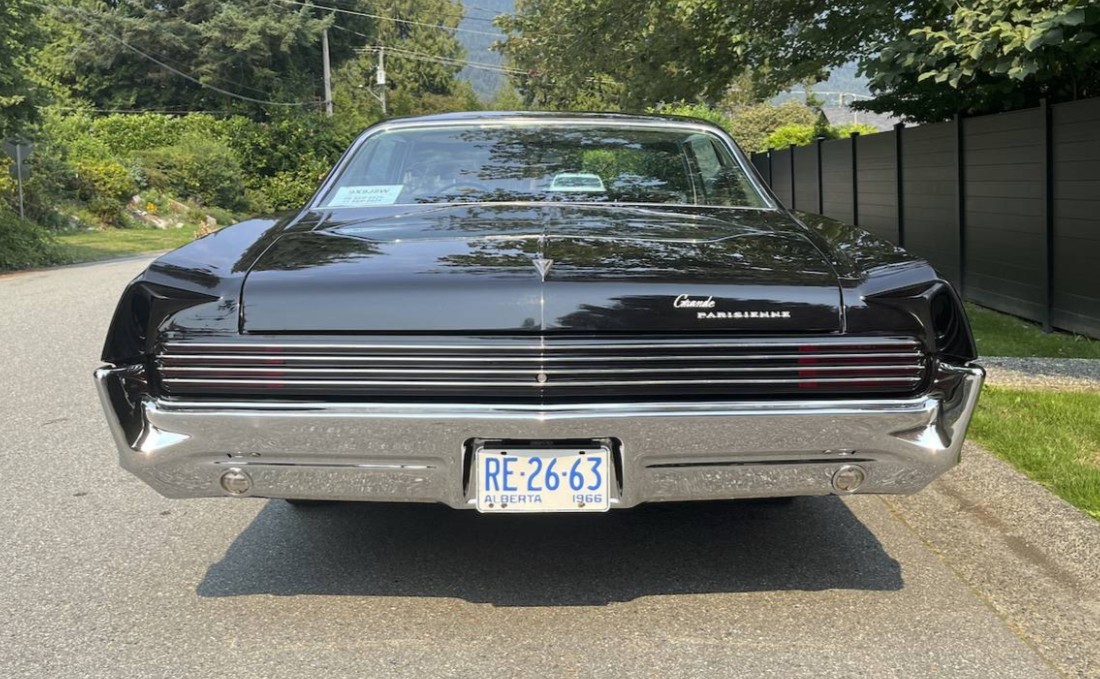
Canadian Parisiennes drew from GM’s B-body platform between 1958 and 1986. During this run, you’d find a familiar engine and transmission like those from a period Chevy Impala or Caprice. Parisiennes were the upper crust of Pontiacs and came with a higher level of trim and standard equipment, and even more so with the Grande Parisienne, which arrived in 1966, a year after the Chevy Caprice in the U.S. These Pontiacs were built in GM of Canada’s assembly plant in Oshawa, Ontario.
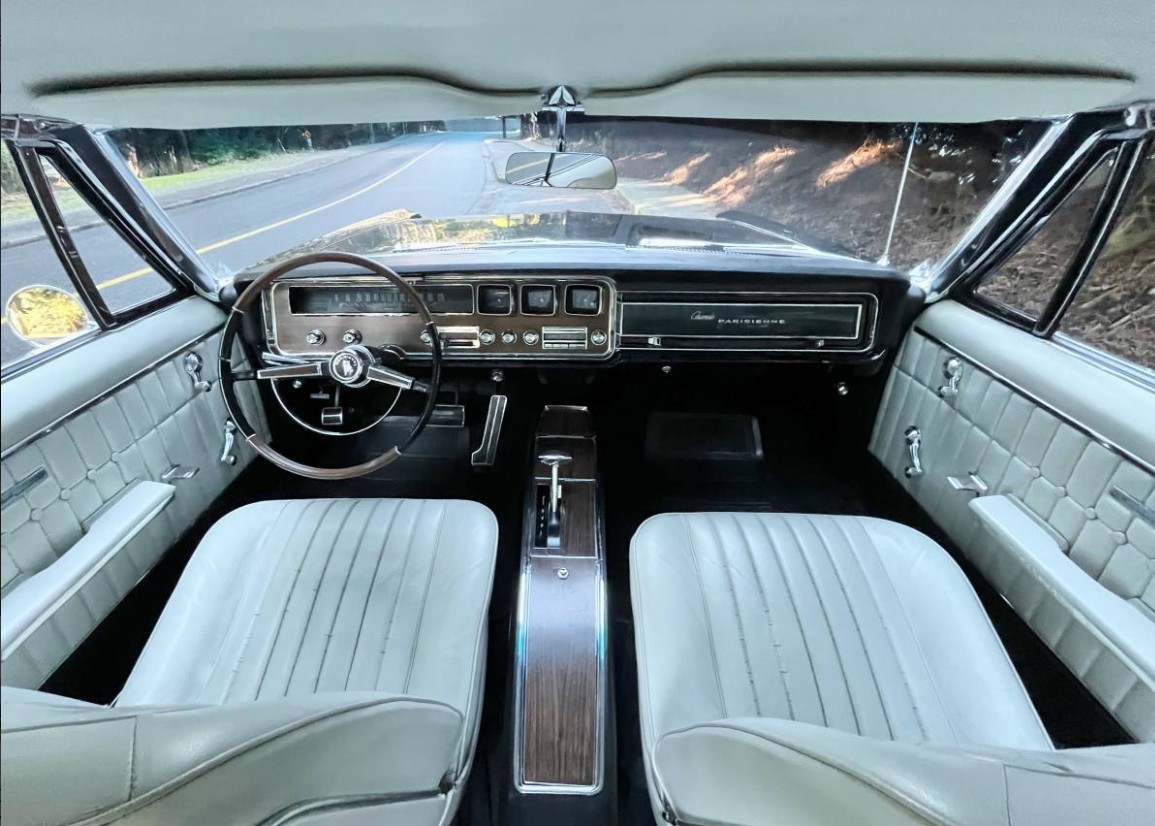
The seller’s Sport Coupe had both a mechanical and cosmetic restoration in 1990. Only 6,000 miles have been added to the odometer since then, but we don’t know the starting point. The black paint and white bucket seat interior look stellar and show the kind of care this vehicle has received in the 21st Century. It only has had two owners, but we’re not aware if that includes the seller as the history lesson is rather brief.
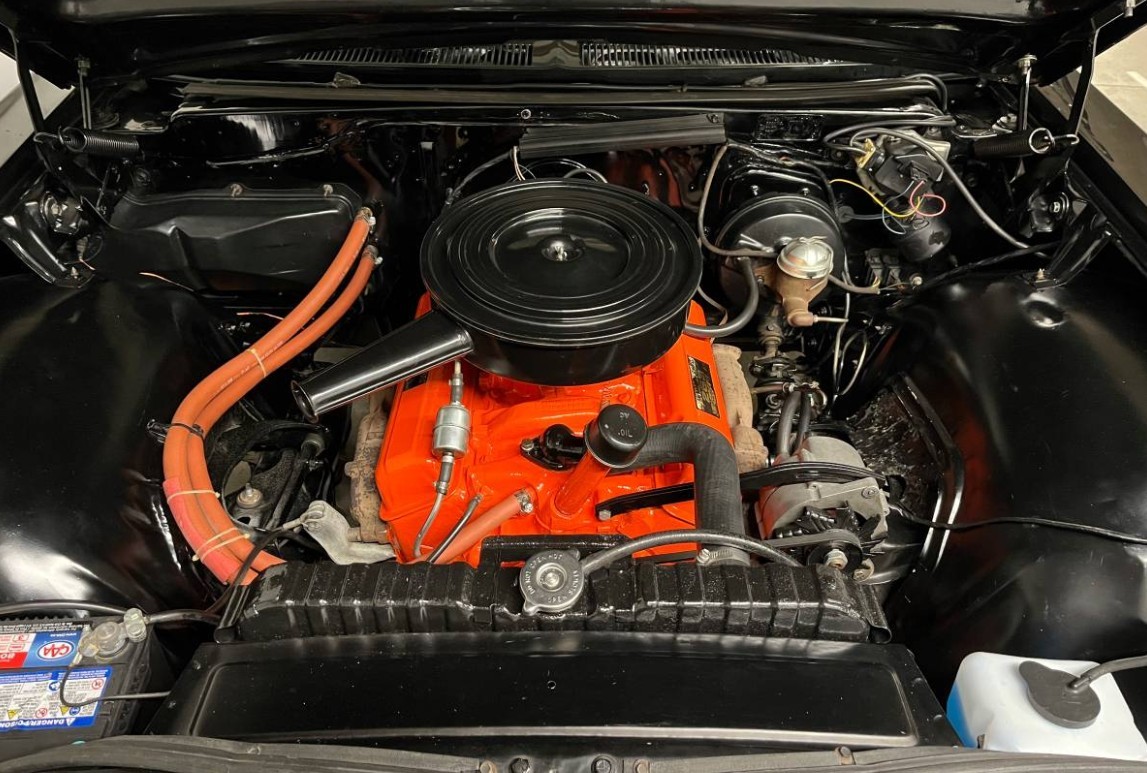
It comes off strange to see a red 283 cubic inch V8 in the engine compartment, paired with the venerable 2-speed Powerglide auto tranny. The car has tinted glass but no factory air conditioning. And it wears Canadian collector plates – are those transferable? If you’re looking for a seldom-seen classic, is this Parisienne the one?




Beauty.
Always fun to see our Canadian issues. This one is a beauty. My uncle had a 66 Pontiac Laurentian. If the Parisienne was the equivalent to the Caprice, Laurentien was to the Impala. I was a toddler back then but still have some pic’s in the family albums. Had a 283 with Powerglide. He sold it in 76 and bought a Catalina with a Chevy 350 underhood. The 66 died of massive frame corrosion a year later, Montreal was of.course part of the rust belt. He kept the 76 until 88 and traded for a Tempest with a 2.8 V-6. He sold the 76 to a young kid, one week later i saw it on a local street with the rear quarter all crumpled and bashed i was sad to see that
Just to clarify, Grand Parisienne was equivalent to the Caprice, Parisienne equivalent to the Impala, Laurentian to the Bel Air and Stato Chief to the Biscayne. A beautiful Pontiac and very rare. It could be ordered with a 327, 396 or 427 as well.
Canadian Pontiac Strato Chief equivalent to Chev Biscayne, Pontiac Laurentian to Chev BelAir, Pontiac Parisienne to Chev Impala.
Smooth ride with big hips. Just like my prom date
My first car. A ’66 Grande Parisienne, but the four door model, which looked almost as good as it was a hardtop with no pillar between the windows. Sold to me by a very generous uncle for a mere $200 back in 1980.
Made me very popular at college because we could cram 7 of us in the front and back bench seats and haul the 30 miles into town to nearest pizza and bowling hall.
But despite its hotter than average looks, that 283 with a Powerglide was indeed “leisurely” at best. Nothing like having only two gears to transmit what was less than torquey performance and it was not a lightweight cruiser.
But it was the tail lights that caught my eye. Loved ’em, and still do. They dont look out of a place for a modern car and I loved the fact that the ‘mericans didn’t have them on their Pontiacs. Sometimes we just do things better in Canada but we’re far too modest to brag about it. Well, til now.
The Grand Prix had those tail lights and the fog lamps in the grill.
The Grande Parisienne was extra special and very rare up here as it was Bonneville with Grand Prix mixed in..the most unique of all Pontiacs ever built U.S. or Canada..Trying to find another,especially in this shape is like trying to find a unicorn.We rarely saw these up here when new and this could be in single digits still existing.
Sweet. And if it’s $21,500 Canadian it’s $15,600 US(today)! Where are you going to find anything in this class this nice for that kind of money?
I was confused at first, but I believe this is more a Canadian Grand Prix and not a Canadian Bonneville. The GP had a 121″ wheelbase and the Bonnie’s was 124″. Additionally the rooflines are completely different. It really makes no difference as the ’65-’66 GM full-size coupes are among the most beautiful large cars ever built, and this one is in phenomenal condition. Whether it’s in $US or $CDN this is a solid deal.
From back when Pontiacs had style,& when you could
tell it was a Pontiac.
Heck,from when Pontiac was still around.
I’ve always been intrigued by the Canadian Pontiacs from this time period. Its a Grand Prix, yet look inside. It has a ’66 Chevrolet steering wheel gas pedal and brake pedal and shifter, yet it has a ’66 Pontiac dash board. Under the hood where you’d see a 389 4 barrel you have a Chevrolet 283 and a Powerglide instead of a THM 400. Either way, its an amazingly beautiful car. Just not sure why GM didn’t keep them all Pontiac?
Keeping them “all Pontiac” wouldn’t have achieved GM’s goal back then. At that time Canada imposed rather significant tariffs on vehicles and components imported into Canada. To maintain Pontiac’s traditional price point of being “just above Chevrolet”, GM of Canada used Canadian-produced components to build vehicles that were Pontiacs visually but were Chevrolets mechanically, since importing Pontiac-specific components from the US would have increased costs.
Engines and axles were manufactured by GM of Canada’s McKinnon Industries, which produced Chevrolet-designed components for Canadian production, and Pontiac bodies and interior components were installed on Impala/Caprice frames and suspensions to create the Parisienne instead of importing Catalinas and Bonnevilles, while Pontiac interiors and grilles and taillights with Pontiac styling cues were installed in Chevelle bodies to create the Beaumont.instead of importing the Tempest/LeMans.
Not enough volume for completely separate Chev & Pontiac lines. Chrysler did the same with Dodge & Plymouth. Interestingly, up here Dodge outsold Plymouth & Pontiac outsold Chev. I believe also that GMC outsold Chev truck. My first car was a 64 Pontiac Laurentian & my 2nd was a 66 Canadian Dodge Polara, Plymouth wheelbase with Dodge front & rear ends & Plymouth dash.
Beauty! What a disappointment under the hood.
I had a 65 Parisienne with the 283 and Powerglide. Performance was leisurely. It was a beautiful car though. This one could use a dual circuit master cylinder.
Beautiful car! I don’t know why there’s always confusion when a car for sale in Canada is listed though or why it’s even mentioned, but if it’s for sale in Canada it’s always in Canadian dollars unless otherwise specified as USD… Do your math as NevadaHalfTrack has done to figure out the exchange rate and realize that there are countries outside the U.S. that deal in their own currency…. Having said that, I’d love to have this car sitting in my driveway, here in Canada!
I realize a Canadian made car will conjure up comments from there, and that’s great, however, I bleed red, white, and blue, and to me, this is still a bizarro world Pontiac to us Yankee Doodle Dandys. It does seem to resemble a GP, and an orange motor, BLASPHEMY,,,although, I suppose the Rink Rats don’t see it that way. As mentioned before, to us American kids, for all we knew, people from other countries still lived in caves, and rode ox carts. Just shows, regardless what abnormalities I see, it still is a heck of a car.
Did you folks from Canada feel the same way about American finds in the 60s? Oh, look an American nickel,, :)
Thanks Howard, but didn’t you guys think we all lived in igloos up here? lol …. just think though, if this car was in your driveway, it’d be rarer than hen’s teeth in the US… cheers Howard, we bleed red, white and maple syrup up here, it keeps our igloos warm!
@ Howard A.-It would be best for us if you spoke for yourself.
Pontiac really had their stuff together in the ‘60s, this cars lines and details are magnificent. If only I had an extra long garage it would fit in.
Well, Ain’t THAT GRAND? 👍
A shame to see a beautiful 60s Pontiac with a stinking 283 under the hood.
Absolutely disgraceful.
They were also available with 327s, 396s and 427s, not too shabby.
Coolest part was it could be ordered with a 425 horse 427.
Now Please don’t bite my head off! JUST ASKING. Someone mentioned Tarrifs from Canada when this car was built. With a Tarrif war currently waging, would a Tarrif apply to a previously owned vehicle 🤔. IMO this is a GRAND opportunity.
Back in the day I worked for a large retail chain based in Michigan which had many stores located just across the border. Canadian customers would cross the bridges on Sundays and shop. They preferred to buy floor models of big ticket items because they didn’t have to pay duty fees on ‘used’ merchandise. Don’t know if this still applies in any way, but this was long ago when we weren’t told to hate the Canadians.
ccrvtt…. No doubt that’s changed since then, sounds like a great loophole though at the time…. duty is charged on everything now… sorry to hear that you’re taught to hate us now, strange times indeed
Many Americans DON’T follow instructions. Myself included, having several friends North of the border. Sending LOL and prayers 🙏 in friendship to ALL on both sides of the border. Thought for the day…LOVE and HATE are both four letter words. But what a difference!
Rick W…I don’t think they would apply, but a duty would be charged though… I’m not up on the rules down there
Years before the 1965 Automotive Products Trade Agreement (APTA free trade between the U.S. and Canada), American carmakers were forced to get a little creative if they wanted to sell their products north of the border.
Prior to APTA, new cars imported from the U.S. were stiffly taxed in order to protect Canadian automakers and autoworkers. So American manufacturers avoided those restraints by building Canadian-market versions—in Canada—under different brand and model names. The vehicles were essentially U.S. models with slight differences in bodywork, engines, and detailing.
Canadian Pontiacs shared frames, engines, and drivetrains with Chevrolets, but they carried specific Pontiac-styled sheet metal to fit Chevy’s wheelbase, which was several inches shorter than that of an American Pontiac.
Pontiac proved to be a cash cow for GM for 40 post-World War II years. Pontiac prices typically ran fractionally higher than corresponding Chevrolets, despite the fact that the cars cost virtually the same to build. However, buyers obviously felt they were getting more value and prestige with Pontiac than the lower-priced Chevy brand. Pontiac new-sales volume was often within 25 percent of Chevrolet’s numbers in Canada—a much higher proportion of the market than Pontiac held in the U.S. The 1965 Auto Pact took effect but eliminating tariffs on cars and auto parts exchanged between Canada and the U.S. didn’t put an immediate end to GM’s popular Canadian Pontiacs. It wasn’t until the 1970 model year, in fact, that senior Pontiacs shared the exact wheelbase and wore the same sheet metal as their U.S. cousins.
Ok, queen of details here.
American Pontiac Gran Prix differentiated itself from the Bonneville with a different roofline, parking lights moved from the bumper up into the grill, totally different taillights, resembling GTOs and different gauges instead of idiot lights on the dashboard, amoung others. Plus, American GP only came in a two door. Can you imagine a 4 door Grande Parisienne in the U.S.? Talk about rarer than hens teeth! Everyone would think it’s a 4 door Gran Prix.
Pontiac really had their stuff together in the sixties mainly because of John Delorian (or however you spell it)
And Mike, I personally don’t think you guys live in igloos (unless you’re REALLY north Canada) which kinda explains the lack of a/c in this car. This car is in such great shape it was obviously kept in an “ice garage”. (Insert smiley face here)
Gorgeous land yacht.
Canadian Pontiac Strato Chief equivalent to Chev Biscayne, Pontiac Laurentian to Chev BelAir, Pontiac Parisienne to Chev Impala.