
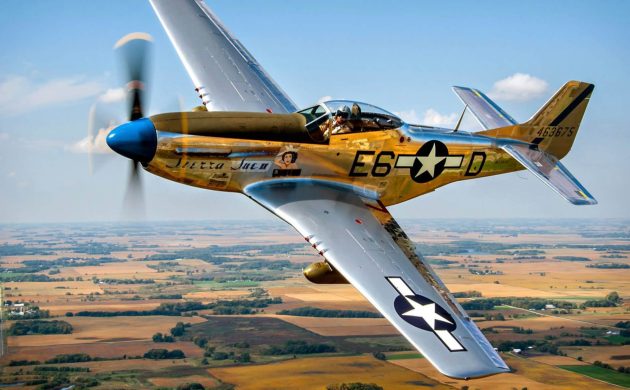
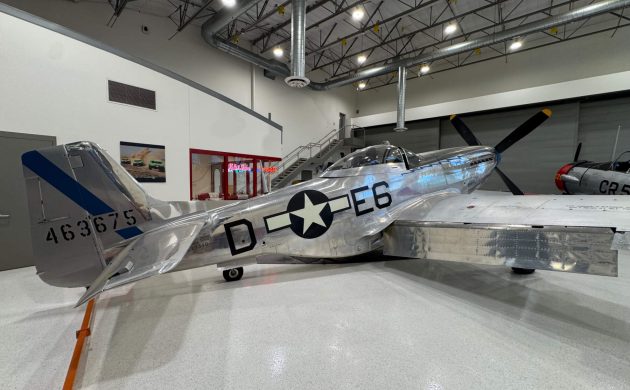
When you look back at the industrial history of the United States, many of the most iconic and successful American products were produced in response to wartime demands. One of the most famous is a fighter plane that was initially designed and built to fulfill a British contract, but ultimately became the plane that enabled our air forces to control the skies over Europe during World War II. This 1944 North American P-51 fighter for sale by Platinum Fighter Sales in Redondo Beach, California, is a meticulously restored example of a Mustang with a combat history. This ready-to-fly veteran, nicknamed “Sierra Sue II,” is being offered for $4,000,000. Thanks to Mitchell G. for this historic tip!

Most people don’t know that the famous P-51 Mustang wasn’t even intended to be an American plane. It was, in fact, designed for the British in less than six months from the signing of the contract to the first test flight. Britain was in dire straits in its war with Germany and had approached North American Aviation about manufacturing the P-40 Warhawk under license. The company was reluctant to produce an aircraft designed by another firm that they also felt was already obsolete. In response, North American offered the British a new, more capable fighter, which they happily accepted. When America’s entry into World War II was all but certain, our air forces quickly adopted the plane as our own.
Early versions were powered by the water-cooled Allison V-1710 turbosupercharged engine. While a reliable powerplant, the nature of its design limited its ceiling to around 15,000 feet. This did not match the demands of combat at the time, so experiments were begun to install the more powerful and much more altitude-friendly Rolls-Royce Merlin in later Mustangs. The combination was a hit, and Mustangs were soon upgraded to carry more fuel to provide the range needed to escort bombers deep into Europe. The air dominance made possible in large part by the Mustang helped to bring Germany to its knees.
When the war concluded, many of the planes were retained and provided service in the Korean War until fighter jet production met the demands of a new type of war. Mustangs by the thousands were either scrapped or sold off to other countries. Some of these planes managed to serve as front-line fighters until the early 1980s. A few managed to survive after being sold to civilians after their armament was removed. These planes, along with many that were repatriated from other countires formed the large contingent of vintage military aircraft that have populated air shows for decades.
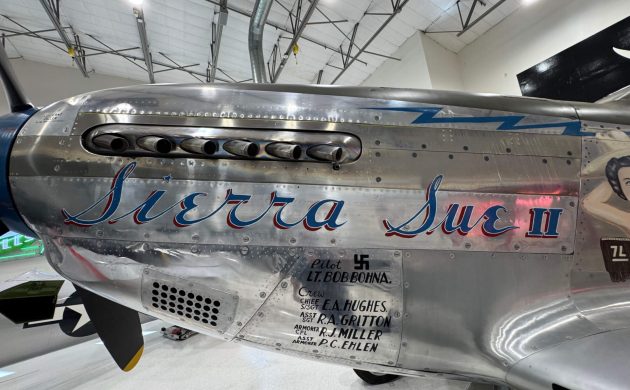
The Mustang you see here has a very interesting history. Produced in November 1944 by North American Aviation in Inglewood, California, the plane was shipped to Belgium in time to catch the tail end of the war in the European theater. It was then assigned to the 402nd Fighter Squadron and piloted by 1st. Lt. Bob Bohna. It wasn’t long before the plane was nicknamed “Sierra Sue II” after a girl in his high school. Unfortunately, the description does not include any description of what happened to the original “Sierra Sue.” It does say that the plane flew escort missions for B-17 bombing missions, took some shots at a ME-262, and found itself patrolling the skies of Paris when V-E Day rolled around.

From there, this Mustang followed the circuitous path of many surplus aircraft. It was sold to Sweden, where it was flown by their military from 1947 through 1952. Then, it was sold to Nicaragua and patrolled the hot and humid skies there until 1961. It was then put on display until 1971. Things took a different turn when it was sold by Nicaragua to an air racer and repatriated back to the United States. After being modified and painted red, the plane was restored to its original condition from 1977 through 1983. It graced many airshows after that but was again restored to factory specifications in 2011. Emerging in 2014 for its first flight, the airplane was flown to the famed EAA Airventure in Oshkosh, Wisconsin, where it received two major awards.
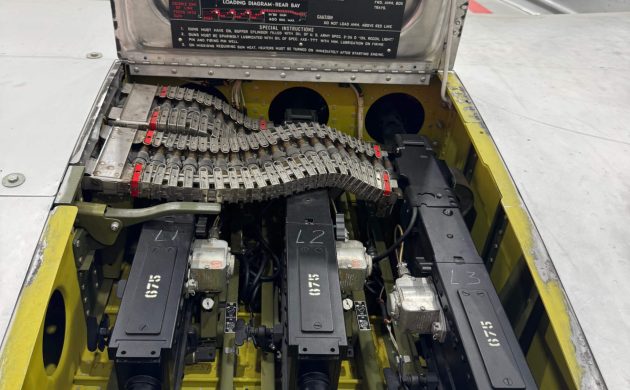
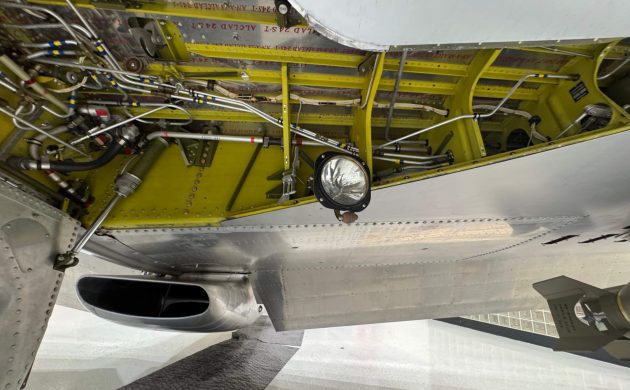
The plane is described as being correct to its April 1945 appearance and functioning down to the smallest detail. The level of craftsmanship is displayed in the photographs posted here and in the many you see on the seller’s website. While there is a fair amount of time on the Roush Aviation rebuilt Packard Merlin engine, it appears that an experienced pilot could climb into this iconic aircraft and head out with little concern.
While the $4,000,000 price tag is steep, this is likely one of the best examples of this famous fighter and is in the preferred late-war configuration. These planes were the pinnacle of piston-driven fighter technology when the war ended, and even managed to rack up a respectable kill ratio on early MiGs during the Korean War. Flying one would be the dream of many pilots, and the fantasy of those of us without the training and experience to handle such a craft. At the rate of inflation we seem to be experiencing, you could also look at this as an incredible investment. Warbirds such as this one will always demand a hefty premium.
If you could afford to fly this P-51 D, what would your plan of ownership be? A museum? Airshows? Throw some clothes in a duffel bag and chase the sunset? Please share your dreams in the comments.




It has always been a dream of mine to first, get my pilot license, and then get behind the controls of a P-51 Mustang. I think Jack Roush owns one that I’m sure he would let me take it for a spin. Gives me goose bumps just thinking about it. I served in the USAF with a one year tour of duty in 1973 in Udorn, Thailand loading bombs on F-4s. The Thai air force had a squadron of T-28s that I could get close enough to see the planes. Sometimes I swear there would be a P-40 or a P-51 sitting in the flight line. I always wanted to go sit in one. And then I woke up.
I echo Woofer’s sentiments.
The first time I saw a 51 in the metal was when I was taken to the air races at a young age. Seeing one just above the deck between the pylons at 400+ MPH was unforgettable, to say the least. I wanted one. Still do.
Much later, I did some stick time, but a Cessna 172 was about as far away from a P-51 as you can get and still be in the air.
I know it will never happen, but my fantasy survives.
Left Udorn after a one year hitch in ’72. There were a lot of interesting planes going through the base then including the Air America trasports and FAC birds. Would have been amazed to see one of these beauties drop in for a visit.
A favorite subject, Jeff. Excellent research and write up.
For those of you who have the dream of getting some flight time in one of these beautiful birds, here are 2 links to start with;
In Chino, CA-https://planesoffame.org/visit/warbird-rides
In Dallas, TX-https://www.airpowersquadron.org/p51-rides
Several air museums also offer rides in similar vintage aircraft. If you ever have the chance to see one up close and personal, you’ll see just a glance of and appreciate the sacrifices they endured.
Outstanding article here.
Look up joepeterburs.com my 101 year old Grandfathers site. He was a P51 pilot.
Sawatdi. Did a handful of TDY’s and flew around 65 missions out of Korat RTAFB in Linebacker and Linebacker 2, with the EC-121. Had a roommate who was a crew chief out of Udorn on a T-28. Can’t say I had a good time, I was scared s*&tless every time I flew. But I made it back, and have fond memories of the place and old friends (some of who I still talk to).
Do any talking to Alley Cat?
I know nothing about aircraft, so I found Jeff’s writeup to be well-researched, thorough, and interesting. Aside: my dad worked on the assembly line for North American Aviation in Columbus in the mid-50’s.
A moment of silence,,( yay), quiet you, we need to remember this stuff. I saw this on the fast finds after posting that floor shifter nobody took up,,,( me,me,me) and thought, what a cool thing to talk about, the P51 Mustang. I don’t think there is a more iconic airplane. Of course this isn’t for a crabby old truck driver in an assisted housing complex, but the historic value far exceeds the $4mil price tag. Sometimes we have a small airshow, and you can always tell when one of these flys over, the sound is unmistakable. It should, nay must be told, Packard had a contract with RR Merlin, and produced like 50,000 of these motors in Detroit. I read, these things could do between 437-487 mph, virtually faster than any other plane in WW2. I look at this cockpit like some may look at a Peterbilt dash. This is far more intense, trust me. We need to salute our British cousins as well, couldn’t have done it without you, mates!
The last surviving Battle of Britain pilot passed away in March 2025 at the age of 105.
The youngest American veteran of WWll should be in their mid to late nineties, now, unless they lied about their age. All will be gone in just a few short years. It’s sad, but that’s life.
I once saw three P51s at a local airshow!
Needs a 4 speed
I was all set to buy it until I realized that I was short by
$4,000,000,a pilot’s license,and…….
No AC-I’m out!
If that’s all that stopping you, it has 1-250 A/C: 1 canopy slid back and open at 250MPH…or you could use the air vents at altitude.
250? Try 450. I’m a retired pilot and that airplane is probably worth that much. Most pilots I have known and worked with love these airplanes. To own, operate, store and maintain a “warbird” like this requires very, very deep pockets. We can all dream though.
Too dry?
Just open the window. lol
A few of these fly out of the Torrance Airport. I can always tell by the deep rumble, sometimes they’ll fly in formation.Pretty cool. I never realized they were worth so much.
It is crazy that so many of us gear heads and low time pilots like myself with a couple of ratings ,think we should be able to fly this airplane. I know it’s not true, but even though I am in my early eighties now, I will not give up my dreams. I just missed a ride in one a few years back and I haven’t gotten over that yet.
Sounds like a cool family birthday present to me!!
A few years ago the Collings Foundation had a fly-in at the local airport. B17, B29 and of course a RR Merlin powered P51. For 2k you got a 20 minute full throttle ride of your lifetime. I got as close as I could while the pilot gave the whole pre-flight speech right down to where the air-sick bag was! Pilot and passenger climbed in and away they went. We live about a mile south of the southern runway and later that afternoon he want over just high enough to clear the high tension lines across the road, low, straight and fast! Made the hiar on the back of my neck stand up!
I wonder what kind of aircraft it was. A P51 is a single seat aircraft.
Hey Don, I don’t know what to tell you. Go to the Collings Foundation Living History website. The flights went out of the Shenandoah Valley Regional Airport in Weyers Cave Va.
A few WW2 single seaters were modified to accommodate an extra person. Some for reconnaissance, some for training, some for “joy” flights. What turned the A6 into a P51 (I think that happened at the P51C) was the Packard version of the RR Merlin (they were fuel-injected). Completely altered the capabilities of the plane! Australia made P51Ds, I think they were called P51Ks, they had longer landing legs and a couple of other changes. Arnold Glass entered one in the mid-1950s (Australian) Redex Air Trial!
Maybe it was a 2-seater trainer P-51?…
Phenomenal write up
This thing EV 😗😎
Seriously super cool historical planes!
It was many years ago when you could get a ride in a P-51 for the cost of the fuel. But I was fortunate enough to know someone that had one and flew in it from time to time. I also piloted a dual control one, but the cost was eye watering and flying one isn’t quite the same as watching one. The P-51 isn’t really a plane that you can relax in while flying. When/if you get near the stall speed, it gets pretty tricky.
I much preferred the T-28 Trojan. It had very similar performance to the P-51 (and could actually out turn it). I could almost afford to fly one and even considered purchasing one when they were not much more than a couple new cars. There just isn’t anything like boring 3000′ loops into the sky while looking out of a bubble canopy, the sound of the big radial stack music filling your helmet. Good times.
A plane like this is a very expensive proposition and it doesn’t stop when you pay for it.You can find them cheaper, but the metals and other parts are getting to where all P-51’s will need to be restored to be safe. I doubt there will be many sub 2 million P-51’s much longer.
The other part is pilot proficiency. You MUST fly this or some other high performance aircraft to stay proficient. That takes a commitment to maintenance for the bird and time and training for the pilot. It seems Iike I see more youtube videos of different ones flying now that ever before and I appreciate the dedication of the owners to keep them in the air. I have a couple of P-51 rims that I acquired many years ago and was recently offered $5000.00. Each! With a promise of a ride once installed. The are going to a new home. Great post.
Very interesting comments Jay E. Talk about a high-commitment, high-dollar hobby.
The T28 in my opinion was a totally different animal. It was more of a trainer. The later models had some great HP and were much easier to fly that the p51
Speaking of high performance, at OSH one year I was chatting with a former ‘Stang driver. He said that the most dangerous part of the flight was landing… dirty, i.e.; low ‘n slow, full flaps and gear down.
Part of the training was to get to altitude, get into the landing configuration and cob the throttle. The torque of the Merlin/4-blade fan was so great than you could not overcome it and you wound up on your back before you knew it.
Sounds like tons of fun!
Oh, and on the Stuart tank, while hitchhiking through Baltimore around 1950, an Army captain picked me up in his gorgeous ’39 LaSalle limo, complete with side mounts. Got into an impromptu stop light dust-up on US 40 east of town with a brand new Olds 88. The kid in the 88, complete with patches on his head, probably from having wracked up his former ride, got blown away.
Turns out the LaSalle’s engine was a brand new surplus 220 HP Cad tank engine!
In certain configurations and conditions, the Trojan can outclimb a P-51. The P-51, however, is much more agile than the Trojan. Also, at max speed, it is nearly 100MPH faster, although is is 1200 pounds heavier and capable of nearly 4000 pounds more TO weight. There’s really no comparison, capability-wise.
You’d need lots more capital than 4M to buy it. Just for reference, if it needs an engine – and one day it will need an overhaul at least – $150,000.00 could be the top figure. An overhaul may be $80,000. – $125,000.00 depending on what is needed.
I had the good fortune to fly a T34B a few times, which was lucky enough, but there is no way I’d be able to fly a P-51.
The fuel cost alone would be pretty staggering, at 60GPH at cruise speed. The P-51 is certainly not a plane for pattern flying, so your fuel card better have a lot of room on it. Also, that 100 octane fuel is soon to be harder to come by, and it is the minimum required.
Beautiful plane, but for somebody else to own. I’d be fine with a Piper Archer II. I couldn’t afford the P-51 if it was given to me.
I live just south of West Point Military and Stewart Airport (AFB). Mostly transport planes fly out of there with commercial jets now, and some I think F-17s. But once in a while you hear a vintage plane, it’ll stop you in your tracks to look! Thanks for the education on the P-51 guys!
I am fortunate to live in Oshkosh, Wi. right near the EAA Airventure Musuem and the EAA air show. They are always the high-light of the show. Thank you for the wright-up.
Been a member of Barnfinds for many years, and my first comment is going to be on an airplane. Go figure! What a gorgeous machine! The sound of that V12 just tickles my inards. I was a crew chief on the F4-C stationed at Torrejon AB, Spain in the early 70’s. Never saw any warbird prop planes but many others, including a Spanish F100 crashing on landing. I’ve never seen a pilot get out of an airplane and run across a field so fast in my life! And the testing of the Concorde SST that was an icredible sight to see . Anyhow, I was drawn to the Reno Air Races primarily because of the P-51’s in the unlimited class. What an experience! I wanted to go the first in Roswell but that is quite a trek from Idaho so I didn’t make it. Maybe next year.
Beautiful airplane!
Too cool. I only wish…
I also am a few $Million short, not to mention license and proficiency. I’d still put this on my list when I win Powerball. My uncle flew in the Navy during WWII and had many interesting stories. Our daughter and her family live in Bentonville AR and frequently see the Walton grandsons flying their (2) P51’s. I’d pay the $2k for a terrifying ride in one of these. That would be quite a difference from the ride I took in a Stearman biplane!
My Dad had a chance to buy one in the ’60’s at a surplus sale for 25k. Oh well
Early versions of the P-51 were Allison V-170 powered, but it was a version with a single stage blower, no turbocharger, which is what limited it’s altitude performance. The Allison had been intended to be turbosupercharged but priority for turbos went to B-17s and B-24s and P-47s. The Merlin powered Mustangs, like this one, had a two stage two speed blower, which gave them great performance at altitude.
Nice airplane. I wonder what insurance and maintenance costs are?
Ballpark of $1000 per hour…
The first time I saw one was at our small local airport in Bloomington Illinois when my Uncle took me to see it. I was 10,
maybe 11 back then and I never
forgot about it. That gleaming silver fuselage, those silver wings, you just don’t forget something like that. Then, I saw
Suzanne Pleshette “fly” one in the
movie “Wings Of Fire” with James
Farentino, Ralph Bellamy, and Loyd Nolan. That was it, I was hooked!–on both the lady and the
Airplane. Made my then 13 year old heart skip a beat every time I
saw her after that. Had a huge crush on her since I was 10 years old when I saw her in “Fate Is The
Hunter” with Glen Ford. And seeing her fly that Mustang in
“Wings Of fire” just made it worse! Even today, my heart goes pitter pat when I watch that movie on YouTube. A great plane
and a beautiful woman, who could ask for more…
We have the awesome privilege of being in the western most flight path of “Sentimental Journey” the B-17 that flys out of CAF Falcon Field Mesa AZ.
My Brother and I rode in the nose back in December of 2018!
Sound and feel of these old warbirds brings tears to my eyes every time…
I’ve always loved war birds of every conflict.
Nowadays seeing the modern aircraft flying out of Luke AFB (west Phoenix) I get the same feelings…
We’re not far from Luke. We see the F-35’s and French Mirage chase planes all the time.
My father was a fighter mechanic in the Army Air Corps, no Air Force then, in England. Repaired these, said some would come in so shot up he didn’t know how they made it back. Also never wanted to see another spark plug the rest of his like, cleaning them constantly. The greatest generation!
I guess Nevadahalfrack and I are very blessed to be able to see these (as in several at a time) racing at the Reno Air Races. Just to feel the ground shake and hear these things on full song several atca time is something you never forget. Unfortunately the Reno “Air Races” are no more. The FAA decided that it was too much monkey business too close to residential neighborhoods. And they are probably right. I was able a couple of years to get a press pass and have air race officials drop me at the base of a pylon with my camera. (Ex- got all my pictures) It was a huge rush to see them get as close to the pylon as possible turning on wing tip just over your head under full power! An experience I will never forget!
I have not been back for the “Air Show” so I’m not sure if P51s appear there. There are “new” air races out in the eastern part of the state now. (Elko area?) But I have been spoiled with the best experience short of a ride.
Caught the Reno races late ’60s early ’70s. About as earth shaking as it can get.
All original for 1945? I don’t know a whole lot about airplanes, but I see a couple digital gauges with LCD displays in there.
I seem to remember seeing a video of military aircraft being pushed off aircraft carriers at the conclusion of WWII, as it was cheaper than flying them back to mainland US. Is that correct or is that just an urban legend? If so, there are lot of vintage aircraft on the bottom of the ocean, including, I bet, P-51’s
For all aficionados of warbirds, here’s a story of one of their heroes:
https://www.smithsonianmag.com/air-space-magazine/the-soplata-airplane-sanctuary-22000009/
Hi Charles, nope, it’s true. I had a friend, his dad was in the Pacific theater, and he said, on the way back, they were ordered to dump EVERYTHING over the side. Trucks, tanks, Jeeps, and yep, I bet planes too. Not sure why, I think they feared if the ship got hijacked the equipment could be used.
Ditto Viet Nam
The government didn’t want the surplus vehicles to hit the civilian auto secondary market before the auto builders were able to begin supplying the demand for autos and thereby stimulating the post war economy. With the war over and cheap surplus vehicles hitting the shores Emma’s the automakers were certain to fold since the income from government contracts were cancelled.
These are the most beautiful warbirds ever!
I have 2 P51Ds and 1 P51 B mustangs.
They are incredible flyers. Handles very crisp at speed. You have to have the power on during landings and stay away from the stall speed.
I can only manage to get about 15 minutes of flight time as the battery runs down pretty quick. LOL.
Radio control P 51 is all I can afford!!
Was this ever at Beach Air, in Long Beach, CA, back in the 60’s? They had one for rent.
My Father and I went to the EAA fly in in OshKosh back in the 1990’s. Dad had been a Hellcat pilot back in 1945 (with one kill, a Japanese “Judy” dive bomber) and as we were walking the grounds we happened to be in the right spot to see six P-51’s taxi by right in front us. Dad just stood there with his hands in his pockets and a far away look in his eyes. “Now that’s one plane I never got to fly but I sure would have liked too.” Dad had loved airplanes since he was a 13 yo boy who would let himself in to an airport and take pictures of the planes, and he kept flying right up until he couldn’t pass the flight physical at age 72. At the time there was an outfit in FL that would take you up in a dual place P-51 trainer for $1800. As a surprise to Dad myself and my brother & sister got him a flight. He even got to control it for a short time. He said about the experience, “It was the most fun I’ve had with my clothes on in 50 years.”
I was a navy UDT combat sailor in 1950 during the Korean war. WE saw the bad ass P51 do many a flight. I was 18nyears old and had never seen those black pilots before. MAN O MAN what a fighter.
Wow what a beautiful bird! My uncle was a Design Engineer on the P-51 and my father also NNA Engineer both friends with Bob Hoover who flew the P-51 way pasted it’s limits & many other aircraft. All three of us worked in aircraft me on B1-B Lancer bomber another plane I’d give anything to fly as well as the P-51. The other fun thing is to talk to the great pilots flying these great planes and their stores which are amazing and I’ll never forget. Just get in fly to wherever have breakfast, fly on have lunch and back to the barn for a amazing Day. Thanks For the Memories…
A bit more from Tonio… The movie REDVTAILS is quite good about the black pilots from Tuskegee who were the 1st to fly the 52’s in combat ith the eighth Airforce over Germany. A former church member here in Parker Co. was one of those pilots. My book BROKEN ARROW has direct data and photos from some of them. And Showing General Davis.
Just finished measuring my living room, and it won’t fit. Sadly, I’m out.
I had one many years ago when I was a little kid, but crashed landed it the first time I tried to fly it. The control strings got tangled and there was no saving it.
I saw one on a pylon at the airport in Guatemala City years ago. I’m sure it has been sold for restoration at this point.
puddlejumpsquadron.com has much more affordable versions of both.
It wasn’t Fantasy Of Flight near Polk City Florida was it? A fella
named Kermit Weeks owns the place and I understand that he does indeed give rides in some of the aircraft for a fee. I recall he had a lot of different warplanes there. He also had a Lockheed
Constellation there for quite some time. I also recall a guy in
our town that had a B-17 at the
airport and would take people up
and fly them around for a penny
a pound. You stepped on a scale
and that’s what you paid for your fare. I never got to do that as my
Mom was a single Mom who never could really afford things like that no matter how cheap they were. There was always
something we needed more than
being flown around in a B-17 I guess and I never got to do it. This took place in the early ’60s
when things were still affordable
and most everyone we knew lived
well. But I still have the memories of seeing the people lined up for their rides in that old
bomber though. It was something you’d never see today.
My close friend a black Aeronautical engineer was one of the designers of the 51 he was 20 years old and a graduate of MIT while I was atOSU, we were a few of the black professionals ; around at the the time. ME an Architect. even while still in the navy.
This find sure stirred up a lot of discussion. So I’ll chime in. A couple of months ago I read a book entitled Spitfires. It was about American female transport pilots stationed and trained in Great Britain during WW2. They flew the planes from where they were manufactured domestically or shipped from the USA to where they would enter combat. These women flew everything from trainers to four engine bombers. What they did for the war effort was under appreciated during their service. Without them, pilots who were needed for combat would have had to be diverted to get these planes to where they were needed. A lot of the military decision makers scoffed at the idea that these women, many of whom were barnstormers, could do the job. The women proved the doubters wrong. Tragically some of these women made the ultimate sacrifice. Not only was this book a great read about something I knew nothing about but it included a bunch of interesting pictures of the pilots and the planes that they flew. It’s also very well researched so the reader gets an insight as to what these women were made of. After reading the book It got me watching videos of these old warbirds and recreations of the missions they flew. This led me to something else that I never knew. Right before Christmas when I conduct my annual viewing of Its A Wonderful Life; I found out that Jimmy Stewart was an accomplished fighter pilot and war hero. It was something he felt was his duty and he didn’t want to use his fame to just recruit. He wanted to fly. He was also modest to a fault about his accomplishments. Based on the BF comments today; apparently I’m not the only one who is fascinated by aircraft like this. Thusly inspired, I’m adding going to an airshow where they fly these planes to my bucket list. Thanks, Jeff
The women you re referring to were called WASPs or Women’s Air Service Pilots. Despite various members of the armed forces being involved in the creation of the program, the WASP and its members had no military standing. The service was disolved in December 1944. Fortunately, in 1977, for their World War II service, the members were granted veteran status, and in 2009 awarded the Congressional Gold Medal.
Flew in “Ye old pub” B-17 back in 2018. Will never forget it. Took all the video I could as I moved from spot to spot during the flight and ended up in the nose for a long time. Had a chance the same day to fly in the P-51 that came along but the $1500 was a bit too much. I’ll jump at the chance if it ever comes around again. Love the sound sound of the old war birds.
One thing that amazed me up close is the prop. 11 feet across! Incredible!
One of my aunts was in the WASPs during WWII and was rated to fly trainers to four engine bombers (she said she once flew a single engine trainer over the Rockies and said she would never do that again). One of her flights was of a P-51 from its factory in Texas to a field of embarcation in the Northeast. The plane’s engine caught fire over North Carolina and she had to bail out. (Years later, I found a newspaper article about that.) The plane was lost but she survived and joined the “Caterpillar Club,” which gave her a gold caterpillar to wear on her uniform. She attended many P-51 reunions over the decades. My son has a P-51 model she gave him and I have various documents about some of those reunions we saved after she died.
Your aunt and so many like her are one of the biggest reasons why we had an edge up in that war. From women in every profession like Rosie The Riveter and Jackie Cochran they got practically none of the accolades but formed the backbone of how things got done at home.
Lessons like that need to be passed along in our history-especially family history-for our next generations benefit.
Hopefully someone did up a book from her scrapbook like a specialist at Forever, etc., of that ilk so everyone can read about her courage, trials and tribulations.
I flew TF51D “Crazy Horse” in Kissimmee,FL back in 1997, the year I turned 50. Yes- it cost about $1,800 for one hour, and I flew almost the whole hour, with the assistance of Acrobatic Star Eliot Cross. He was in front, and I was in the rear seat. Probably best $$$ I ever spent in my 78years ! Made a great landing! But I had prev. experience and ownership of a Super Decathlon. That helped a ton! Great article, and fun Comments !
I never would have expected to see this on BF but what a treat. Thanks for the write-up and history Jeff, I think I’ve seen just about every movie made with a P-51 in it but I knew very little about their history, so this was a real treat. I had a distant relative who was a pilot in WWII and was shot down in a P-51 over France while he was protecting bombers on a mission to destroy Nazi supply lines.
Drive in and fly out???
Me personally, I’d fly it and enjoy it. I know nothing about airplanes but I know that I’d love this old girl and fly it. These planes remind me of those Red Bull air races. Guys cut these up and modify them extensively which is cool in a way but also sad that the historic originality is changed. Cool toy!
The main thing that old war racing planes get done is shortening the wings creating less drag allowing faster speeds. Needless to say a higher speed is required to get the plane off the ground after that modification!
My Dad was a WWII “90 Day Wonder” pilot. That was the nickname given to recruits because that’s how long they attended Pilot Training before being sent to war. He was sent to the South Pacific, and as a teenager years ago I would listen to his exciting war stories over & over. He was a Fighter Pilot, and most stories were about flying P51s, and the different models & engines. He loved the P51, and would go on about the marvelous Merlin engine, and how it was his favorite powerplant out of the variety that powered the P51.
Injuries he sustained while in flight included schrapnel in his leg & buttocks, and schrapnel near his eyeball that was never removed. It was a lump that you could see & feel under the skin.
He was shot down twice, and received a Purple Heart, and a Silver Star. One of the times he was shot down he floated in the water overnight in what he called a “Mae West” life preserver. His parachute was made of white silk (yes, early parachutes were made of pure white silk!) And he cut off a portion of it and sent it home to my Mom, who made it into a Christening Dress for when us kids were baptized as newborn babies! The “dress” is still being used to this day (myself included, in 1958!) whenever a new baby needs to wear it!
I normally only praise the beauty of the ’67-’69 Mustang, but I guess I’ll have to add the ’44 to my list – not only for the design, but for the awesome V-12 engine as well.
After the war you could buy these all day long for 7K each.
Great comments and observations. The one I really liked was if you were given one you probably couldn’t afford it!
Several years back I got called into work early (in Findlay, Ohio) and got treated to watching one of these flying. I was going past the Findlay airport and could hear it long before I ever saw it. The guy flying had the plane in a vertical power dive from an unknown altitude and would pull up before crashing and go straight back up in the air under full throttle until he was just a speck. Then repeat the process all over again. He did this several times while I sat there awe struck by what was happening. From the sound alone, it felt like being a WWII arial dog fight.
Carbob, not only trained as a fighter pilot, Jimmy Stewart also flew the B-24 Liberator and commanded his own bomber squadron as well. No wonder he knew how to fly the B-36 and the B-47 in the film Strategic Air Command with June Allison. After the war, he flew with SAC as
an Air Force reserve pilot all the way up to the early ’70s at least.
And he retired as a Brigadier General after 30 years of service.
In my family, we had five of our members that were airmen. My
Uncles, John and Frank, flew C-47
transport planes over France on
D-Day. Uncle Bill flew Corsairs off
the Enterprise under Admiral Halsey. My stepdad was a bombardier/ nose gunner in a B-24 with the 15th Air Force in Italy
and his squadron was escorted by the Red Tails on many missions over Eastern Europe and Austria. And last, but certainly not least, my Grandfather, who flew as a tail gunner in a B-17 Flying Fortress.
He went to Schweinfurt twice and
Berlin many times. As a 10 year old kid, I could sit and listen to their stories for hour whenever they talked about it if at all. The only way Grandpa would talk about it would be after he got a few drinks in him when we watched 12 O”Clock High on ABC
every Friday night. They must’ve seen and done some horrible things back then to make them not wanna talk about it.
My Uncle Jim was a medic at Normandy D day, battle of the bulge and captured and spent time in a Nazai prison camp. He would not talk about it ever. Until his son took him back to that beach in France. Where an older French lady met him on the beach, asked him if he was one of the invasion force. When he said he was. She hugged him and thanked him and took him and my cousin for lunch in her home. He visited all the places he had been. Including the prison camp. At our last family reunion he decided to tell us the whole story from drafted to home. He started in the morning and went all the way to late in the evening. It was fascinating. Mom and cousin wrote notes and another cousin recorded the whole thing. We laughed, cried and celebrated. It was emotionally draining and bonding. Unfortunately he passed away a few years ago. He is still my hero.
Wayne, you’re truly fortunate. Most of those folks are gone now, and they lived a pivotal time in history. A first hand account is priceless.
The comment record is broken by the addition of this plane!
A few summers ago now my friend and I went to see the warbird tour put on by the Collins group from MA I think it is. Anyhew the B-26, B-24, B-17G, P-40 & P-51(D I think it was) amongst some others were there in Salem, OR. We watched the B-17 take off and land and saw the Mustang take flight twice. Quite the sights and sounds. We got to do walk through of the old bombers and that was neat to see. I couldn’t take enough pictures either. That B-17 crashed a couple months later striking some fuel holding tanks. Some passengers survived. RiP both pilots.
AKA “ The Cadillac of the Skies “!