
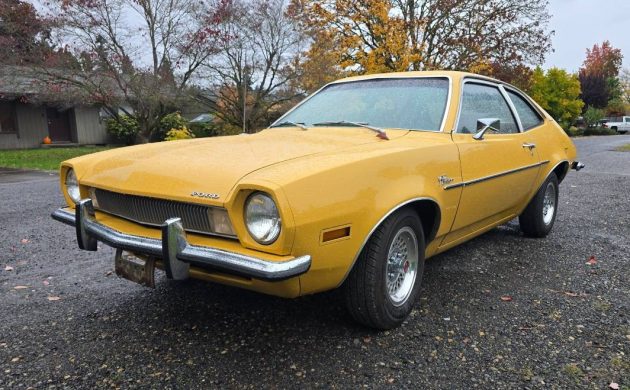
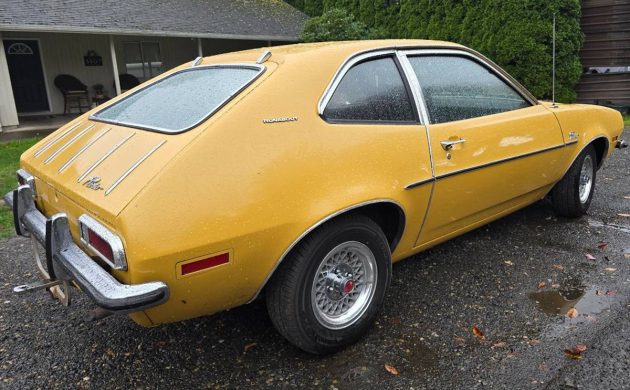
Should we give this Pinto a “best condition” award? Showing only 89,000 miles and with one repaint since new, this well-preserved 1971 “half-hatch” is located in Vancouver, Washington. It’s advertised here on craigslist for $8500. While we aren’t given much in the way of ownership history, the quality of this car’s paint, trim, underhood real estate, and interior supports the mileage claim. Increasing the desirability factor is this car’s rare body style, with its half-sized rear window, and vertical chrome accent trim on the “trunk” portion of the hatch. Later cars received a much larger rear window, and of course the trim was deleted. Thanks to Curvette for spotting this one and sending in the tip!
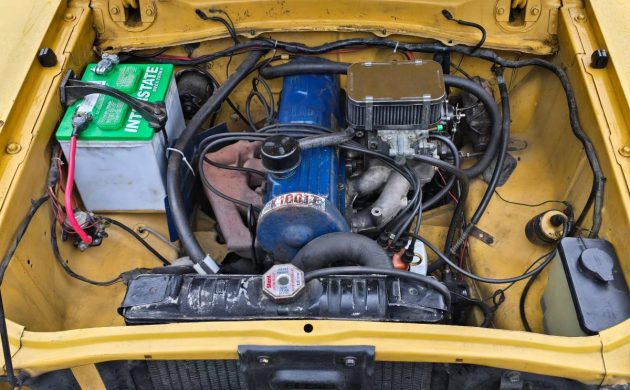
Ford sent the Pinto through the development gauntlet in just 25 months, a little more than half the time of its usual cycle. Lee Iacocca spearheaded the effort, aiming to put an import-buster on the ground as quickly as possible. The first body style was a sedan, with the hatchback and a wagon following shortly after. In 1971, this car’s 2.0-liter four-cylinder made about 100 hp, a darn sight better than the anemic 1.6-liter base engine. A four-speed manual brings power to the rear wheels. That’s another checkmark in the “plus” column for this pony-wannabe: most Pintos made do with a three-speed automatic. New tires, a well-groomed engine bay, and great running condition add to the appeal.
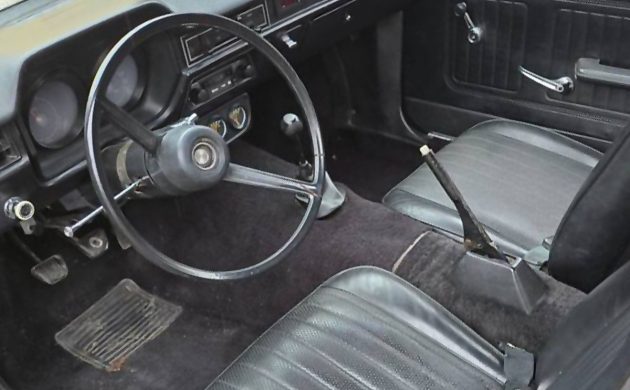
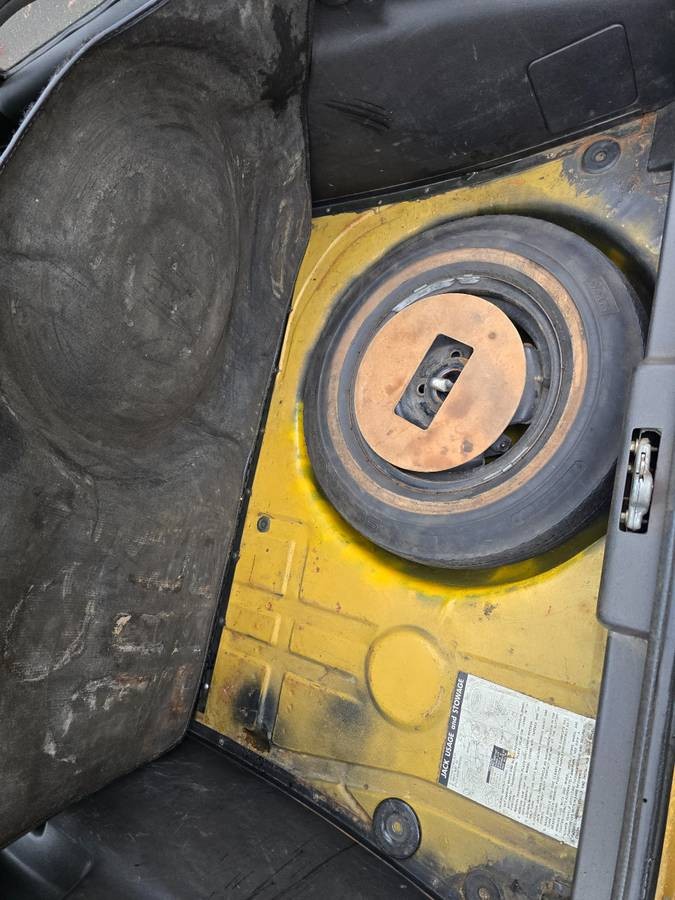
The interior is exceptional, considering the Pinto’s age, mileage, and not-so-plush materials. I could fool myself into believing this cabin belonged to a sports car. But Iacocca’s mandate was a car that weighed less than 2000 lbs and cost less than $2000 new – necessitating the bare minimum in accessories and quality. The seller includes a photo of the cargo area and the spare tire well, both of which are in fine condition.
The Pinto competed with Chevrolet’s Vega, VW’s Beetle, Toyota’s Corolla, and the AMC Gremlin. The market was thirsty for economy cars as the 1970s wore on, so each of these models drew success. The Pinto sold over 3.1 million copies up to 1980, when the last of its kind rolled off the line. Love it or hate it, these little cars have gained a following, pushing prices up. Still, good drivers like this one can be had for $6k to $8k, with a premium accorded to early cars. Would you pay the seller’s price for this ’71 half-hatch?




Fun to see a nice Pinto, as most were used up and thrown away long ago. I’ve never heard them referred to as a “half hatch,” but I get the point. Given their economy car place in the world, I remember plenty of them as having manual transmissions (at least in their early years; Kevin Marti would have the data). I got a chuckle out of the seller’s reference to “muscle car.” Period-correct color; not going to see this shade on new cars today.
Lots of us had Pintos (including me) and lots of us had good experiences with them (including me). Thanks Michelle, good job.
I can’t imagine a simpler, less cluttered engine bay ever. I love this one.
Wow, very clean. I like the chrome accents on the lift gate too. Its those little touches that just added a bit of class to what is essentially a basic economy car. The yellow and black interior go great together. Like Bob said, these were used up and scrapped many years ago it’s nice to see one so clean. I do have one question though, are the rims original? They look like Mustang II rims, and quite frankly, they really dress it up nice.
That hand brake needs to be adjusted.
Picky picky picky. But you’re right. :)
Nice little car.
Good eye. Usually I catch that stuff…. thanks!
Hummm…. Trailer hitch. Well, I hope what ever you need to pull is small and light weight. If I ever decided to buy a Pinto, this is one I’d go after.
Everything you need and nothing and nothing you don’t to get around town. I’ll use my F-series to do all my towing.
I like the contemporary design of the Pinto hatchbacks. But the I think the chrome accent bars on the hatch of this one, were a mistake. They seem to echo a “luggage rack”, but they are really a useless interruption of the clean lines of the hatch.
That’s probably part of why they only lasted half a model year.
In August of 71, I had my choice of a brown 72 Runabout or a red 71 Runabout. The 72 was when they came out with the glass hatch. I liked the 71 with the chrome on the hatch, as it reminded me of the 55 Chevrolet Nomad Wagon. I also liked the idea of not being able to see what I had in the back of the car. I needed a reliable car for my last 2 years of college.
100 horsepower, a 4 speed and $5 worth of gas, what more did you need on a Friday night in 1971 except for maybe an eight track player under the dash. This one looks in great condition. Anything under $10000 that is this nice seems like a deal anymore.
Pintos, great cars and fun to drive with the stick. I had two of them back in the day and I’m waiting for the right one to come along. This one checks almost all the boxes. My only quibble is the miles are a little high for me.
i see its equipped with the optional gas tank protector
I almost, almost, thought we’d gone beyond the Pinto gas tank saga… Nope.
The pintos weren’t any more likely to catch fire than other similar sized vehicles. The only reason the numbers of reported fires were higher was because there were so many more of them on the road than other models of small cars. Pintos were everywhere.
And today, the Tesla has a higher rate of fire related deaths than the Pinto ever had. I believe I read that in a Car and Driver article. Wherever I saw it… it was a reliable reference.
There was a series of cars which had the wrong bolts holding the diff cover plate in place; they ran short of the spec’d ones and line workers pulled the next best which had a head that protruded and would puncture the fuel tank in a rear-ender. Ford paid big time for that hourly-worker’s boo-boo.
My favorite of this genre was the AMC Spirit Sedan, a Gremmy with rear side windows in lieu of the huge sail panel.
The real Problem with the fuel tank/fire issue was 2 fold. #1 The recall kit included a shield for the fuel tank to protect it from getting pierced. Covers for the shock bolts to keep them from piercing the fuel tank. And a longer fuel filler neck to keep from getting pulled out when getting rear ended. (I still had recall kits in stock in the mid ’80s) #2 If getting really nailed in the back end, the 1/4 panels would bucket and force the doors to stay shut. Which was deemed a bad thing when the car caught fire. It had to be a VERY HARD HIT, AND HIT EXACTLY SQUARE. Fuel tanks as trunk floors had been done for many years. Particularly by Ford and Audi. Mustangs, Falcons, Fairlanes, early Audi Fox/80s, and Dashers. And I’m sure others also. But the “locking” of the doors was the really scary part.
I still love the little Pintos. I had a hotrod wagon the same color as this. And wish I still had it.
The question is: does it have Firestone 500s?…
That came later, just about the same time as the Aspen/Volare fiasco. With tin foil wheels and 500s a passenger could get quite the message. (The driver was hanging on for dear life!) I was in the tire business back then. ( running a couple of Goodyear stores thank God) We had some issues back then, but nowhere the problems that Firestone had. And it appeared to me mainly do to poor quality assembly of the tire. (Yes, tires are assembled. AND THEN put into molds to vulcanize all the different types of rubber together and form the tread) Once when removing a Firestone 500, I noticed a large bubble on the inside under the inner inner of the tire. I pushed on it and it made a crinkle sound. I cut open the inner liner to find a lunch bag laminated into the tire. That was done on assembly!
I paid $900 for my 71 Pinto 4 speed wagon with 41,000 miles on it. But that was around 1977. Served me well, hauling my bass rig to gigs, and hauling kegs to parties. Sometimes the parties never left the car. Sigh.
Sweet , do a Proper Bob Glidden Flavored Flyer .
That came later, just about the same time as the Aspen/Volare fiasco. With tin foil wheels and 500s a passenger could get quite the message. (The driver was hanging on for dear life! I was in the tire business back then. ( running a couple of Goodyear stores thank God) We had some issues back then, but nowhere the problems that Firestone had. And it appeared to me mainly do to poor quality assembly of the tire. (Yes, tires are assembled. AND THEN put into molds to vulcanize all the different types of rubber together and form the tread) Once when removing a Firestone 500, I noticed a large bubble on the inside under the inner inner of the tire. I pushed on it and it made a crinkle sound. I cut open the inner liner to find a lunch bag laminated into the tire. That was done on assembly!
I still have a “power” manual for these, don’t remember the publisher’s name. You could turn them into a real stoplight screamer!
Racer Walsh was a company that I used for my “hop up” parts for my 2.0. Cam, header, manifold and high compression pistons. It was a screamer!
I had a 74 back in the day with a 2.3 Comp cam header and side draft webers. With the Webers I mounted the distributor with a bracket on the front off the cam gear. Nothing but good memories!!!
Yes, a friend of mine used to race his 71 in Saratoga, California.
This was a real trip down memory lane. Thanks Michelle!
Cool. I had one, my 1st car. a 71 put in a 8000 rpm cam from eslinger engineering milled the head .125″ , header, webber lowered 2″ all around, Shelby Vector wheels . It came alive like a mofo, raced 240z’s gave them a run for their money. Lots of sand rails with Pinto motors with 4 side drafr Mukini carbs.
This one really sparks childhood memories. Could not help it to notice the “Sears” logo on the spare tire.
Amazing you’re able to see that!!
Modern 2 door car owners eat your heart out. This has room for 4 inside. When dealer did gas tank fix, didn’t they replace the body colored gas cap with a chrome one, & throw the former away? If this Pinto does not have the gas tank fix, are recall kits still available?
Also, i do not see a new fuel tank listed anywhere – if u need a new one, are you out of luck?
I don’t remember a filler cap as part of the recall package. The kit has been obsolete since approximately 1985. So it is unlikely there is one available. Also, the tank was not the problem. It was stuff poking through the tank and the filler neck popping out. (The reason there was a longer neck included in the kit.) As far as replacement for one rusted out. You have to have it patched and sealed. It’s almost impossible to fine an intact fuel tank for anything in a wrecking yard anymore. They picture them to drain them. (At least that’s what they do in our neck of the desert.)
I’m just saying, if u want to replace a 54! year old Pinto gas tank instead of flushing the old 1 out – or if the tank has a hole in it, i can’t find any new ones online! Yet for a ’69 falcon i can, & for a ’68 nova i can also find a stainless steel! one as well as galvanized steel ones.
Just found this …
https://www.hagerty.com/media/automotive-history/meet-the-fix-that-kept-the-ford-pinto-from-exploding/
The article says the 1975 Pinto came with factory dual exhaust!, which is apparently a one-year only configuration. I find that hard to believe.
I also remember reading that only the Pintos with a TRUNK had the gas tank issues & not the hatchback – not sure if THAT’S true tho. I don’t think Pinto wagons were recalled, however.
I never saw one with dual exhaust. (and I have been under many Pintos) But the only thing that I can think of would be a V6 option. Which might also be why the author came up with the kit. Very few cars to modify!