
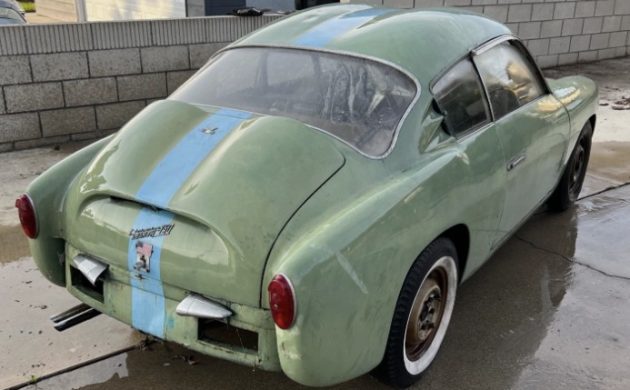
The first car Carlo Abarth manufactured wasn’t an Abarth at all: the 204A was developed from the dregs of Cisitalia, which went bankrupt in 1949 while Abarth was working for Piero Dusio. Lightweight and designed strictly for racing, the monoposto collected a number of wins. Drivers including Tazio Nuvolari and Piero Taruffi piloted 204As. With those credentials under his belt, Abarth accelerated his racing program, propelled by a deal with Fiat initiated in 1952. The company also made performance parts and tuned engines for speed – particularly small-displacement engines. The Zagato 750 GT, based on Fiat’s 600 platform, brought exotic Italian racing to everyman. It’s a jewel, designed with a “double bubble” roof for head clearance, built of aluminum by Zagato, running a highly-tuned 747 cc rear-mounted four-cylinder. The 750 GT remains one of the more reasonably priced Abarth cars available, despite its rarity. This project-quality 1958 Abarth 750 GT Zagato is available here on eBay, with bidding at $11,211, reserve not met. The winning bidder can collect the car and its parts from Garden Grove, California.
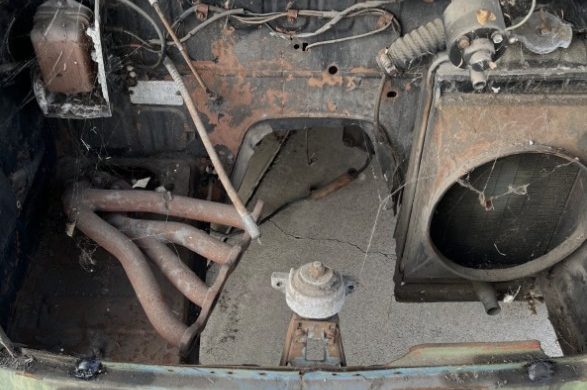
From the factory, the Abarth 750 GT was not fast, per se: it took over 18 seconds to reach 60 mph, and top speed was around 90. But in its class, the little cars spanked the competition regularly. Unfortunately, the missing engine represented the bulk of this Abarth’s value. The factory provided the knowledge, the skill, and the parts to bump the output of Fiat’s base 633 cc from 23 hp to about 45 hp. Specialized parts ranged from the famous billet steel crank to a high-lift camshaft, high-compression pistons, lightweight flywheel, finned alloy oil pan, and a larger Weber. Even the radiator was particularly configured to the Abarth. The loss of these parts and the difficulty of locating them again make this 750 GT just another pretty body. Of course, an enterprising owner can install a regular Fiat engine and still enjoy the driving experience, but it’s not really an Abarth then.
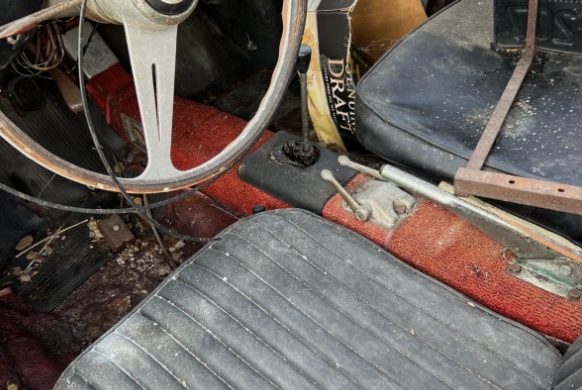
The cabin offers just enough niceties for comfort without compromising the car’s racing ambitions. In the Italian way, every bit and piece is elegant – while sacrificing slightly to function. One of those slender aluminum levers on the transmission tunnel is the choke control, which has a tendency to loosen over time. The thin bucket seats are barely supportive. But moving up top, the steering wheel, which is losing its rim, is gorgeous – perfectly framing the big round Jaeger gauges.
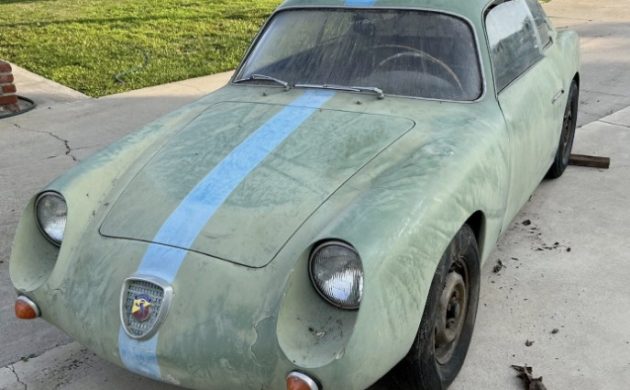
The double-humped aluminum engine lid facilitated cooling and neatly matched the roofline; the aluminum latch is missing here. This photo was taken while the car was wet, making the paint appear less chalky. The front and rear bumperettes are missing. These are the correct early tail lamps, though, and most of the trim, as well as the wheels, remain as original. A complete, original Zagato 750 GT with its Abarth engine can sell in the $90k to $100k region; cars with replacement engines will sell for half that or less – no matter how nice the engine may be. This car could make a fun SCCA entry, and you might find a vintage race organization that would allow an engine swap. What would you do with this little Italian exotic?



Another fine write-up, Michelle!
I’m not really up on my Abarth history, but given the build date wonder if this could have been a “Bialbero” with the Columbo-designed twincam cylinder head. Back in the day, those were pretty successful in SCCA racing against Austin-Healey Sprites.
They were pretty, too! I’m still amazed that Zagato could avoid making such a short car look dumpy. A friend had one, and while I had difficulty getting in and out, and more trouble getting comfortable behind the wheel, it was wonderful to look at.
Bialbero or not, you’re absolutely right about the parts situation, Michelle. The Abarth bits that have survived and are usable might as well have been cast in gold and encrusted with diamonds.
Thanks RayT. Abarth is one of my fetishes. I won’t own another (see below) but I enjoy his quirky and technical creations. Carlo Abarth had a knack for aligning with just the right coachbuilders to stamp his cars with standout style.
The parts situation has devolved to “make it”, and there are folks who can but fewer every day and the cost is prohibitive.
Quite a writeup Michelle. You sure got a lot of unknown history on that one.
Some say that clever Italian double bubble was to allow for helmet headroom.
For Billy Barty’s Italian brother, maybe.
I’m 6’2″, and it was tight inside for me.
And I was eager to drive it, too….
The only 6’2″ Italian was Clint Eastwood. His cousins were all 5’2″.
At risk of redundancy, Michelle-you always amaze with your write ups. Another fine machine delivered to us with the designer personality.
As a youngster, another hardcore car connoisseur opened my eyes to the depths of custom coachbuilding when he saw me outside of his open warehouse staring as his abundance of beautiful classics. The Porsche Abarth really was an amazing story and you hit it with your story here,
Thank you as always, Michelle.
I’ve owned dozens of various types pf alloy bodied Abarths over the years including a number of Double Bubbles. This one is pretty crusty and looks like a few that I bought “back in the day” (late ’80’s/early ’90’s) for $500. Mine were usually found in SoCal backyards covered with weathered blue plastic tarps. Occasionally I would venture out of state if the model was rare enough to make it worthwhile. I once discovered Al Cosentino’s rare Monomille ducktail in an apple barn in uptstate NY, a Record Monza Zagato and genuine 1000 TC berlina in Columbus Ohio (still have the TC) and a prototype 750 GT Spider Zagato in Texas. When this Double Bubble popped up on ebay I reached out to the seller to get more information and photos of underside rust. The seller has still not provided either of these. I was driving through LA last week and requested to view the car in person and he declined to show it. Some sellers don’t really make the process very transparent for buyers. Is he hiding something? No way to know, but there may be some major surprises to be found after purchase – it could be a Flintstone car!
I owned two Allemano Spiders (one a parts car but with engine, one a complete low-mileage treasure) and one double bubble. I may still have the “race” engine for the double bubble lying around, I’ll have to check. It’s most likely a fancied-up 600.
Anyway, none of these critters liked me. Most of my cars like me and will start and run for me. Not these Abarths. They had the best of care, but simply shunned my attentions. The double bubble was especially ungrateful. I sold them all to buy a BMW Z4 M.
There was a fabric/curtain shop in Royal Oak, Michigan called Calico Corners that my mother liked to drive all the way from Lansing to visit. Right next door was a foreign car dealer that I would sneak over to look at. Parked among the for sale and the for repairs was a Fiat Abarth 750 painted dark blue and Bondo. I didn’t know what it was but I was smitten. Several months passed and my 13-year old brain could not forget the little blue car. On the next trip I walked over and asked about the car, seeing if it was for sale. I was going to offer them $50 for it. Someone told me someone named Reno owned it, he was in the back. I walked in and this swarthy, friendly guy said, “I’m Reno.” He explained that it was a race car only and it wasn’t for sale. Nice enough guy, but I’m sure they had a good laugh after I left.
That was 1963. That car will live forever in the Dream Car Garage.
This one is ripe for restomoding for sure.
You could go to a lawnmower dealer and order a 45hp engine just like the arbarth. Get two.
Or, what engine would you put in it?