
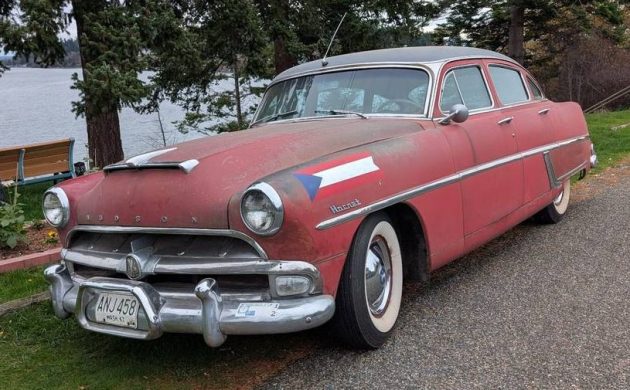
“My days monkey wrenching on cars are over. This old Hudson needs a new home,” claims the seller of this 1954 Hudson Hornet. Unfortunately, I’m down with that sentiment. Father Time has an insidious way of making crawling around under, bending down and over, or just trying to eyeball small details a tough row to hoe as the age odometer continually advances. It’s not all gloom and doom, of course; time marches on, and everyone needs to adjust. Anyway, today’s tip, courtesy of Curvette, is a nice find for more than one reason, so let’s give this old Hornet a proper review. Skagit County, Washington, is where you’ll find it, and it’s available here on craigslist for $9,500.

Hudson and Nash had the urge to merge in 1954, thus creating the new American Motors Corporation. As a result, 1954 marks the end of true Hudson independence, with later models being based on Nash designs. Also gone after ’54 was Hudson’s famous “step-down” design as well as its iconic “Twin-H” powerplant, though the basic 308 CI, in-line six-cylinder engine continued (This may not be the case as I have discovered conflicting information sources, some of it perhaps due to the availability of a new Packard V8 engine on the ’55 Hudson option list- JO) – the times, they were a changin’. The Hornet, available in two or four-door body styles, generated about 24K copies in ’54 – about a 3K unit reduction from the previous year. This example has a faded and well-used look about it, though the seller claims it has only experienced about 100 miles of use in the last twenty-five years. The seller adds, “Always garaged… Great belly pan,” that pan reference is a nod to the step-down floor that resides between the frame rails as opposed to being placed on top. All in all, this car appears to sound with no evidence of rot or crash damage. I’m not sure about the painted-on fender flags. I tried to research what they represent and turned up zilch. They are the same pattern as the Bahamian flag, but the colors are wrong; anyone have an idea?
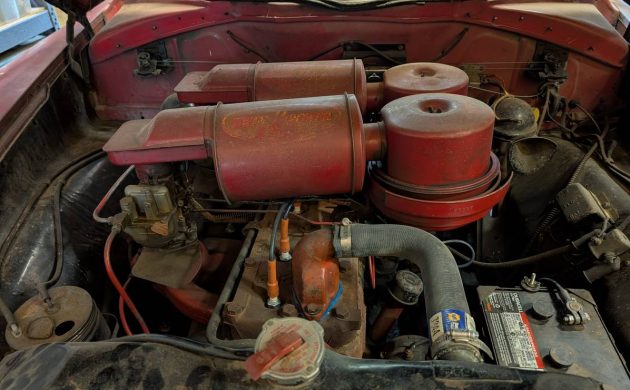
Famed for its NASCAR performance, this Hudson is powered by a 170 gross HP, “Twin H-Power” dual-carburetor, 308 CI, inline six-cylinder engine paired with a Hydramatic automatic transmission. The seller states, “Engine runs well,” and adds, “…carburetors rebuilt, new master and wheel cylinders, drums turned, new exhaust, new manifold gasket.”
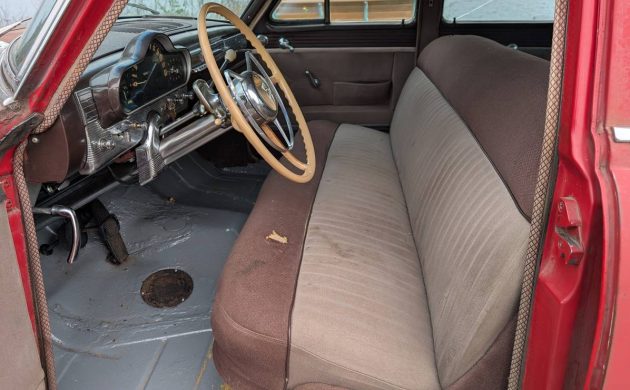
The interior, which appears to be original, is in pretty fair condition. The driver’s side of the front bench seat is stained, and there is some material degradation, but the entire environment is in better shape than I would have guessed. The lack of carpet validates the seller’s claim about the floor pan, and the chrome-enhanced instrument panel is perfectly representative of a car from this era – it’s an attention getter!
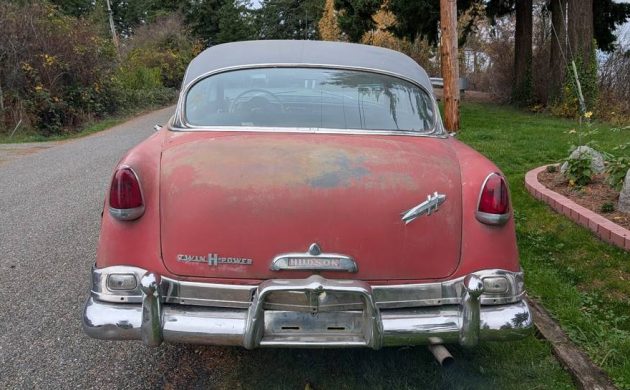
OK, this one’s a postwar car, but my thought is that many fifties models that are not either Baby Birds or Tri-Five Chevies will, or already are, suffering the fate of late prewar cars. The market for this ’54 Hudson Hornet? Probably limited, though there are Hudson aficionados who may be attracted to this claimed 96 K-mile example, the Twin H-Power feature is a draw. Anyway, what’s your thought on that matter?




Jim, the closest match for the flag I could find was the Czech Republic’s, but it’s not quite an exact match. Anyhoo, I don’t see anybody restoring this car but it would be fine for a Hudson fan or somebody who wants to tinker around with a ’50’s classic and not drop a ton of dough.
While not exactly right, could the flag be a nod to Cuba?
I thought it was Puerto Rico’s flag.
Missing some stripes but yes its closer to Puerto Rico
I am a auto tech since 1993 and my question what is the plate on the front floor for? This is a pretty clean Hudson here and hope it stays that way with the next buyer. The add says the Dad is done working on cars.Hope it goes to a good home.
Lot of cars of that era had the master cylinder under the floor. Notice that the pedals go down through the floor.
Thanks that’s what I thought but wasn’t sure.
Cover plate for master cylinder
Access to master cylinder.
Dang, got to be quicker for this crowd, the cover for the master cylinder. I’m sure many can’t fathom why it would be located in such an odd spot, see, the master cylinder was mounted on the frame rail, and a hinged rod from the pedal actuated the brake cylinder, I know, back axxwards, but that was just the location for years, like the truck battery under the passenger floor.
Anyone not familiar with Hudson, may automatically think, what an OLD car, like Studebaker, conjured up images of OLD cars. The Hudson shown here was actually one of the most advanced cars of the time. Streamlining, low center of gravity, many safety features that took years for other cars. They had a mechanical fail safe gizmo in case the juice brakes failed, never knew that. Door locks, improved door latches, dual horns, ( not shown here) even power steering and brakes, almost unheard of then. The Twin-H is an unusual option here. I read, like most new gee-gaws, it was rarely ordered. Some sites say, of the 51,000 Hudsons sold in 1954, less than 530 had Twin-H. It wasn’t a particularly expensive option, about $110 from the dealer, but few saw any use for it, and optioned the car in other ways. While Hudson did have some success in racing, the V8 shut that down in a hurry,, for most, a Hudson was something that odd uncle from Chicago drove. They were wonderful cars. I always say, a company formed by the merger of Hudson and Nash(AMC) would theoretically have been the best. The public didn’t think so and missed out on fantastic cars like this. Their loss.
“Some success in racing”. You need to do some research. This engine won MANY stock car races in the early 50’s. People today don’t credit straight sixes but these things were fast and with the step-down feature handled better than other cars. Many were driven to the track, raced, won and were driven home.
This post is about this particular Hudson Hornet, not the model’s racing record or participation. True, it was successful but that’s not relevant to this particular car. You need to subscribe to a NASCAR fanboy site for that coverage.
JO
JO–I don’t think his comment was at all inappropriate to the discussion.
Hi William, I knew I’d ruffle a few feathers, and aside from some fuel job, the Twin H was probably the most famous of all in line 6s. Hudson had several factors going for them they dominated mostly because V8s were just gaining steam, the low stance, but most importantly, Hudson had some of the best drivers, Herb Thomas, Marshall Teague, Tim Flock, and while the V8s began to take over, the poor Hudson had reached its zenith. Shame, as I read, in ’55 the Packard V8 came out, and would have helped dramatically, no?.
And JO, I take a bit of offense to that, whatever you’re intentions are as a writer, that’s well and good, but to your “audience” here, you mention Hudson Twin H, one thing immediately comes to mind, it’s outstanding racing heritage, and forgive me for saying, but you should have mentioned more of that in the article. It’s how we forget things. Peace, brother!
Hi. Article says it’s a 308 engine. For me looks like a smaller one 262. Look at the cast iron head. There is a 262 number stamps on it. 308 have that number one cylinder head. Usually aluminium.
Another screamin’ deal…3000 miles away. I guess I’ll have to get a hotel room out in Washington, and camp out for a couple weeks.
Interesting. I agree with Howard, for a post war car it has a modern look and with advanced, for the times, engineering. Too bad it.wasnt a coupe, it would garner more interest.
The body type most seen in the HET Club is the Hudson 4dr sedan.
My favorite stepdown is the smaller Hudson Pacemaker 2dr sedan, the Brougham. That is probably the rarest of the restored stepdowns. I had the opportunity to buy one back in the early 1990’s but the things I did not like about it was that it was black and it had a Ford motor. Ironically, the guy who came down from Maine to buy my 1950 Commodore sedan, threatened to go buy that black Pacemaker if I didn’t lower my asking price. He wasn’t a Hudson guy, just a wealthy guy who wanted to add to his vintage car collection. He insisted on driving the Commodore home from York, PA to his home in Maine. I warned him not to do that, but he did it anyway. I doubt that he succeeded because the motor had a leaking seal which in the early 1950’s was just a piece of rope sealed with something like wax. I never had the motor yanked to replace it. So I left a case of motor oil in the trunk for the new owner since the car used a quart of oil every 25 miles because of the leak. This guy did not seem like the type of person who would bother stopping every 25 miles to refill the oil. When he got in the car to drive it away, I offered to take a picture of him inside the car, but he said he had to get on the road and he just drove away with me laughing at his impatience typical of a Type A personality. He tried to force open the locked door of the bank when we got there a few minutes before the bank opened.
Author Richard M. Langworth discussed the origins and uses of Twin H-Power in his book, The Postwar Years: Hudson: “[The] best-known Hudson ‘severe usage’ item was Twin H-Power…a device Hudson had on the shelves since 1944–and the firm had experimented with dual carburetors since 1937. Twin H consisted of a dual-manifold, dual-carburetor induction system, providing a very even measure of fuel-air mixture to the cylinders, which in a standard induction arrangement is not ideally suited to six-cylinder configurations. It was a fair reply to the four-barrel carburetor then coming into use on competitive V-8s.
“Hudson claimed that Twin H-Power was the first instance of dual-carb, dual-manifold induction on an American-made six: ‘The secret of the amazing results which Twin H-Power provides is that it so accurately measures the gasoline, so evenly distributes it to each cylinder, and so thoroughly vaporizes the fuel with air that it provides what the engineers call far better “breathing” and combustion than has heretofore been obtainable,’” Langworth continued.
“The ruggedness of the Hudson engine is an important factor in the development of Twin H-Power. The oversize bearings, the extreme rigidity and hardness of the block, the weight and stiffness of the crankshaft–in fact the extra sturdiness built into all parts–make it possible to utilize the extra power,” he concluded. “Unquestionably, the Fabulous Hudson Hornet was the most hairy-chested, impressively performing six the American industry has ever created.”
Thanks for that wonderful writeup, almost BFs writer worthy, however, I must say, the Twin H was not the most hairy chested, factory offered, in line 6, that honor went to the Hyper-Pak Slant 6, that put out almost 200 HP, leaving the poor Hudson in the dust. Today, Chrysler shines once again, as the new “Hurricane” Twin turbo HO in line 6 produces almost 540 HP!
Put a star in the blue area and you’ve got the Puerto Rican flag. About the car, I love these old behemoths and this one has nice lines and a look that nicely straddles the post-war cars and the more modern ’50s cars. The four speed HydraMatic is a nice addition to a car of this size. Unfortunately, can’t do a four door.
Again an excellent entry vehicle into the classic car hobby. It is all there!!! Just would need some cleaning and a paint job.. There are a lot of car clubs which would welcome you with this car. NOT all of them are concourse quality picky (I HOPE!!) This is a car you could drive and enjoy.
I’m betting that the seller’s Dad could tell us all about the fender art since he’s owned this car for a long time. Probably the son can tell us as well. Yet again here’s another nicely preserved car residing in Washington State. I think this car will likely find a new owner and maybe it will be on the road more frequently in the future. GLWTS.
“The odd uncle from Chicago”….”
Not so at all. As I have stated here before, all 3 of my uncles lived in Chicago and all 3 drove Hudsons in the 1950’s and none of them were odd. I am probably the odd one in the family since I bought a 1950 Hudson and then a 1954 Hudson in the early 1990’s, I am from Chicago, but I am no one’s uncle.
I remember my uncle’s new 1954 Hudson very well. Algerian Blue body with cream top. This featured Hudson would be easy to restore, and would be prized by someone in the Hudson club. The article failed to point out what is probably the most valued item on this car. The optional ivory colored steering wheel. In the 1990’s my friend and I went to check out a 1954 Hudson stored since new in an an old man’s 3 story repair shop near Baltimore’s famous shot tower. A wooden ramp went from ground level to the third floor. My friend bought the Hudson that had only a few miles on it because while it was out from the nearby Hudson dealership it was hit in the side by another car and somehow this old man bought it. But it was never repaired because the frame was damaged along with the doors. So there it sat. Pristine interior with that valuable ivory steering wheel. One side of the car in perfect condition. No rust. The paint and chrome were spotless. I think my friend paid $1,500 for the car. Wanted it as a parts car for the 1954 Hudson that he planned to restore. Unfortunately, the old man would not also sell the engine and transmission which sat beside the car. So my friend, who lived in Iowa, had the car towed and stored on the property of the shade tree alcoholic mechanic who worked on my Hudsons in York, PA. At some point the mechanic took off the steering wheel and sold it to a Hudson collector. He denied doing that, but that is what happened. My friend never retrieved that Hudson from that property because he lost his one man business and ran out of money. So I am sure the mechanic parted out the rest of the car.
“Also gone after ’54 was Hudson’s famous “step-down” design as well as its iconic “Twin-H” powerplant…”
As I pointed out in my earlier comment (since deleted, apparently) there was a ’55 Hornet with the 308 Twin H written up on this site back in August. So the “step-down” was gone after ’54 but the iconic Twin H 308 lingered on for ’55. (There was also a less iconic 202 Twin H offered in the ’55 Wasp).