
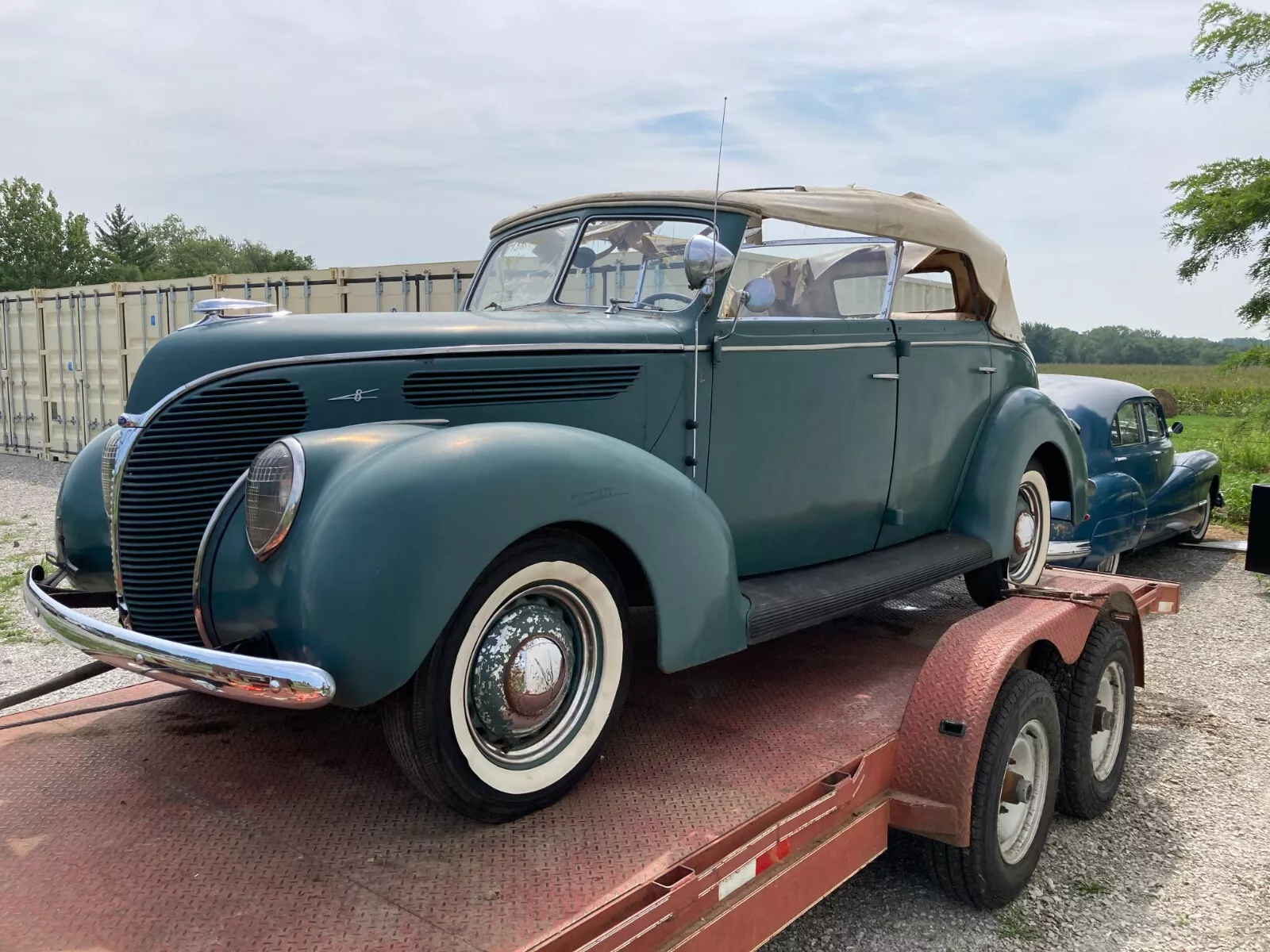
Ford’s love affair with the phaeton body style is a mystery unto itself. For a huge company well entrenched in the mentality that profit was king, why did they offer the slow-selling phaeton body style until 1938? Why did they modify the more expensive convertible sedan body to do so? Who was buying these cars in 1938? If you are looking for one of the rarest prewar Fords, then you might want to have a gander at this 1938 Ford phaeton for sale on eBay in Salem, Iowa. Bidding on this unusual but quite restorable Ford is sitting at $15,395 with six days to go.
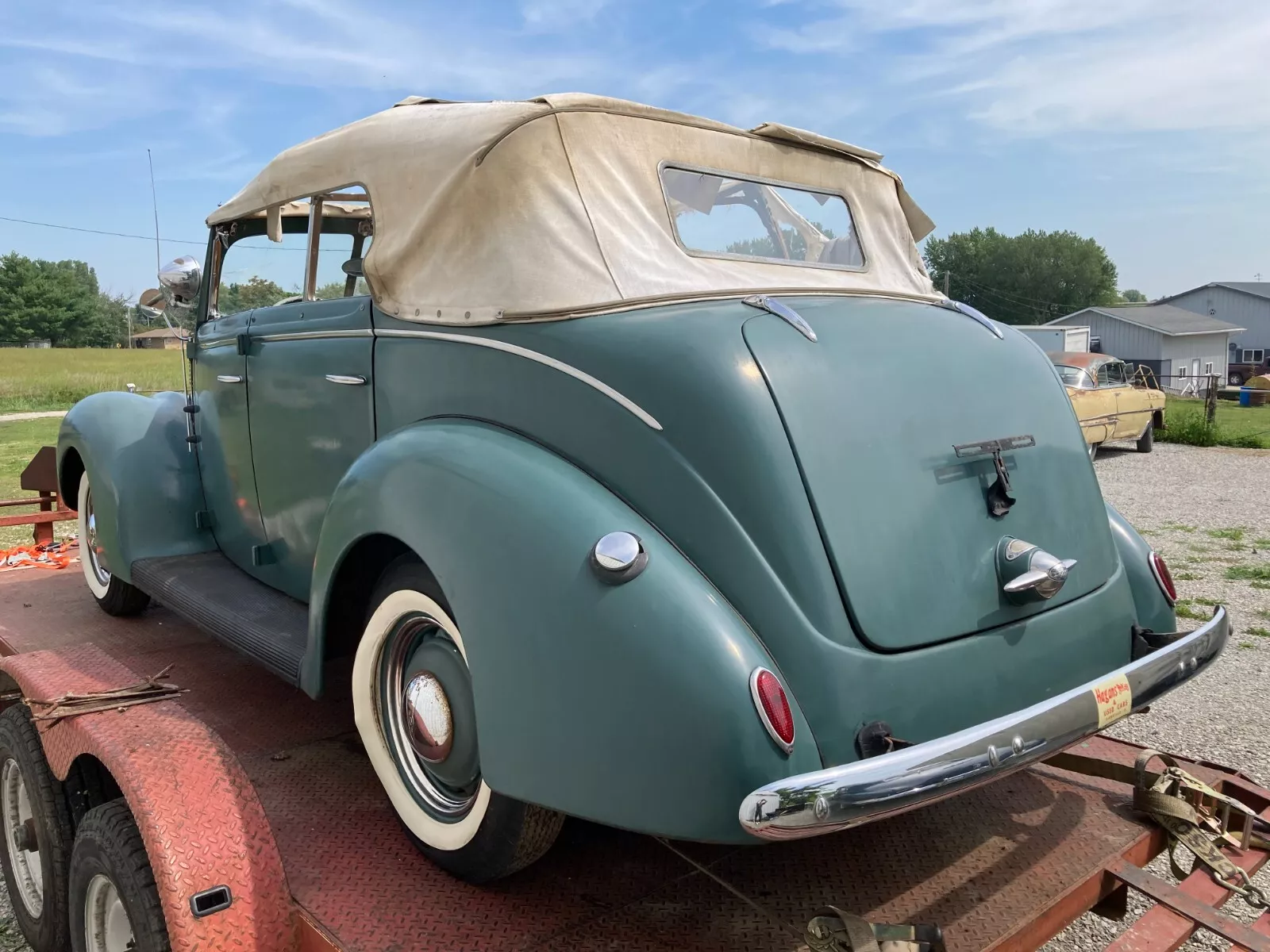
For those not current on their obscure automotive vocabulary, a phaeton is a four-door convertible that uses side curtains instead of roll-up windows. This body style was quite common in the early days of the automobile and was commonly referred to as a “touring car.” As time passed, the technology to build an enclosed car economically allowed companies to offer a vehicle that protected the occupants from the weather. Thus, demand for convertibles of all types began to wane. Outdated body styles that used side curtains to seal out the weather such as roadsters and phaetons became even more uncommon at dealerships than their convertible coupe and convertible sedan cousins. Roll-up windows were a lot more convenient for customers who liked an open-top experience.
The Ford Motor Company, by that time famous for parsimoniousness, stubbornly hung on to the roadster and phaeton body styles when other manufacturers had long since abandoned them. While the last roadster rolled off the assembly line in 1937, the final phaetons were offered in 1938. In all, just 1,169 of them cars were produced in that year. The big question is why did Ford even offer the car after making just 3,723 of them in 1937? That number is especially hard to understand when the company sold 410,263 cars in total in 1938. Were there leftover bodies from 1937 to dispose of? Were fleet sales a reason? Was there a powerful executive at Ford who was the guardian angel for this body style? Perhaps we will never know.
What we do know is that convertible sedan bodies were modified to produce phaetons. This is also difficult to understand given Ford’s intense desire to produce as many vehicles as possible. It took more effort to set these cars up for side curtains than it would have to install windows and window regulators. Add the costs of production of side curtains, stanchions to support the curtains, and the effort required to precisely drill holes in the body for the hardware needed to snap the curtains into the body, and the whole mystery gets even stranger. If any readers have a theory on this, please share your thoughts with the rest of us in the comments.
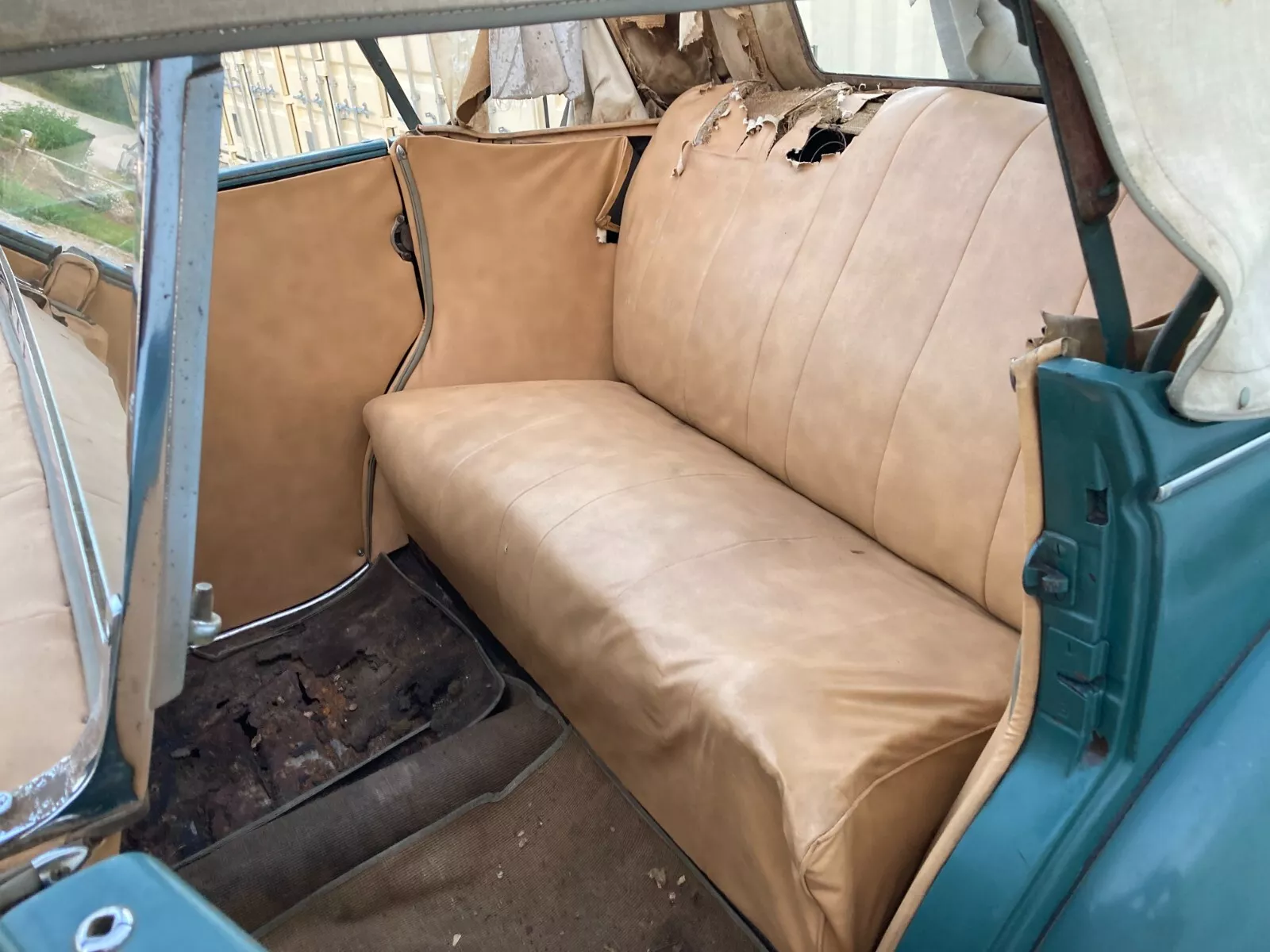
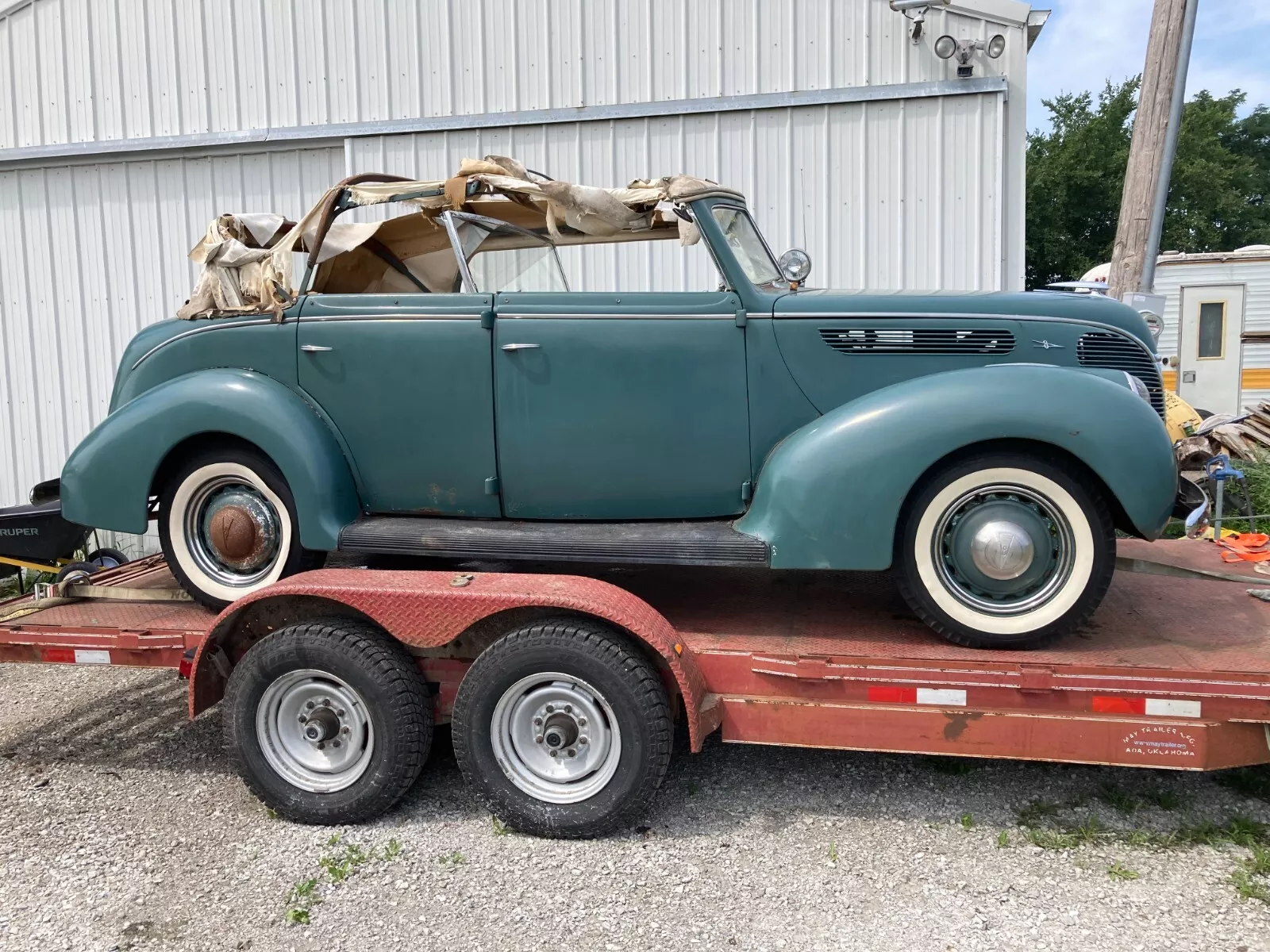
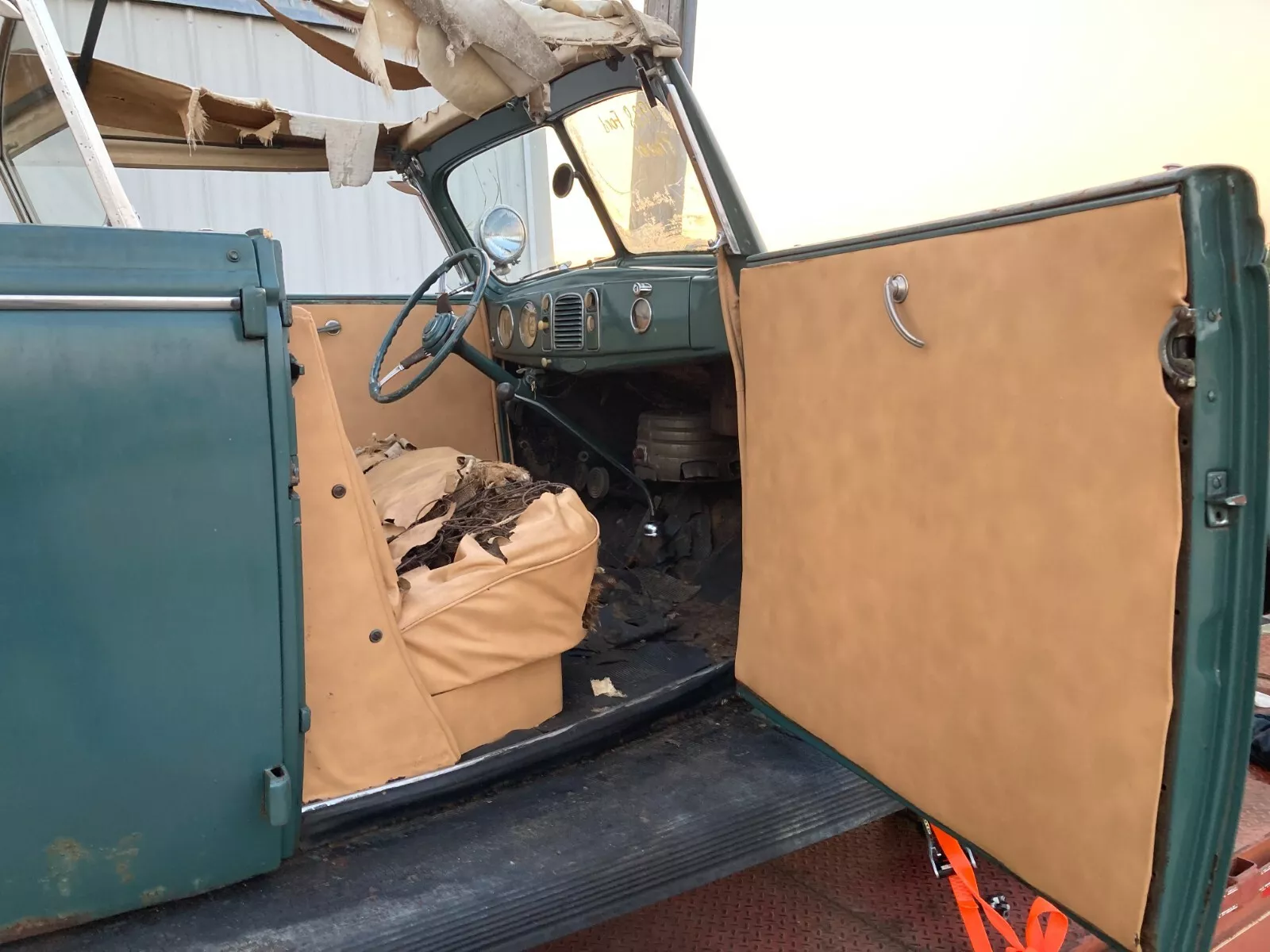
Some estimate that less than 200 of these rare cars remain. While I have never seen one in person, I did write about one in a 2023 story here on Barn Finds. That car, like the one you see here, needed restoration but was complete. This example being sold on eBay may be a bit rougher overall. The pictures show a car that has been left out in the elements for at least part of its life. There is damage to the floors, and the crudely covered seats are also damaged by exposure. The top has also succumbed to the elements. What we don’t know is just what else was damaged by moisture and is still hidden. Such was the fate of many of these cars once they reached the low end of their value.
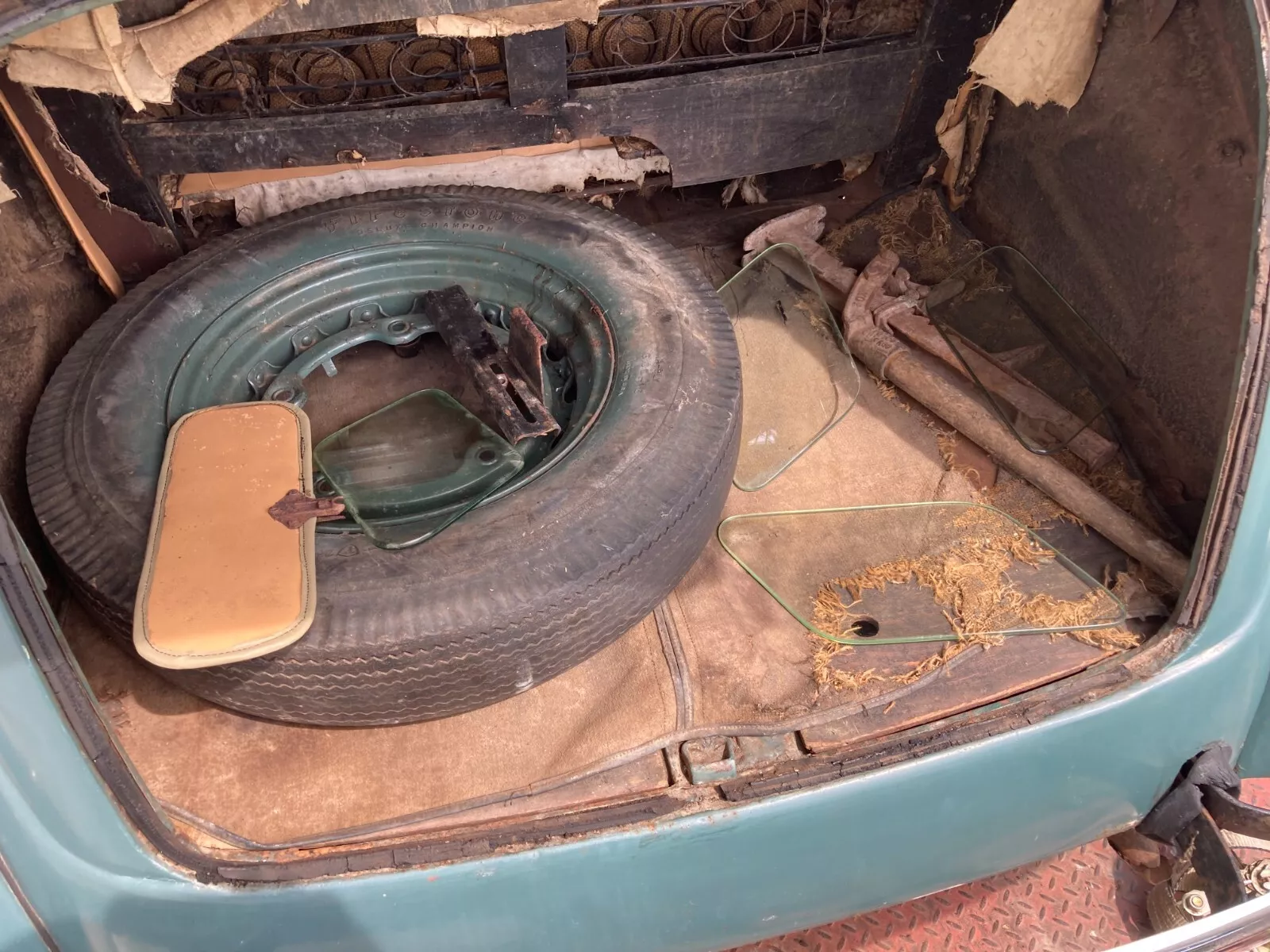
The seller gives us a decent amount of information on this phaeton. It has a straight body, and the rust issues are described as being limited to the rear floor. While patch panels for this car are likely nonexistent, a fabricator shouldn’t have too much trouble replicating the panel you would need to repair. The interesting blue exterior color doesn’t appear to be a Ford factory color for 1938 but is pleasing all the same. Perhaps the most interesting part of the car is the secondary windshield to shield rear passengers when traveling with the top down. It would be interesting to know if this was a genuine Ford accessory. If so, it may be worth a considerable sum by itself.
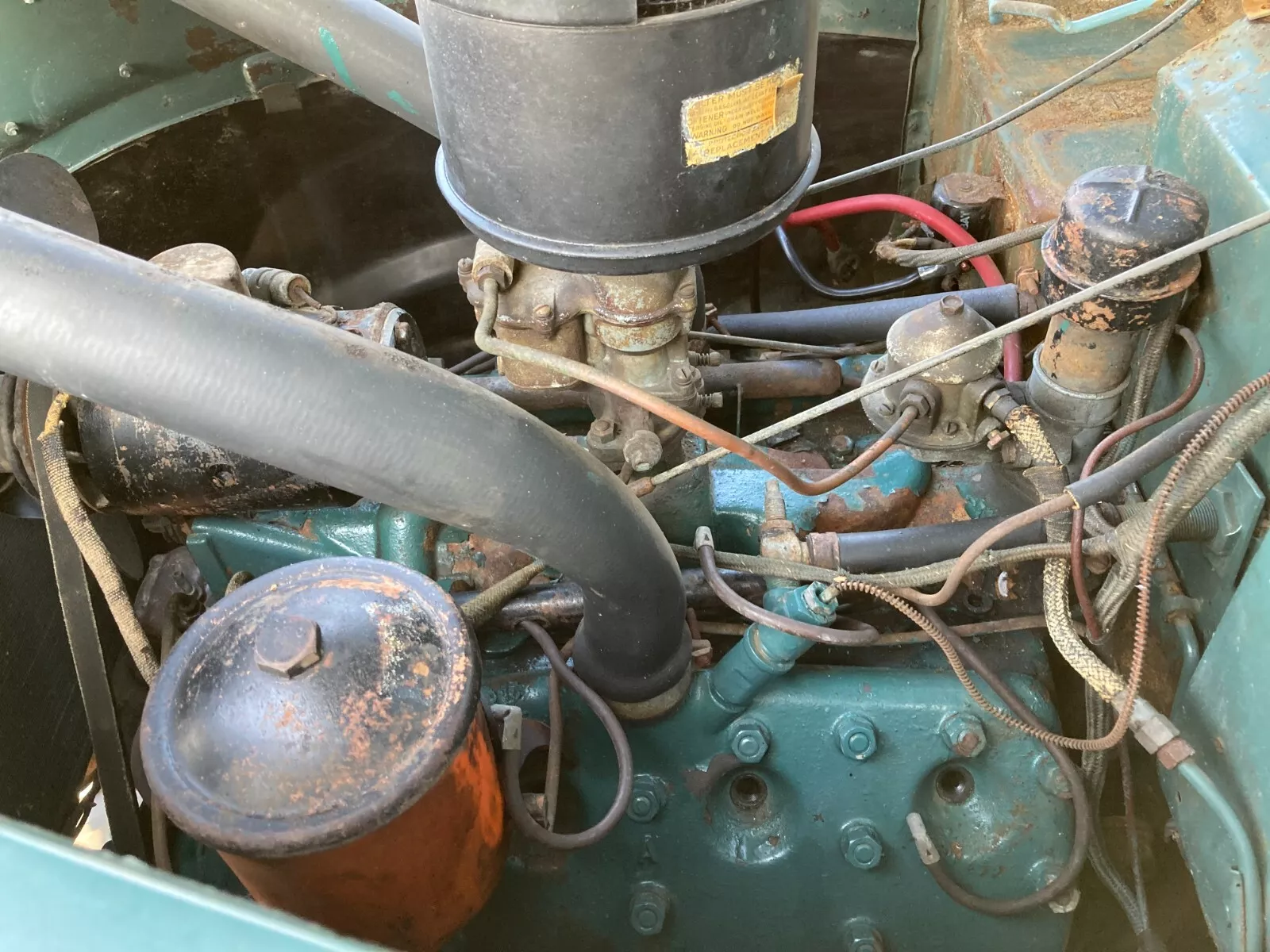
Looking into the engine compartment reveals an overabundance of the same paint used on the exterior of the car. The seller says that the engine compartment looks to be “untouched original.” Other than the paint issues, they may be correct given that the genuine Waltham Clock Company-made odometer shows a scant 39,884 miles. We have no way to know if that number is true, but the car does not appear to be a clapped-out high-mileage vehicle. The fact that it still wears the original wheels and, thus, the mechanical brakes Ford last used in 1938 is a big clue as well. Most likely poor storage left it in dire straits.
Restoring a plain 1938 Ford sedan in this condition wouldn’t be such a good deal. However, the rarity of this car will surely ensure that someone out there will go to the trouble to bring it back to its original condition. While it is still hard to fathom why Ford even made this car, its graceful beauty will make the expenditure of time and treasure to restore the car worth it. Phaetons are as stunningly beautiful as they are impractical.
Why do you think Ford continued to build phaetons for so long? Do you think a full restoration would be worth it in this case? Have you ever seen a 1938 Ford phaeton? Please share your thoughts and memories in the comments.


That would be such a cool street rod. I’d probably go bbf in this just because it’s rare and should probably run Ford power. Imagine cruising the fairgrounds with a bunch of friends on a warm summer night.
I get what you’re saying but this particular car should probably be restored to stock condition only because there’s so few of them and for it to hold it’s value.
It’s kind of looking at the last one of an animal that’s going extinct.
Spark plugs are removed. Is that a good thing or a bad thing?
That depends. If they’re out to allow the owner to pour in some Marvel Mystery Oil to free up the pistons, it’s probably good. If they were yanked years ago for no reason, it’s not so good….
Whatever, I’d opt to restore the car. Not just for its rarity, but also because it’s a neat piece and usable if restored. You wouldn’t have to haul it around on a trailer to avoid blocking traffic. Of course that would also be true if restomodded, but the idea just doesn’t appeal to me. YMMV.
As to Jeff’s “Why?” question: my guess — based only on supposition — is that Edsel had more to do with that than Old Henry. The latter would have been just as happy if everyone bought a black Fordor, while Edsel was a stylish kind of guy. Phaetons are classy, especially with the top and side curtains stowed.
Not so good if you want to start the engine.
First one of these I’ve seen was at Harrah’s museum in Reno, NV. Beautiful cars. While l think this car should be restored to original, the 4 door Phaeton restomod featured a few years ago was, and still is, one of my favorite cars.
This is a very rare and WAS a very desirable car, and to some of us it still is. The thing is we are dying out. Our Early Ford V-8 Club here locally in near Philadelphia is on its last legs. We had our meeting last Monday with only 4 people showing up. The Hawk Mountain regional group near Reading shocked us last year by closing. It had seemed healthier as it sponsored two shows annually. No group has stepped up with enough members to host the Eastern Regional Meet next year. The National had looked to us as it will be our countries 250th anniversary in 2026, we being just outside Philadelphia. So, these cars, with the expense of restoration, will be coming down in value.
Sad but true.
I didn’t even know there was an Early Ford V8 Chapter anywhere near the Philadelphia area. I belonged to the National back in the 70’s, but dropped my membership probably 40-45 years ago. Back then the majority of the club and their activities seemed to be west coast oriented. At one point or another over the years I had a 32 Tudor, a 39 Deluxe Fordor (a beautiful all original, unrestored car), a 41 Convertible and a 41 Deluxe Fordor. The 32 had been in my family since 1968, but I finally sold it about 15 years ago. The last pre war Ford I still have is a 31 woody wagon that it’s probably getting time to sell too?
Yes, we have been meeting as the Delaware Valley Region since 1969, one of the earliest chapters of the Early Ford V-8 Club in the east. As I said above, we are having fewer members or attenders show up lately. But we are staying together for at least this year. We would be glad to see any of you. We meet every third Monday at 7PM at Daley’s garage, 2749 Bristol Pike, Bensalem PA 19020 in Bucks County just outside Philadelphia. I have been the newsletter editor for about 30 years. Many of us no longer have early Fords V-8’s (1932-53), but later Fords from the 60’s. I sold my 1953 F-100 with the flat V-8 in 2019 for the more comfortable 1966 F-100.
Little duct tape will fix that convertible roof right up.
I love 4 door convertibles. That being said, they are usually 1961 to 1967 Lincoln Continentals.
Seems 4 door drop tops fell out of favor in the 40s. I know Cadillac made a few, probably Packard and Dusenburg but can’t think of any except Lincoln from the 50s on. Anyone help my feeble memory?
I always loved the 1938 Ford DeLuxe fordor in black, with rear fender-skirts! The 1938 Standard was a warmed-over ’37, and an entirely different car. The ’38 Deluxe had the all-new body which carried-on into 1939 and 1940. But the 1938 had that grand art deco grille that I loved. Its disappearance in 1939 disappointed me. The 1939 Standard looked somewhat like the 1938 Deluxe, but not close enough, and without that special grace. Although I love originality; if I had the funds and could find a nice rust-free 1938 Deluxe Fordor, I might be tempted to give it “juice” brakes, the larger brake-drums that were new for 1946, and a 1953 Mercury flathead V-8 — of course, with Columbia Overdrive, so I could cruise the Interstates with it. And I would replace every rubber window-seal: these vehicles LEAK!
I always loved the 1938 Ford DeLuxe fordor in black, with rear fender-skirts! The 1938 Standard was a warmed-over ’37, and an entirely different car. The ’38 Deluxe had the all-new body which carried-on into 1939 and 1940. But the 1938 had that grand art deco grille that I loved. Its disappearance in 1939 disappointed me. The 1939 Standard looked somewhat like the 1938 Deluxe, but not close enough, and without that special grace. Although I love originality; if I had the funds and could find a nice rust-free 1938 Deluxe Fordor, I might be tempted to give it “juice” brakes, the larger brake-drums that were new for 1946, and a 1953 Mercury flathead V-8 — of course, with Columbia Overdrive, so I could cruise the Interstates with it. And I would replace every rubber window-seal: these vehicles LEAK!