
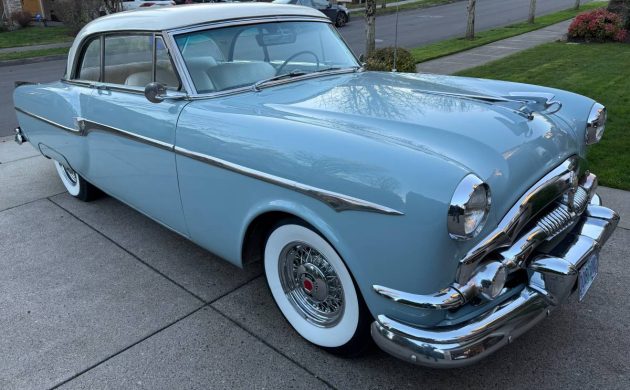
In the 1920s, Packard’s brand name was akin to nobility, on a par with Cadillac, Pierce-Arrow, and Peerless. By the 1950s, the company had taken a different path toward financial stability, moving its product downstream to capture a larger audience. The Mayfair hardtop coupe was designed to compete with Oldsmobile’s Holiday and Lincoln’s Capri. While priced slightly higher than its peers, it was cheaper than the contemporary Cadillac Series 62. Its production run began in 1951 and ended after just three years in 1953. Here on craigslist is a 1953 Mayfair coupe, restored to fine condition and priced at $21,500. The car is located in Happy Valley, Oregon, a hop skip from yours truly. Thanks to Curvette, who has a knack for finding great cars in my vicinity!
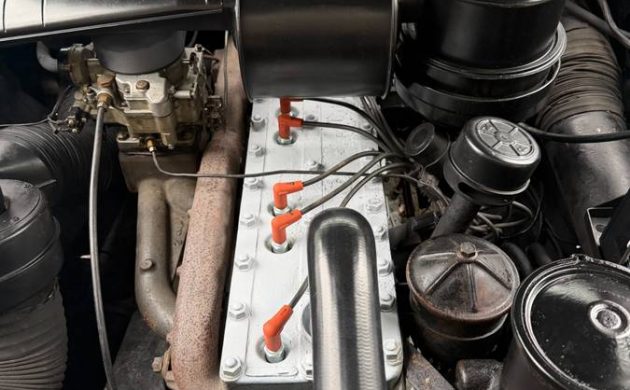
No complaints about the condition of this engine bay, where the factory-supplied eight-cylinder, 327 cu. in. Thunderbolt flathead lives. Equipped with a four-barrel, it’s good for 180 hp. This example comes with Packard’s Ultramatic two-speed automatic, which garnered early criticism for being sluggish off the line. Packard fixed the problem in 1954 when the Pacific was introduced, with “Gear Start”. “Easamatic” power brakes by Bendix were standard. The seller notes the car runs, shifts, and stops well. A slight transmission fluid leak and a “clicking” from underhood when the car is idling probably don’t merit immediate attention.
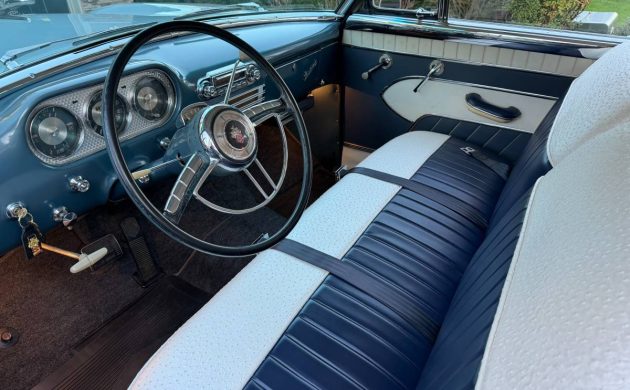
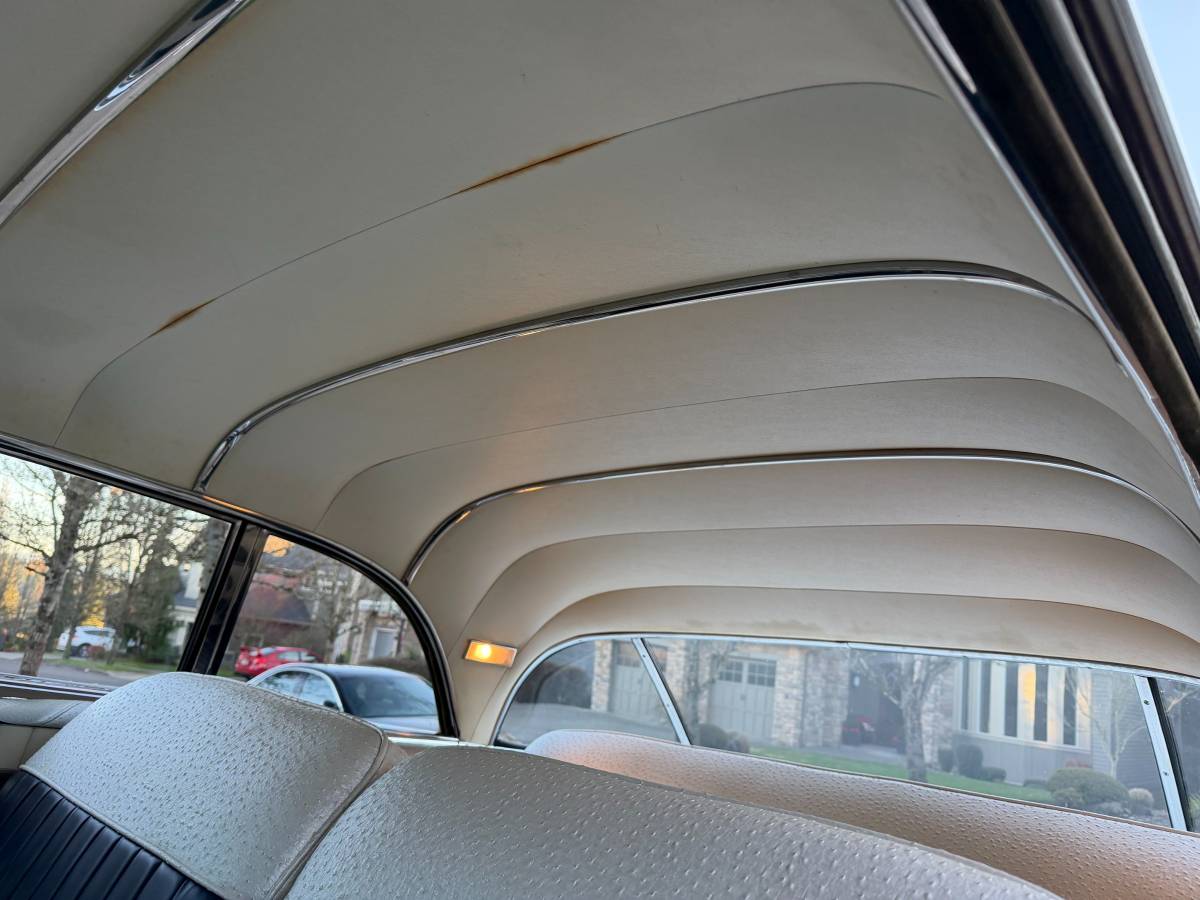
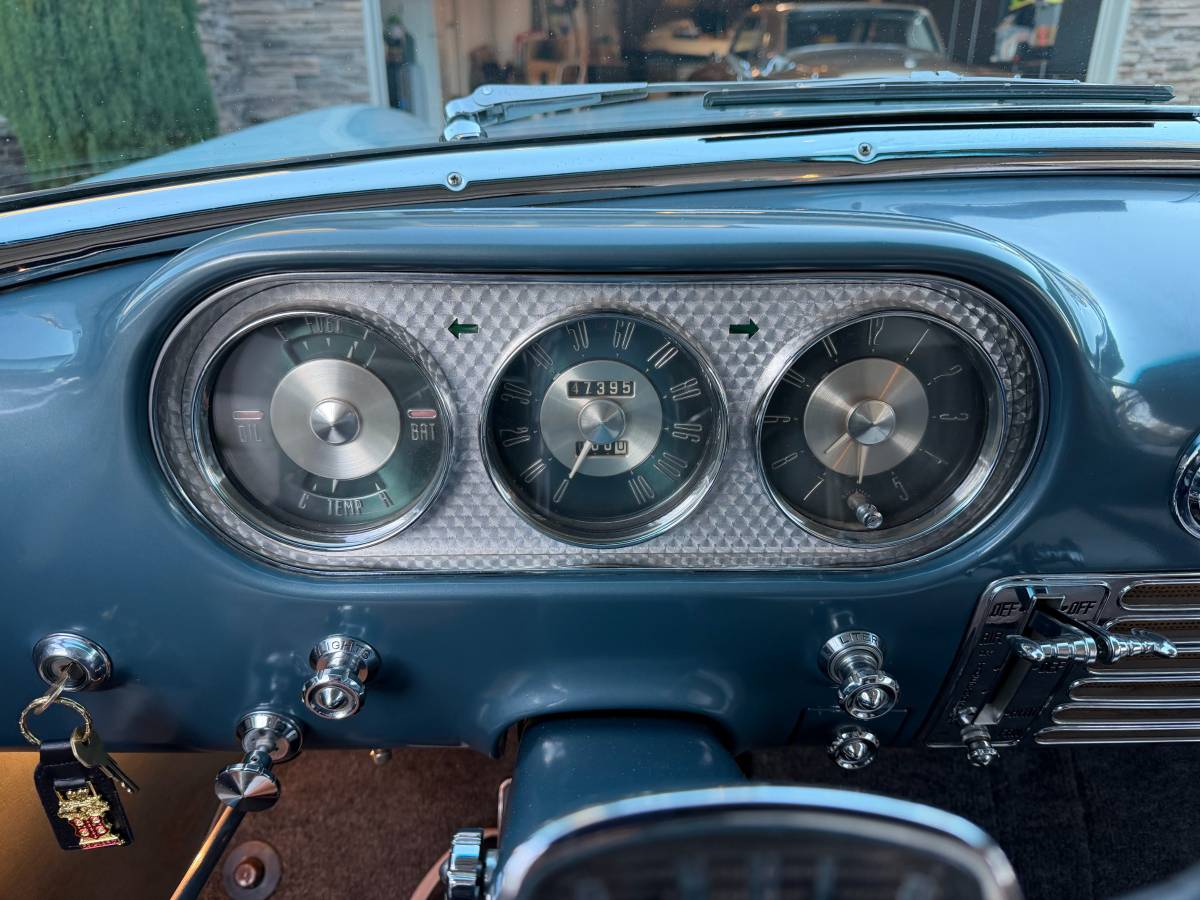
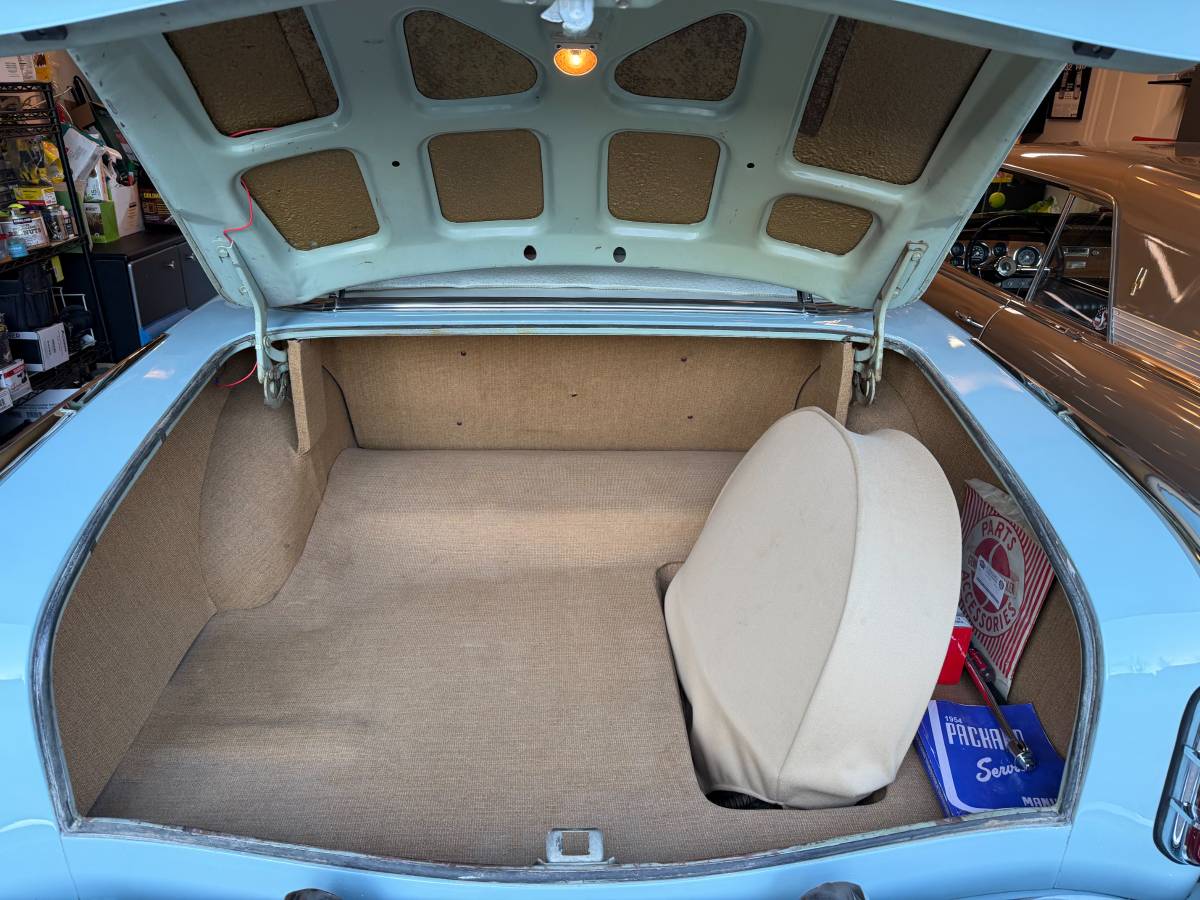
The interior was renovated in Ostrich leather, and aftermarket seat belts were installed. A faux convertible top look was popular in the 1950s, with stylists employing chrome strips in the headliner to mimic top frames. This one is slightly stained along one crease. A machine-turned dash sets off the round-dial gauges. All the instruments and electrical items are said to be in working order – except the clock, of course. The car is equipped with an optional tissue receptacle beneath the glove box. The trunk mat is original; even the trunk lamp is operational.
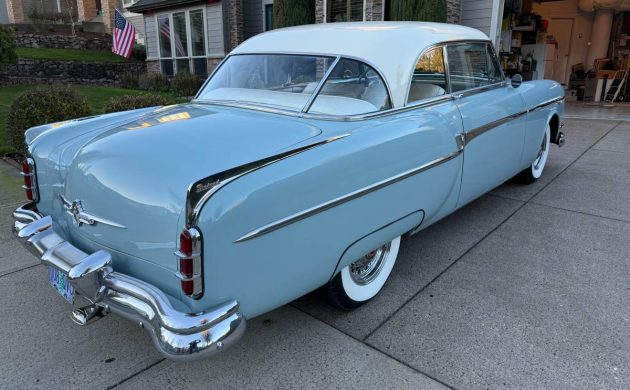
Packard was under new management as of 1952, when James Nance joined the company from General Electric. High sales in 1951 – thanks to refreshed styling across its range – obscured the fact that Nance had unwittingly walked into a desperate situation: Ford launched a price war shortly after his arrival, sending sales into a tailspin from which the company never recovered. Evidence of the company’s reputation for a sclerotic approach to the market is seen in the Mayfair’s rear window – still made in three pieces while other makers were casting full-width glass – and the wheel spats, which had nearly disappeared from most American cars. It didn’t help that the Mayfair’s grille looked like a downturned mouth. Still, this example is almost above reproach. The asking price is hefty relative to recent sales, but for the right buyer, it’s worth it.




Perhaps being a bit partial to Packards, I can say while the style was clearly dated, it was still one of the classiest looking of the “old” style cars. Not sure it was Packards intent, they knew the handwriting was on the wall for this style, and with the all new ’55s probably already being designed, they threw everything from the parts bin at this car. In true Packard form, wasn’t cheap. I read this car listed for about $3800 bucks, like this, over $4 easy, when a base(?) Caddy 62 coupe was about $100 less, AND featured a V8. For comparison, a Ford Crest line was about $1900. The 4 barrel did little for performance, the Ultramatic sucked a lot of juice, but get this thing rolling, that in-line 8, from the 30s, btw,, and a flywheel that weighed a ton, this car could roll like thunder. It still retained its “Ask the man( sorry ladies) that owned one”, motto, and they will agree, it was a heck of a car.
The ’55s were not “all new” — they were a heavy facelift of the ’51-54 design. They practically looked all-new, though, a testament to the design skills of Dick Teague who worked wonders with what he had.
Even as a wee lad in the ’50s I thought these looked stodgy and appealed only to older folks. But Packard was a conservative company and not prone to change quickly with the fast-changing postwar times. Sad, as they were great, high-quality cars.
IDK, the styling doesn’t look any more dated than any other early fifties car. It is rather handsome in fact. I wondered about the box under the dash until I read the ad and found out it was a tissue holder. Classy.
I never thought of these as stodgy, compared to most of the GM brands and the Chrysler products of the early 50’s these were ultra modern. The 55’s may not have been “all” new, but did have an all new body, an all new V-8 engine and an all new automatic leveling suspension ( though the latter didn’t work out so well. I’ve seen several of these for sale lately and hope the young generation develops some interest in them as they are some of the last of the “fine motor cars” of the past.
Don’t forget the “all-new” Twin Ultramatic transmission, developed by a young John Z. DeLorean. The leveling system, that used torsion bars instead of air ride, was complicated, but was more reliable than the Caddy air ride many removed.
There is a knob on the left side of the steering column.
Anyone know what it does?
Oooo, me, me, ( waving arm frantically),,,it’s the windshield wiper control. It was a cable to the vacuum wiper motor on the firewall.
OMG how do you happen to know that?
Not an intuitive location.
Thanks.
Howard,
Did you attend any of the Races at Wisconsin State Fair Park? There was a Packard driven by Don O’Dell (?) that was very competitive in the early 50’s!!
In 1951, when Packard’s all-new body came out, it was way ahead of the others, and even Cadillac did not surpass it for modernity, until 1954. The rear fenders were fully erect, The hood and trunk lid were flattened, and it had lovely graceful lines in a fully integrated sweep — unlike the awkward way that most others tried to come up with a postwar style: Packard showed the way, and did so with class! If this were a 1951, I would be drooling to somehow find the money to own it. That straight eight was so smooth and quiet, you might have less regard for a V-8: Buick kept a straight eight for a long time, and their cars enjoyed a great longevity. The 1951 Packard Mayfair in my experience, back in ’51, was my father’s Packard convertible — and it was the admiration of everyone at the time, and for several years afterwards. As to style, the Mayfair hard-top convertible was more awkward than those from other manufacturers, because some of their hard-top convertible designs (notably G.M.) naturally flowed out of their body lines; whereas the hard-top on the Packard Mayfair looked added-on, as though it had been a last-minute accommodation, rather than an intentional integration into the body itself. The tall sides of the Packard did not lend themselves well to a hard-top convertible version, unfortunately: the 1951 Packard body was conceived as a sedan, and it shows. They did not build a wagon, either. The Patrician was the best iteration on the ’51 Packard design — though you’d better have a long garage! How I miss Packard!!! By the way, that Borg clock was reliable and kept accurate time: I have brought many of those back to like-new life — unlike a lot of the utter junk used as car-clocks by other manufacturers. Packards were closer to Buicks, than to Oldsmobiles; but, regardless of more moderste pricing, Packard never compromised on build-quality, until after Studebaker came on board.
At least nobody mentioned putting a LS in this. I know a gentleman who has a nice Packard collection. There is just something about the sheer presence of them. When you are around them up close you really see that Packard was still building to a standard and not a price point even as the big three were squeezing Packard out. I would be happy to be the man who owns one but money and inside storage are insufficient. GLWTS.
I don’t see but 6 spark plugs in the head of this engine ! Where are the other two??
Air filter intake & housing ass’y. are blocking your view. It’s really a 7 cylinder
Very strange: it LOOKS like a straight six; but how can this BE?? Did Packard even MAKE one after about 1941 or 1942?
Hope you’re kidding. It’s an 8, which you would know if you’ve ever seen the top of one. Plugs are hidden by the air cleaner as mentioned.