
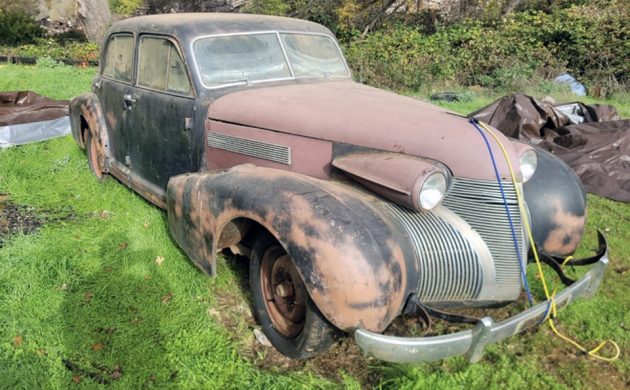
In the 1930s, the hallmark of luxury was length. Wheelbase measurements became part of manufacturers’ marketing strategies. Cadillac generated several entries in this race, with tiers of cars aimed at capturing wallet share. The Series 70 and 75 sat on 131″ and 138″ wheelbases; the Series 65, in the “mid-sized” niche, also came in at 131″. Meanwhile, the Series 60 was aimed at the entry-level buyer, ringing in at 121″. To fill that empty place, where a guy might not want the massiveness of Cadillac’s largest cars, but aspired to a better conveyance than the company’s “junior” 60, Harley Earl and Bill Mitchell brought out the Series 60 Special. The Sixty Special’s wheelbase measured 127″. To impress buyers further, Cadillac gave the new model the “Fleetwood” designation, harkening back to the company’s captive coachbuilder. The Fleetwood name was consistently associated with a top trim level. Today’s 1939 Cadillac Fleetwood Series 60 Special needs a Prince Charming willing to bring her back to life; listed on eBay at a price of $1500, this car is located in Placerville, California. You’ll need a trailer, as she hasn’t run in years.
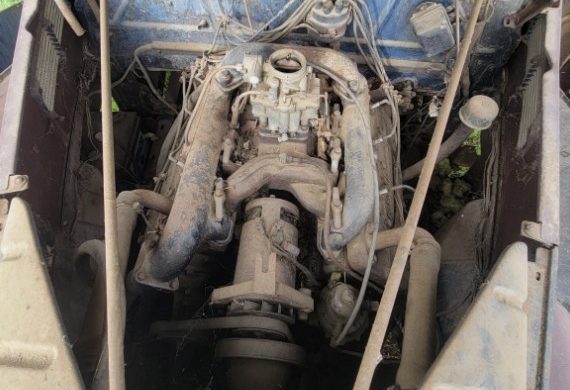
While the late 1930s saw countless body styles, wheelbases, overall lengths, and trim levels from Cadillac, one thing remained the same: the 346 cu. in. monobloc flathead V8. If you like military vehicles, you may have seen this engine before: it powered M5 Stuart tanks like Donna from DeKalb here. Capable of 135 hp when first produced in 1936, output worked its way up to 150 hp by 1948. These engines are extremely robust but very heavy, weighing in at 900 lbs when decked with all ancillaries. A three-speed floor-shift manual brings power to the rear wheels.
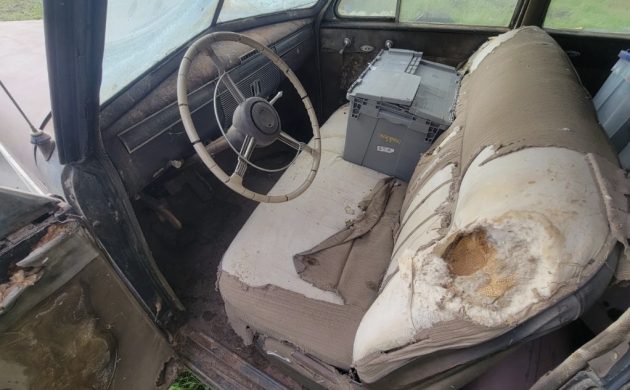
The formerly beautiful broadcloth seats are tattered, the horizontal gauge is barely discernible, the bakelite steering wheel needs restoration, and the door panels are torn. While plastic tubs containing parts are visible both on the front and rear seats, the seller notes that these are not part of the sale. Thanks to a revolutionary new “X” frame, the Sixty Special’s body sat lower on its chassis, expanding headroom inside the cabin.
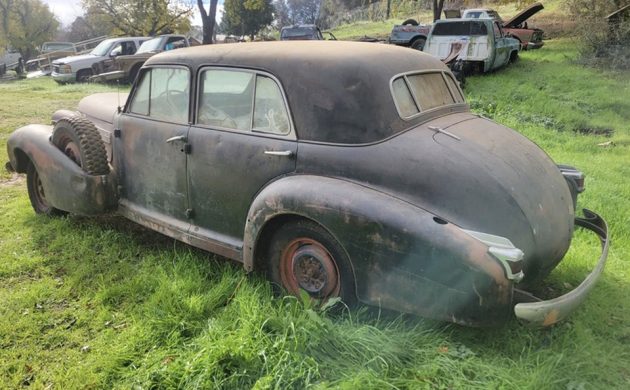
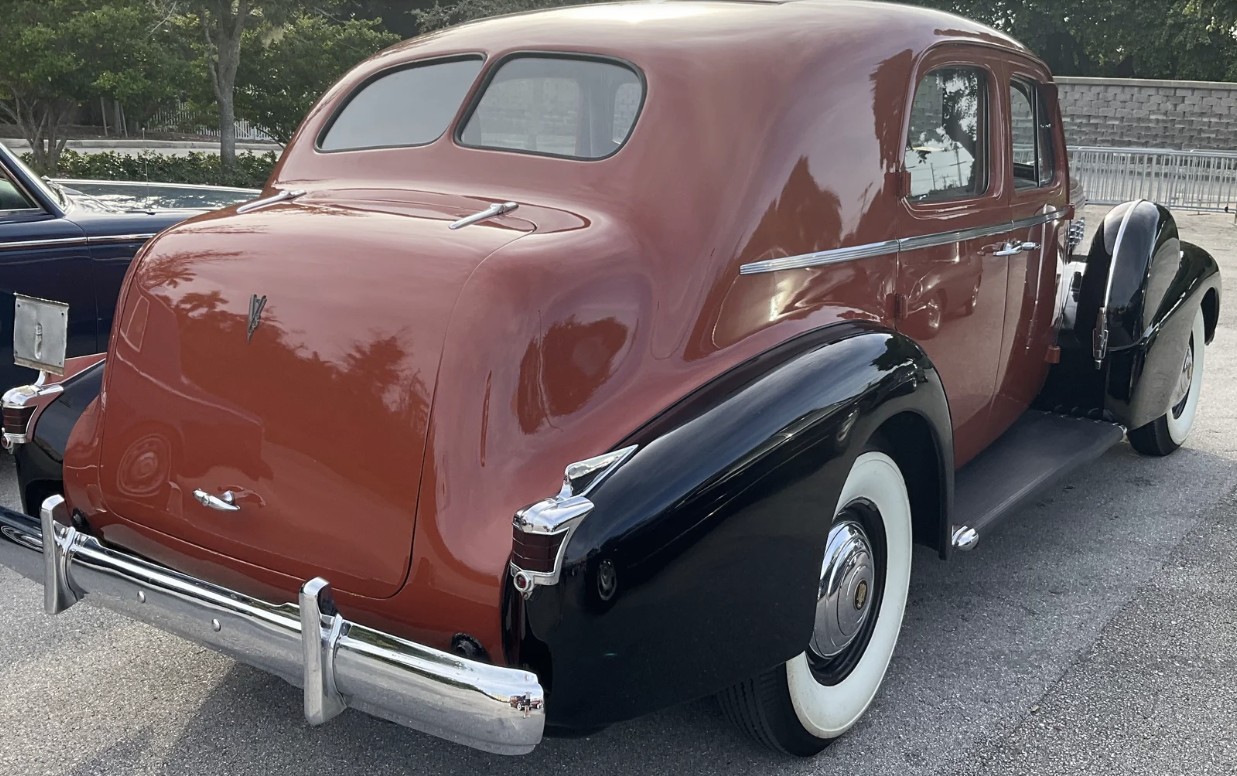
The Sixty Special’s styling was revolutionary, incorporating elements that have impacted automotive design ever since. Unlike its siblings, it did away with running boards. Its elegant trunk sloped enticingly towards its tail at a time when other sedans still employed a “bustle back” trunk line. Its glass area exceeded that of most of its competitors and even many other Cadillacs. Its extravagant winged grille was unique and modern. The only regressive feature was the exterior spare tire cavities in the front fenders; this example is missing the steel caps for the spares. The Sixty Special was the genesis of the “three-box” styling that we see everywhere today. Despite that bit of fame, interest in these pre-war giants has waned: the few that found new homes over the last couple of years sold in the $10k to $25k range – prices that seem disconnected from this model’s important influences.



You want to blow your “Jimmy Dean” all over the screen, just Google this cars images. It’s not fair, really. Folks not familiar with these grand automobiles, may look at this and think it’s just a derelict old car that nobody wants. While the “nobody wants” is correct, it’s a shame this is what remains of one of the most beautiful cars of the 30s. I see absolutely no desire for a car like this today.
Cadillacs from this period are absolutely beautiful. Harley Earl and Bill Mitchell are two legendary GM designers that put outbsome beautiful designs Cadillacs LaSalle the Buick Y Job and so many others. The original owner of this Cadillac must have been so proud of his purchase. Its just sad to see it this way. I’m wondering what it’s future will be. Thank you for writing this one up Michelle and your time and research and history lesson too.
The steel caps for the spare tires are in the back seat.
Restomod this one. I’d go with a
472 V-8/T 400 for a power train and leave the rest as original as I
could. The original front suspension will do just fine while
I’d wanna upgrade the brake system to PDB up front and drums in the rear. Face it folks, this car is a labor of love 💕 to
the person building it. That means any really good upholstery
shop can stitch you up a super nice interior for about half the price that a premium shop will charge you. The same is true with the paint and bodywork. What’s gonna kill you is rechroming all that chrome trim.
Even with that spray on chrome
they used on the show Counting
Cars, the expense would still be a
monumental one. But since it’s only gonna be you driving it, you can get it running and take your
time on the other stuff. That’s how a lot of street roads were built nearly 60 years ago. Guy
buys car, gets car running, then
fixes up the rest as he gets time and cash. That’s what I saw at the first Street Rod Nationals in Peoria Illinois back in 1970. The
guy that won the long distance
award in 1970 drove his Model A
touring all the way from Canada
and the car wasn’t even finished!
And yes, I got to see a ’39 Cadillac there too. It was Avon’s
Solid Gold Cadillac! Avon built the car to promote it’s lineup of
car shaped decanters that each
held their Wild Country aftershave when it first came out
in ’69. And when the guitar shaped bottle came out, I bought it and took it with me on my first
tour. After all, you just never know when you’re gonna play a
little guitar 🎸 LOL!
Well it’s all there. If youre not looking for perfection and can do most of the work yourself I think it would be a fun project. If you can’t or don’t want to do the work a phone call to ask about will put you under water.
these indeed were works of art from art deco age of GM. shame this was left to end up like this. this could easily cost 250k to redo. this style car it a very niche market mostly for the jay lenos of the world. at this point really cool yard art
Definitely, a work of automobile art from designers Harley Earl and Bill Mitchell, especially the front grill. This car has custom build written all over it and for the price, that’s an added incentive. Doesn’t make much sense to do a faithful restoration. H and H Flatheads could help someone rebuild this beautiful, and capable engine.
Sad she done turned into a parts car… If you needed parts, the price is right. Probably has $500 in steel scrap value after picking it clean. Was beautiful at one point in time .
The Cadillac Sixty Special was conceived as a luxury automobile that was meant to be driven by its owner, as opposed to being chauffeur-driven.
I saw one of these turned into a pickup, years ago. He said it was a rear end crashed sedan, he did like Terraplane and Stude did for late 30’s. Looked like factory would have done.
Too bad it wasn’t a V12 or V16. Then, there would be no doubt about restoring this.
The parts are worth enough to put this in stock! Tear it down and catalog it, if the entry fee is less than $5k, one would easily double the investment! And regardless of the view of many, there really is a market for units of this era, limited perhaps, but it is still there…
Wouldn’t you love to know the story of her original owner.
I love front half. The rear half not so much.
RandyKS I belive the Ute conversion would be super cool along with a 2 door and chop (about 2.5″) top conversion would be a really cool custom. Keep it black with gold artillery wheels (including both spares)
SORRY TO ALL YOU PURISTS OUT THERE. It’s just that this car in stock form doesn’t appeal to me.
Michelle, my 1939 7533f limo lives 15 minutes north of Donna , and as stated here ,all the potmetal chrome needs to be restored which would cost a fortune now . Also the town of Geneva where the auto store is was used in Tom Hanks movie The road to perdition.