
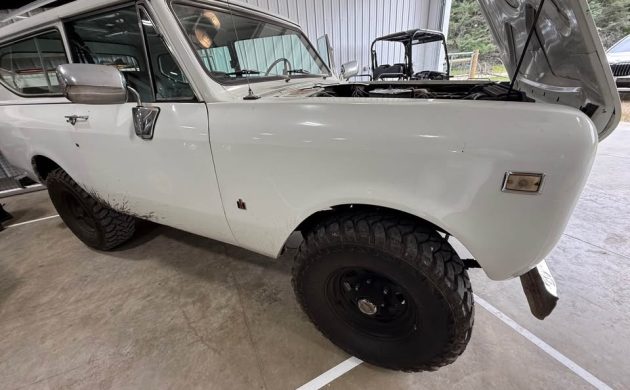
The ever popular International Harvester Scout was produced from 1961-1980 with total production exceeding 500,000 units. This example is a 1979 International Harvester Scout II located in Fond du Lac, Wisconsin. It is listed for sale here on Facebook Marketplace for $34,900. The seller states that this Scout is in like new condition. Long before the modern SUV became a fixture of suburban driveways, the International Harvester Scout was carving trails and hauling supplies. By 1979, the Scout II had matured into one of the most 4x4s in America. As the final years of production approached, the Scout II represented a rugged alternative to the more mainstream offerings from Detroit, blending tractor-like durability with a growing sense of recreational style. We appreciate Lothar submitting this listing for our review.
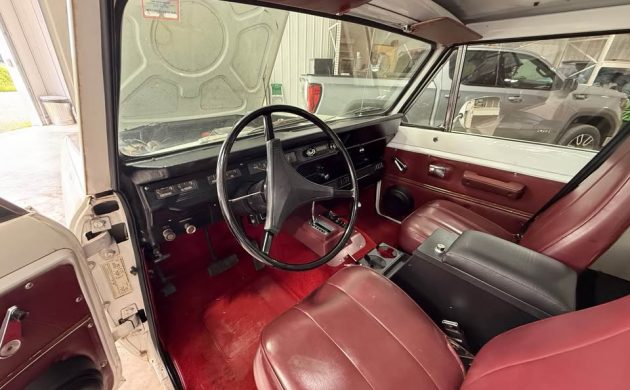
The seller claims this Scout runs and drives flawlessly. That is a bold statement for a vehicle famously prone to rust and electrical gremlins. However, the fact that it is garage-kept and in excellent condition inside and out suggests a level of restoration or preservation rarely seen in vehicles that were originally sold as farm tools. The original 4WD system is the vehicle’s greatest asset—a robust combination of Dana 44 axles that remain the industry standard for off-road strength. For the collector who wants to skip the multi-year restoration process and head straight to the trails or the local car show, this 1979 Scout II is a rare find.
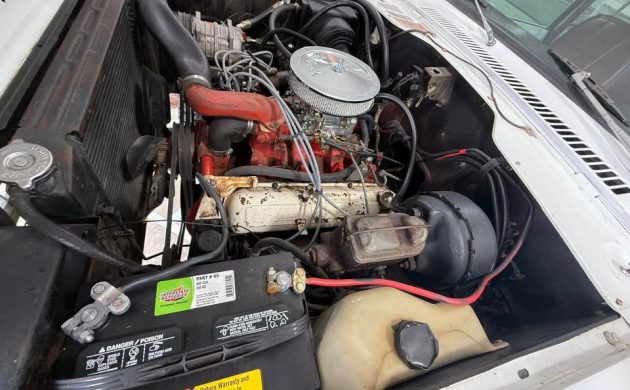
It would be nice if the listing had more information on what powers this Scout II. In 1979, the Scout II’s mechanical heart was defined by heavy-duty reliability. Buyers had several engine options, starting with the 196 cubic inch (3.2L) slant-four—essentially half of a 304 V8—which prioritized fuel economy during the era’s energy crises. For those needing more muscle, the AMC-sourced 258 cubic inch (4.2L) inline-six was a popular middle ground. However, the definitive Scout experience lived in the “SV” (Small V8) family. The 304 cubic inch V8 and the legendary 345 cubic inch (5.6L) V8 were industrial-grade engines designed for long-haul duty. While they weren’t built for high-speed sprints, they were famous for their massive low-end torque and a lifespan that often exceeded 200,000 miles. For the efficiency-minded, the 198 cubic inch Nissan-sourced SD33 diesel was also available, making the Scout one of the few diesel-powered passenger vehicles of the time.
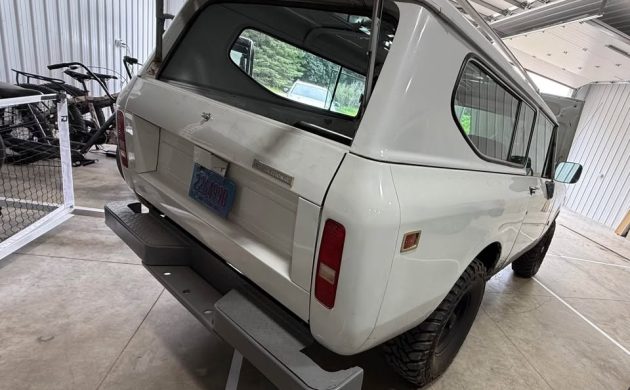
The late seventies were a bold time for automotive aesthetics, and International Harvester leaned into the trend. The 1979 color card was a vibrant reflection of the era. Iconic “earth tones” like Dark Brown Metallic and Buckskin were staples, but the more adventurous could opt for Sunburst Yellow, Terra Cotta, or the eye-catching Mint Green—a one-year-only shade that has since become a collector favorite. This example appears to be painted in a fresh coat of white paint and the seller states that it is in like new condition. Production remained steady in 1979, with approximately 40,000 units rolling off the line in Fort Wayne, Indiana. While this was a far cry from the volume of the Ford Bronco or Jeep CJ, the Scout’s smaller production numbers only added to its cult-like status today.
Very nice, and let me be the 1st to say,,,you’re not from around here, are ya’? Fongeulak, in the heart of the rust belt, there is no way on Wisconsins salty earth, this came from there. Plus, the a/c appears to be aftermarket, telling me this truck spent its life in sunny somewhere and dragged north. I think it is a low mileage vehicle, but clearly “dollied up” for the sale. It’s an unbelievable find. It’s obviously not the 4, the V8s are tough to distinguish, but I can smell the gas from here. They were great trucks, certainly capable of anything we could dish out. This particular truck led a cushy life in Phoenix.
would bet it is a AMC 304 from the looks
I don’t think so, you could tell the AMC motor by the thermostat housing. This I’m sure is an IH motor. Besides I read, no Scout left Fort Wayne with an AMC 304. I believe they were for the pickups.
Definitely an IH engine. Thermostat housing and valve cover shape confirms that. There’s also the “International” embossed on the cover…
Saw more than a couple of Scouts through the years reel a Bronco/Blazer out of the desert sand or off the “dry” lake alkali flats. Underrated for years (sometimes for good reason) but out west a good ranch implement.
This one sure looks purdy…
Like I mentioned some time back, only a matter of time until Scouts go thru the roof in price, after Broncos prices landed on Mars…
Scout II was closing in on the best of the Scouts. There was something lost on the instruments but that was the downfall of a lot of vehicles at that time, not just International.
Looks like a 345 4bbl in that engine bay. And someone tried to use an Edlebrock carburetor. To each their own. Myself, I’d much rather see a Holley 4160 on that manifold.
I worked on lots of Scouts with the Nissan SD33 engine. Those were good as long as you weren’t looking for jack-rabbit starts. Some governor issues that some of us modified and made them work a lot better. And, I cannot forget, that timing device that would clog up and quit functioning if you didn’t change oil often enough, or keep it up to temperature.
For me, a V8 like a 304 or 345, or the diesel, and I would be happy. The 258 is good too so that could be considered. I’m not a fan of the half-V8 engines…
Had four of these, 69, 72, 74 and a 78. Two fours, both 196 cid (half of the 392, not the 304; that was the earlier 152), an AMC derived 258 straight six, a 304. All manual transmissions. The only real flaw they had was rust. The drivetrains were bulletproof.
Wish I had bought a turbodiesel, but that’s life. But just in case, I still have all the factory manuals. Keep wishing…. ;-)
As for the four cylinders, they were unexpectedly smooth and economical. Not fast, but respectable and reliable. I drove to Florida twice with my last one. 21mpg and no issues, even when a truck tire bounced across the highway and “kissed” my radiator.
If I had the cash, I would probably make a move on this one, considering the huge aftermarket for them, but an automatic is a negative for me.
I had a ’77 with the SD-33 diesel – fitted an aftermarket turbo to it. No rust problems in California for the 2 + years I had it but it leaked water like crazy in the rain so they no doubt rusted in most states. My dad owned a bunch of trucks with the IH 345 engines and had a lot of camshaft/lifter issues with them.
There were a lot of camshaft failures all makes of automotive engines back in the late 70s/early 80s. I worked for GM but we were in a small town and took in everything. In the spring of 1980 we had a 55 gallon barrel full of failed camshafts.
Along about that time the API changed its oil spec from SE/CC to SE/CD, which coincided almost perfectly with camshaft failures. In the early 80s the spec was changed again to SF and camshaft failures stopped almost overnight.
I never saw a breakdown of the formula but I’m curious about the CD spec possibly eliminating the zinc content. I might add that I, along with a lot of customers, got our oil from the Co-op which was essentially Exxon’s XD3, a formula that was supposed to work in everything from your lawnmower to your 18-Wheeler. We had next to ZERO camshaft failures…
A nice find. I watch listings for these all the time. Grew up with a ‘79 Scout from new in ‘78 through 91 or 92. It was my mom’s family car. Hope to get another one someday.
Small nitpicky detail: Terra cotta was a GREAT color (and one of my favorites), but it was not offered in 1979. Instead, there was a dark orange called persimmon and a metallic red-orange called Tahetian red that carried through until the final year of 1980. That was the color of our rig. A great color since it helped the ubiquitous rust blend-in well. When this white one rusts (and it will), it’s gonna stand out big time. I was going to attach the color sheet for 1979, but I don’t seem to be able to include a photo comment anymore. Btw, ours was a 345 with the automatic, but I’m hoping to have a manual shift Scout someday. Keep on Truckin’.
I’m glad to see that this vehicle brought out some Scout fan(atic)s. I love learning all of the details that y’all bring out.
Is it just me, or are all the pictures wacky and out of proportion?
I’ve always been leery of listings with creative pictures… my experience is the seller is generally hiding sum-ting that ain’t right!
Maybe they work, but I just can’t stand those clamp on battery terminals.
Looks straight and probably solid. Way too many creative liberties to go back over and make right for $34K.