

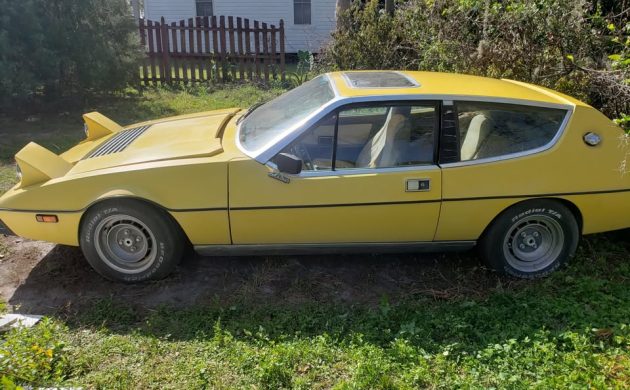
For sale here on Facebook Marketplace in San Antonio, Florida, with an asking price of $7,000, is this restoration-in-progress 1976 Lotus Elite, wearing its original yellow paint. These cars are pretty rare. The owner informs us that only 220 Lotus Elites were imported into the U.S. between 1974 and 1981. This one has a mere 12,311 miles on the odometer, but that doesn’t mean it’s ready to roll. The owner says he’s “reassembling” the car. A restoration has been started, “and the more work I do the higher the price will go.” If he gets it running, he’ll be at $9,000 firm, he insists. The car is complete, and it comes with a four-speed transmission installed and a five-speed that would bolt in, along with extra suspension pieces and wheels. Thanks to Chuck Foster for this tip.
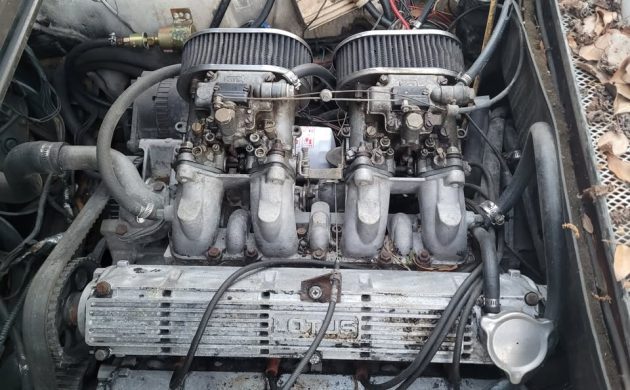
The Lotus 907 engine with Euro-spec dual Weber carburetors is “very rare,” we’re told. The engine looks fairly tidy, as is the fiberglass body in its original paint, but we only get three photos, and none of them show the interior. Said interior is “complete but in poor condition”. The Elite was available with either a four- or five-speed transmission, explaining this owner’s inclusion of the five-cog unit. An automatic was optional, starting in this car’s year of 1976. The aforementioned 907 engine was a two-liter, four-cylinder unit that produced 155 horsepower, enabling a top speed of 125 mph and a 0-to-60 time of 8.1 seconds. Impressive then, not so much now. Oddly enough, the aforementioned Jensen GT also used the Lotus 907 motor. Performance in the Elite was aided by the car’s low weight, just 2,300 pounds.
These four-seat Lotus cars (much bigger than the Elan Plus 2 they replaced) were offered as the Type 75 and, later, as the Type 83. This is the former. The idea with the Elite was to show Lotus’ growing sophistication and an evolution from the kit cars the company had previously built. The styling is rather handsome, and the “shooting brake” (station wagon) body is reminiscent of the Jensen GT, another limited-edition British exotic that came out around the same time (1975). The Elite continues Lotus’ lightweight fiberglass body structure, and as in the Volvo 1800ES (another contemporary) there’s a big opening glass hatch that gave it some utility. The car has four-wheel independent suspension with coil springs.
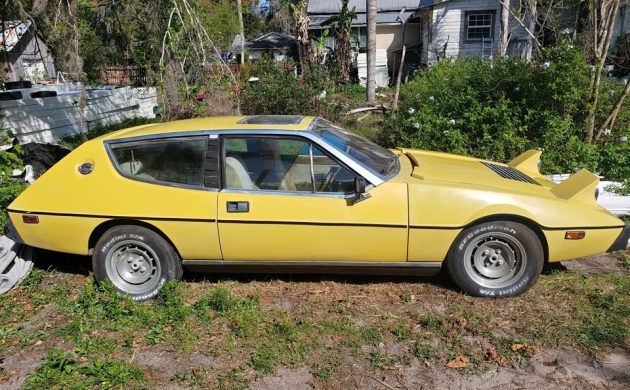
The Elites were slippery, with a 0.30 drag coefficient. And they were expensive, with an MSRP of $19,615 in 1976. The owner of this car entices buyers with the notion that restored Elites are worth $40,000, but Hagerty says only $10,400 in “good” condition. These are high-strung, finicky cars, and it takes a lot to make them perform up to capacity. These were the last Lotuses that the late Colin Chapman had much to do with—he reportedly sketched the basic chassis and suspension designs before Oliver Winterbottom sculpted the body.
There were four trim levels for the Elite, 501 through 504. With the latter, you get air conditioning, power steering, and an automatic transmission, so this is not a 504. In 1980, the Type 83 was introduced, featuring a Getrag five-speed gearbox (replacing the BMC unit), electric rather than vacuum-operated headlights, a front spoiler, a new rear bumper, and Rover-branded brake lights. Not a big change. It’s always challenging to buy a restoration in progress, and this one is more of a mystery than most because we don’t even get one interior photo. If the owner says it’s in “poor condition,” then I’m sure it is. Imagine trying to source trim pieces when only 220 Elites were imported! Buying parts from England will incur tariff costs, no? The economics don’t quite add up here. The owner wants the customer to pay $9,000 for a running Elite with (only one of its likely ills) a trashed interior, when good examples are only $1,000 more.

And yet, some people think the Gremlin is ugly.
well, when you consider the Gremlin was little more than an amputee Hornet ..I dare say, however, the Gremlin was the best by far of the American sub-compacts being offered, its competition being the Pinto and Vega.
Thinking the same thing.lol
Actually I kind of like the looks of the Lotus Elite and was thinking of it as the Gremlin’s less-ugly cousin. :) I remember seeing them on the street once in a while way back when.
Very cool design. Lotus never was one to go with the flow.
Pictures don’t do justice to what an exotic design this is. In the flesh, the proportions are striking. The interior is pretty special too, when it’s in good shape. I’ve never driven one, but such an obvious luxury GT needs more than a 4 banger, IMO. Obviously the economics don’t work out with buying a project like this when a complete car isn’t a whole lot more.
It’s kind of an oddly shaped car. The love child of a Renault and a Gremlin perhaps? It’s also a little lacking in the motivational department, having only 4 pistons. Would I own this one? I admit I would, because it’s a Lotus and it’s just unusual enough.
These only weighed about 2500 lbs., so a 4-banger is adequate for motivation, but these early Lotus 907 twincams were known as “the torqueless wonder” for their lack of bottom-end grunt, though peak power was respectable for their size, so you really had to keep the revs up to get much scoot out of them.
Later Elites of this generation from ’80-on got an improved Lotus 912 twincam with a friendlier torque band.
Always loved them but the hassle of owning one keeps me sensible. These always sell under 10k and never appreciate. Interiors are nearly always trashed. Those are Del Orto carbs and not Webers, which came stock on Euro cars. This car has a bogus sunroof installed. Good luck to seller.
The owner said Webers!
The European 907 engine had Dellorto DLHA 45 carbs; these look to be those. Webers are substituted since Dellortos are pretty close to unobtanium.
I only have beginners knowledge on Dellortos as I’ve recently got involved with a Jensen Healey. Alas, it has ZS.
I own a 1974 Lotus Elite. Mine now has an Excel motor with dual del Orto carbs – much like those shown on this auction. It’s a BMC 5 speed manual. The early cars have some quirks. The upper link of the rear suspension is the halfshaft. This makes for some additional stress on the bearings and CV’s of the rear suspension. Parts are hard to come by. I have relatively new crash bumpers – I’m not sure I could find them today. There is a lot of shiney metal around the glass – hard to find in the US. If you’re willing to deal with international shipping and duty lotusbits.com has most parts.
“the more work I do the higher the price will go”.
What’s his hourly rate? Because he’s probably gonna price himself right out of the market pretty soon.
What happens when one feeds their Gremlin after midnight….
I owned one in the mid seventies. It was a special car and very capable for 4 people even. Very low but easy enough to get in and out of. I miss it. BTW, I also owned a Gremlin!
I had five Elans back in the 70’s and they were fun cars, however you had to enjoy wrenching because they were finicky, but still fun! I never really liked the looks of the 2nd generation Elite with it’s chopped off rear end, however I did acquire its sister car, the Eclat which was basically the same as the Elite except it had a trunk. This was done to try to sell more cars in the states. That did not really work either. Not many of the Eclat were made either. My version (pictured) is one of 131 made in 1983. They are rare but not necessarily super valuable. Mine will be going up for sale in the next year as a 90% completed project. It’s RHD, 18K on the clock and has twin Dellorto carbs. It will be in the 10K range. Anyone interested? I just don’t have time in my 70’s with other projects.
I always wonder what kind of person buys a Lotus. It seems to me, that people in general who drive these buy them with absolutely no concern for their well beiing in general. How else do you explain that most are thrashed beyond recognition and in need of a total restauration after less than 20000 miles on the clock; never mind all the ¨add lighness¨ bull.
In my experience this is what I’ve found with cars like Lotus of that vintage… They were initially bought by enthusiasts of some means and driven for 2 or 3 years… until the next must own enthusiast ride came along, or they got bored with it, or got tired of maintaining it, etc., etc. The value of these type of cars depreciated rapidly and the ask on the used market attracted a buyer that stretched to afford the purchase, but had no hope of covering the frequent required maintenance. They kept them going with bailing wire and masking tape as long as they could but eventually lost the battle and the car was parked… typically outside were it got weathered for several years (or longer… much longer sometimes) and finally was sold off as a non-runner, donated to charity, or simply hauled away as scrap. The same story applies to MGs, Triumphs, TVRs, etc. of the day…
Guys want to experience the marques unique qualities.
Maybe lightweight, great handling, hi rev engines. Whatever.
And, honestly, you get to feel special. Its not run of the mill stuff. But it’s also not McLaren-special.
The more obscure the marque, generally, the more disposable income that you need.
I’ve had some sports cars, but mostly mainstream stuff. I’d live to experience Lotus, TVR, Alpine, etc.
ok, good thoughts, however this does not apply to MG´s or Triumphs, noone of which carried the stigma of poor assembly and quality. Neither did they require a second mortgage on the home to buy. Maybe TVR´s, I don´tt know.