
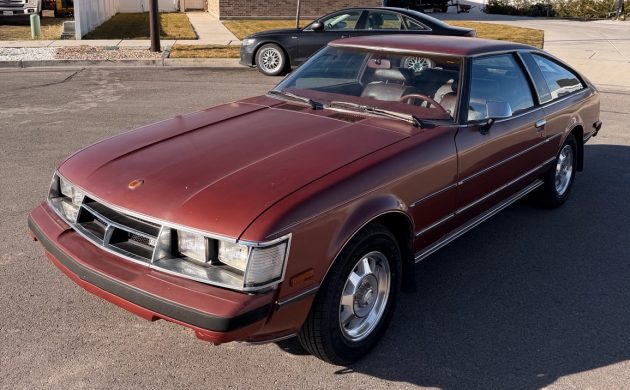
It is often essential to carefully scrutinize listing images to determine whether a classic is all the seller suggests. Such is the case with this 1979 Toyota Celica Supra. It features a fresh motor under the hood and appears to be rust-free. However, whether readers will consider it restored is debatable. It runs and drives well, and if the buyer decides to perform a cosmetic refresh, they could do so at their leisure. I must say a big thank you to Barn Finder Curvette for spotting the Toyota listed here on eBay in Springville, Utah. The seller set their BIN at $16,499 with the option to make an offer.
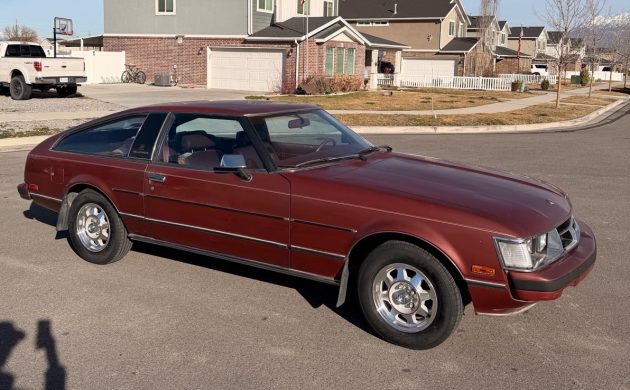
Toyota released its First Generation Supra for the 1979 model year. Based heavily on the existing Celica Liftback, the company extended the body forward of the windshield to accommodate a six-cylinder engine. North American dealers were particularly happy to see the Supra, as it provided them with a worthy competitor to Datsun’s 280Z. The seller states that this first-year example has a fascinating backstory, but fails to provide any information surrounding why its previous owner parked it around 1998. They describe the car as restored, although the apparent flaws and deterioration visible in the exterior shots suggest that they largely spent their money under the skin. Of course, I must emphasize that I am basing my assessment on three photos taken from a distance, so an in-person inspection may reveal that the Supra looks better than these shots suggest. The listing states that they refurbished the beautiful factory alloy wheels, and they sparkle in as-new condition. Otherwise, the Red Metallic paint is faded in several spots, appearing to exhibit mild deterioration on the front bumper. The trim below the back window has also aged, but is restorable. There are no visible dings or dents, and the seller states that this Supra is rust-free.
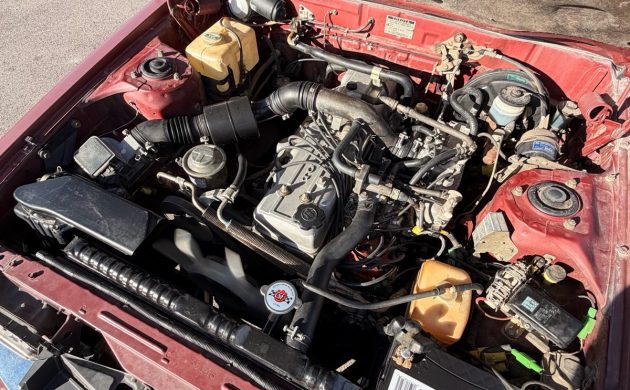
Lifting the Supra’s hood reveals the six-cylinder 2.6-liter 4M-E motor. Thankfully, the first owner teamed the six with a five-speed manual transmission, not the four-speed automatic that somewhat stifles performance and reduces the enjoyment of what Toyota marketed as a sports car. Power steering was standard fare on the ’79 Supra, as were four-wheel power disc brakes. The 4M-E placed 110hp and 135 ft/lbs of torque at the driver’s disposal, with both figures lower than those generated by the 280ZX. We’ve reached the point where this Supra partially justifies its “restored” tag, and may help unlock part of the mystery of why the previous owner parked it in the 1990s. The seller has splashed plenty of cash on its revival since they became its custodian a year ago. They removed the original motor and replaced it with a fully rebuilt identical unit. While not stated, it is possible that an engine issue accounted for this classic’s decades-long hibernation. Those concerned about originality will welcome the news that the sale includes the numbers-matching engine block and other parts. The seller rebuilt many original items, such as the intake system, while replacing others, including the exhaust, fuel injectors, alternator, fuel pump, all hoses and filters, the clutch, and sundry smaller items too numerous to list. Potential buyers can consider the Supra a turnkey proposition, and the seller will provide evidence confirming that the odometer reading of 102,000 miles is genuine. The buyer also receives the original Owner’s Manual, Window Sticker, and other documentation.
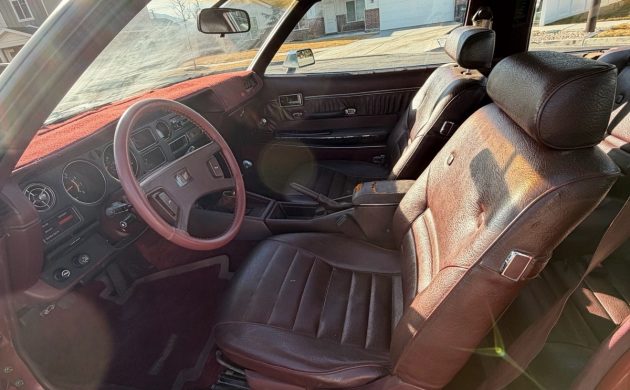
While Toyota marketed the Celica Supra as a sports car, the interior equipment would justify it wearing a Grand Tourer label. This car features air conditioning, power windows, GT instrumentation, a six-way adjustable driver’s seat, a tilt wheel, a rear window defogger, a four-speaker AM/FM stereo radio, and a cassette player as standard equipment. The first owner ticked the box next to cruise control on the Order Form, helping ensure fatigue-free long-distance cruising. I would describe this interior as serviceable, but it is far from what I would consider restored. The seatcovers have significant deterioration, with the back seat top sections particularly noticeable. The dashpad is cracked beneath the cover, the center armrest is split and cracked, and the tops of the door trims are succumbing to UV exposure. Most of the plastic looks good, which isn’t surprising, because Toyota was a market leader in plastic development during this period, with its interior trim pieces proving particularly hardy.
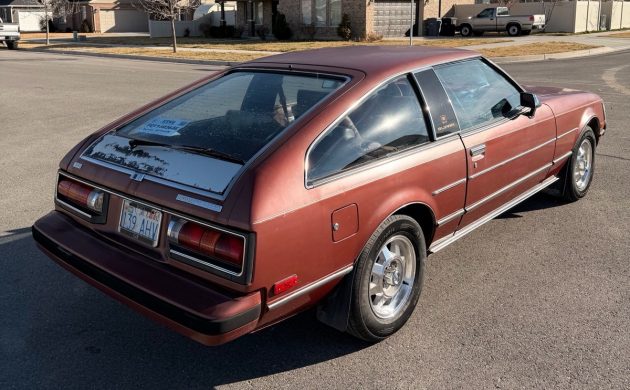
Although the seller describes this 1979 Toyota Celica Supra as restored, the images suggest it is actually a barn find that they revived after a decades-long slumber. Its lack of rust is positive news, as is its overall mechanical condition. The listing statistics suggest it has generated reasonable interest, but I do believe the seller’s BIN is optimistic. Therefore, only time will tell whether the interest translates into sales success. Do you believe the seller will get the price they are asking, or will they need to compromise to help this Supra find a new home?



Only 100k on the engine and gets replaced, I’d be curious as to why. Rust free claims are just that, claims, they probably mean rust through. I’ve looked at cars where they claim no rust and found rust, not bad, just surface rust.
Many of us are curious why this needed a new motor at 100K.
Extremely high price I’m guessing trying to get a profit from investing to much money into a $5k car I would be curious how they even found a factory replacement engine for it and what the mileage on the engine was before the rebuild good luck to the seller.
I’ve owned quite of few Toyota’s and Lexus’, still do. Never had to replace / rebuild any of the engines . My daughter’s 2003 Corolla has 400,000 miles , mu Lexus LS430 has 367,000 miles . The interior on this Supra looks like it had a tough life sitting out in the sun. Crack in the dash above speedometer. Vinyl throughout the interior is sad. No pictures of the hatch area where sun fades the carpet. As many have said on here it’s an $8000-12,000 Celica Supra. I’m sure he added all of his costs and came up with a price. No mention of Air Conditioning status. As this is a R-12 system
Awesome mileage on those two cars, by the way!! 👍🏻
Lovely car. I’ve always loved the first two generations of Toyota Celica Supra. I hope it goes to a good owner.
Old and worn out, but it looks like all the original parts are still there.
Personally I more prefer the early/ mid 80’s Supras but the car overall looks fairly clean. I think calling it partially restored would be more accurate. It would take a complete in person assessment to really get any idea of what was needed with regards to body, interior etc. and I’m not sure how easy it is nowadays to source parts for these, especially interior pieces. I think their asking price is certainly on the high side. Probably trying to recoup the money they’ve already invested in it.
I really like these. They were so disrespected by their own manufacturer that Toyota did not even count them when it did the 15th Anniversary model in 1997.
The MK I was essentially a 4-seat luxury Toyota Celica with an I-6. But they were pretty cool. A friend of mine’s dad had one back in the day and it seemed very premium.
I had an ’81 Supra I bought in 1988; the seller had a major engine problem and got it replaced but decided to get rid of it afterwards. Never asked what it was; I assumed they didn’t change to oil or something, killed it through deferred maintenance. These cars are so robust, it can be easy to forget…
It was cheap, and I never had a single issue with it. Same color but with the burgundy velour interior. Good power and silky smooth. Really enjoyed that car.
The weird custom 3-component stereo worked well and sounded satisfactory, fortunately, as there’s no dropping an aftermarket unit in it.
I’ve looked at hundreds of cars for sale, and after viewing the online photos, not a single one has ever looked better in real life than it did in the pics!
This car was for sale last October on FB marketplace as a non-running ‘best offer’. The seller did put some money into it since then with wheel refinishing and paint in some places. And obviously, work to get it in running condition again. It is far from ‘restored’.
The original owner didn’t have to tick a box to get cruise control – it was standard on all Celica Supras. What they didn’t select, though, was the optional manual sunroof, which makes this slick top relatively rare. @2010CayenneGTS is absolutely correct that this generation of Supra was ignored by Toyota themselves until this year when they curiously decided the 2024 BMW…errr uhhh…GR Supra would be the ’45th anniversary’.
I have been collecting these cars for over 15 years and maintain a database of all the ones I find left in the world. If all systems work as advertised, it is a $8k-$10k car.
10K is what these cars cost new back in 79 with no options. All the magazines back in the day had their doubts about selling a 10K Toyota. That’s all they’re worth today except for an exceptional one. This one is not exceptional.
The window sticker from my almost fully optioned ’79 was $11544. The same window sticker from my ’80 with the CB radio option was $13332. My ’81 Sport Performance Package optioned car was $14152. But yes, $10k is about the max for a running/driving example these days. The highest I’ve seen is over $30k on BaT a few years ago, but there is also a member of my FB group who paid $37k for one out of Chicago a while back with only 7000 miles
Late 80’s [ I think ] pulled into the used car lot of the biggest Chevrolet dealer in town. 1981 Supra setting there, Silver and charcoal. wanted it bad until I got up to it, it was an automatic, I was crushed, and was in a stage where an automatic was not happening in a car like this. A pickup maybe.
First car was a 71 Celica ST, so I was fond of these, and the Supra was great looking, but sadly I wasn’t ready for a car like this in autotragic.