
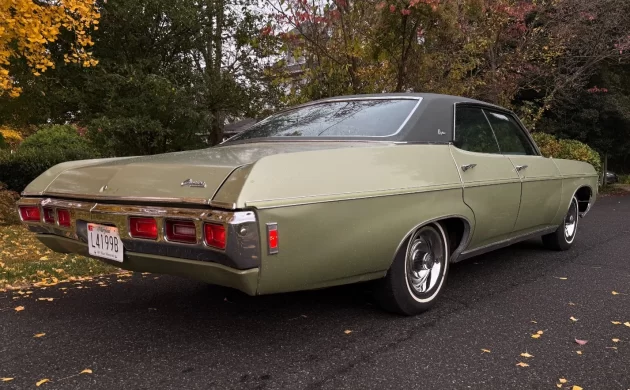
You could make a case for 1969 being Chevrolet’s pinnacle year. Number one in production with almost 2.1 M cars, they had all the bases covered from full-sizers like this 1969 Caprice four-door hardtop (Sport Sedan in Chevy-speak), to the intermediate Chevelle, the compact Nova and Corvair (though the ‘Vair’s days were numbered at this point), 243K F-body Camaros, the very popular C-10 pickup, and of course, Plastic Fantastic in the form of the fiberglas two-seater Corvette. All that said, it was the big car (Caprice, Impala, BelAir, and Biscayne) B-body that rang the register due to its outsized sales volume. Today’s Aberdeen, Maryland discovery, courtesy of Curvette, is a fine-looking example, so let’s delve in and see what it has to offer. It can be found here on eBay, where it’s available for $19,500, OBO.
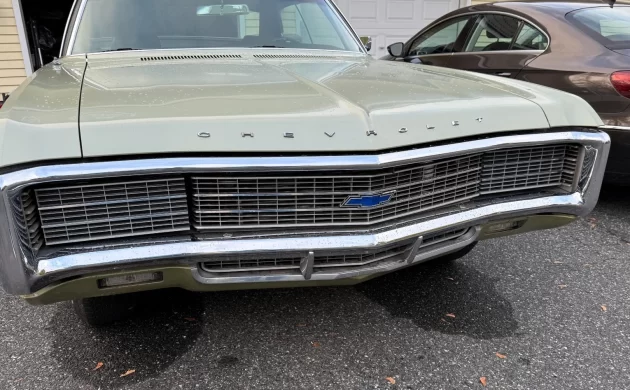
Chevy knocked out 1,109,000 B-bodies in ’69, of which 167K were Caprices. Body styles included two and four-door hardtops, along with a faux-wood paneled station wagon known as a Kingswood Estate. On the surface, this Champagne-hued four-door looks sound. The finish is good, though the seller mentions, “There is a small rust hole in the picture on the front right fender. There is no rust under this hole or around it. It’s just a hole, maybe about the size of a nickel that is there.” This vintage B-body is notorious for rust. The “flush and dry” rocker panels get flushed and then don’t dry. I had a ’69 Impala in this same finish, and by ’73 it was pretty holey. The vinyl top is nice and tight, and this Caprice has optional hide-away headlights, a popular feature offered on many different marques from this era. The seller notes that he replaced the wheels, and it looks like he got the size right; they appear to be the correct, optional 15×6-sized rims.
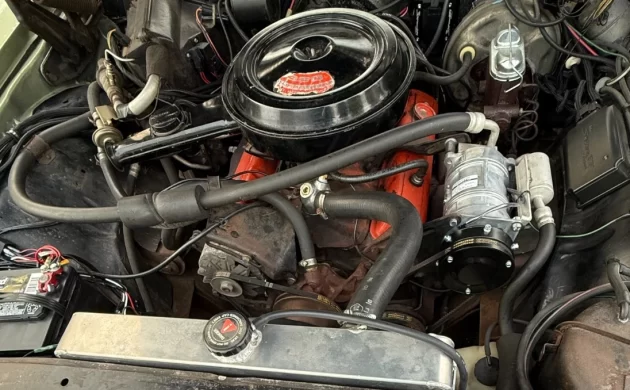
The seller doesn’t describe the engine, but the fender badge indicates that it’s a 350 CI V8. Horsepower ratings were 255 or 300 gross, depending on which version was selected. The seller adds, “The carburetor was junkie, so I paid over $4000 to have fuel injection put in it. Because it has an electric fuel pump, it starts very quickly even after it’s been sitting for a month. The throttle is a little sticky at first, but after the 1st mile it loosens up.” Yikes! $4 grand? The engine looks stock, so my thought is the F.I. feature is courtesy of a throttle body unit that fits under the air cleaner assembly. Also noted is the aluminum radiator, a common upgrade these days, and in this case, there’s an electric fan to provide cooling. While Chevy’s ancient Powerglide automatic was still on the order sheet in ’69, the original buyer of this Caprice specified a Turbo-Hydramatic three-speed automatic transmission.
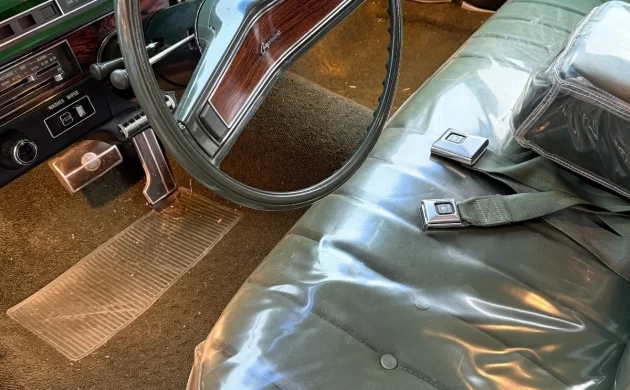
Nothing says “Grandma’s House” like plastic seat covers! Now granted, they’ve kept this Caprice’s cloth and vinyl seats in pristine shape, but boy, talk about a hot and slippery situation. The dash lights have been replaced with LED’s but the included images don’t reveal their intensity. The old Fridgidaire A-6 compressor has been swapped for a more modern unit, and the seller states that the system works “very well.”
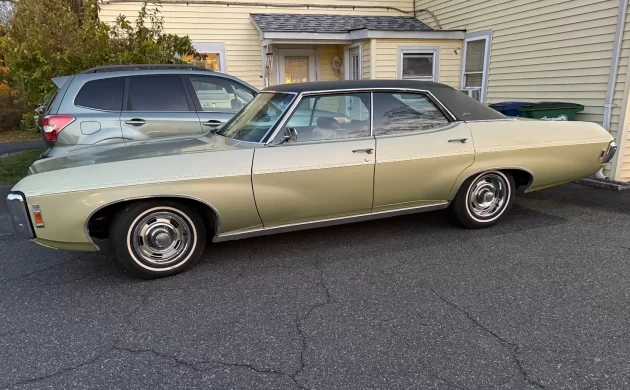
OK, so this 1969 Caprice isn’t an SS396 Chevelle or a Z28 Camaro, but it’s still an attractive ride, ions removed from anything available today. I track prices for Chevy B-bodies from this era, and the $19,500 ask may be a bit optimistic, but the seller does state that he’s open to best offers. I guess my remaining question is whether this Caprice has two doors, too many. What’s your thought on that matter?




I agree with “Yikes $4K” for fuel injection. You could buy a half dozen good carbs that $.
There are a number of aftermarket FI conversions available in the 1K range. They are typically the size and shape of a stock 4 barrel carb and bolt right in. That is just the beginning. Also needed is a high volume electric fuel pump and a return line. That could get into the $400 or more range by the time you add pressure regulators, hoses, fittings, etc. If you use an in the tank pump, then either you modify the original (labor), or buy a new tank. Once that is done you have wiring . One of those wires connects to an O2 sensor. That means welding a bung in the exhaust to install it. Then there is the initial tuning. Don’t forget that it was installed by someonelse. Shop labor isn’t cheap these days.Did I forget anything?
I’m guessing that the labor was about $110/hour, so assuming two (2) eight-hour days at that rate yields $1760 for labor, so $1400 for parts and $1760 for labor puts you at $3160. If you use a full port-injection kit from Edelbrock or Holley, the kit starts at about $2200, then there’s about $400 for the new gas tank, fuel pump, etc., then add $1760 for labor, and you’re up to $4360. Some tweaks to the labor rate and time to install the kit will adjust this figure somewhat, so $4k for professional installation might be a tad high, but isn’t outrageous, given the time required to install one of these systems. If you do the job yourself, then your labor is free, but you will probably take longer to do the job yourself, if for no other reason than you tend to be more careful when doing the work yourself.
If swapping the two-barrel intake for a four-barrel intake, whether you use a four-barrel carburetor or a “four-barrel” Throttle-Body Injection (TBI) setup, there’s the cost of the new intake manifold to bolt the new fuel mixer into place. Holley also makes a two-barrel TBI setup that is a direct bolt-in for a GM Rochester fuel mixer, so if you go the two-barrel TBI route, you can use the stock manifold and save significant amounts of money, but the power gains won’t be very impressive. Here’s a link to the Holley two-barrel TBI systems:
https://www.holley.com/products/fuel_systems/fuel_injection/sniper_efi/sniper_1-_and_2-barrel_systems/sniper_efi_2300_2bbl/parts/550-849K
The Holley kits also offer a replacement distributor, to upgrade to electronic ignition. The port injection kits from Edelbrock include the new intake manifold and new distributor for the electronic ignition in the $2200 price, so factor that into any costs comparisons. An Edelbrock intake manifold is about a grand ($1000), so that must be part of the cost if you are swapping out the intake manifold.
A very nice car. I just now noticed the swells in the body that follow the wheel cutouts. A really nice feature. Good looking car…
Oh no you referenced SS396.
When I see cars like this it makes me remember my father. It’s just the exact type of car he loved. He would have given up his spot in h e l l and sat on the coal pile to own one like it. He really never had a nice car till four of his five kids grew up and left home.
Me too. My Dad worked for a plumbing supply company that used the 69 wagon to deliver parts and bathtubs. He brought it home for family outings on the weekends. After he cleaned out the cardboard and wood from the shipping crates.
Nice clean caprice here! I would have left it carburated and they do say they have all the original parts. I would fix the headlamp doors. It does have the drive by windows and tilt steering.
In 1969, this would’ve been a very nice upscale family hauler. I love that it has hideaway headlamps. This caprices are good. Looking Chevy. 1969 is one of my favorite years for Chevrolet. I like the colors too. It doesn’t bother me that it’s a four-door hardtop. Too bad Chevrolet can’t seem to build a car like this anymore!
I always loved the one-year-only hidden headlights option on the 1969.
They were available in ’68, too.
JO
One year or two, they were incredibly rare! This is the first time I’ve ever seen pictures of an Impala with the hide-away headlights, and I’ve never seen one in real life! The hide-away headlight option must have been somewhat pricey, which could be why they are so rare. Bravo Zulu to Barn Finds for finding this rare example for us to enjoy!
Technically, concealed headlights were only available as an option on the ’68 or ’69 Caprice. Occasionally, however, I have encountered an Impala so equipped. A factory build or an after-the-fact addition? I don’t know for certain.
JO
I saw a lot of full size ’69 Chevys with hidden headlites – were they even available on Bel Air & Biscayne? I know i saw them on Impalas.
But I only ever saw ONE! full size ’68 Chevy with hidden headlites probably because they were available ONLY on Caprice for ’68. Also ONLY Caprice got ventless front door glass & perhaps many buyers wanted to stick with the door vent windows 1 last year on Impala, BelAir & Biscayne.
Actually hidden headlights were also an option on the 68 Caprice, as well
I traded my first car, an Irmine white 66 Impala Super Sport 327 PG, to a 69 Impala custom with the inward curved-concaved rear window. I still wonder what I was thinking, the 66 would be a $50K – plus car today in the shape it was. The 69 Gold with a brown vinyl top and factory 327 4BBL with 3 speed hydromatic tranny. This was the last year GM produced the early 327 engines. I was a junior in high school, and this was late 1978. Gas shot up and dad talked me into (more like made me) purchase a red 71 Pinto hatchback. Kept that until graduation then purchased a 77 Trans Am in 1980 when I got the job at RR Donnelley. Wish I had all 3 back plus many more I’ve run through.
1969 was the last year for the 327, but it only came in two-barrel carburetor form; 210 gross HP in the Camaro (until mid model year) and 235 gross in the big car.
JO
That is correct. it was 9 years old when I bought it and had an intake and 4 BBL, plus headers and duals installed by the guy I purchased it from. It had a big set of Western slotted wheels and Remington XT-120 white letter tires. (Remember those?) The darn thing looked real cool with that setup but was a pile of junk. I learned how to change a starter on this car, changing it twice before realizing the flywheel had a couple teeth missing. Shortly afterwards traded it to the Pinto on a used car lot.
Nice looking car. 1969 has always been my favourite year for the Chevy Caprice and Impala. I’d buy one if it lived on the West coast.
had 1 in gold in high school. paid $100.00 for it. 350w/glide. loved that car. this looks like it was a 2bbl car. i would take out the f/i and put a well-built q jet on it and the regular fan and fix the hide aways. seller paid a lot to have this work done so i think he can’t do it himself. it looks to be clean as a pin.12k-15k would be a good # to get it for in my opinion
I had a 2 dr version w a 427/390 horse with buckets/console hide a way headlights w/bad frame. I pulled the motor/trans and hopped them up and put them in a 70 Monte Carlo for my wife. The Caprice was surprisingly fast for what it was, damn shame the frame was shot because it was a beautiful car.
Yes, a bad frame is a car killer, as the cost of repairing the frame can often exceed the value of the car. Aftermarket frames are an option now, but are probably even more expensive than trying fix the stock frame or sourcing an OEM frame from a wrecked example, and they may not have even been a thing back then. It’s always sad when you have to give up a car you like, because the dreaded “tin worm” has attacked the structure. My sympathies for your loss. Thank God for modern rustproofing techniques!
My Grandmother had one almost the same color, but without the hide-away headlights. The front floorboards were rotted away, so pieces of plywood were used on top of the carpets to provide some support for your feet! We called them “Flintstone Floors”, a reference to Fred Flintstone’s Flintstonemobile, which Fred propelled by pushing the car with his feet!
Yup, love those “Marie Barone” seat covers.
A 4dr. hardtop CAPRICE was referred to as a Custom Sedan, whereas a 4dr. hardtop IMPALA was a Sport sedan. Concealed ( hideaway) headlamps were a Caprice-only option, though some contend that if your IMPALA was of Canadian manufacture, option T83 (hideaways) was available.
Actually, the four-door Caprice was just called a “sedan”; see the attached.
JO
Hide-a-way headlight ONLY came on the Caprice, in 1968 & 1969. If any other model had them, it was not from the factory.
The seller got fleeced on the FI and appears to be passing the $4k cost, on to the next owner. Take away the shellacking he took for the FI and that’s the real value of the car. If it were a 2dr or had a big block, I could see the higher price. I could rebuild the 2bbl in my sleep and I’m of the opinion, I’d have put the $4 large into other areas of the car.
My father bought a 4 door hardtop 1969 impala brand new, dark brown with a light tan painted top and believe it or not a green interior. Thinking maybe it was the last one on the lot.
My wife had a two-door one of these back in her school days. Told me many a story about the shenanigans she & her friends got up to in it. Good times were definitely had by all.