
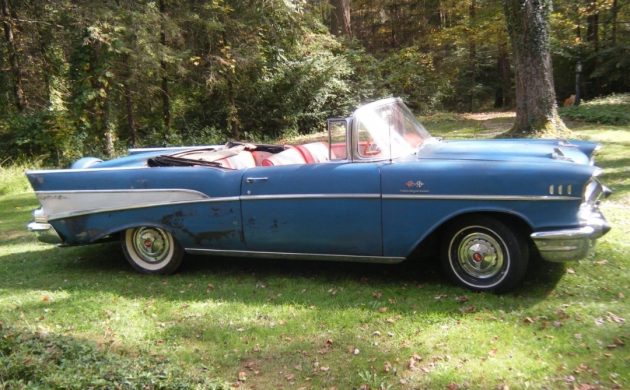
The word “iconic” is one of the most overused in the classic world, but there is probably none better to describe the 1957 Chevrolet Bel Air. The last of the renowned “Tri-Five” range, 1957 marked a high point in styling that has allowed the Bel Air to remain a strong player in the current market. However, when the vehicle in question is a Convertible, and a genuine “Fuelie,” the stakes are raised considerably. That is the story behind our feature car, although it is begging for TLC to recapture its former glory. Its lack of significant rust makes it a prime candidate for a project build, a fact seemingly confirmed by the healthy auction statistics. The seller has listed the Bel Air here on eBay in Sherman, Connecticut. Bidding has surpassed the reserve, currently standing at $30,100 at the time of writing.
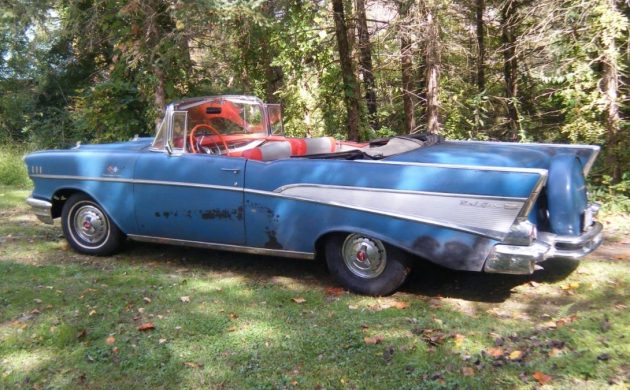
The seller purchased this Bel Air in 1979, and it remains largely as it was when it entered their care. A previous owner had applied a layer of Harbor Blue paint, but it is peeling away to reveal the factory Onyx Black paint beneath. Any restoration would entail stripping the panels to bare metal to achieve a high-end result. That task sounds daunting, but with pristine examples consistently topping $100,000 in the current market, the results should justify the effort. The panels are relatively straight, with only a few bumps and bruises. Rust isn’t as bad as you might fear. There is a patch in the front floor, the inner rockers require replacement, and there is minor steel penetration around the rear floor edges. Otherwise, this beauty is rock-solid. The seller identifies a few trim imperfections, but whether the components require replacement will depend on the new owner’s desire for perfection.
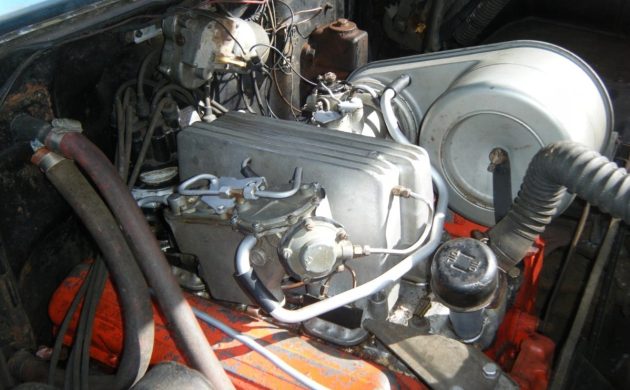
Chevrolet offered ’57 Bel Air buyers a vast array of engines to power their new purchase. This Convertible’s first owner ticked the box on their Order Form beside the 283ci “Fuelie” V8, teaming it with a two-speed Powerglide transmission. The motor would have produced 250hp and 305 ft/lbs of torque in its prime. Those numbers may sound modest by modern standards, but they were considered mighty impressive in 1957 when generated by a vehicle that could comfortably accommodate six people. The seller states that the engine is no longer numbers-matching, although it is date-correct. The original V8 suffered from fuel hydraulic lock many years ago, but a rebuild of the fuel injection system included an anti-syphon solenoid to avoid a repeat performance. The car runs and drives, but since it hasn’t seen active service for around forty years, it will require work to be genuinely roadworthy.
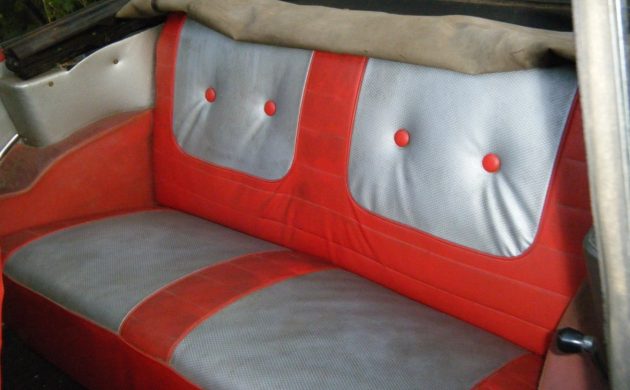
This Bel Air’s interior is a mixed bag. It retains its correct Code 683 Red and Silver vinyl trim, and the seats are free from rips and tears. The carpet is in good order, but the door trims and a few small items require replacement. That isn’t the end of the world, because there are now some excellent kits on the market that would provide the winning bidder with the opportunity to perform a retrim using parts that perfectly match the factory items. That is the path I would take to ensure that every aspect of this Bel Air turns heads wherever it goes.
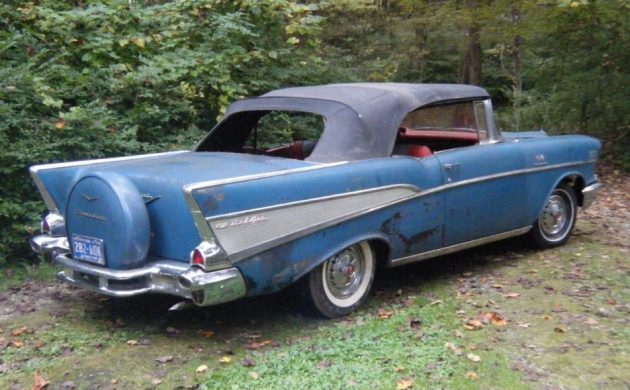
I was once asked to compile a list of post-war classics that I would park in my dream garage. The only rule was that I could only choose one car from each decade, and that was challenging. However, the 1950s proved a no-brainer, because it had to be a Matador Red 1957 Bel Air Fuelie Convertible. This Chevy only misses out due to its paint shade, but that could be easily changed during the build. Regular readers will be aware of my desire for originality, meaning that if this Bel Air were to find its way into my garage, it would eventually emerge wearing its factory Onyx Black paint. That is a compromise that I would willingly accept, but would you follow the same faithful path?




The seller never claims the car came from the factory with fuel injection. The use of the word “genuine” suggests it is. The ending bid will tell if potential buyers thinks it was factory installed or done at a later date.
Steve R
Steve R
Yep…and how many times have we seen this one before……..
Nice project. As for what to do to it, I’d ditch the continental kit and repaint in the original red. Too many black cars on the road already and it’s not the original color.
Ah no. From the owners write-up “The car was originally black and a previous owner had a poor Harbor Blue paint job done.”
Yup, screwed that up. Was too early to soak up the correct info.
It wasn’t that long ago that a fuelie ’57 for 30K would have been gone in an instant. Just to own and drive one is a treat few experience. Never mind the condition.
But times have changed and this one gives you pause. The original 793 black Onyx on a ’57 convertible is a beautiful as they get. With all the chrome, it stands out like no other.
Off setting that is the rust, and as bad as the rusty parts are, this is a probably a frame off requirement to restore.
Which makes every other part of the project be brought up to the same high standard. A six figure undertaking.
It will be beautiful when done, a rare classic, a labor of love. But whoever takes it on will have years of work and a shrinking market value.
All that said, someone will find this impossibly low entry price worth the pride of ownership once completed and you definitely will not see many, even in the endless sea of tri-fives at car shows..
What really astonishes me is that you can now buy amazing ’57’s for prices unheard of just a few years ago.
Here is a gorgeous ’57 2 door, sport sedan for around the same price.
https://www.ebay.com/itm/306530385732
For my money a running driving red/white ’57 would be my choice.
This is an auction with over 4 days remaining. The current high bid of $30,100 does not represent anything. I’m sure the seller has been receiving, will you accept this to end the auction early or what will it take to end the auction early.
Steve R
going to cost a lot to redo. if its legit it would be worth it. need to lose the continental kit. does nothing for the looks.
I always thought that the FI option gave you the first engine with 1HP per cubic inch or in this case 283HP. Could a lower HP FI be ordered back then?
There was a hydraulic lifter option rated lower HP.
The non-matching block will reduce the interest of the purists. For others the FI can be desirable eye-candy.
If the FI was added after the fact it’s quite possible it was added within a few years of 1957. Mechanical FI was considered by many to be unreliable. The problem was service-station wrenches had limited experience tuning/adjusting mechanical FI. Retrofitting a carburator did require changing the intake manifold etc. Doing so was not uncommon in the period putting a number of used FI units on the market.
In 1957 Chevy offered two fuelies. Along with the 250 HP fuelie, a 283 HP fuelie was also offered. It was a solid-lifter engine with a Duntov cam.
Glad to see I’m not the only one who thinks the Continental kit on the back needs to go. I think this would make a fun car to do some restoration on and just enjoy it
He really needs to post pics of the engine stamp, and the stamps on the FI unit. Did they stamp the partial VIN on the FI units in 57? Seems like I recall they did in some years.
According to info on the Chevy Tri Five Forum, the plant and VIN of this car puts it as built on approximately 2/4/1957. So the engine assembly date of December 14, 1956 (per the Seller’s ad text) could very well be correct for this car. And the suffix code FJ is for a fuelie engine with powerglide.
If the car was blown up later, and a replacement engine block installed then, seems odd that the new block would precede the car build date.
So he might have more than he thinks he has …
Great questions/ information. Even with the limited information given in the description, I tend to think that the car is legit. The FI unit appears to be correct the suffix add to it’s provenance. Regarding the comments about losing the Continental kit, I agree that is unattractive, but given that they were a fairly popular option on higher end cars from this era, it very well was a factory installed option and removing it could affect the restored value.
A seven-week spread is a lot, chevy used 283’s up pretty fast at the factory. The chevy restorers I know say 1 week to a month max date difference.
Ken Kayser’s excellent book on FI design and production says Rochester began production of the 4520 FI series on February 25, 1957. This series was the first one designed for passenger car assembly line installations, although some were later installed on Corvettes.
Rochester assembled 10 of the 4520 units during the last week of February. They then made an additional 449 units in March of 1957. All those units went on 250hp passenger cars.
So… if this car was built during the first week of February, 1957 then… uh-OH!
Good sleuthing.
So then the FJ stamp from December is either fudged, or it is actually December of 1957 (or 58 or 59 or 60 …). Guess he needs to post a pic of the block casting date too!
The seller already stated that the block is not original to the car, so whether or not the car is 100% original is a moot point. I think that the fact that the injection unit is from 1957 (which according to the stamping on the unit it is) and that the car appears to be an original FI is much more important.
In 1968 I had looked at one they wanted $450. for it . Shows how the dollar has been devalued .As for the car, very interesting project .
Being a “real” fuel injected car makes zero difference these days. Since there was no build sheet or option GM records kept in 1956-57. Thus, assembling a fake car is easy and has been done thousands of times. This car has an electric wiper motor which was not available on FI cars. Could the electric wiper motor have been added? Sure. Everything said, the value of original FI and 2×4 cars has declined significantly. A buyer would be far ahead to buy a car already done or use this car to build a resto model and sell the FI components to a Corvette builder, where the original performance parts still have some value.
The eBay ad text says “The Chevy had vacuum wipers and I replaced them with an electric unit many years ago.”
If the car was a real factory FI car (which seems to be doubtful based on the build date analysis above), then it would, in my opinion, be blasphemous to restomod that car.
How many complete, unrestored, and fairly unmolested factory black / red 57 V8 convertibles are there still left on the planet ?? So my opinion would probably be the same even if it is not a factory FI car.
There are way way too many decent 6 cylinder and other “not significant” cars available out there to use as the foundation for a restomod build.
I would leave the Continental kit just where is the car came with it, and it deserves to be there. What’s wrong with a big ass LOL?
Thanks Bruce. I agree. I owned from new a 1956 Bel Air convertible with all options offered, including the Continental kit. I liked the looks of it then and still do. Of course it added the benefit of more room in the trunk.
I was curious as to why there’s a spare in the trunk when it has a continental kit.
If someone that owned a body shop got a hold of this car it could be restored for less than $20k, I never figured an hourly rate for my labor for what I did fixing it up into a selling price when I sold car, just actual money spent on parts or I’d have to charge an extra $90 bucks labor for every oil change! Someone is going to make a pile of money on this one when it’s finished.