
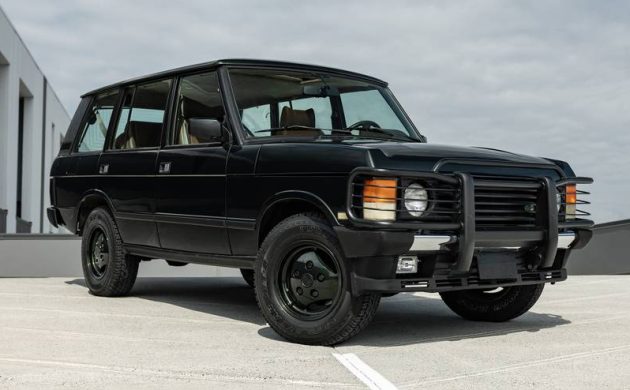
Over the years, organizations like Hagerty track prices for vehicles and make predictions on which ones will stay hot for years to come. The vintage SUV market is one where I seem to notice a lot of “winners”, meaning there are numerous classic trucks that seem to keep gaining in value. There are always some outliers, of course, like the Jeep Grand Wagoneer which has faltered a bit in recent months, but overall, if you fancy a 4×4, you should have plenty of good options. One of them might be the Range Rover County Classic models that have reached the point where the trashed ones are now parts rigs and the nice ones stand out. Check out this 1993 long-wheel base example here on craigslist for $28,000.

These Land Rover Range Rovers have long been associated with various symbols of wealth, from downtown financial executives to yacht club memberships. But like many vehicles that initially carried a high MSRP, the second and third owners rarely commit to the same level of maintenance and upkeep as the original caretaker. Given the Range Rover came from the factory with complex systems like hydropneumatic suspension and occasionally iffy electronics, it doesn’t take long before the invoices stack up. Ironically, this era of Range Rover is more or less a simple vehicle mechanically, so the engines are rarely problematic; it’s everything else around it.

I briefly owned a 1994 County model similar to this, right down to the long wheelbase set-up. However, mine was a truck that had been neglected for years and was scuttled to become a parts vehicle for a far better rig. The interior is another area where these trucks either sink or swim, as buying one that had been wet and exposed to the sun like I did resulted in torn and shrunken leather, warped wood trim, and a cracked dash. The seller’s truck has none of those issues and looks spectacular inside, with all of those fragile surfaces in excellent shape. With mileage approaching 145,000, it’s impressive to see one still looking this tidy inside.

The 4.2L V8 engine offered 200 horsepower channeled through a 4-speed automatic transmission. It also is equipped with a two-speed transfer case with viscous coupling, and while these trucks do respond well to off-road modifications, a Range Rover County like this one is definitely more appealing to collectors in stock condition. The paint is also worth nothing on this example, as Eastnor Green Metallic is a stunning shade especially with the color-matched wheels. While you can find one of these for well under $10,000, it will likely have a host of issues to sort out, so plan to spend money now or spend money later, as there’s no getting around it with one of these. Thanks to Barn Finds reader Mitchell G. for the tip.




Nice find although I have to admit, I’ve NEVER heard “Investment Grade” and “Range Rover” ever used in the same paragraph before when it came to motoring lore OR when referring to a “County” but I may be wrong!
Having been around the block with several of these at the $8-10k price point over the years, you are spot on in your write up regarding the necessary work to make such a vehicle road worthy and practical to drive once again. Then once you’ve conquered those mountains let’s talk about fuel consumption!
Only if a live-in mechanic comes with it.
Nice design but..
I don’t really see Range Rovers as ‘investment quality’. It’s more like ‘investing in quantity’ (with not much return). Unless you are a decent mechanic and you know these vehicles, they are not items to plan and put money into! This one is a good example but $28K? I think not!! Certain Land Rovers, maybe, but not Range Rovers. They are very similar to older 7 series BMW’s. Expensive when purchased by the wealthy, used for few years and then put out to pasture. Who really wants one when the maintenance (and parts) is off the charts, especially if you are not your own mechanic. Add to that, there are not many’ parts cars’ out there in these expensive autos…..I’ll pass……..
Who in their right mind would invest in a Range Rover in these days? If it were the first series original Range Rover , yes maybe, but a 1993 long wheel base ? You gotta be high to think that’s a good idea. Investment grade 🤣
To start, how did it EVER get to 145,000 miles! Ive seen the same ones in the junkyard with 60k. No wreck, just bad engine design. It has been on borrowed time for 90,000 miles.
I always liked to look/design of these. BUT NEVER EVER CONSIDERED BUYING ONE. Having been in the repair side of automotive world for the first half of my working career. And having to give CPR to an owner of one of these everytime you present them with the quote/repair bill. I know enough not to own one. These are the perfect LEASE vehicle as long as the maintenance is included in the monthly payment AND as long as the warranty last as long as the lease term.
False. The engine was quite reliable and robust. It may have leaked, but there are ten times more 3.5s, 3.9s, 4.0s, 4.2s and 4.6 engines that made it past 150,000 miles than ended up in a yard due to a failed engine. If it failed at 60K, it was the owner’s fault due to severe neglect. I only ever replaced one engine due to a manufacturing defect that cracked the camshaft (1997 4.0); the entire engine replacement was offered by Land Rover for customer satisfaction at the outset.
Starting in 1996, there were new materials and procedures that could be performed, often under warranty, that when performed reduced the leakage to practically nil.
They only have a few common issues. A typical statement goes something like;
“The 1993 Range Rover, a classic but notoriously temperamental vehicle, suffers common issues with its infamous Lucas electrical system, prone to glitches, along with significant rust (especially roof drains/windshield seals) and persistent problems with the air suspension, often leading owners to convert to coil springs. Expect frequent issues like head gasket failures, oil/coolant leaks, warped brake rotors, rough idling from intake leaks, and general aging component wear (transmission, steering), requiring diligent maintenance or specialized help.”
Don’t forget to mention the terrible gas mileage whilst also having no power. Even the 4.6L engines
The only “investment” for one of these should be at your local dealership’s parts counter.
Very well said
I’d like to correct a few things here: One, the suspension was NOT hydropneumatic, it is called EAS (Electronic Air Suspension). There was a drain on the air reservoir in the case of water presence, something that was supposed to be checked during service. This (or any other EAS service for that matter) was rarely performed outside of the dealer network, and the results should have been expected. Any EAS-equipped Range Rover that has had that system disabled or “converted” is worth at least $5,000.00 less, because it takes away the very thing that made the vehicle what it is.
This needs several underside shots and pictures of the engine bay to evaluate further. There are some identifying things that might suggest this is worth the price, but if they aren’t there, items that will need attention should be counted off the offer.
Second, the Range Rover did not really suffer from “iffy electronics”. That old Lucas joke hasn’t been true for years, if it ever was. the biggest problem with Lucas was the mechanical portion, such as brittle plastics that failed.
People often disparage things that they don’t understand, and such it was with a few Land Rover systems. If one had an HHT and a manual, the Engine Management System was fairly straightforward. A Wabco tester certainly made the ABS system much more manageable, but the main problem was the wheel speed sensors, often damaged by poor service practices or lack of maintenance. The EAS system was best serviced with either the HHT or Testbook, but few in the aftermarket had those. Most problems were due to leaking bags (consumable, like tires) or lines damaged by poor service practices or road debris/off road damage.
There were some typical issues, but every manufacturer has those. I remember MAF sensor failures were very high on GMs, but a MAF failure on a Land Rover product was quite uncommon.
There were several quality issues that were addressed during a program that started in 1996 and continuing into 1997, but those folks who never went back to the dealer never took advantage of those updates, and they were mostly covered by manufacturer warranty.
This must have been repainted as there are no decals on the vehicle anywhere. In person inspection required, and an extensive test drive should be performed, along with a good corrosion inspection.
Who do you think reads a long winded post like this one? I sure didn’t. Keep it short and sweet
I’ve owned 8 Land Rovers over the years, starting with one just like this. If you like to wrench, this era of RRs are very simple vehicles to work on. They are also extremely stout and capable off-road. The only problems I ever had were power window switches and other minor electrical issues that were simple and cheap to fix.
Of all the Rovers I owned, there was only one dog: a 2010 with the dreaded 5.0 Ford engine. Lost the timing chain at about 108k miles due to the fragile plastic – yes, plastic! – tensioners. But my guess is this one, if properly maintained, will go for another 300k. If you don’t recognize the RR Classis as an investment grade vehicle, then you haven’t been following the market.
i have worked on these. that’s the only thing i invested and never would again.
Good points, Tom. Incidentally, people often complained about the seat switches, but they never admitted to allowing their crap to fall/spill into them: food, coffee, cigarette ashes. They often could be repaired by pulling the buttons and cover off and cleaning with Deoxit.
If I were to be looking for any Land Rover product, it would be one from 1987 onward to 19981/2; things started going downhill with the Bosch engine.
You Americans really don’t have a clue about the Classic Range Rover . First of all it is NOT a truck ! Secondly this is indeed a very investible vehicle, just ship it back to the UK where there is a very strong following here. And it is not as unreliable as you think, simple to work on and a joy to drive. Nothing wrong with the engine either, it came from America in the first place !
Nothing better than to be told off by some rude French dude. We are fully aware that the Range Rover had a Buick engine. It’s the implementation that is bad not the tool.
It’s like powering a 747 with a Cessna Citation turbine.
Not a good comment about the Citation turbine with the Citation II crashing and killing the Biffle NASCAR family. I’m not an aircraft officianonado by any stretch of the imagination. But I flew many of miles in our Corporate Citation II. I realize it wasn’t a Lear. But, I “walked away” from every landing and was never delayed by any “airplane” issues.
👍right on military guy😂
What I would consider potentially a future “investment grade” vehicle from Range Rover – from BAT on the market as of Dec 31st
https://bringatrailer.com/listing/1973-land-rover-range-rover-5-2/
Yes I agree with that one
I read the comments and am amazed at the knowledge out there. So much that can be learned.
And then along come the cartoon watchers like BB and military guy and dumb it down with nothing to offer or add.
No even a real name.