
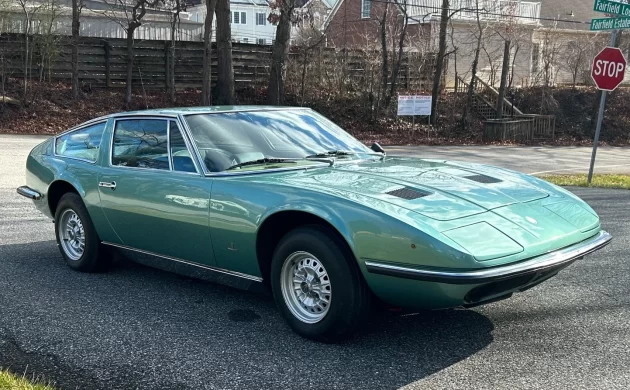
It’s 1969, and you are shopping for a Maserati of the grand touring persuasion. The options are prolific. The six-cylinder Mistral, or its sister, the Sebring? In the eight-cylinder category – the Ghibli, the Mexico, or – fresh to the lineup – the four-seat Indy? What a miracle that a company like Maserati, building a few hundred of each model each year by hand, every one designed by the best stylists in Italy, could present so many choices to its buyers. The 1960s were a lush landscape indeed for enthusiasts of all stripes. Today’s Italian diva is a 1971 Maserati Indy, available here on eBay for $95,000 or best offer (down from $99.5k when I started writing this article). The car is located in Crownsville, Maryland, and the odometer reads just 50,550 kilometers. Curvette – thank you as always for the wonderful tip!
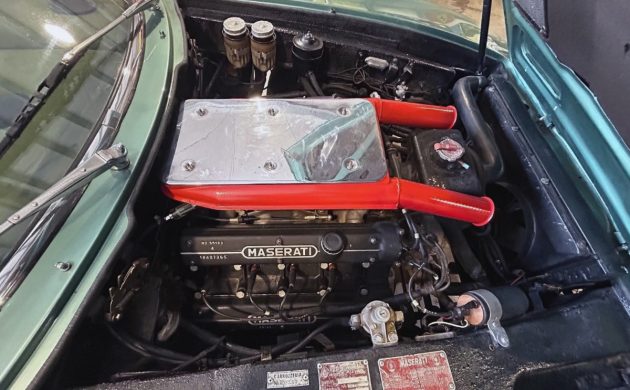
Today, as in 1969, collectors have choices when it comes to their next garage inhabitant – and those choices can be from among models, condition, price, and provenance. Many of us buy the former owner as much as we buy the car. Some of us want a very particular configuration. Others sacrifice condition for price, or the obverse – pay a high price for the best condition. This Indy was recently imported from Kuwait; all of its documents are in order. It was in storage for fifteen years, but is said to run and drive well. That’s a 4.7-liter double overhead cam V8 breathing through four Webers in the engine bay – good for 290 hp and an under-seven-second vault to 60 mph. Top speed should come in around 16o mph. Brakes are servo-assisted discs all around. The gearbox is a ZF five-speed, used throughout production – though in 1973, it was given a dogleg reverse and its internals were improved to match the power output of the newly available 4.9-liter V8. Unlike the Ghibli, the Indy’s engine is a wet-sump, resulting in a higher bonnet line. The body is a monocoque type, while the Ghibli sits on a tube chassis with a lower center of gravity. These differences add up to civility over performance, though the latter was nothing to sneeze at.
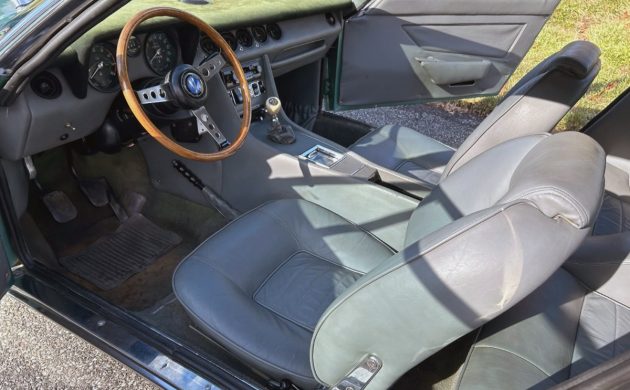
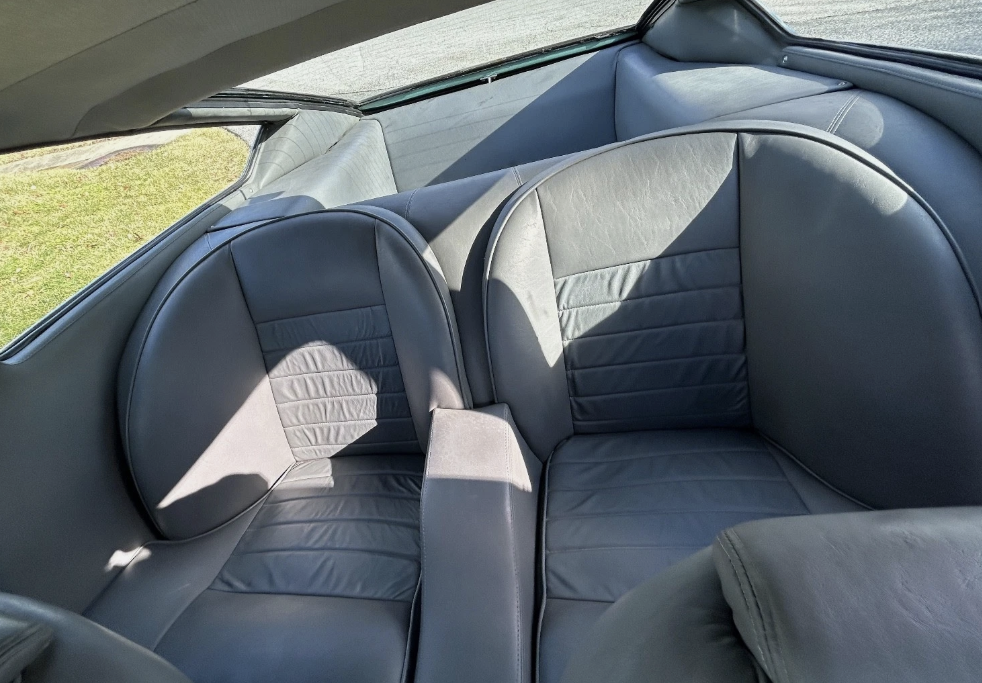
Not much beats a 1960s Italian car interior. Even the lowliest Fiat was somehow more elegant than many other cars, cabin-wise. Here, we find leather seating, low-profile headrests, a three-spoke wood-rimmed Nardi steering wheel, sparkling sill plates, and an instrument panel that puts a Cessna to shame – what more could you want! The condition of all these surfaces appears excellent, including the rear bucket seats. That’s right – the Indy dished up more than a glorified parcel shelf back there, in keeping with its berth as a true four-seater.
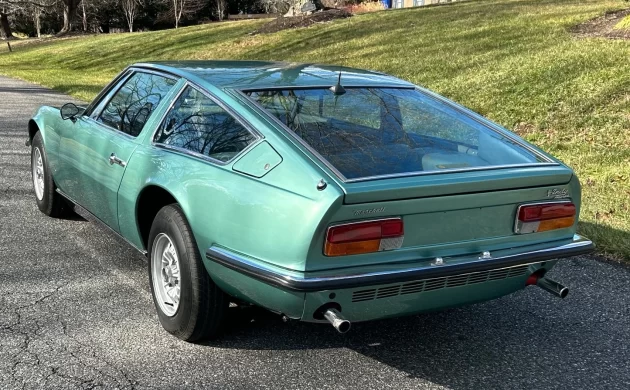
Vignale had designed the Sebring and the Mexico for Maserati; tapping his talents for the new Indy was natural. Challenges included a high bonnet line to account for the wet-sump engine and the bulky four-seat configuration, but Vignale’s solution is brilliant. A creased waistline, the huge rear glass hatch (Espada fans will recognize that idiom!), and generous quarter lights relieve the bulk. If I have a gripe about the Indy’s looks, it’s those Borrani alloy wheels fitted at the factory; they’re 14″ and seem small for the wheel arches. Low mileage or not, Indys are a tough sell. A prospective owner can opt for the sportier Ghibli, or some 12-cylinder Ferrari. Recent sales include this ’70 with an engine swap to the 4.9-liter, sold at Scottsdale last week for $84k; and this 4.2-liter ’70 with a few needs for $41k. As nice as it appears, this Indy will probably require another discount from the seller before it finds a new garage.




Great write up Michelle! Agree about the wheels. I also don’t care for the rear panel and taillights, looks too much like an early 70s Datsun.
A beautiful and fast FOUR seater. Who said you can’t do a GT with more than 2 people on board? Your knowledge of amazing machinery abounds, Michelle. Too, I’m thinking you all should put Curvette on your team payroll-excellent find once again.
Boy these Maseratis always seem to have a wild top-end. One plus of the smaller rims, they allow a taller sidewall, which can really help cushion bumps for a nicer ride 😌
Maserati has always had the nicest interiors of the Italian brands.
Such a deal ,compared to the 2 recent sales of the ugly Espadas on BaT
Got the opportunity to take one of these for a quick test drive, decades ago, just a short jaunt from a friend’s garage that unfortunately didn’t present a chance to work it through the gears. First time in a true Italian exotic, with all the classic points; happy to rev, heavy clutch, arms straight out, sumptuous interior. Would buy it without hesitation if it was possible
Who has addressed the restoration of the infamous Vitaloni combination switches in these models? The Ghibli, Mexico, Merak, Kamson, Indy and some Boras all use this unique and abandoned combination switch contact function that is used by no other Italian switches. How the shrinking plastic has panned out over the years is telling.
Good point, switches are a sticking point (ha ha) – Ferraris have the famous “gummy plastic” problem, the BMW Z series switches can be cranky too.
Sweet!! Great color, check out the sellers other 3 cars.
I really like the 1960 Facel Vega Excellence he has for sale, never seen one before.
Guys is that steering wheel a later replacement – I thought the Indy had a bigger center piece……..
Your knowledge of the Italian divas is formidable, bravo Miscelle! Again, u nailed it in my gearhead heart “an instrument panel that puts Cessna to shame”. I recall when i bought the Lancia Abarth Autobianchi 112 my happiness upon seeing its full instumentation like a real sports car. Although small it had oil pressure, battery amps and oil temp in the console. Once i won a bet that it could sustain 9,000rpm (over the 8,000rpm red line)(little secret: i used to add some 2 stroke lubricant in the fuel as i have learned from a Porsche enginner at the time). I raced it successfully, sold it for postgraduate studies in England, where with the money i bought the Bertone Fiat (Abarth engine) X1/9. Congrats again!