
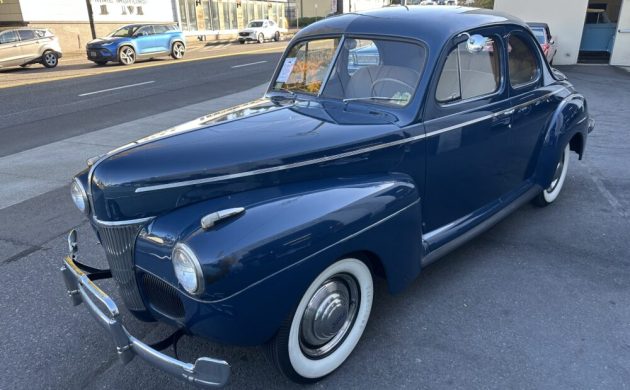
From one of my favorite dealers in Portland, Oregon, comes this wonderful, well-documented 1941 Ford “Opera” coupe with only 48,200 original miles. The recipient of three Rouge awards attesting to its originality, this coupe can be found at Matthews Memory Lane Motors. It is priced at $20,500. Ordered radio- and heater-delete, it runs and drives well. But what exactly is an “Opera” coupe? Turns out the nomenclature is a matter of ongoing debate, with the arguments mired in definitions of coupe, five-window coupe, and business coupe.
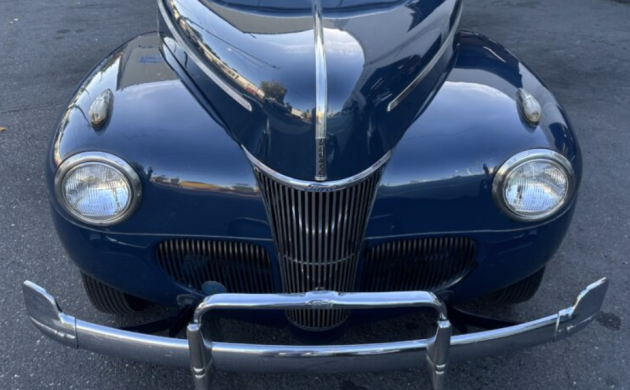
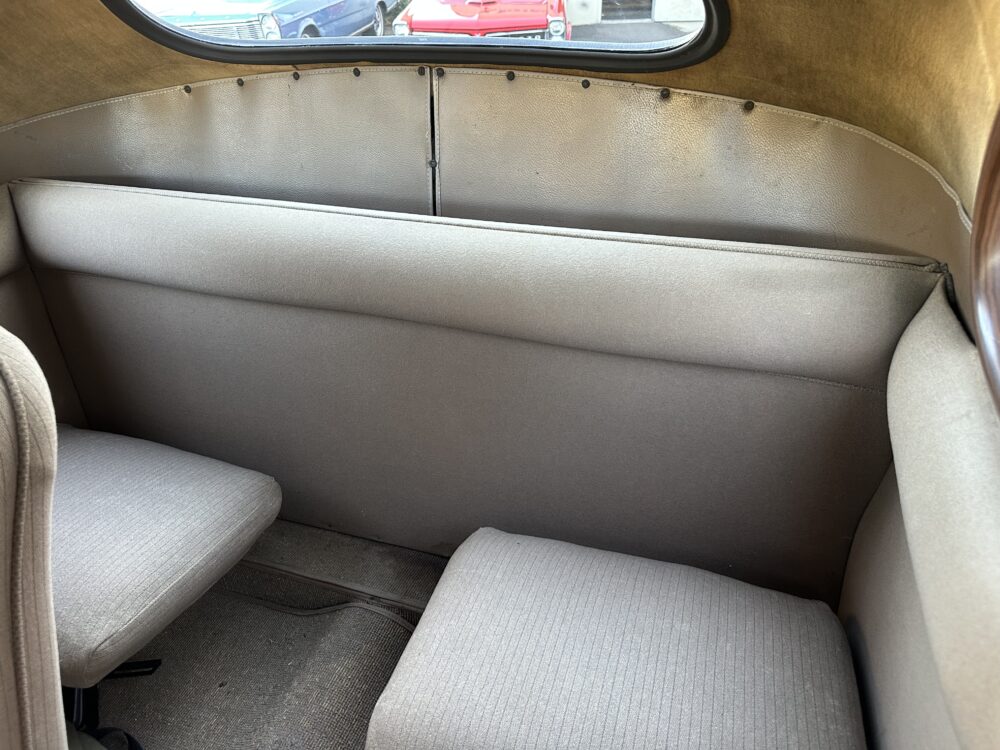
Ford substantially restyled its product line for 1941. Running boards were nearly completely absorbed into the body. Headlamp nacelles melted into the front fenders. The grille was given wings on either side of a central waterfall. These elements emphasized the new external width at over 73″, up from 69.5″ in ’40. The car was longer, the A-pillars were thinner, the rear window was a single piece of broader, curved glass. Trim levels included De Luxe and Super De Luxe. Both were offered in coupe body styles, and as stated in this brochure, each was available “with or without auxiliary folding seats.” Ford never used “Opera” to describe a coupe offered with folding seats. However, the coupe body parts manual described the seats as an “opera assembly” in several places, lending that verbiage to the car itself.
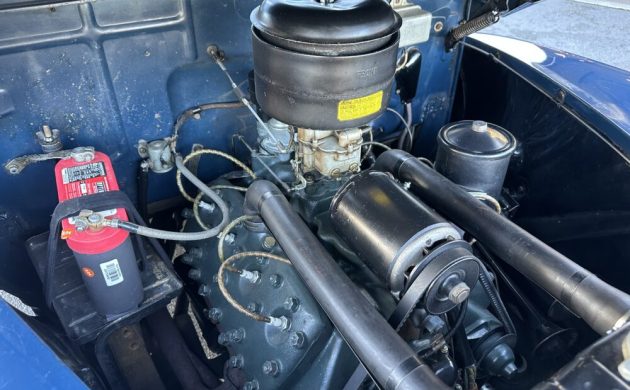
Ford’s 221 cu. in. flathead V8 was standard in the De Luxe. This engine was first introduced in 1932; back then, output was 65 hp. Rapid development, including a transition from poured Babbitt bearings to inserts in mid-1936, a shift from 21 studs to 24, and a gradual increase in compression ratio that hiked output to 90 hp resulted in a modernized engine suitable for the updated Ford. The transmission is a three-speed manual.
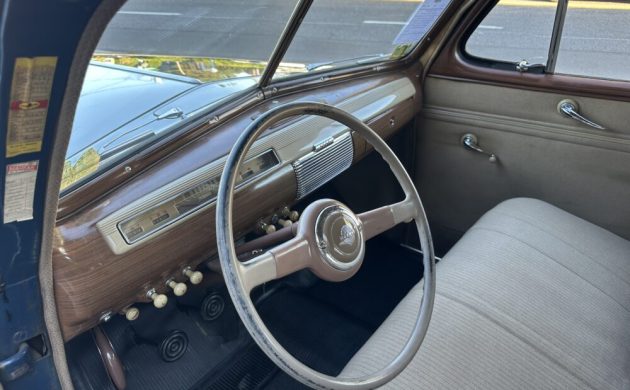
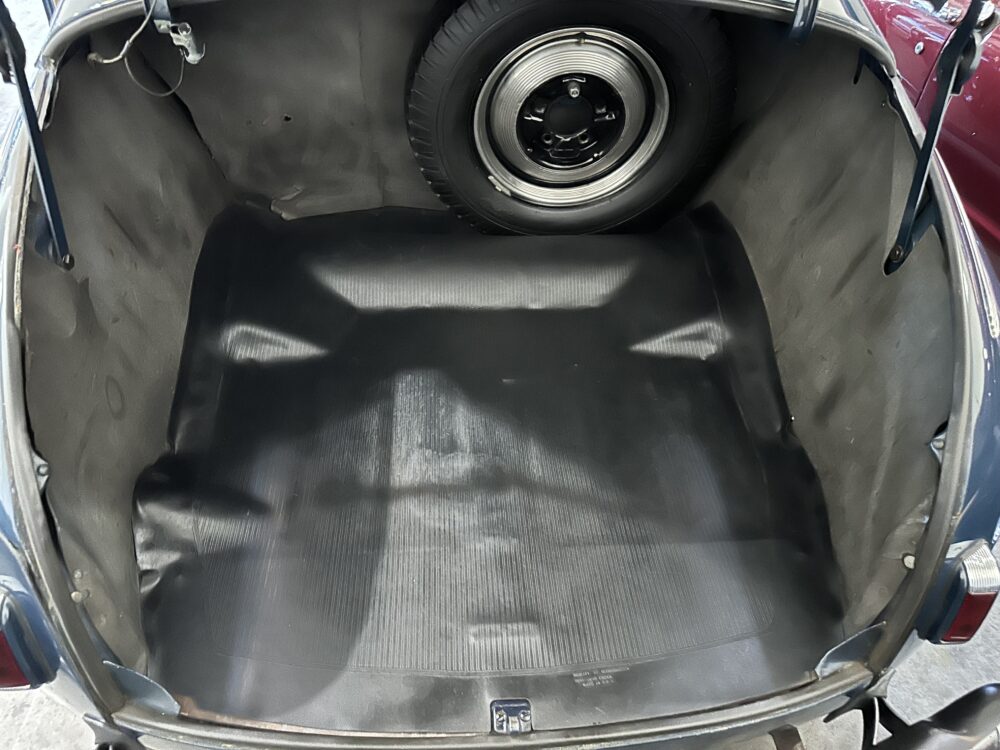
With its original upholstery and faux wood-grain dash still in great condition, we can see how the De Luxe differs from a Super De Luxe: no horn ring, no driver’s door armrest, no clock, no crank on the dash vent. But here’s the money shot, showing those rear fold-up seats. The car’s trunk is as spiffy as the rest of the vehicle.
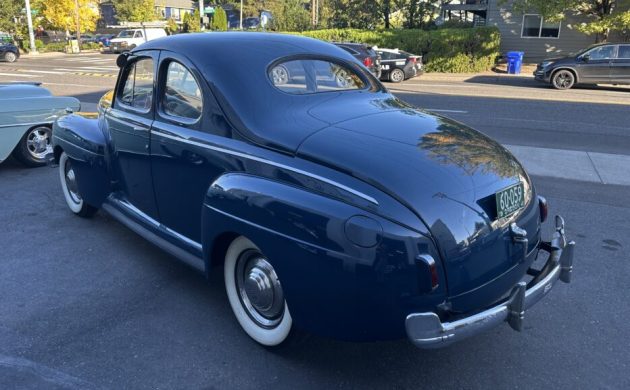
The graceful lines of the coupe put it head and shoulders above most other body styles of the era. The market has favored these Fords for a few decades, at the same time that resto-rods have become popular; consequently, finding an original example is tough. Scanning offerings in the market turns up very few ’41s at all, and only a couple of coupes – all of which are priced higher than this one. Given its condition, survivor status, and running condition, this Ford is almost irresistible at the price.




I hope people don’t tire of my, “gone off to war and didn’t come back” references, we can’t forget that, not on my watch, anyway. This, however I don’t think was one of those. I wager this is a nice job of a light restoration on a seldom used car. Steering wheel the key. The Optima 6V battery and tarp straps are a nice touch( cough), I mean, really, come on. You’ll notice a feature here, that lay dormant for what, 30 years? The locking steering column, new for ’41, did any others have that? I also read, the “Opera coupe” was essentially a business coupe with the rear jump seats, but I doubt this car had any sales person history. Just a beautiful car, automatic/stick blarney still enforced, but they don’t come any nicer than this.
A neighbor owned a ’39 Ford and it had the locking steering column.
I believe the 1938 Buick was the 1st production vehicle to have a steering column lock.
Ford had locking columns at least as far back as 1935.
Howard, My ’37 Coupe had a locking steering column. Had to pull the pitman arm when I had it picked up. No front bumper, wheels were turned. and the key wouldn’t work. December ’64 I’d been kicked out of college for low grades, jilted by the goddess I’d been dreaming about since the second grade. but getting that engineless coupe for $50 made up for everything. I was 19 and everything was promise and possibilities.
Howard, few young men could afford a new car in 1941, those are who went off to war. This was a wealthy older persons car as noted by such few miles. Most cars had to last the war so had many many miles by wars end, though, then again, there was gas ratioing, so maybe the few miles on it. many young fighters never even had a car, they grew up in the deppresion. A car, any car, was the dream of many a GI, only second to actually getting home in one piece.
Radio/heater delete meant for standard equipment deletion but these weren’t standard equipment. They were just uninstalled accessories.
This is an absolutely beautiful Ford. I enjoyed your write up along with the changes the famous Ford Flathead V8 went through in the 30’s. All for the better too. To see one this original, and this well preserved, I’d be hesitant to drive it, but because I wouldn’t want to, but just to not chance anything happening to it. This car, hard to believe is almost 85 years old. This one certainly does not look its age at all. I enjoyed your write up Michelle!! Thank you.
-Dave
Beautiful example! I drove a 1946 Ford Super Deluxe V-8 for 27 years, so I know this car very well. HOWEVER, I would not want this one for two reasons: 1) It’s a COUPE!!!; 2) It’s the base Deluxe. If this were a Fordor or a Tudor Super Deluxe, with radio, clock, and heater, and Columbia Overdrive, I’d be tempted! Considering the mileage, I am surprised at the wear on the steering wheel. My ’46 had close to 160,000 miles, before the paint began to wear through to the metal underneath. Did they use a thicker coating of paint in ’46?
Harrison, a friend and I drove his 1941 Ford Super Deluxe V-8 four door sedan about 20 years ago from Philadelphia to Dearborn for the Early Ford V-8 Grand National meet that occurs every five years. He had an upholsterer remake the front seat, so he had what he called a “command position” so that he could see better over the hood. The car did not have the Columbia overdrive, but another newer version between the transmission and rear drive. I can’t think of the name. After the meet Tom continued both driving a taxi and using his 41 Ford for hire and for special events. Unfortunately, he lost his left leg in a motorcycle accident and could no longer use a clutch, so sold the car for only about $5,000. Did Tom stop riding cycles? NO, he had made and modified a big Honda with the insurance money so he could ride with just the right leg.
Dave in PA: Hello again! It is amazing, how cars are perceived differently now, than only a few years ago. A 1941 car is emminently (sp?) driveable, just as it was in 1941. Interstates add a requirement for some sort of “overdrive” set-up: my ’46 happened to have a Columbia. But I could take it anywhere a “modern” car could go. However, it was far more fun to drive (smile)
Lovely car. So very stylish, unlike any of today’s offerings from the “Big Three”.
” No crank on the dash vent ” ? Well how do you get it open to let the air in ?
To Paul X: There is a small locking lever at the bottom of the vent window: you release it, then you push the vent to however far you want it to be open. This arrangement was pretty-much universal on lower priced cars in the late 1930s, the 1940s, and well into the 1950s. Unless you were used to Packards and Cadillacs, and the highest tiers of lesser makes, this was how you operated the vent windows: you didn’t have a crank. What feels strange, is to get into cars made within the last 55+ years, and find no vent-window! Just about all cars had them, and everyone knew how to operate them. Eventually, once all vent windows had cranks in the late 1950s, they did away with the little lock at the bottom. Good thing, too!! — you can’t imagine how many owners forgot to release the lock before attempting to crank the vent vindow open, thus stripping-out the pot-metal or zinc gears in the mechanism! If you go to buy a car from prior to the late 1950s, that has both the crank and a lock on the vent windows, be sure to check the condition of the cranking-mechanism: if it is loose or stripped-out, then FINDING an original, new old stock, MIGHT prove to be a PROBLEM!
Howard, few young men could afford a new car in 1941, those are who went off to war. This was a wealthy older persons car as noted by such few miles. Most cars had to last the war so had many many miles by wars end, though, then again, there was gas ratioing, so maybe the few miles on it. many young fighters never even had a car, they grew up in the deppresion. A car, any car, was the dream of many a GI, only second to actually getting home in one piece.
Hi Zippo, I see the “new” format is not without glitches too. ( double posts) I’m not so sure about that, war took all kinds of soldiers, from rich or poor families. You are correct, the masses of soldiers probably couldn’t afford a new Ford, but I bet there were many that could. Maybe an officer, or enlisted may have come from affluent homes, and I think that is what happened here.
No doubt a very nice car! We often referred to the coupes as short doors or long doors. This example is the short door. I personally prefer the long door, it doesn’t make the back & the trunk appear to be so long.
Seems my dad’s 1948 Mercury had locking steering. I could be wrong.
Hello, Bob. My 1946 Ford had steering that locked when you shut the car off — a bolt through the steering column — and the 1948 Mercury was essentially the same car, having a slightly longer wheelbase, and more upscale trim. Everything, of course, changed in 1949, and Ford had a very different structure to the Mercury: Mercury then had more in common with Lincoln. But then in 1952, Mercury returned to being an upscale Ford-based vehicle. As most of us know, Mercury got kind-of repeatedly re-positioned as either a more affordable Lincoln-based car, or else an upscale Ford. But, for the 1957-’59 “Big M” years, Mercury had fully its own individual identity.
I’m no expert, but NO ONE can say anything bad about this car or its price.
These were considered the UGLY duckling for many years. I had a solid project one here for years I couldn’t sell. Someone came in and said he needed the rear fenders. I told him I wasn’t parting out the car. He offered me $600. for both rear fenders, I said by golly I’m parting it out! Sold the perfect trunk pan and eventually the nose off it, the rest is still out back. Doesn’t really get much rust here in Montana.