
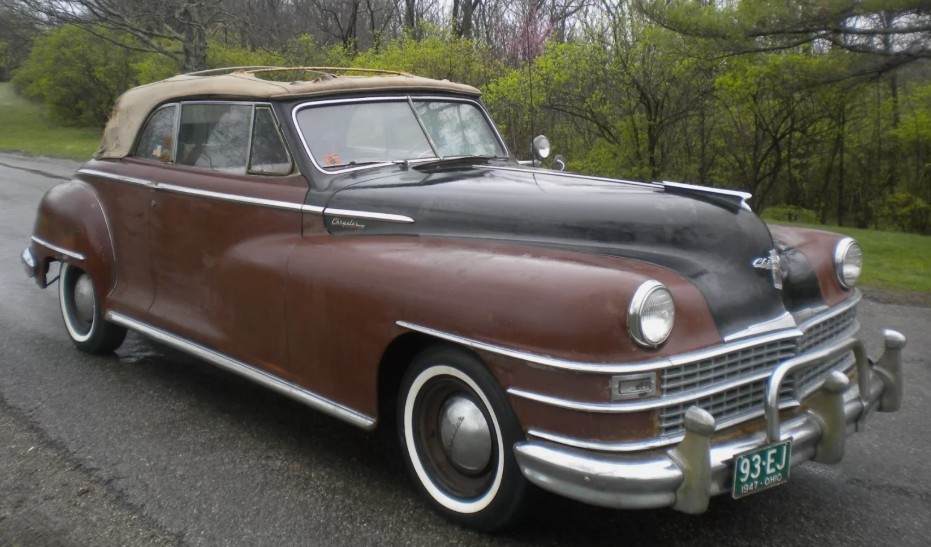
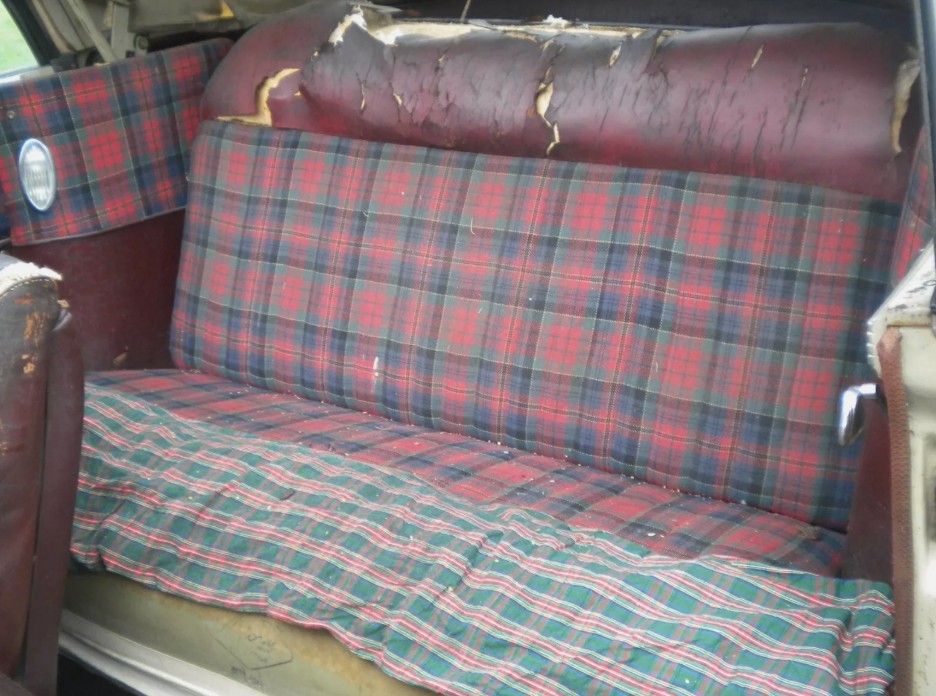
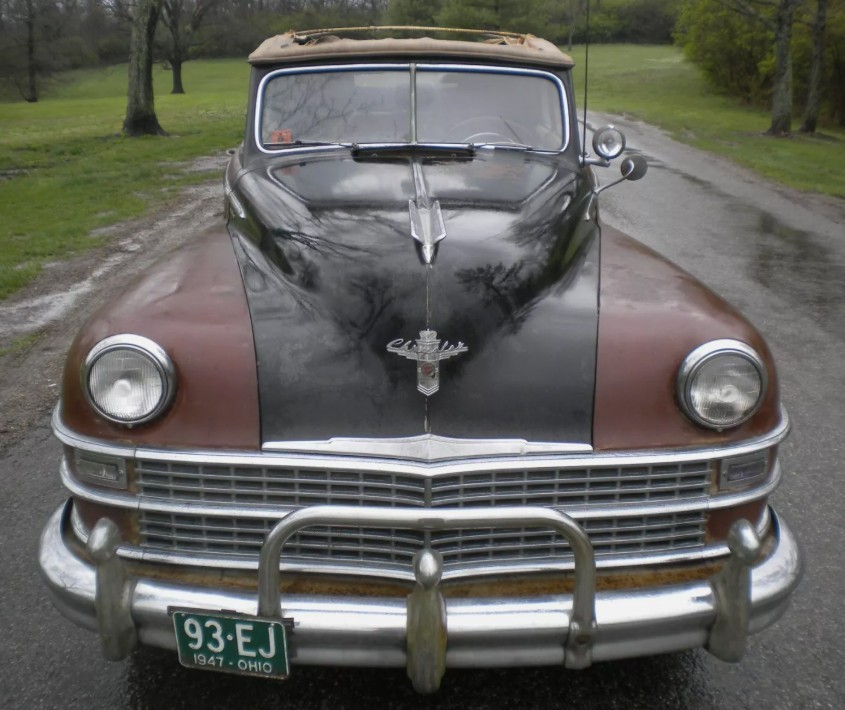
Reading between the lines, this New Yorker Highlander convertible may be a one-family car. The seller notes that it has covered only 66k miles since new, and that it is being sold to settle an estate. It was stored for 35 years in “the family’s dry barn” in Cincinnati, Ohio, where it remains. Listed here on eBay in a no-reserve auction, the car has been bid to $6500. Chrysler introduced the stately New Yorker in 1940 to establish a berth in the growing luxury market. By the time this car was made, it was competing with Packard, Cadillac, and Buick’s Roadmaster series. Postwar New Yorkers through 1948 offered almost no styling differences compared to the last pre-war New Yorker produced in 1941. In fact, even the optional Scottish-plaid interior of the Highlander was a holdover from the pre-war period, first appearing in 1940.
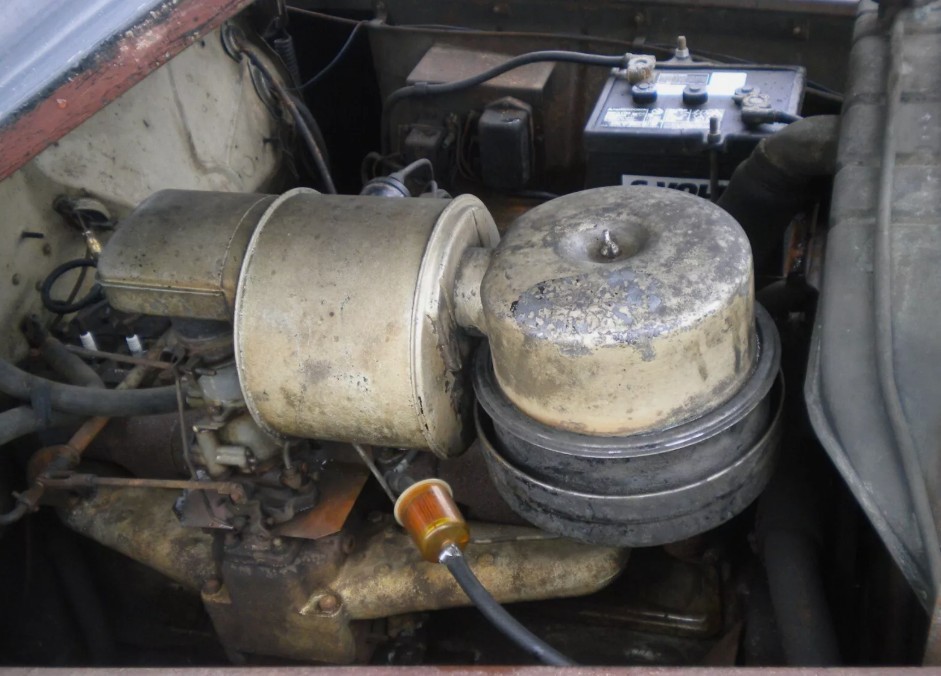
Another holdover from the pre-war period, the car’s 323.5 cu. in. straight-eight engine was first seen in Chrysler’s 1934 Imperial. By 1947, it was rated at 135 hp, a figure that barely budged over its production span. The company’s Fluid Drive coupling, enabling use of a semi-automatic transmission, was more innovative, arriving in 1939. The seller notes that despite its long slumber, the car started after a modest effort, though it will need mechanical servicing before it can be expected to drive any distance.
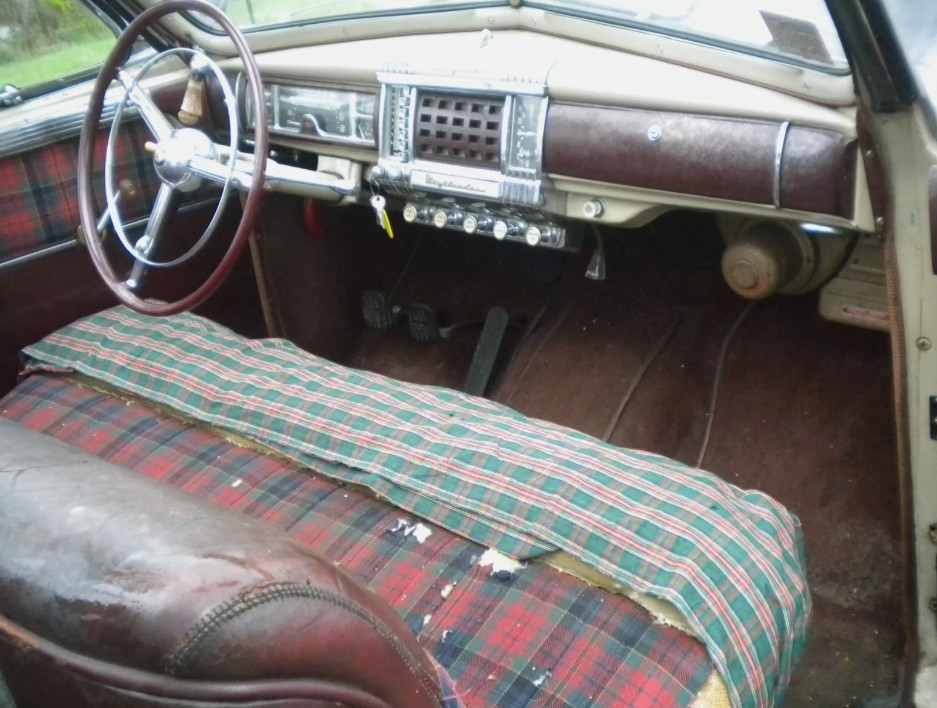
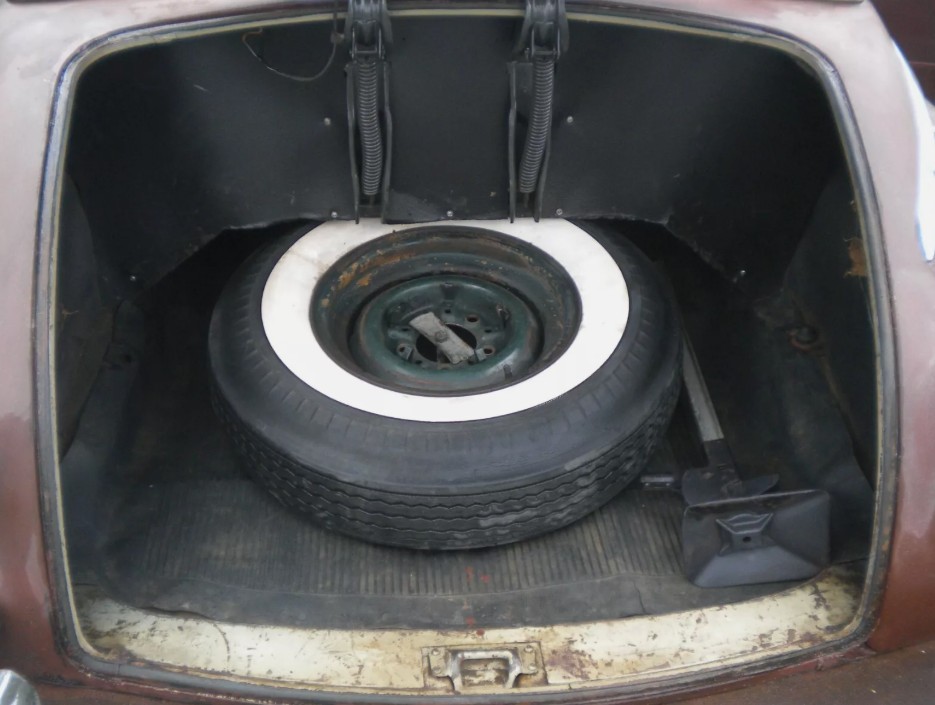
Despite the passage of time, the highlander interior – plaid cloth inserts surrounded by leather – is elegant. The plaid is carried right onto the door panels, which are in good condition along with the Art-Deco dash, steering wheel, sun visors, and top frame. The trunk is clean, and contains what looks like a nearly new spare anchored to its floor. The car will need a new convertible top in addition to upholstery work.
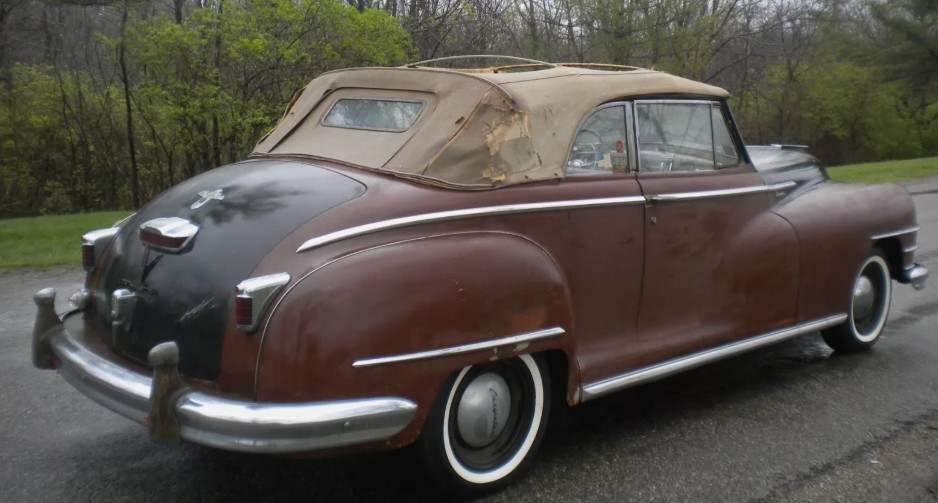
For some reason, the car was put into primer before it was stored. An interrupted restoration, perhaps? We may never know. Rust is said to be minimal. The trim is all present – in fact, the completeness of this car is one of its charms. Speaking of charm, these swanky cars offer big presence once complete, with acres of sheet metal sitting on a 127″ wheelbase. The impressive grille remained a defining feature of the New Yorker well into the early 1950s. Considered in the context of sheer mass, these cars are at bargain prices – even the desirable convertibles have declined in value as collectors eschew cars from the ’40s. Are you tempted to tackle this restoration?



We had a 4 door new yorker when I was in gramer school. We called it the nancy hanks decause it was big as a train! 1947
.
Good parts car for that Town&Country you dream of owning…
Indeed. That’s the money shot, the Town & Country. But this Highlander would be cool, too, maybe in black with that maroon interior.
These are wonderful cars, Chrysler took what it had and made the best possible version of it. If you can work on things, and like doing it, here is a great opportunity to repair the mechanisms like the power top, the power windows if it has them, and all the mechanical parts – one can do it – there are no computers which are “no longer available”.
I like cars of the early/late ’40s but the deal breaker on this one is the tranny. In H.S. I drove a ’50 DeSoto (yep, real chick magnet in ’68) with that semi-auto, aka the original slush box. A car this heavy with an early, primitive fluid drive as no fun, especially if it involves stop and go, or hills.
Outside of top and paint depending on what you can do yourself or find good sources for what you can’t do yourself. This looks like a restoration that should only cost one body part instead of an arm & leg.
Outside of top and paint depending on what you can do yourself or find good sources for what you can’t do yourself. This looks like a restoration that should only cost one body part instead of an arm & leg.
I wonder how many were made? I was under the impression that there could be only one.
Don’t fix the top, leave it down, you’re not gonna drive it in the rain anyhow. Tune-up, belts, hoses, fluids, check the brakes, drive and have fun 6 months out of the year, park it in the garage the other 6!
Love these! So massive!
Can someone explain to me why early convertibles had such small rear windows?
And why could you zipper them down? I feature i have always loved in my non air conditioned convertibles of the 60s & 70s.
My Lincoln and Buick had a plastic rear window and my Oldsmobile & Cadillac had glass rear windows you could zipper open.
SOLD for $7,300.