

This 1993 Cadillac Allante is listed for sale by our kind of seller: honest, to the point, and deadpan about the known issues the car has. The ’93 Allante is potentially one to buy or one to avoid depending on your view of the Northstar engine series. Later cars like this one certainly had a lot more get-up-and-go, but they also had their fair share of reliability concerns as well. Regardless, the seller has priced this car correctly for the issues he knows it has, and the color combination is pretty sweet. It’s in Scotty G’s backyard; maybe he should take a run at it? Check out their Allante here on craigslist for $2,500.
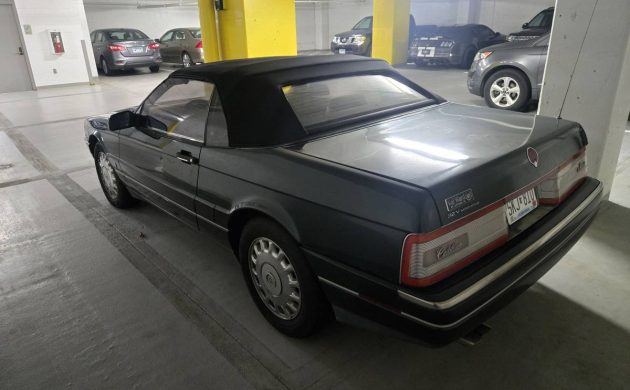
The Allante is a known quantity around these parts, for better or for worse. It was a car with high aspirations, striking designs, and a slightly bananas production process that made it an extremely expensive car to build. The consumer audience it was meant to appeal to more or less showed up, but the early cars with their high price tag and somewhat tepid performance didn’t win over a lot of hearts and minds. The later cars with the Northstar certainly lived up to the image that Cadillac wanted the car to have – a powerful road car with a disappearing roof and prestige coming out of its tailpipe – but by then, it was seemingly too little, too late.
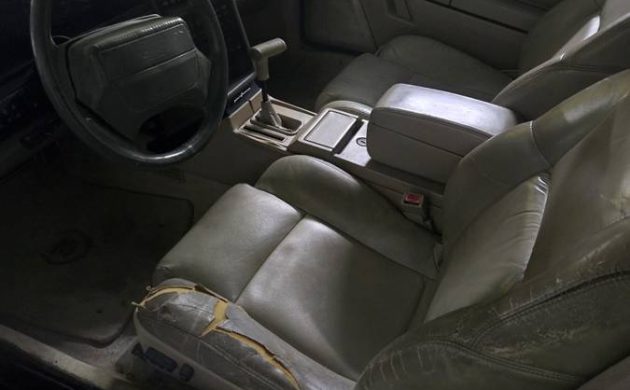
The seller hits on one of my primary complains when selling anything: don’t list my car’s flaws in an effort to knock down the price. The last two items I sold almost sent me to anger management class because I couldn’t stand to be lectured any longer on the numerous things wrong with my vehicles (plot twist: nothing was actually wrong with them.) The seller is up front about this concern and I applaud him for not beating around the bush. Frankly, the car is priced fairly for the issues he discloses, which include dash lights that don’t work at night, a blower motor that needs replacing, and a passenger-side window that falls off the track. As you can see, the driver’s seat leather is also fairly beat up.

Those concerns are all secondary to what could be lurking with the Northstar engine. These motors, while powerful with 290 horsepower and about the same torque rating, are known for having numerous oil leaks and head bolts that typically need replacing if they’ve never been done. Now, I will also admit that the internet can blow car issues out of proportion (everyone tells me a 911 I own should have the coolant lines pinned; it’s never been a problem for me), so I’d just go check it out in person and see if any major leaks are present. The seller contends it doesn’t overheat and it does still run and drive, which is about all you can ask for at the current price. Thanks to Barn Finds reader Jack M. for the tip.


Rode hard and put up wet! This will be a money trap wit no upside.
I’d never buy a car with the Deathstar. But if you’re willing to take on the head stud project, they can be reliable after that. With this car, that seems to be like it would be the tip of the iceberg however. I would want to start out with a cleaner example because it wouldn’t cost much more.
The early Northstars equipped in these final-year ’93 Allantes were produced before the infamous major problems with head bolts and such cropped up in later-production revisions to that engine.
The problem was the head bolts were threaded too finely, and lost integrity with heat cycling and stress. The “stretching” of the head bolts would cause them to strip the metal off the block as the threads pulled away. It is my understanding this afflicted all Northstars before 2005. It wasn’t like they had a proper head bolt design and then changed it, at least to my knowledge anyway.
The earliest engines also had a block integrity problem because the aluminum they used did not bond properly with the alloy that they also used.
For some reason, GM didn’t take as much criticism for the design flaws on this engine, as they did for some other product failures such as as the Chevy Vega, X-cars, Olds diesel (which ironically also had bolt failure problems), and HT4100.
This Cadillac Forums reader poll is interesting:
https://www.cadillacforums.com/threads/northstar-headgasket-cracked-block-bolt-failure-please-let-us-know.122898/
Note the vote/% figures there reflect how many of the poll respondents reported a failure for each model year, not how many cars that year were affected. Seems like the major problems started cropping up in ’97, started subsiding significantly from 2000-02, and back to nominal from about 2003-on.
Thread pitch is interesting as, all other factors aside, a finer pitch can support a higher bolt torque and clamping force than coarser threads.
It’s not if the Northstar will fail, it’s when.
Correct. Sadly. I very nearly bought a mint low mileage ’04 Bonneville GXP a couple of years ago. But after doing my homework, I decided no way. The head bolt conversion would fix the issue – at least that one. But it’s very expensive. In the $3,000 range by my research. The supercharged L67 3800 maybe a bit slower, but it’s a far cheaper proposition.
I owned a ’93. It was an outstanding car with crazy FWD torque.
And like a boat, 2 days stood out as the best days of ownership.
Sadly, these cars were non-stop problematic, and so many did NOT want to work on them.
It runs that’s amazing, I say put the top down put all the windows down and just cruise it until it dies regardless of the weather, be kinda funny to be going down the road with the top down in the snow.
@Troy
When I was 17 I lived New Jersey. Snow and cold winters. My first car was a 1962 Lincoln Continental 4 door convertible and when I’d drive it to school, the top would be down, the windows would be down, the heater on full blast and I’d wear a long scarf that would flutter in the wind behind me.
It was fun.
Didn’t do much for the convertible top but what does a 17 year old know?
Yeah Troy, I bought a ’29 Pontiac 4 Dr,, June 4. 1960 with rotten wood. I was 14 and thought I’d just knocked over Ft. Knox. What did a 14 year old know? Not much.
electrical nightmare run away as fast as you can
The assembly process was completely rational.
GM simply did not have a factory that could build a car at the low projected production numbers or at the high quality levels required at the Allanté’s price point. It was either Pinninfarina’s Turin factory or the staggering cost of a new one for a new model in a new segment
In the early eighties, the dollar soared to unprecedented heights, making European assembly really cheap. Chrysler with its TC and Ford with the Merkur project both sought the same advantage. The high dollar also handicapped VW’s Pennsylvania plant, leading to its closure.
When the dollar then collapsed in the mid 80s, the cost advantage disappeared, a factor in the cancellation of the Allanté, the TC, and Merkur.
As a minor note, every year has a “disappearing” convertible top. It was improved in late 1990 to fold a little deeper. ‘91 and ‘92 got a new design, and further improvements were made for 93. A power top would’ve been added in 1994, had production not been axed by GM
For the price point a power convertible top should have been standard from the get go.
I heard it was half power half manual which in my opinion is even dumber than a fully manual.
Admit it, Cadillac f’d up on the Allanté
Many would agree.
The 380sl that it was designed to compete with did not have one nor did the 560sl. When the 500SL came out with the power roof, Allanté sales took a big hit
As the dollar collapsed in the mid 80s, the cost of building the car increased, and features that would increase cost for probably not looked at very carefully
A bigger problem with the top than being manual was that it was very difficult to operate and the first year, they leaked very badly. Pininfarina definitely under achieved with the roof.
It wasn’t a perfect car, but I don’t think the lack of a power TOP killed it. It’s always more complicated than that.
GM designers were pissed when it went to Turin.
Halo cars don’t last long. I bought a 2002 TBird replacement and am much happier after 12 years.
I’ve had both a 2005 Thunderbird and a 1987 Allantè.
Loved both of them superb highway cars incredibly comfortable and more practical than more exotic competition.
The decision to build in Italy was a symptom of bad times at GM and conflict between GM
and Cadillac management
Management was really angry about the ridiculous development time for the downsized Deville. There was not really a decision between Cadillac and Pininfarina.
Cadillac was basically informed that they were going to cooperate with the Italians in development of their design. The same thing would happen with the Catera.
Cadillac proposed an alternative, but it was never seriously considered.
Management was convinced that in this era of “designer everything“ that they needed a European designer and the brand names like Recaro, Bosch, and Poltrona Frau for its very affluent buyers.
Whatever happened to the GM that produced the ’66 Toronado, a, radical rewrite the book car, with tour de force engineering with blinding beautiful styling and virtually zero glitches?
Those people have been dead for 50 years.
That kind of panash and loyalty probably died with them.