
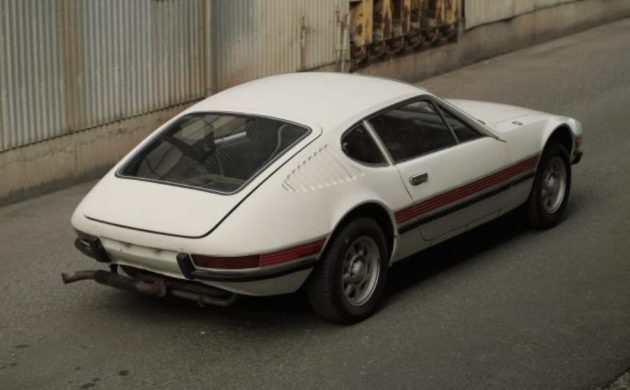
The VW SP2 (sports car) is rarely seen in the U.S. Volkswagen produced it in Brazil in the mid-1970s and did not officially export it to the 50 American States. It used a widened Karmann Ghia chassis (Type 14) and was dubbed Type 149 within VW circles. A German magazine went as far as to call it “the most beautiful Volkswagen in the world”. The seller has a pair of these rarities from 1974, one that runs and one that does not. From Mercer Island, Washington, this duo is available here on The Samba for $14,000, but he/she will sell them separately. This interesting tip comes to us via Barn Finder “Yargbull”.
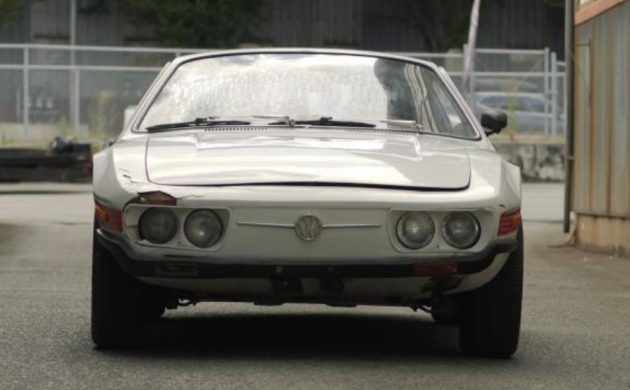
Production of the SP2 ran from mid-1972 until the end of 1975. The SP designation was derived from where it was built, São Paulo. VW wanted to bring it to the U.S., but the front end was too low to pass muster with the DOT. Production stopped after 10,205 cars were assembled, and 93% of them stayed in South America. There was also an SP1, a version of the same vehicle but void of much of the SP2’s bling, and only 88 of them were requested. With a 1.7-liter engine, the SP2 would top out at about 100 mph.
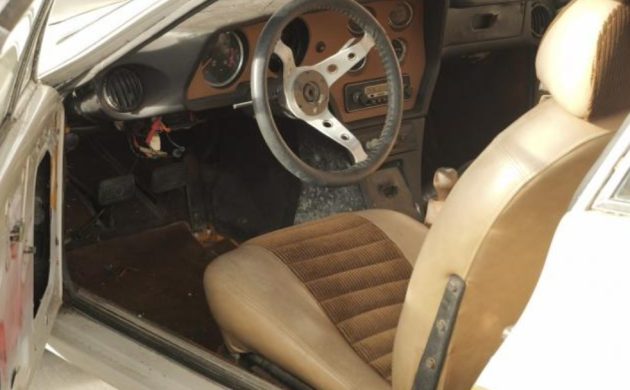
No history is provided on this pair of SP2s and how they came to find themselves in Washington State. Both have bonded WA titles, which suggests that some amount of effort was involved in getting them imported at some point. The one with the “red stripe” (seller’s lingo) is the only one that runs. While it was stored for 27 years, we’re told it drives but needs TLC. The interior is good, but the right-side front corner received a bit of a whack. You can have it for $10,500.
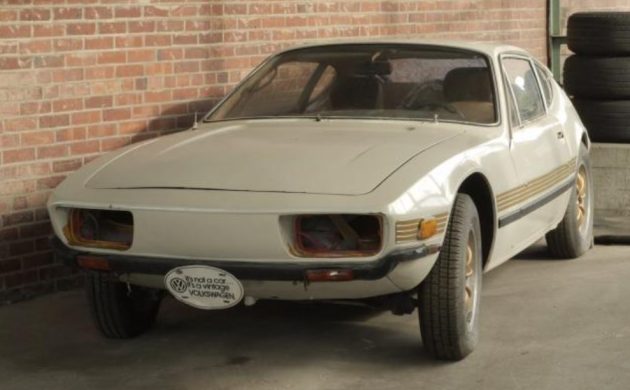
On the other hand, the SP2 with the “yellow stripe” and fewer photos does not run but is mechanically complete. The body is okay, sans some surface rust and no headlights. It will need more work and has been priced at $5,000 because of that. If you opt to buy both, the seller will knock off $1,500 ($14,000 instead of $15,500). We don’t know why the seller checked the “poor” box to describe the condition of the duo.




One of my favorite things about Barnfinds is learning about cars I’ve never heard of. These are certainly that. Unfortunately the ad is deleted and most likely already sold. Neat cars. Does anyone know, were those air cooled, or water?
Both were air cooled VW Type 3 engines. The SP1 used the 1.6 liter, the SP2 had the 1.7 liter.
I imagine it was air cooled since 1979 was first year they had water cooled engines. Looks like a Pinto but I like it
That’s news to me. I thought the Dasher which hit the market in 1974 was their first commercially available water-cooled car.
And Vanagons were air cooled until the middle of the 1983 model year.
Reckon Daniel is referring to VW do Brasil, which had to continue making do with air-cooled VW boxer engines long after water-cooling came to the rest of the VW world.
VW’s first water-cooled car was the K-70, designed by NSU and made from 1970-1975
Although the Audi 80 preceded it, the Dasher/Passat came out in 1973
I believe VW’s last air-cooled vehicle was the Brazilian Kombi van, which shifted to water cooling in 1995
Well, both the Pinto and SP2 feature tires and windows……
There used to be one of these out East that used to show up at the Carlisle (Pa.) Import & Kitcar Show and the Manassas (Va.) VW Bug-Out. Always attracted a curious crowd.
It boggles the mind how many of these could have been sold in the U.S. if not for our archaic headlight laws (even in 1974). Some minor revisions to the front end would do the trick with today’s lighting technology. Interesting that it was built in Brazil which could have been a detriment to its perception in this country. Along with Embraer jets and various other industries Brazilians are much more than our jingoistic view of them as partiers and soccer players.
I agree. I would have been all over this in 1974. The price on these two seemed very reasonable, especially considering what old Type 2’s are going for.
Headlight issues were only one of many issues the car would have faced if they ever seriously considered “federalizing” this car.
The biggest issues would have been canibalization of sales from late Karmann Ghias and early Sciroccos. I’m thinking second would have been quality control. Then myriad safety features, emission constrols, HVAC,
It was not just about the headlight height.
SOLD, SOLD
I have never seen a more amazing version of a VW. To bad they weren’t sold in North America, I’m sure they wold have been an incredible hit!!
No a/c and the awesome power of the Karmann Ghia…..which was approaching the end of its product cycle after about 15 years of production.
Beautiful cars!
I requested pics and the close-ups give you a better idea of the amount of work it will entail. No fiberglass repair in my area made it an easy decision. Ask is almost half of what an excellent condition SP2 is going for without the work.
No fiberglass. These were all steel, real cars. I’ve lived here for 30 years and would love one of these (Had a Brazilian Type 3 here for years) but the best SP2s go OS, often to Germany. The US dollar or Euro to the dollar exchange rate right now means that sadly they will continue leaving Brazil. I nearly bought a Karmann Ghia TC for peanuts. Another regret.
I mean US$ and Euro to the Brazilian Real
Fiberglass around the headlights, where the damage is on the white car. It’s an unmistakeable zig zag “strike slip” fault line with the steel frame showing beneath it. A shame, because the rest of the car looks good.
When I spent 6 weeks working on a ’69 Camaro build in Longmont Colorado, the shop owner had a really nice one of these. Significantly lower to the ground than you realize!
Another “what could have been” from VW along with the 914 that was intended to be a joint VW/Porsche car. VW could have had a great sports car to complement its basic transportation models, but never seemed to pull it off successfully.
This car was never intended for export, probably because of the significant limitations of the Beetle-derrived motor and quality issues. It would have canibalized sales from other VW models, and with Brazil’s trade policies at the time, it would probably have had issues on that front as well.
It did not sell well in the home market because of its high price and low power (SP=Sem Potencia -No power). Even though it is beautiful and a fun car, it’s an artfully rebodied Karmann Ghia for a home market that had no imported sports cars available.
It’s a bit of history, but could never have been a contender in a world with Datsun 240Zs on the loose
The best looking Volkswagens ever designed. If I weren’t a continent away? As usual….
Could this car have been inspiration for the 924/944 series Porsche?
There are people who think so.
For those who are curious about other exclusively Brazilian VWs, google “Karmann Ghia TC”. Brazil designed these after global production of the normal Karmann Ghia ceased. They are lovely cars.
I have a 1973 SP2
It is a really fun car to drive. The low center of gravity and light front make it quite nimble, but it is not fast. “SP” officially stands for “Sao Paulo” or “Sports Prototype,” but in Brazil, it was jokingly referred to as “sem potencia,” meaning, “no power.” It is a very beautiful design, for sure, and gets lots of attention.
The usual suspects will blame US headlight standards alone for the car not being exported to the USA. VW North America was winding down its antediluvian air-cooled fleet, and it would have competed with the first generation Scirocco, a truly modern much higher quality German car. The SP2 would have required a lot of re-engineering to make it a viable product in the US market, and not just bumpers. These cars do not have modern safety glass. 1970’s consumers wanted good a/c, and the EPA wanted clean exhaust, neither of which is easy with air-cooling. VW do Brasil might have briefly talked about North American exports, but they did not export the car anywhere. The 10,000 units made all stayed in Brazil
And don’t forget that Brazil’s automobile market was essentially closed to all imports by the government at the time. That is the reason that VW created a new sports car in the first place. To this day, imported cars are subject to very high tariffs.
It is rumored that the car’s shape inspired the Porsche 924.
The Brazilian designer who penned the body, along with the phenomenally successful Brasilia, Marcio Piancastelli, spent a couple of years at Ghia in Italy, and it seems that he was a good student.
The distinctive healights, shared with the Brasilia and VW 412, were designed by American designer Brook Stevens.
It is not surprising to see rust repair. Brazilian steel of the times has issues, and quality issues are another one of the reasons that importation to the US and Europe didn’t happen.
Air-cooled VWs continued in Brazil long after they were phased out in North America and Europe. Beetle production ended in 1986, but was restarted from 1993-1996. The Brasilia ended production in 1982. Its successor, the Gol, which looks like a VW Polo but is a unique car based on an Audi A2 platform, was powered initially by a variation of the Beetle air-cooled flat four, but mounted up front in this front-engine front wheel drive car.
Water cooling was added in 1981, and air-cooling was phased out in 1985. Some of these later cars were exported to North America as the VW Fox.
Wow! I did not know these existed. Truly the best looking VW ever.