
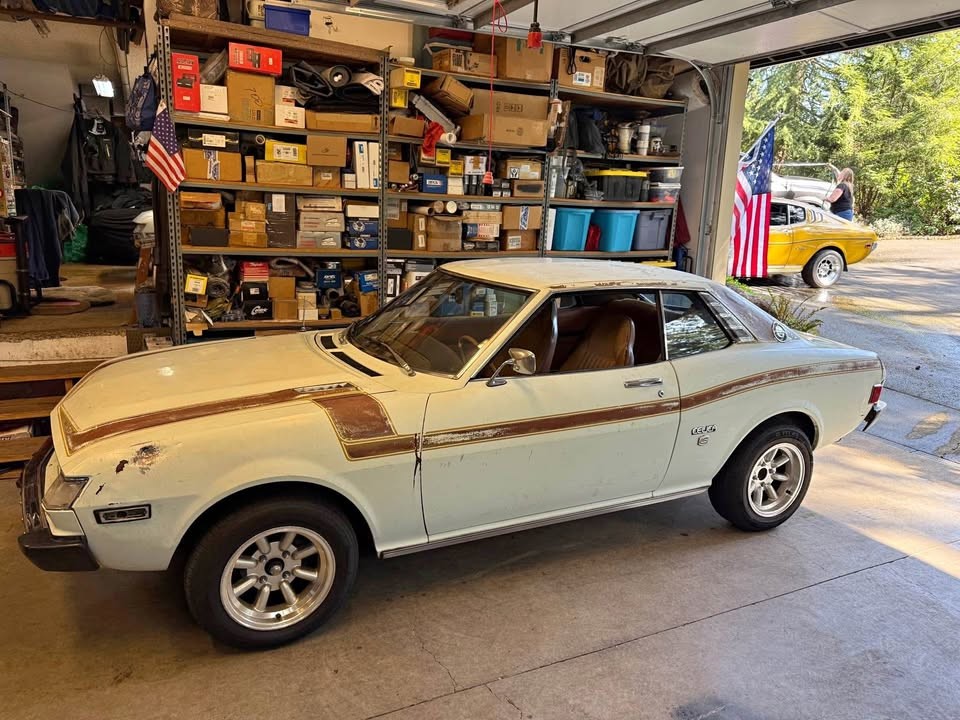
What to make of Toyota’s Celica? It seems that it was Toyota’s pitch to get into the pony car segment. It was similar in concept to the Camaro and Mustang but with a typical Japenese twist – using four-cylinder engines that provided enjoyable power but focused on fuel economy. Today’s discovery, courtesy of T.J., is a 1975 coupe, a member of the first generation offered between ’71 and ’76. Located in Portland, Oregon, this claimed to be an early production example is available here on Facebook Marketplace for $7,000.
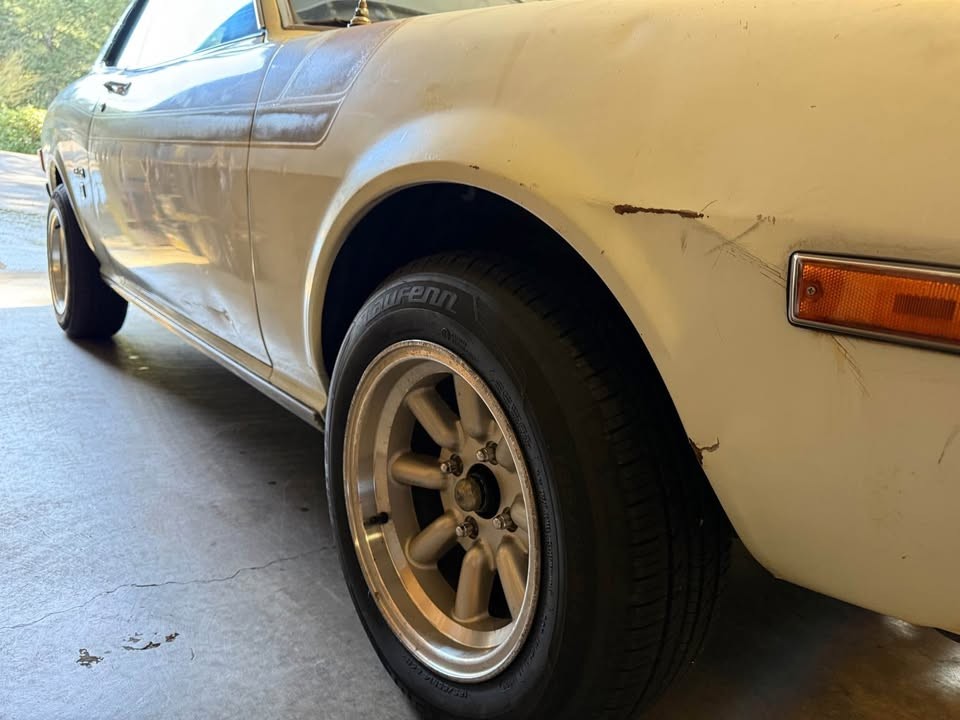
Our subject car is a model RA22, which is a two-door coupe; a liftback version was available as well. Trim levels included the ST (our subject car), GT, and new for ’75, and LT. The seller tells us that this example sat in dry storage from 1987 until recently, when it was “brought back to life“. It shows pretty well with no indication of rust, but there are some scrapes, dings, and contusions – and a lot of fade to the sport stripes. Still, the white finish is reasonable, and the Minilite-like wheels are an uplifting addition.

The listing is very light on detail, so I’ll try to fill in the blanks. The engine appears to be a 2.0-liter, in-line four-cylinder powerplant, known as an 18R, and generating approximately 87 HP (the figure varies depending upon the destination export country). The seller claims a rebuild (doesn’t look like a recent one) but offers no specifics as to what, when, or how many miles. The listing states, “Runs and drives, starts and stops no issues,” and that’s about it. To my surprise, this Celica is equipped with an automatic transmission that likely saps some of the fun factor from the driving experience.
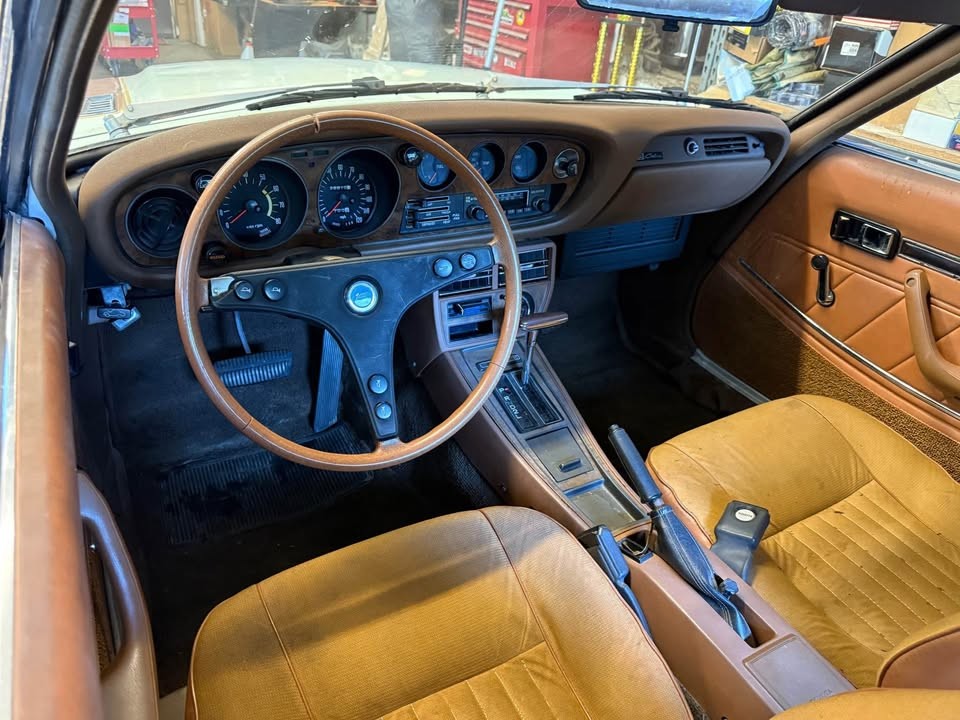
Inside is a typical seventies’ Japanese car environment – lots of plastic but solid workmanship – and in this case, it has all held up well. The seating upholstery, door panels, and dash pad are not indicative of heavy wear, water intrusion, or sun damage – its long slumber must have been in a dry, protected environment. The steering wheel has a crack at twelve O’Clock, but that’s not unusual. If you will notice the instrument panel, it’s of a slightly concave design, intended to create a driver-centric feel and remain separate from the passenger portion.

Toyota’s Celica lasted through seven generations, finally singing its swan song in 2006. I’ve owned two, a 1983 GT liftback and an ’87 GT coupe. The ’83 was a rear-wheel drive version, and I enjoyed it immensely for ten years. The FWD ’87, not so much so. The driving characteristics were squirrely, the 2.0-liter engine was woefully underpowered, and the throw-out bearing and second gear synchronizer started to fail long before 50K miles of use – I wasn’t sorry to see it go after four years of ownership. I’ve often wondered if Toyota would seriously consider returning the Celica to market just as they have with the Supra. I hear speculation (threats?) from time to time, but I wonder how a new version would manifest itself. I prefer the simplicity and ruggedness of these older RWD versions. Nope, these weren’t powerhouses, they were never intended to be, but they occupied this sporty (pony car?) marketing slot with solid numbers, producing approximately 4M over its lifespan. So tell me, have any of you ever owned a Celica, and if so, what generation?




Love the paint scheme.
I think the stripe makes a pretty car ugly. TEOO-
Sale pending 4/8/2025.
Steve R
The liftback version of this generation of Celica did a good job of looking like a pony car. And like all Toyotas of the time, they would dissolve before the drive train gave out. Between these being such good little cars and America building such garbage as the Pinto and Vega, is it any wonder the Japanese captured the small-car market?
Pinto garbage? I think not. I bought a used 74 Pinto wagon that had at least 107,000 if not 207,000 miles on it when i purchased it in 1981. It soldiered along through my final 2 years of high school, 4 years of college and several years after that until i was able to purchase a newer primary daily driver. I still own it today and it’s been hooked to a wrecker once in the 44 years that ive owned. I found it to be extremely reliable, pretty good handler with rack and pinion steering and routinely logged about 23-24 miles per gallon. With its 2.0 german capri engine and a whopping 86 hp it was not overly powerful but it did everything i ever asked it to do & i was rough and abusive as a teen driver. It’s quite tiresome to continually hear negative comments about 1970’s american built autos, especially the ford pinto. My experience has been totally the opposite. Also as a sidenote, if you’re response mentions anything about explosions and fire hazards, i suggest you do proper research first. Thats another myth that has been debunked over time. Ford pinto fatality rate was consistent with all other subcontacts of that vintage.
I agree. I had a neighbour when I was a boy who had a Ford Pinto. I cannot remember now whether hers was a two door Runabout or a four door wagon model. But I remember her enjoying the car and caring for the car.
And I also agree. From personal experience.
If it is a true 75 model it should be a 20R motor that is a 2.2 liter. The United States model for 1975 was kind of a transition model with a bump in the hood to accomodate the 20R motor. Several other parts were different from the 1974 or 1976 model years. There are a few people out there that look for the 1975 models. Some might even pay a few extra $$$ to get one.
Correct on it having a 20R, This is my vehicle shown here and we have a huge hobby of rescuing Celica’s and getting them back on the road here in Oregon. This is one of Many we have here today. 2 more will be going up for sale soon. Another 1975 and a 1972. The 1975 is a one year only chassis due to the introduction of the 20R in the early version platform. They increased the engine bay size to accommodate the larger motor by putting a bulge on the hood and extending the front end at the radiator core support areas.
So, what is the story with the yellow liftback in the background of the photo?
Many years ago traveling cross country in a 83 Celica I had the cruise set at seventy At around 3am I fell asleep I awoke to the car bouncing all over and I just grabbed the wheel and snapped it hard right I knew if I hit a drainage ditch that car would explode like a water balloon My heart was pounding so hard it gave me a headache
When I met my wife, she had an 82 with a stick. I was a classic car guy but I had to admit, that was a good car. Fairly fun to drive and seemed to get better gas mileage the further the needle went to “E”. It was also really easy to work on.
First gen Celicas went through 1977 model year, with manufacturing for the 1978 model year beginning in late 1977. I had a first gen ’77 GT Liftback (manufacture and model year) in pure yellow with (obvs!) black louvers and a black front end bra. I thought I was SO cool. Bought it in 1983 with 70k miles from the next door neighbor for $3,000, drove it between Los Angeles and Baltimore eight times for college and finally sold it in 1990 with 168K miles for $500 to an auto dealer who wanted his kid to have it for beach trips. It’s likely an artificial reef off of Ocean City, Maryland right now.
I see that it already says pending, the Latino crowd loves these old Toyotas.
I love this car and I’m English and German. Hmmmmm…
Had a 74 which was the last year of the skinny chrome bumpers which are 100x better looking than those 5mph eyesores so other than the 20r instead of 18rc motor the 75 imo is not as desirable.
I’ve always loved the Celica S or GT but the 77 GT is the ticket for me but a clean 75 is rare. Good luck to the buyer and seller.
Automatic should not be aload in this car
I had a couple of 1st gen Celicas – an ST and a GT, with the 18R engines and standard transmissions. I also worked on many others for customers. They were good little cars and felt sporty to drive, Toyota would do well to try to reproduce something like that, perhaps with their hybrid powerplant.
Subaru badges their BRZ for Toyota to retail as the GR86. It’s maybe more 240/Z but it’s as close as you can get today.
I concur with John. I had a 1974 and it had th 18RC 2 liter. My sister had the 1975 with a 20R 2,2 liter. The 20R is a more durable engine as the 18RC was prone to timing chain and valve burning issues however, with only a few tweaks like recurving the distributor, drilling the main primary jet and cutting a coil off the vacuum actuated secondary for the carb, my 74 was quicker than my sister’s with the larger engine. Both were comfortable and excellent cars for their time with really great styling.
It seems like all of the survivor first gen Celicas are automatics.
I wonder if they sold a ton more autos or if the manuals were all enjoyed to death.
The automatics were also fun to drive and they were heavy duty and durable in a small and lightweight car. My Celica was well taken care of in those days but driven hard and fast. That automatic held up very well.
Nice looking car. Although I was way too young at the time to drive a car I remember when the Toyota Celica looked like this. My cousin had a Celica GT.
Has a yellow Liftback in the background of the photo.
My very first new car was a ’77 GT coupe. red with a black interior. Unfortunately, it had a head on collision with an Audi Fox.
In 78 I bought a 71 ST for $1000 from my grandfather, who had bought it from his neighbor a Chevy dealer body shop foreman [Pawpaw bought two from him, the 71ST 4speed and a 76 Corolla automatic] I drove that car thru high school and beyond until I let a friend drive it late one night to meet up with a girl and he crashed it.
I had a 1981 Celica ST, a 1983 Celica GT, a 1986 Celica ST, and a 1987 Celica GT! I miss all of them a lot! 🙂
Parents bought one of these used, maybe a 1975?? It had wide 60’s on the rear and would shoot six foot high roosts out the back in the snow .It was given to my brother and he drove it until the front strut towers went into the hood. Years later I bought one that was very solid but had the engine disassembled in the car and I was not going to start at this point. So I thought about a transplant which involved a Chevrolet 400. I installed it with the HEI jammed against the firewall and the water pump extending past where the rad would sit. It was also very apparent that an upgrade from the tiny front springs would be required. My conclusion was that this would be a very bad idea and decided to shoot for longevity in my life moving forward.