
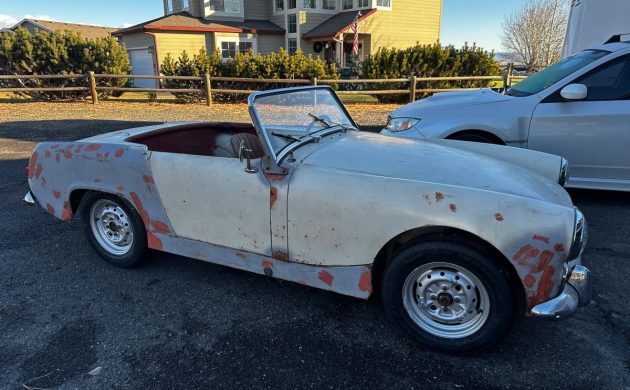
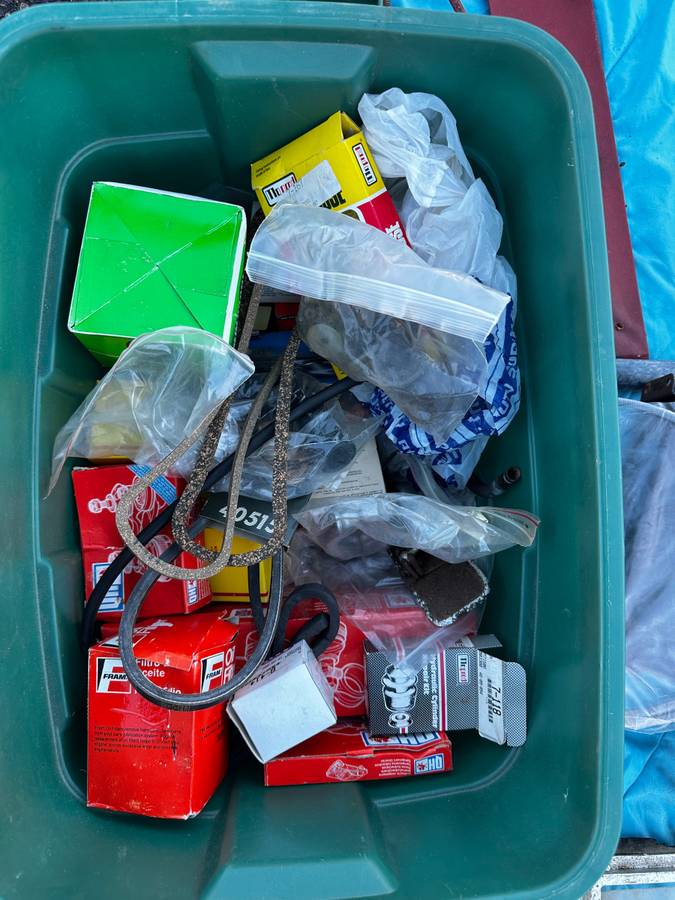
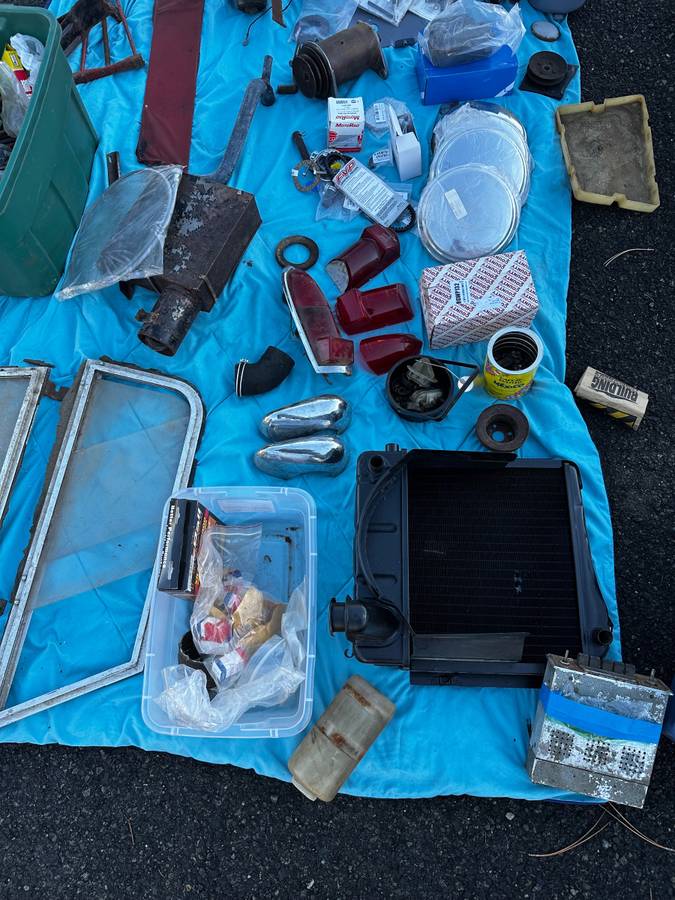
Please buy this Sprite before I head up to Ellensburg, Washington to haul it home myself! This Mk II project car is advertised here on craigslist for $2500, including a veritable plethora of parts, many of them new. We’re promised no rot, and it looks like someone has gone ’round with red body putty to identify spot repairs. These cars are as simple as stones mechanically; a winter’s worth of work could bring this one to driving condition, with a few cosmetic improvements thrown in. Curvette, thanks as always for the tip – I wish this one wasn’t so irresistible!
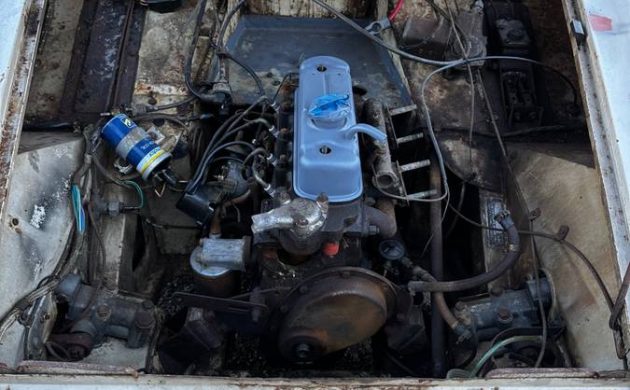
Yup, there’s a motor in here – the carbs are in the parts pile along with other ancillaries. I can’t tell if that’s blue paint or primer on the valve cover, but it and the engine should be painted olive green. Early 1962 Sprites were fitted with a 948 cc A-series four-cylinder from the factory, breathing through two 1 1/4″ SU carburetors. Mind you, that was an upgrade over the Bugeye’s 1 1/8″ set – and good for maybe another hp or two. That said, in October-ish of ’62, the Sprite was fitted with a 1098 cc engine wearing the same carbs – resulting in a whopping 58 hp. This early 1098 would have the “small” crank, with 1.75″ journals – vs the two-inchers on the later 1098. Anyway, enough scouting around in the weeds…. the gearbox is a four-speed manual, with synchros on the top three gears. These cars are quick, not fast, though performance can easily be upgraded.
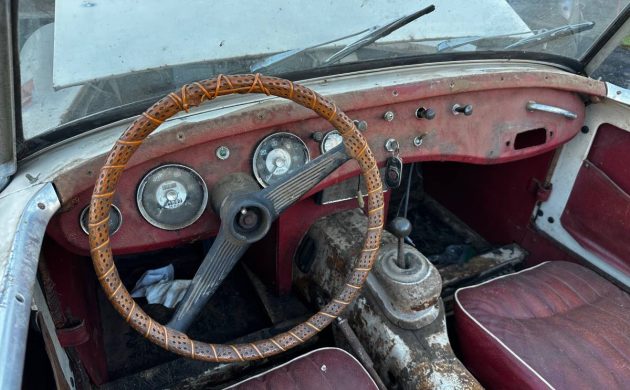
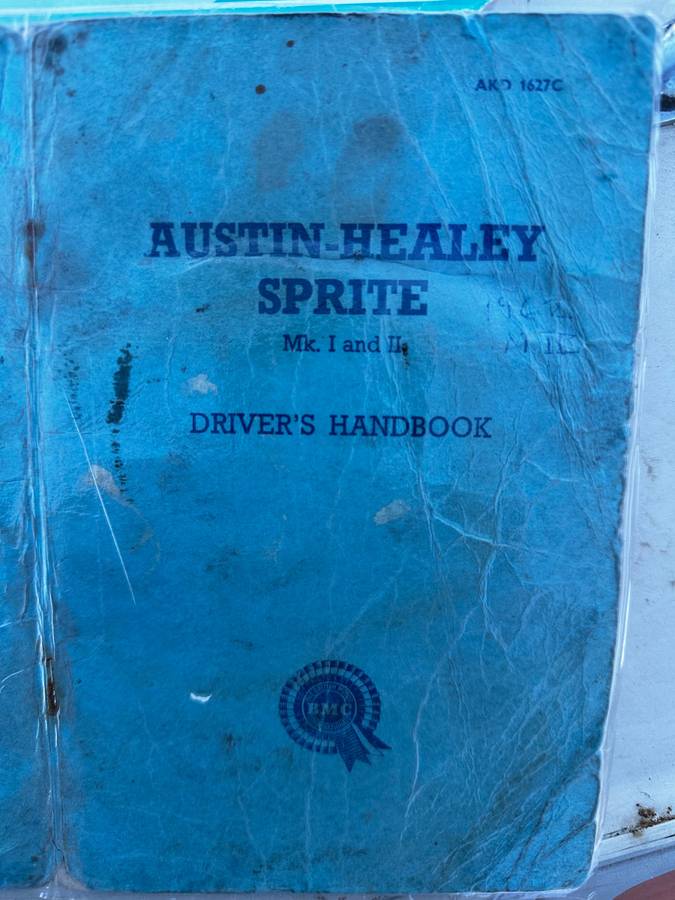
The interior is a reminder that this car isn’t too far afield of its older sibling, the Bugeye: the gauges, steering wheel, horn button (this one is missing), rubber mats (ditto), side curtains, interior-only door release, dash, gearshift cover, cockpit trim – all these items are stylistically nearly identical (or actually identical, like in the case of the steering wheel) to the Bugeye’s comparable components. The ignition key is in the switch here. The car comes with a shop manual and an owner’s handbook.
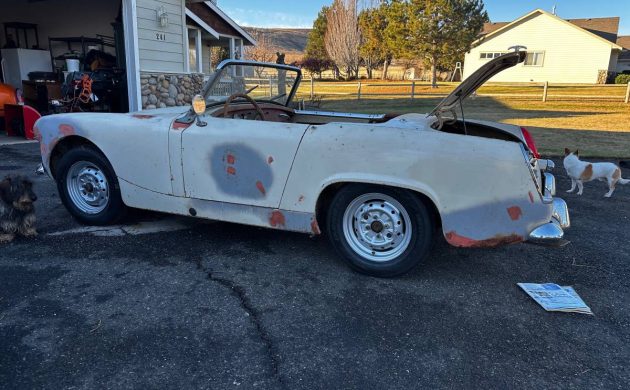
Where the Bugeye had round wheel arches at all four corners, British Motor Corporation gave the Sprite a real trunk lid, necessitating squared-off arches to stiffen the body. Later, when the Austin-Healey Sprite was discontinued in favor of its cousin, the MG Midget, British Leyland (the successor to BMC) rounded the arches again in 1972. US crash test requirements mandated a reversion to square arches in 1975. Round-arch cars are mildly more collectible than square-arch cars, but I’m a fan of early cars, no matter the body style. Would it be smart for me to buy this car? Not really; this running, driving ’62 sold recently for only $3900 a couple of months ago, and a better example sold for $12,250 in the Spring. On the other hand, there’s being smart, and then there’s passion for the project…



You need this car Michelle. One correction on the 1098 engine.. It was introduced in late ’63 and debuted in the ’64 model. The only rust I see on this car is the lower left rear fender behind the wheel, a closed in box that isn’t waterproof but is available from Moss Motors and easy to install. The cars are fun to drive. My first new car was a ’62 Midget and the only thing getting used to was being able to read the printing on 18 wheeler hubs.
Ditto- my first car was a 62 Midget, but it was a year old when I bought it. Had mass amounts of teenage fun on the road from Tacoma to Mt. Rainier and enough incidents to teach me welding and rudimentary bodywork. Eventually swapped it for a ’53 XK 120 FHC that was plaguing the owner in repairs and gasoline. I am always compelled to read the ad for a Midget whenever one comes along. Mine was also white with red interior, but after one of my incidents, I painted it the required British racing green.
My third car was a Midget 67 mark 3 and Bob is spot on, your not too far from the ground. All of them are fun and easy to wrench on. Rust can be an issue, but this one looks fairly clean and so many mechanicals are interchangeable. Later motor, transmission etc. Bob correct me if I am wrong but these were fitted with full length rear leaf springs. Early models had a different rear suspension with half a leaf bolted in the subframe.
My first car ever (1968 era) was a 61 Sprite. My brother and I bought it for $100. It needed a throw-out bearing. We pulled the engine replaced the bearing and sold it for $200! That was a big deal then! I did not even have my drivers license. Since then Spridgets have been one of my favorites. I always preferred the Sprites to the Midgets because of less trim and usually steel wheels instead of wires. This one looks like a good project however (for me) it is maybe a little high for $2500. 30 years ago 1275 motors were plentiful and that would be the first thing I would change for better performance. Today they are harder to find and much more money if you do. My covid car project was a 78 Midget remodified to look like an early Sprite. I do not like the rubber bumpered cars so I put it back together as an early Sprite look. It is 95% complete and all I need to do is ‘sort’ it. It will go up for sale as there are other projects in the wings. Here is a pic of the ‘older look of a 78 Midget to an early Sprite.
Correct. The early cars came with the quarter eliptic rear springs and the longer rear springs came with the 1275 cc engines.
Early 1/4 elliptics were a Bugeye carryover….
glad folks put up better examples
(just wishin 1 wuz not from ‘the other channel’)