
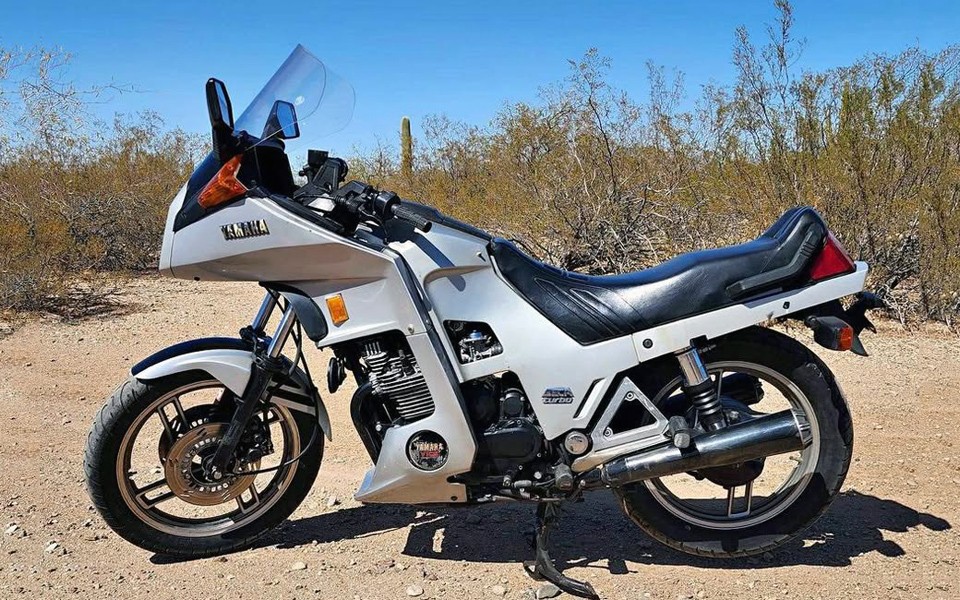
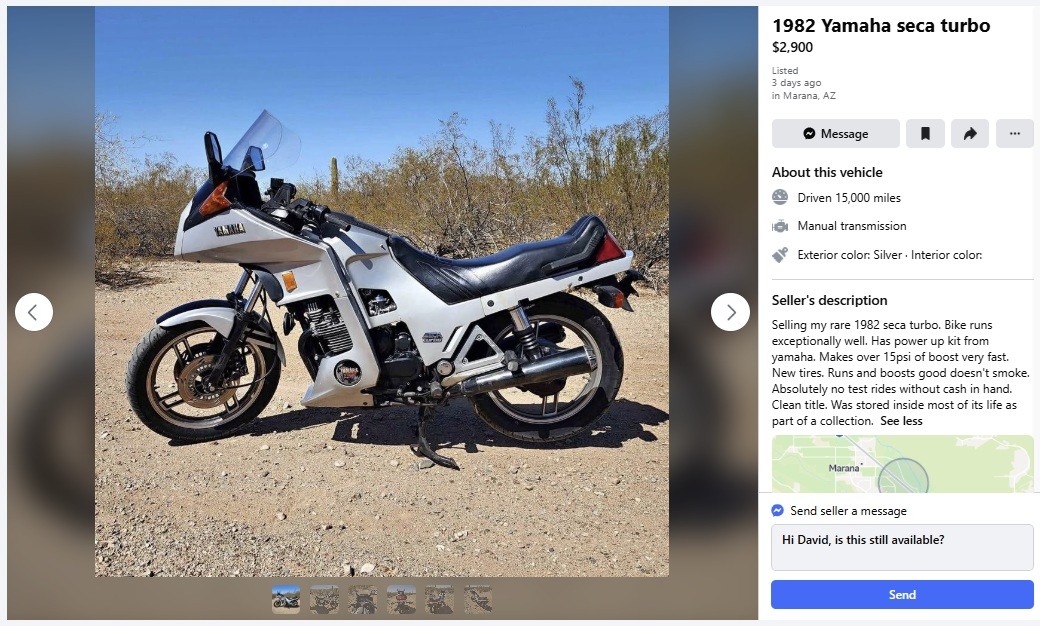
Power-Up Kit? That sounds like something David Hasselhoff would have said to his car (K.I.T.T.) on Knight Rider just before jumping over a couple of bad guys with perfect hair. It was actually a factory kit to boost the power of the 1982 Yamaha XJ650 Seca Turbo. This rare bike is listed here on Facebook Marketplace in Marana, Arizona and the seller is asking $2,900. Here is the original listing, and thanks to Jack M. for the turbo tip!
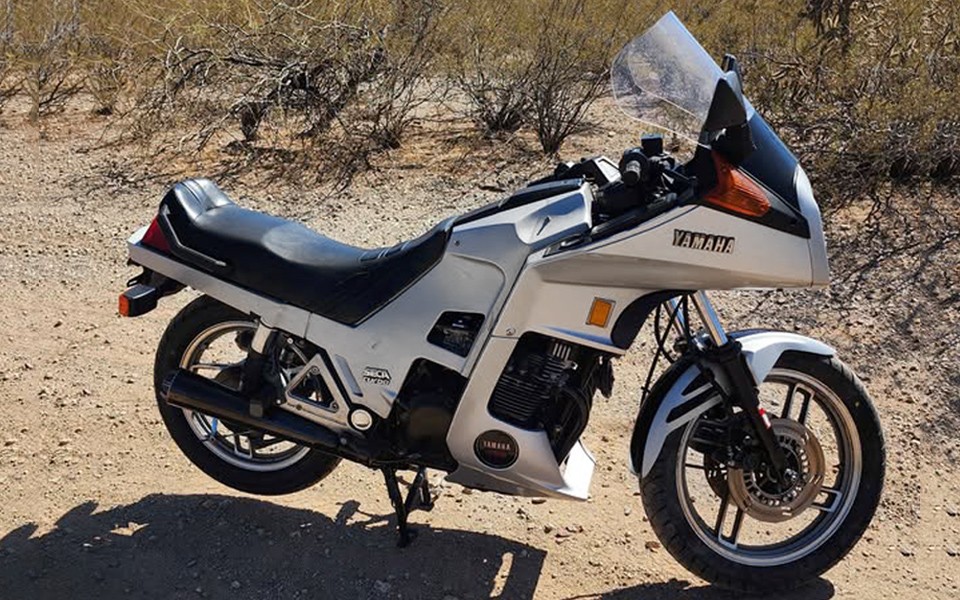
Yamaha turned their XJ650 line into something for everyone: a Maxim cruiser bike and a Seca for sport bike enthusiasts. The equivalent of eating your Wheaties and working out at the same time, the company added a turbo to the somewhat mildly powered Seca and created a caped crusader for the street. It looks the part of a sport bike, there’s no question about that, but it wasn’t a world-beater in standard spec. That isn’t to say that it didn’t handle well; it just wasn’t particularly quick in normal breathing mode. Much more so with a turbo.
Honda’s CX500 Turbo snuck past the opening gate first in 1982, followed closely by the Yamaha XJ650 Seca Turbo, which was made for only two years. The Yamaha was different in three big ways: first, it was air-cooled as opposed to being liquid-cooled. An even bigger surprise is that it was an inline-four rather than a V-Twin. Also, rather than fuel injection, it used pressurized carburetors. Double-walled exhaust pipes with stainless steel inner lining helps with longevity.
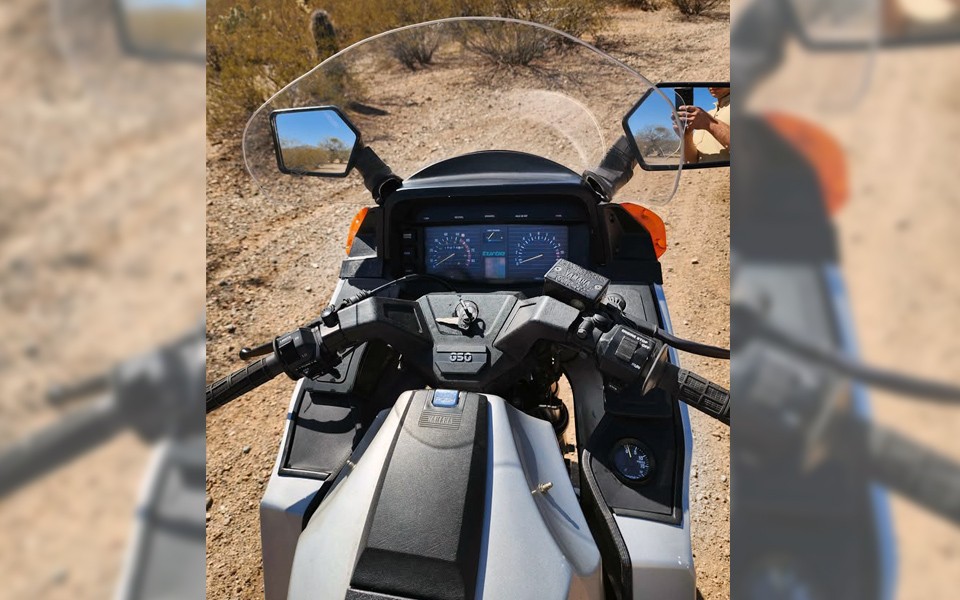
I’ve always liked unusual vehicles, so a turbo-powered two-wheeler is right in my wheelhouse. Plus, it’s a Yamaha. This example is said to have around 15,000 miles and air-cooled turbo Secas can top 80,000 miles without trouble if they’re maintained. Not being liquid-cooled isn’t always a death sentence for motorcycles. This example looks great in the seller’s photos, and Hagerty is at $3,100 for a #3 good-condition example. If it was local, I’d check it out for sure, with cash in hand, as there’s no other way to take a test ride, according to the seller.
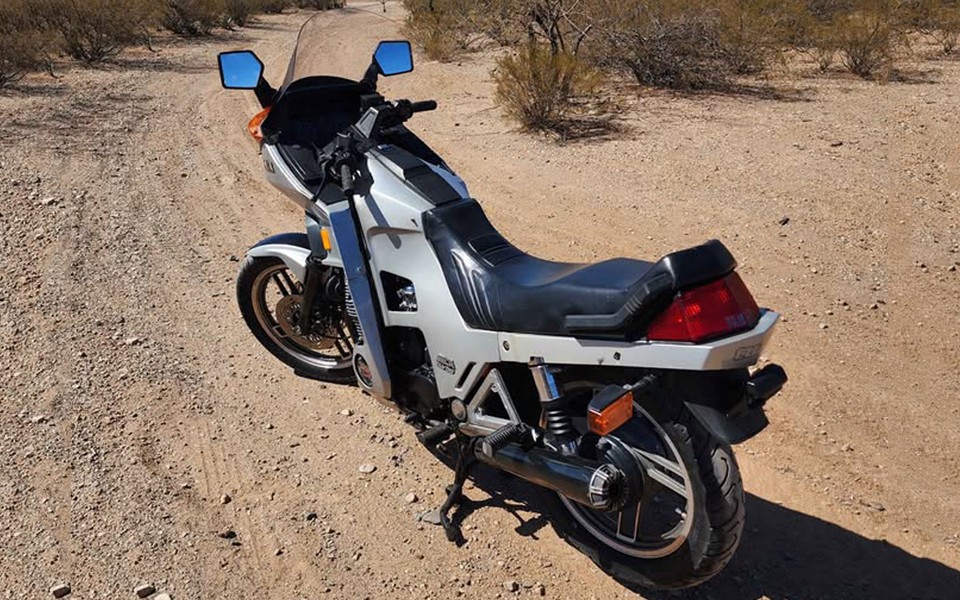
The engine is mostly hidden behind sleek and futuristic body panels; it’s Yamaha’s 653cc DOHC transverse-mounted inline-four with 90 horsepower and 62 lb-ft of torque. A tiny Mitsubishi turbocharger is positioned between the five-speed transmission and the rear wheel- nice packaging. Yamaha sold a “Power-Up Kit” to boost the power, and despite two extra cylinders and more displacement, Honda’s CX500 Turbo still took the lead in the quarter mile by 0.3 seconds. Both bikes hit the line at 106 mph. Have any of you owned a turbo-powered motorcycle?




I owned one of these in 1983 and despite a rather lackluster response from the bike mags, it was fast when it came on boost. In 5th gear, boost just started to build at 70mph so interstate roll ons were exciting! Shaft drive, an awesome faring, the bike routinely got over 60mpg with carburetors. It was a heavy 650 but had a great lean angle. Unlike the 750, no Anti Dive which was fine. Fully adjustable forks with air caps and air adjustable rear shocks. A really fun bike that would make a great daily commuter. The downside of this design is internal parts availability and the complex fuel control system. Still, I would not hesitate to buy it and ride it like you stole it.
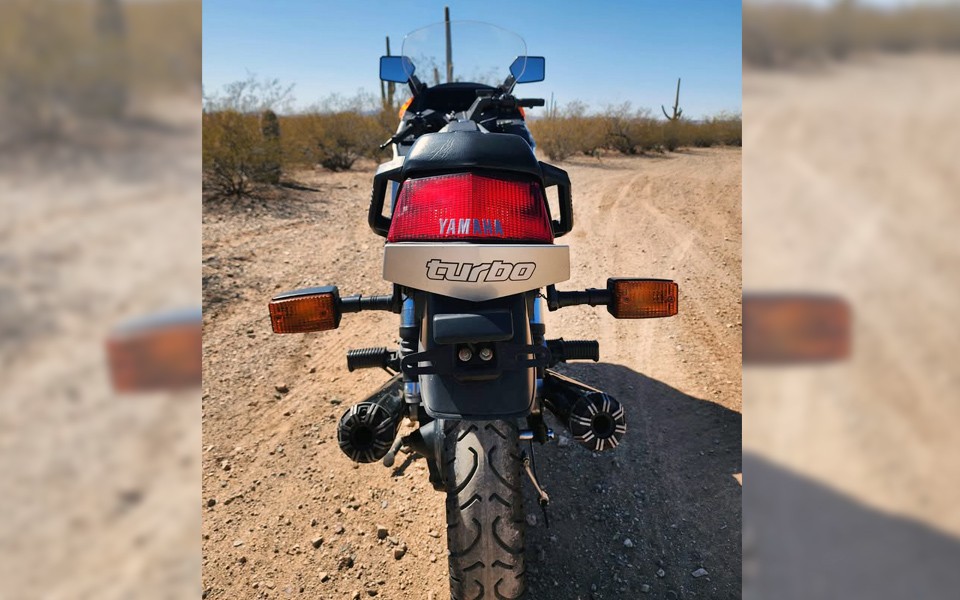
I forgot to mention that even though it looks like a 4 into 2 exhaust, it was actually a 4 into one on the right side. The left muffler was the waste gate outlet. Part of the power up kit was a restrictor in the waste gate to give more boost.
I’m glad you mentioned that about the exhaust, John, thanks much! I never know how deeply to go before everyone falls asleep.
Love the bikes here on BF. Thanks Scotty, good comments John, sounds like a neat and fun bike. 90hp+ is nothing to sneeze at on 2 wheels. Doesnt Kawasaki have an insane turbocharged beast launched a few yrs ago ? Eye watering power and speed numbers.
Yamaha led the Japanese charge with shaft drive bikes in the late 70’s and they sold well but by the time the Secas came out, a bike had to have a chain to be a serious sport bike so this Seca 650 turbo, the Seca 650 standard, the Seca 750 and really great Seca900 did not hit the sales goals and in fact, many were sold heavily discounted as non currents. Then Yamaha introduced the FJ1100 and they were in the hunt again. Shame really. The Seca900, a 1 year only US import, was hugely popular in Europe.
The Seca engine with the alternator behind the cylinders, offered a much narrower engine and un paralleled lean angles. The engine was practically bullet proof.
Not sure there’s a word to describe these bikes, way past awesome. I swear, the Asians think we drive around on Bonneville Salt Flats all day, with the monsterous bikes they sent this way. Thing is, I had a friend with a Seca 750, not near as fancy as this, but more of a mid range bike, and the speeds these attain are a bit much for the bike. 100 mph + (easy) is a bit tense on a bike and these don’t behave well at a slow pace. I’ve pretty much accepted the fact my 2 wheel days are over( 4 wheelers maybe?),,oh, it’s okay, lots of memories to call back on. There are plenty of these crotch rockets around, Marketplace is inundated with all kinds, if you have the chutzpah to hang on to these things. Dang, oh to be young(er) again,,,
Ride On Howard 😎 🏍 👍
I think I’ve only owned three turbo vehicles, and they all had four wheels. I can’t imagine being on two wheels when a turbo kicks in!
Reading the paragraph about configuration of this XJ650 versus the CX500, I think this is misleading. At that time, the vast majority of the big 4 Japanese manufacturers (Yamaha, Honda, Suzuki and Kawasaki) mid-to-large sized four-stroke model range were – air-cooled, “across-the-frame 4” motors. The Honda CX500 and 650 water-cooled transverse V-twins were the odd ones out. Incidentally, getting a two-cylinder engine to run properly with a turbo is much more technically challenging, Honda did a good job with that.
The other two contemporary Japanese turbo models that followed on around that time, the Suzuki XN85 and the Kawasaki GPz750 turbo were also based around conventional air-cooled across-the-frame 4s.
It was a technically interesting exploration into turbocharging for the Japanese manufacturers to get the enhanced performance, and it was relatively short era…. seems like they just found ways to squeeze more and more power out of normally aspirated motors and the priority was to make them ever lighter and slimmer, so the extra weight and complexity of the turbo was redundant? …and of course, they did eventually as the years moved forward, move to fully water-cooled engines. I remember Suzuki brought out the oil-cooled GSXr engines (with huge oil cooler radiators and large oil capacity) as a kind of evolutionary steppingstone between air cooled and water-cooled designs.
I was just about to mention the GPZ 750 turbo! I had the GPZ 900 with round slide mikunis & boy did that wake that bike up!
ClassicCarFan, Cycle World Magazine was one of the sources for that paragraph.
Had a 79 Kawasaki Z1RTC bought new in 1980. After a few internal mods it ran the 1/4 in 9.2 sec at 144.It would try to throw you off when you tried to slow down.I would not ride it at that speed but my son could handle the tank slapping,so I gave the bike to him and he made it even faster.
I had a friend that had one of these. Nevadahalfrack are you there? If in first or second gear at full boost. You should be shifting at 6,000 RPMs. Because if you are not you will be over revving. I always like these.
I was the service manager in a full line Yamaha shop when these came out. The power up kit was free for the asking. It up the boost pressure slightly on the forst run of them as they were a little slow. Later runs of them had a boost upgrade. We sold one to a fellow who left it out side and stored his ladies panties under the seat…(rags but still funny).
He untapped it in the spring and took it for a ride and it almost spit him off. He said when he rolled the throttle off it kept going, scared the crap out of him.
One of my guys took it out and same thing. The waste gate had rusted shut, and it was a pressurized airbox with carbs, a popoff valve in the airbox was suppose to go off at 12psi if I remember. A lot of owners would weld the waste gate up and let the pop off valve limit them to 12psi. Unless…. a bunch of panties blocked the pop off valve then the airbox would over pressurize and take a few seconds (anxious) to return the box to regular pressure after the throttle was closed. We all took it for a drive, would have been interesting to have a boost gauge on the airbox. We left the “rags” on the top tree and explained it to him. He was happy after that, left the turbo alone.
Thanks for picking this one up, Scotty.
As Scotty knows, I am a fan of Yamahas from this period. I had a ’79 XS 750F and my friend’s brother in law had one of these, along with a bunch of his friends. If the kid wasn’t such a stuck up puss, I would have asked him to trade bikes for a ride because I really wanted to see what a turbo would do on a bike. I never thought that turbo and 2 wheels was such a great idea, almost the exact opposite of a 2 stroke.
I have 2 of these (one is parts bike) – huge fun. Easy to maintain – great value at this ones asking price.