
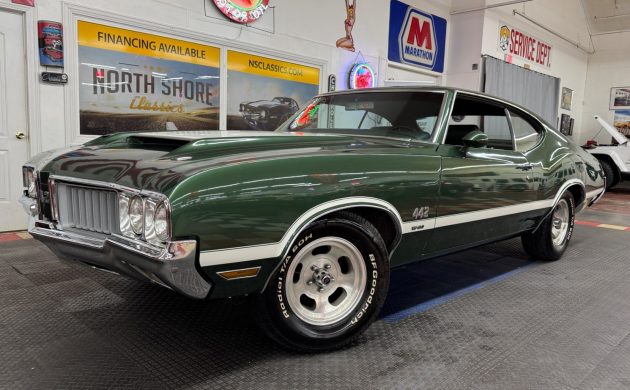
GTO, Boss 429, GTX, SS 396, ZL1. To the uninitiated, that sentence is little more than an alphabet soup of letters and numbers. However, for classic car enthusiasts, it represents some of the most desirable high-performance cars to emerge in the 1960s and early 1970s. I think it is safe to add 442 and W-30 to that list, because those numbers represented the moment when Oldsmobile shook off its staid and conservative image by producing vehicles with genuine performance credentials. This 1970 Olds 442 has been with the same owner for forty-five years, but it’s time to find a new home. It doesn’t just look nice; the engine bay houses a professionally built 455ci V8. I must say a big thank you to Barn Finder Curvette for spotting this American icon listed here on eBay in Mundelein, Illinois. The seller set their price at $49,900 with the option to make an offer.
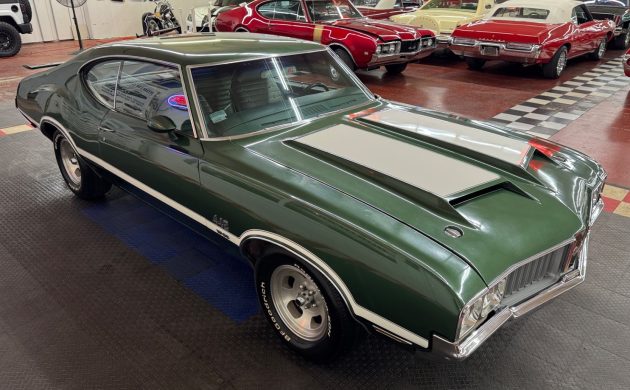
Oldsmobile launched the 442 in 1964 in response to the Pontiac GTO. The company sought to inject excitement into its model range, and although originally an options package, the company granted the 442 standalone model status in 1968 when it released the Second Generation. This 1970 example presents well for its age, and the seller has been its custodian for forty-five years. The first owner selected Sherwood Green to cloak the exterior with contrasting White stripes and the W25 hood, which was part of the 442 package. The seller confirms that the Olds underwent an external restoration between 1986 and 1988, and there is no evidence of significant deterioration. The paint shines nicely, the stripes are crisp, and the excellent underside shots confirm this classic’s rust-free status. The trim and glass are in good condition, and although the wheels aren’t original, they are period-correct.
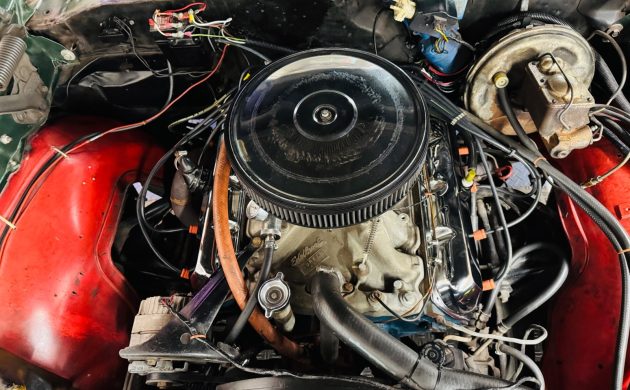
Ordering a 442 in 1970 brought owners the 455ci V8 as standard equipment. The first owner wielded their pen when ordering this car, adding the W-30 upgrade, a three-speed automatic transmission, a 3.23 12-bolt Posi rear end, power steering, power brakes, and the desirable W27 aluminum axle carrier and cover. Many people believe that Oldsmobile followed a prevailing industry trend by understating this car’s performance potential. That year’s Sales Brochure quotes power and torque figures of 370hp and 500 ft/lbs, which is almost enough to rotate the Earth on its axis. The first thing for purists to note is that this classic isn’t numbers-matching. The 455 occupying the engine bay is professionally built and should provide impressive performance. It doesn’t wear its factory air cleaner assembly, but the correct intake is included. As demonstrated in this YouTube video, the V8 sounds sweet and smooth, and is ready for action with its new owner behind the wheel.
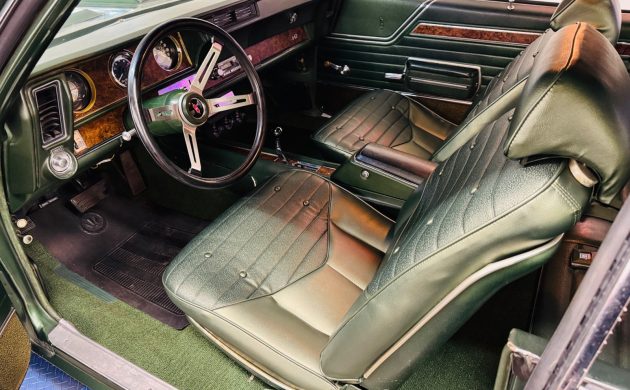
The Green theme set by this classic’s exterior continues inside. There are some additional gauges and switches, including a tachometer mounted in the gauge cluster. Otherwise, it appears to be in the same condition as when it left the factory. The vinyl seatcovers are spotless, and as is the case with the carpet, there is no evidence of wear. The dash and faux woodgrain are excellent, as are the pad and console. If potential buyers seek a high-end driver, this interior helps this gem to fill the bill.
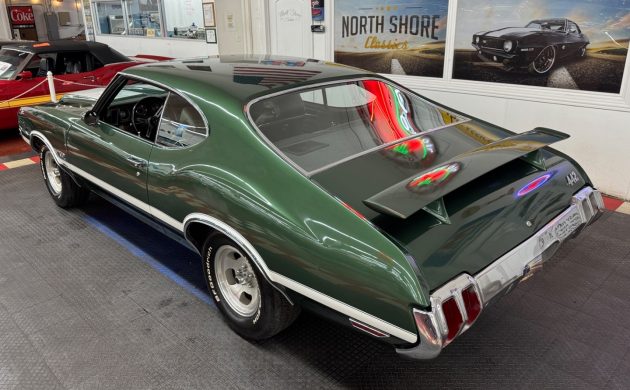
Will we ever have another automotive era like the one that spawned the muscle car? I doubt it, but if we do, it will almost certainly take on an entirely different form. Some electric cars can match or exceed the performance potential of classics like this 1970 Oldsmobile 442, but they do so without producing the bass rumble that moves the soul, which is a significant part of what makes these cars so special. Two of the great marques, Pontiac and Oldsmobile, are nothing but memories. Preserving this 442 would be a fitting tribute, but are you up for that challenge?



Okay then…
Not a fan of that rear wing,or the price.
Otherwise a nice car.
That whatever it is on the trunk, plus the orange fender wells (what are those about?) don’t turn me on. However, it sure is a good looking beast otherwise.
You obviously don’t know the history of the Olds 442. The red fender wells are a critical piece of a true W-30 from these years. Silly or not, it is an important piece. I personally am not a big fan of the whale tail myself, but it is a factory correct option on this car that probably more collector types like. On this body style, I am OK with it, especially on a 442, but I really don’t like seeing it stuck on the formal roof style Supreme or SX, but it happens often.
You are correct about info.
The red inner fenders were plastic as a weight saving measure on W-30 models. If you’re looking at a W-30, that’s one of the first things you spot. Run of the mill 442 models didn’t have them. (like my ’69) Olds was serious about being competitive back in the day and saving weight was one trick they used. Look into the history books a bit and you’ll see Pontiac offered them on GTO models at all four corners. Yes, I’m an old guy and also was a GSM at several Chevy, Olds, Cadillac and Pontiac dealerships years ago.
With 500lb-ft and 370hp how does an aluminum differential carrier hold up.
No way it can handle high rpm manual shifts ?
I am confident Oldsmobile did not under design the high performance W-27 option aluminum carrier housing and cover. It is rare and some will install the W-27 cover on a non W-27 carrier housing. The W-30 was not a ‘high rpm’ engine. Smooth shifts are not the problem regardless of RPM, hard launching the car with slicks and gears, that creates the load.
If into drag racing you may have changed out the Oldsmobile 12 bolt for a Chevy 12 bolt and if you were serious beefed up the Chevy, or fabricated a custom rear.
The 10, 12, bolt discussions are not for street applications with original horsepower, torque, 3.23:1 axle ratio, and tires. This car as built is not likely to be used for competitive racing.
Many of them did not hold up and were replaced. That said, with no undercarriage shots you can’t even tell if this car still has the W27 rear end.
Look at all the Aftermarket Aluminum Ford style 9″ center housings out there, they hold up to thousands of HP and Torque, granted it’s all aftermarket, but it’s Aluminum.
What a difference NOM makes…
This car has too many boy-racer things done to it for me. Not the original engine, no outside air induction setup, no tailpipe or exhaust trumpets, day 2 wheels and the list goes on. It doesn’t matter if it’s a W30 if all the stuff that makes it a W30 are gone.
I agree with your comments. It may look cool and clean from a distance but the add on performance stuff ruined it such as the tach in the dash, trunk battery, and the messy wiring in the engine compartment. Comes with original rims which should at least be put back on.
Although not original it’s still a nice looking ride. I got to say, Man o Man I love the greens from the 60s and 70s!!!
this was a nice car, but it has been butchered up. no “F” casting heads all the ram air parts seem to be mia.; speedo moved over to the right. for 50k this should a correct car. if that pro built then you can keep it. this is lipstick on a real pig
Not a single picture of the W27 rear axle ?
Don Kiepert, the fender wells on 1969 and 1970 Cutlass/442 were plastic from the factory. Actually all from 68-through 72 were plastic. The W30 cars were molded in red to make them more distinctive and aggressive appearing. Plastic was cheaper to produce. The rear axle is undoubtedly NOT a W27, just the cover which seems to be on every cutlass these days. A real W27 rear axle sells upwards of $20k, probably much more these days.
Yes, i thought the inner fender wells were plastic also, on all the models like you said, just the W30,s came in Red, i guess to make a statement.
Incorrect. Better look it up. There were more metal inner fenders than plastic. Especially on Cutlass and 442 models. Red plastic was exclusive to the W-30 and some W-31. There was more plastic than I was aware of, but nowhere near what you’re saying. I stand partially corrected.
Ok, i was just agreeing with 19sixty5, i haven’t seen too many 68-72 models, but the few I’ve seen at shows i believe were all plastic, with the W30 cars in Red, I’ll look little better when i attend future shows.
Red fender wells were not available from the factory on the W31 cars. I did know a guy around 1973 that had a 2 red W cars, a W30 and W31. His W31 had them, but he added them. There may have been some dealer installed, but again, not from the factory. He used the W31 to flat tow the W30 to the track. I have never seen them on a W31. I graduated high school in 1970, and a family friend was an Oldsmobile Dealer in north suburban Chicago, I used to hang out there often. I can’t guarantee that there not metal ones out there, but again, I have never seen them.
Beautiful car, but things go sharply downhill from there. Non-original engine, air induction missing, more as others have mentioned. Absolutely hate that tach in the dash, and the relocated speedo looks so wrong. So does the silver panel of mystery switches the aftermarket gauges hang from.
A real hack job.
WHATTA car !! I have some choice cars, but I would sell my kidney for this car…. Find me another…. Even back when muscle cars were all over, hardly ever did you see one,,,,, Like a hemi anything they just weren’t common….Comfort and power, green on tasteful green, no vinyl top, W30from 1970 …??? lf l had the $$ right now I might go 59……
in 50yrs i never seen a 68-72 “A” body olds with metal fender liners. they were all plastic. this does not have a “W27” rear center section only a repop cover. if it did have the rear its worth buying the car and taking it out. this car is a 442 in vin # only all the factory parts appear to be long gone and that is areal shame.