

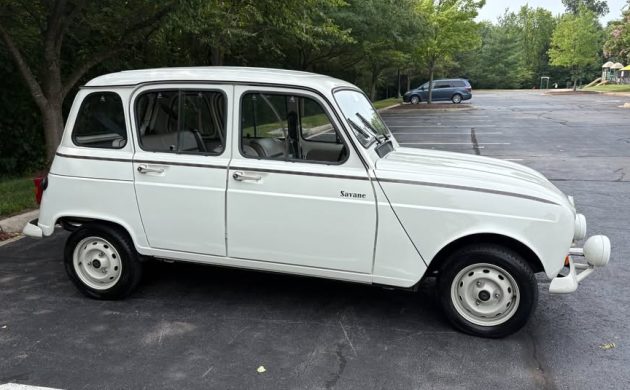
Although the Citroën 2CV is considered France’s iconic “car of the people,” its sales figures pale in comparison to those achieved by the Renault R4. In fact, during a much shorter production run, the R4 outsold the 2CV by over 2:1. This 1988 R4 Savane recently arrived on local shores after spending its life in the Netherlands. It presents extremely well and is a turnkey proposition with no apparent needs. I must say a big thank you to Barn Finder JDC for spotting this French classic listed here on Facebook Marketplace in Ashburn, Virginia. The seller set their price at $12,000 for this wonderful survivor.
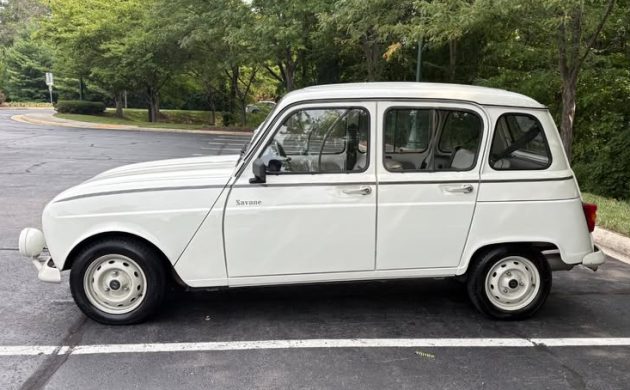
Renault released the R4 in 1961, breaking new ground in vehicle design. Although originally considered a short estate, the R4 is now recognized as the world’s first mass-produced hatchback. It remained on sale until 1992, selling in enormous numbers during that period. Our featured R4 left the line in 1988, ordered by its first owner in White. It is unclear when it arrived in North America, but the seller confirms it spent most of its life in the Netherlands. The car presents extremely well for an original survivor, with no major paint or panel issues. I can’t spot any evidence of rust, with the lack of surface corrosion in the engine bay a positive sign. The glass and trim are in good condition, while the Cibie spotlights will turn night into day.
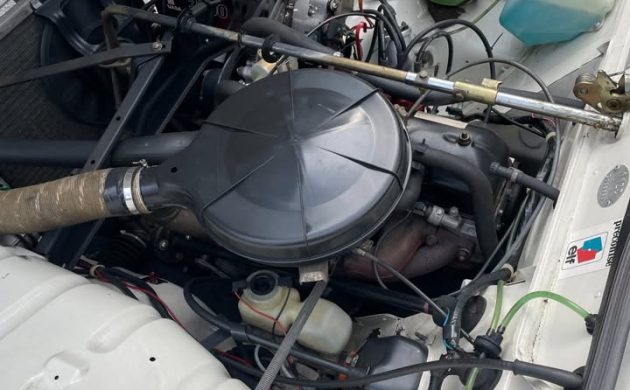
The R4 was typical of French vehicles from the 1960s, featuring a relatively small engine producing moderate power and torque. As the Savane variant, it has a 956cc four-cylinder engine that delivers 34hp and 46 ft/lbs of torque, which is enough to propel this R4 to a factory-declared top speed of 73mph. The power feeds to the front wheels via a four-speed manual transmission, revealing why the R4 was so versatile and successful. The drivertrain layout maximized interior space in what is a relatively small car. It also allowed Renault to engineer the vehicle with a low, flat cargo area floor. That made loading easy, allowing the R4 to cart some pretty bulky items. The seller recently replaced the tires and carburetor and described the Renault as fun to drive. Therefore, flying in and making the return journey behind the wheel of this classic is a viable option.
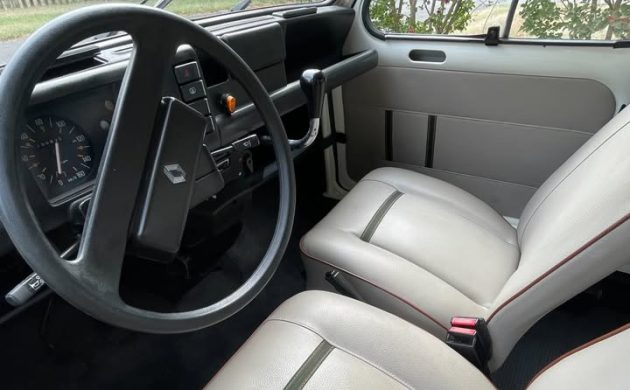
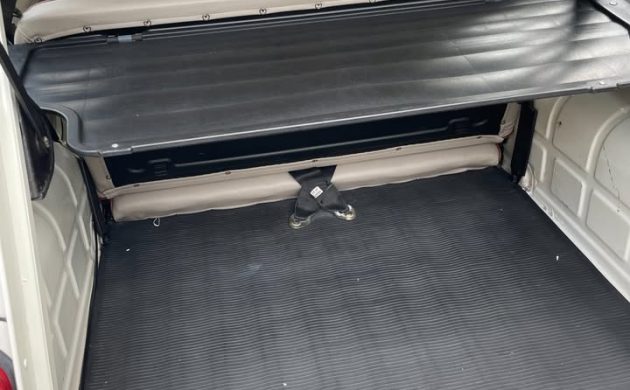
Trimmed in White vinyl with subtle, contrasting stripes, the Renault’s interior is extremely impressive. There is no evidence of wear or abuse, and the cargo area looks remarkably clean. The dash and plastic haven’t succumbed to UV exposure, and the rubber floor mats enhance the vehicle’s inherent practicality. The seller includes a radio console, and since it doesn’t actually contain a radio, the buyer could install a retro-style Bluetooth stereo for a more modern touch.
I will never downplay the importance of the Citroën 2CV, because it was effectively a tool that brought affordable mobility to the population and stimulated France’s economy following the ravages of World War II. However, the Reanualt R4 was a game-changer. It was more refined than the 2CV, offered greater versatility, and still fell within the affordable category. The sales figures tell us much, because while Citroën sold 3,872,583 examples of the 2CV between 1948 and 1990, the R4 found 8,135,424 buyers during its thirty-one-year production run. Our featured R4 Savane is a wonderful survivor, ideal for someone seeking a quirky, practical classic. Do you fall into that category?

Well, let’s see,,,quirky design( I realize the irony as an AMC fan), check, 3 bolt wheels, check, tall roof,( to clear Gendarmes hats) check, unusual body panel proportions, check, dash shifter( hate to hit that thing with your head), yep, it’s French alright. Here’s another example of such a popular car in Europe, and here, bupkis. We were lucky to see a R8 or 10. At least it has a plausible motor, I think 73 mph is a bit of a stretch, but the French aren’t stupid, they engineered the car for where it would most likely be used, going around and around the roundabouts of Paris. For a little “puddle jumper”, I’d love to have it.
Out of town, one drives “pied a plancher”; it’ll do 70 all day.
Quatrelle’s a great car, I’ve driven quite a few of them. So simple and well-packaged! And the gear lever’s easy once you’re used to it (what’s your head doing down there, Howard?).
The trick to understanding the gear shift action is to disregard that rod going horizontally into the dash, and just focus on how the knob itself moves — in a conventional horizontal H pattern, like any other floor/console mounted shift lever.
This car is neato. Longitudinally mounted engine yet fwd. I owned an R10 and two LeCars. Loved them. Great in the snow. Reliable too. But mon dieu, the rust!
This one seems to have avoided the rust
I’d guess I owned 20 4L during the 1980’s. I could buy them for 500 Swedish Kronor ($50), then fix them up a bit and drive for a few weeks and then sell for 2500. They are surprisingly simple and sturdy, but rust was always an issue especially around the rear suspension mounts. One time I had fixed one up with plenty of small pieces of metal welded over the existing rust. The vehicle inspector didn’t like my repairs, but technically I had ”repaired” each and every failure noted from the previous inspection. A few weeks later I was back with another one and the inspector greeted me saying ”haven’t I told you that you shouldn’t bring me more of these?” This time he didn’t bother listing each area of rust, he just failed the car on one point: ”Rusty Chassis” with a few exclamation points and and underlined 3 times. I got the hint and scrapped that one.
Anyway, this is a fairly rare version with the large 956 cc used in Renault 6 and 8. Normally they had the older 845 cc engine that had debuted in the Dauphine. Sweden also for some time got a sub-750 cc engine to skirt emissions laws.
Great cars, but I still think that for this money I’d rather get the 2CV.
When introduced in Paris the factory left a bunch all over town with the keys in them. Only requirement was to gas it up after you used and park it up for someone else to drive.
Makes me think of a Roger Moore era James Bond movie. Take your pick.
If you look at the movie Romancing The Stone or its sequel you will see Michael Douglas & Kathline Turner trying to drive an R4 caught in some water rapids while floating down the river. I think Danny DeVito was hiding under a blanket in the back. The car ended up going over a waterfall, as I recall. It did feature elsewhere in the movie.
There’s nothing like the white-knuckle driving thrill of a 34hp car on the freeway.
I had the opportunity to drive an R4 for a couple weeks in Corsica more than 40 years ago. I’ve wanted one ever since. Gotta love the shifter which comes horizontally out of the dash – you can see in in the interior photo just to the right of the steering wheel. This looks like a fantastic specimen!
Having driven a 2CV AND a Honda 600. The shifter on this one. Although again will be quirky, looks to be a step up. (Just remember not only do you move the shifter up and down, but also twist left and right.) This is the first one that I have seen. My first car was a 4CV Renault (not driven legally on fire roads as I was only 12) And Dad had a, couple of Dauphines that were basically junk even when new as Dad found out. And my last racecar (generation I) spec racer was Renault Alliance based. And my auto shop teacher in high-school had an R10 that I was tasked to over haul. So I have been baptized in Renault. This looks ugly. The center auxiliary light is a driving pattern lense and if most likely plenty for the amount of speed this car doesn’t generate. There is nothing in the description that says the out 2 are “spot beam lamps” So I would venture to say (and based on where the vehicle lived) that they are most likely fog lamps and not “spot beams” This poor little car could never hope to go fast enough to even use a spot beam lamp, much less 2. This would definitely get some attention at a cars and coffee meet. But don’t EVEN spell the word rust within earshot. As it will disintegrate before your eyes! Living in Nevada would not be a concern for rust. But it would get blown off the highway very easily. (faster cars AND cross winds) We don’t get a rear view of the car. But, I suspect that it has a rear fog lamp also.
Having driven a 2CV AND a Honda 600. The shifter on this one. Although again will be quirky, looks to be a step up. (Just remember not only do you move the shifter up and down, but also twist left and right.) This is the first one that I have seen. My first car was a 4CV Renault (not driven legally on fire roads as I was only 12) And Dad had a, couple of Dauphines that were basically junk even when new as Dad found out. And my last racecar (generation I) spec racer was Renault Alliance based. And my auto shop teacher in high-school had an R10 that I was tasked to over haul. So I have been baptized in Renault. This looks ugly. The center auxiliary light is a driving pattern lense and if most likely plenty for the amount of speed this car doesn’t generate. There is nothing in the description that says the out 2 are “spot beam lamps” So I would venture to say (and based on where the vehicle lived) that they are most likely fog lamps and not “spot beams” This poor little car could never hope to go fast enough to even use a spot beam lamp, much less 2. This would definitely get some attention at a cars and coffee meet. But don’t EVEN spell the word rust within earshot. As it will disintegrate before your eyes! Living in Nevada would not be a concern for rust. But it would get blown off the highway very easily. (faster cars AND cross winds)
If you stay inside of the car, it is very nice. They seem to pay attention to driver and passenger comfort. Somewhere along the way, they forgot about exterior design – a lot of French cars are “unique” in appearance, to put it lightly. It would be entertaining to own, and get a lot of stares, especially at C & C, but as someone pointed out, they will rust very easily.
I purchased my 1968 R4 Fourgonnette (Van) in 1973 for $5 Australian dollars. It cost me about $20 to get it running and I drove it for about the next 20 years. There is much more that can be said than is written here. They have a separate pan type chassis and the various bodies are bolted on. To keep the under chassis flat the muffler is high up inside the left mudguard above the wheel. The seats lift out without any tools needed. I then slept inside on the flat floor and put the seats around the camp fire – no tent needed. The rear door had a full width flap that could be lifted up to to put a ladder through or open it up on a hot day to let masses of cool air to flow through. The car here is nearing the pinnacle of production with its 4-speed box – mine was the 3-speed. Early engines were the 845cc, 745 and a 600 not mentioned in the text above (wet cylinder liners). That engine was completely different with three bearing crank than the vehicle here with five bearing crank. I think I am correct but even the engines run in the opposite direction and the crown wheel is turned around to get forward movement (as the smaller engines originally came out as rear engines in a different car). An 1100cc engine was fitted in later cars. As they have wet cylinder liners that engine went to 1400cc in other models including the R5 Turbo. My 845cc would cruise at 60mph after you could find a hill to get you up to that speed. It would return 47mpg. Everyone should have the opportunity to drive one of these French cars for a few weeks to experience the Designers approach to concentrate on practicality and overall usefulness rather than all the hype we hear today.
I would give it a try if it presented it’s self.
Forgot to mention that after my initial investment of $5 + $20 and 20 years of driving, I sold the car for $2500 as it became too small as my family grew. My wife keeps asking for a DS23 Citroen.
I always wanted to play with an R17 Gordini. But never got the chance.
I moved to Southern France 4 years ago. From the states. Where you would rarely ever see a French car.
But moving here, they are everywhere. As would be expected, but atons of them are 40, 50+years old now, and lots and lot of 2CVs, cars, trucks, wagons. 50 years old, still being used daily, as transpertation. Blows the mind. Rugged little buggers. As the French drivers are very casual about their cars.