
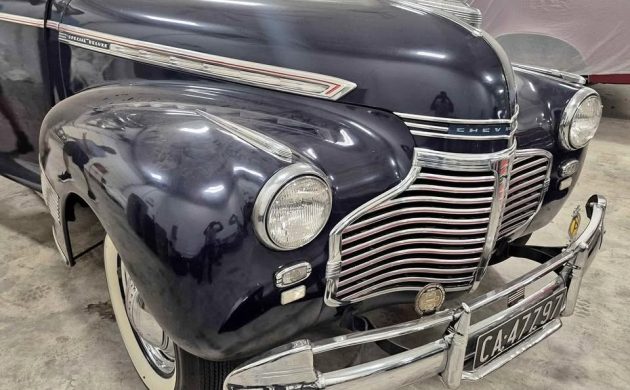
Now, this is an unusual find! It’s a 1941 Chevrolet Special Deluxe, four-door sedan, which isn’t particularly unusual or uncommon. It does have two standout traits, however: one being its fine condition and the other being its right-hand drive layout. Unfortunately, the listing’s text is brief, and nothing is mentioned about this car’s origins or its previous 84 years on the planet. Regardless, this is one that is certainly review-worthy. We have Zappenduster to thank for this Wagoner, Oklahoma tip, and those with an interest will find this Chevy sedan here on Facebook Marketplace, where it’s available for $16,750.
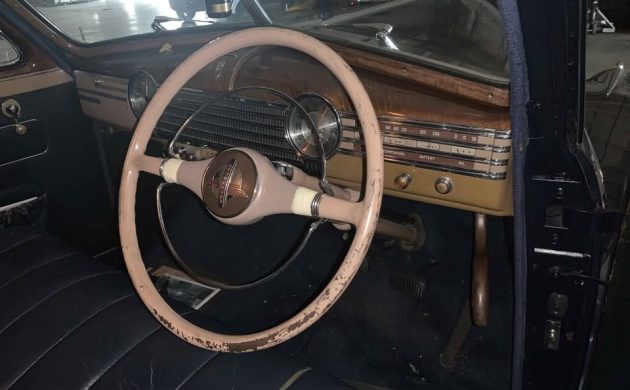
Chevrolet offered two trim levels in 1941: the Special Deluxe, our subject car, and the Master Deluxe. Body styles were coupes, two and four-door sedans, a cabriolet, and a station wagon. Chevrolet produced over one million cars in ’41, with 148K four-door sedans wearing the Special Deluxe badge. How many were right-hand drive? Who knows? Maybe none, perhaps this example is a one-off, though admittedly, that seems unlikely. The dash and steering wheel appear to have been professionally positioned, i.e., production line assembled. Today, there are about 70 countries that employ the left-hand driving configuration, though there were more back in the forties. My initial thought was Australia as GM had a sizeable presence there for years, but I have nothing else to go on; any thoughts?
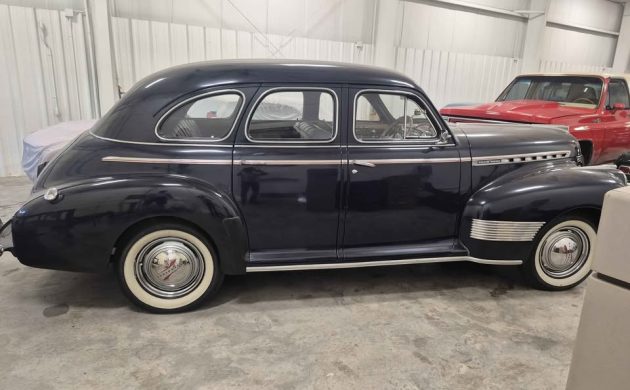
Beyond that, we have a sedan in excellent condition, a deep, still reflective finish, a straight body, and strong, shiny bits such as bumpers and trim. The seller states, “…it is really nice, better in person…” Perhaps so, but from my vantage point, nothing appears to be out of place. I suppose there’s always a question of underside integrity, but I seriously doubt there’s a problem; this Chevy appears to have been well stored and maintained.
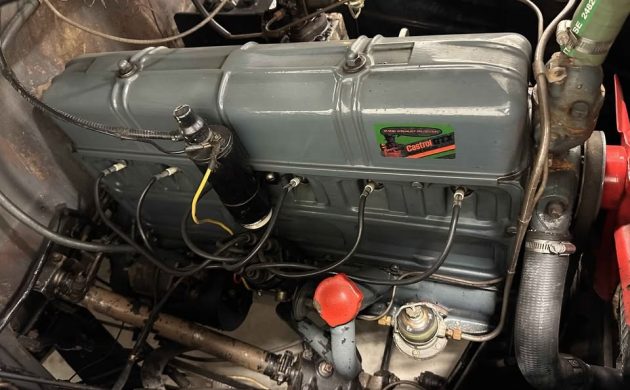
The engine bay is in possession of a 90 gross HP, 216 CI, in-line six-cylinder engine that is joined to a three-speed manual transmission. The entire environment is amazingly clean and looks to be all original – and no obvious scars from an RHD conversion. There’s no mention of running or driving attributes, and the seller mentions that he has two additional engines and many parts, included in the sale.
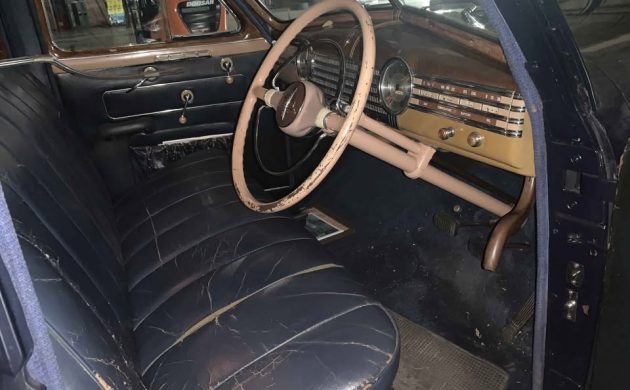
While the interior dash and steering wheel position is the central focal point, the overall condition of the remaining innards is not as well publicized. The original upholstery should have been “breathing-back canda cloth,” according to the Chevy sales brochure, but what’s in place now looks like leather, especially owing to the noted cracking, an aged leather trait. The seats appear to need some work, a split seam or two, but the dash, door panels, and headliner all check out.
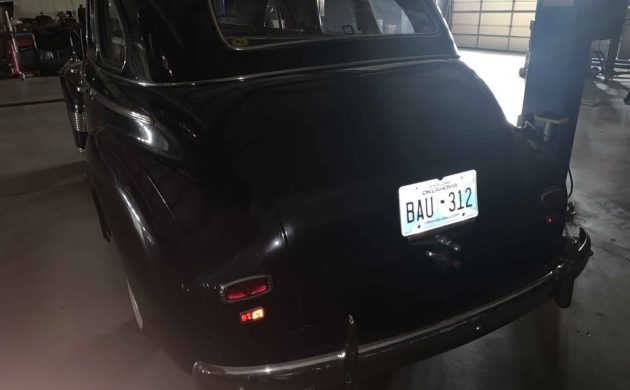
How unusual, right? Normally, I’d suggest that a 1941 Chevrolet sedan would have some appeal, limited however. But the right-hand drive configuration? I imagine some may find that feature as an added attraction and help spur additional interest in this car’s unexpected layout. What’s your thought, a helpful or hurtful feature?



I’ve honestly never seen any 1940s Chevy that is right hand drive. My Dads father had a 1940 Chevy Coupe. I’ve been told it was burgundy, I’ve seen a number of black and white photos. It sure looks factory. The speedometer is on the right side instead of the left, and you notice the shifter falls in your left hand, not right, so it’s a mirror of what it would have been on the other side. The whole car itself looks terrific, especially considering its 84 years old now. Whenever I see an old car like this, I’m reminded now that as theyvare bought, sold, maintained, restored, we aren’t really owners, we are more like caretakers, keeping them going for ( hopefully) the next generation to have, and enjoy. This is a really cool find Zappenduster, and this is a really nice write up too Jim. If I can find a picture of my Grandfathers 1940 Chevy I’ll share it. He sadly died from lung cancer in the late 1940’s. That ’40 Chevy was his last car. And I’ve been told that when he bought it, he was the first in the family to have a “modern” car in the family. It was quite a big deal apparently.
I hope this comes out. This is a picture taken in 1941 of my Dads father holding my Dad as a baby in front of his 1940 Chevy. Not a great picture of the car, but its all I have.
I disagree. It is a great picture.
Thank you!!! Wish I had more.
As the author states, virtually no US cars were made with RHD in 1941. The only exception was an export to countries that drove on the left side. There were companies that specialized in those conversions. It’s not new, I don’t see a mileage claim, but was certainly used. Rural mail carrier, maybe? I read, a RHD conversion took over 80 hours and cost about $320 bucks. Considering the LHD model cost $800, it was a costly update. I doubt many left and came back, perhaps a conversion that was never shipped and stayed stateside. Can you imagine someone not familiar with RHD and a stick, that would be YouTube worthy. I’d have trouble with it. Cool find, and with war clouds a brewin’, shipping it was out of the question.
Hi Howard A,
I live in Cape Town, South Africa. We have produced RHD American cars here since the 30’s. My daily is a RHD 57 Chevy 210. Allot of vehicles you guys had in the US until the late 60’s, we had here in SA in RHD.
Strange but true!
South Africa was one of the biggest producers of American cars outside of the US. I also own a 55 Chevy 2 door RHD 150 with a UTE pick up insert where the trunk would be in the US .
General Motors, along with other major automakers (including Land Rover, where I first learned of them) sent CKD (Complete Knock Down) “kits” to many other countries, including Australia. Imagine a 1:1 scale model of a real car. Chevrolets were sold in Australia as standard with RHD (and, later, amber turn signals). The RHD appears to be factory installed, and not a modification. Google “Curbside Classics Americans Down Under The Chevrolet Edition”. It shows a RHD 1939 Chevrolet sedan in a factory photo. It looks like you could get a RHD Impala in 1966 and, possibly, RHD pickups into the late 1970s, although another source claims that GM stopped RHD vehicle production in 1968. Interestingly, the RHD CKD kits were made by GM Canada. Even more interesting is that GM produced RHD Suburbans in Mexico for foreign markets. I once purchased a derelict 1940 RHD Fargo (Canadian Dodge) 1-1/2 ton truck that I found in a California farm field for the unique components to convert my WW II Dodge weapons carrier to RHD with Fargo insignias. It looked just like the Dodge, except RHD. If you look at the steel dashboard stamping, you can see how easy it is to convert- the same thing with a Series Land Rover and numerous other vintage vehicles. Switch the instrument panel with the glove box, install a RHD steering box and associated components, clutch/brake pedals, throttle linkage and you are essentially done.
The front registration plate appears to be South African – CA is Cape Town:
http://www.plate-planet.com/bodypages/af-safr.html
The write-up on this one:
https://www.handh.co.uk/auction/lot/lot-12—1941-chevrolet-special-deluxe-sedan/?lot=56606&sd=1
Explains the CKD aspect of the manufacting process.
I think it’s a nice cars and coffee discussion if one can find the origins. The price is a little steep considered left hand drive models can be had for 6-8K in great condition. One sits in my dad’s pole bard that runs right now that is black with lebonnie (spelling?) interior now. It the six cylinder model etc. with 12 year old white walls.
I wish this person luck and hope it brings full ask so I can wax up the next one to sale. :-).
At a car show I once saw a Model A that was completely restored. Talking with the owner, he told me it came from South Africa and was rust free when he got it. But it was RHD. Said he got all of the parts to convert to LHD during the restoration. Later as I was walking the flea market area I saw all of the RHD parts for sale. Steering column, box, transmission and pedal assembly, and all of the linkages. To me that was what made the car unique, but to each their own I guess. As for this one I would think this was a foreign market car. I read Chevys were marketed in Australia as a luxury car and came with leather interiors. They even had Chevy utes down under. I saw a ’50 at a truck show a couple of weeks ago. Same set up as this one RHD and three-on-tree for left handers. This is really a neat find, whoever buys it, I hope they like to talk to people.
UK, clearly. There is an AA badge with the yellow background between the bumper and the grille. https://en.wikipedia.org/wiki/The_AA
South Africa also has AA (and that badge).
CA number plate on the front is Cape Town (I am South African). SA market was dominated by USDM cars up till the early 70’s, when we shifted to Japanese and European cars. This was before my time but I think the main driver was rising fuel costs.
Not an Aussie car; this has the usual ’41 Chevy Fisher body while the Holden one retained rear-hinged rear doors and noticeably more square cornered side windows from the ’39 up to 1948.
Leather might be original, an export only option.
Since the bulk of RHD countries were in the Commonwealth, all RHD Chevys were made in Canada (even if locally assembled and/or bodied as in Australia) to leverage tariff preferences.
The trim on the front fender does not appear to be US standard either.
That washboard trim is an option
Doesn’t look like an 41 engine. That one is bigger than those available in 1941. I had a 41 like this one, except the left hand drive. I believe that engine was available in 1954 for autos.
“That engine is clearly a 216. The next bigger engine is the 235, and it would have the side engine cover only to the bottom of the cylinder head.
The 235 has valve cover retaining bolts/screws around the perimeter of the cover. (As does the later 194/230/250/292 engines) The 216 valve cover retention nuts through the top of the valve cover. No need to try and verify side cover location/size until the 194, 230, 250, 292 straight sizes come on the scene starting in 1962 on the ChevyII, and then in 1963 when the 230 came standard on the Biscayne, BelAire and Impala.
The first 2 letters of the VIN are the factory code.
If the engine is the original? the numbers will match.
Example; my 42 coupe has BA, that stands for Flint, Michigan.
The VIN tag should be on the passenger floor.
The 216 and earlier were babbitt pounders and had the vents on top of the valve cover. In 54 they introduced the 235 as a full pressure oil pumper.
Due to a crack in the water jacket, below 5 and 6, I upgraded to the 235, the casting numbers code to 1962.
I still have the original engine complete, it’s getting a friend to do the cold weld, he is a Model A guy with a lot of work.
I also had a 216 in my 1953 3100 panel delivery truck with a,cracked cooling passage external on the driver’s side. A trip to my local wedding shop, and $10 later no more leak. (those carbon welding sticks do a,great job!)
Very interesting car. So my QUESTION is how do they work the shift linkage? I’m assuming that they did not produce a right hand drive transmission with the shift plate on the right side of the transmission. What would the linkage look like?
Quigley the 4X4 van conversion company also produces right hand drive conversions. (At least they did before I retired.) Being their highest selling dealer for their 4×4 conversions, I represented them at the Rual Mail Delivery conference in Oxnard CA. I believe that if GM gets any requests for 4×4 “G” series vans. Quigley handles the conversions for GM. Much like Sherer Truck did for Ford on the crew cab conversions back in the early ’60s & ’70s.
Howard is right. The RHD would make driving in today’s traffic quite interesting. I’ve done a lot of driving in Ireland. Being on the right side of the car feels , well right. And after a bit you stop reaching with your right hand to shift the door pull.
The idea that this was originally intended as a luxury export (and hence, leather seats) makes sense: the steering-wheel has a horn-ring, which would make it top-of-the -line in the U.S., I believe. I know, with Ford, the Super Deluxe had the horn ring, but the Deluxe and the Standard did not. While the right-hand-drive makes this one interestiing; seeing this car makes me think of when the 1941 Chevy and 1941 Plymouth were two of THE most common cars on the roads. Even as other ’41s gradually dwindled and faded from the scene, the ’41 Plymouth and ’41 Chevy were seen still in daily use, into the 1970s, usually by elderly people. But these were everyday cars, to me, in the 1940s and early 1950s. Where did all the time go?
Don’t play games with me Ty! Put that steering wheel back where it belongs, and get this outta here!
WHAT?? — You don’t like right-hand-drive, NBC? Where’s your sense of novelty and adventure!
Thanks for the South African manufacturing information. When I hear RHD, I automatically think of Australia and I do not know exactly what years Chevy changed to Holden down under??
My 1940 Hudson parts manual lists all the parts needed for the CKD cars. My car has a knock out on the right side for the steering column. The parts are listed as “RHD and LHD”
There were several car manufacturers that spiffed their vehicles up for export to make their products more appealing for the customers. Mercedes-Benz shipped the Ponton and Fintail Benzes, although produced in Germany, to the US market equipped with standard leather upholstery, whereas the domestic models had to make do with cloth seats. Citroen did the same with the Traction Avant and DS models for the RHD-markets, either shipping Paris-built cars with leather seats or producing them in Slough (Berkshire, England), also with leather interiors + leather headliners. Some RHD conversions required a change in shift patterns, i.e. the reverse gear location was moved to where usually the first gear is. Moving the shift lever up, would be 1st gear on LHD models. Doing the same in a RHD models would give you reverse gear.
There is a very interesting video on YouTube by HubNut about a 1962 Citroen ID with RHD that has a changed shift pattern. I include the link. If it doesn’t work, place “This is NOT a Citroën DS – so what is it?” into the YT search box. https://www.youtube.com/watch?v=IFuop3YAUl4
In any case, this ’41 Chevy with its full leather treatment (includes even the headliner) would make the new owner the star of the next VCCA show – any show, for that matter!
My 1929 Dodge DA is RHD and has leather, it was built in Canada as a CKD kit and exported to South Africa for local assembly, I bought it in Hillcrest (near Durban) South Africa 20 years ago and brought it to the UK,