
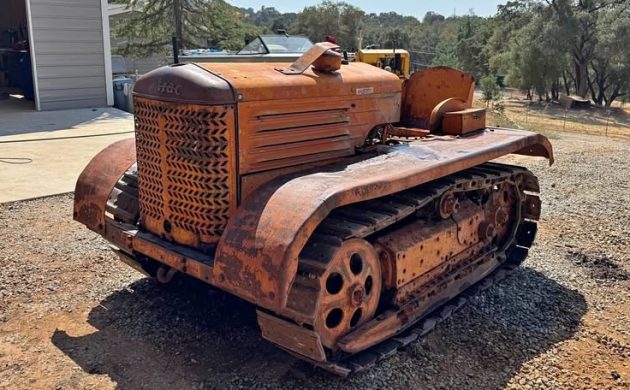
T.J., big thanks for this catnip of a tip, so we can feature the 1945 Oliver Cletrac AD crawler for sale here on facebook Marketplace. The Cleveland Tractor Company merged with Oliver in 1944, folding its variety of tracked crawlers into Oliver’s growing product line. Models ranged from narrow row-crop machines to tall, orchard-specific crawlers. Most Cletracs can also haul a plow or carry a dozer. A video included in the listing shows this compact tractor running well and ready to work. The seller is asking $5600, and this machine is located in Placerville, California. Delivery is available, so you could have it in time to pick pears!
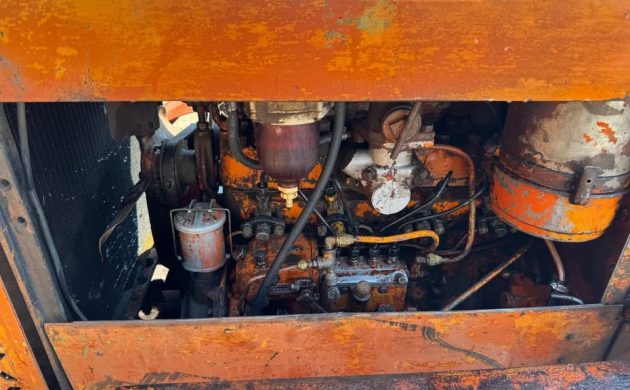
The ubiquitous Hercules four-cylinder diesel engine – this one displaces 3.7 liters – provides power; specifications indicate about 30 hp at the drawbar. Notably, this version of the Herc four maxes out at about 1500 rpm; plenty of Hercules engines are available if you need parts for a rebuild, but many were used for military vehicles and run at 2500 rpm; forum participants warn that matching parts from one engine to another should be done carefully. Steering is controlled by levers on either side of the cab. The transmission has three forward gears and reverse; top speed in third gear is about 3.7 mph. Oliver later made a similar machine with rubber tracks, but the steel version proved more popular at the time, for its durability.
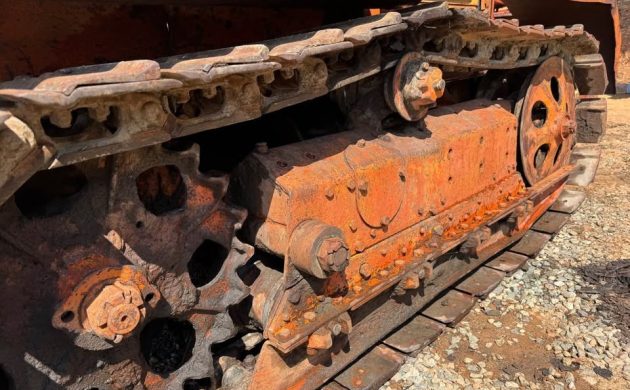
Tracks are tricky. They wear out. Parts are scarce, and the expertise required to perform a rebuild isn’t found at every mechanic’s shop these days. But these guys should be helpful, and there’s a wealth of other sources for vintage tractors generally, via forums and magazines.
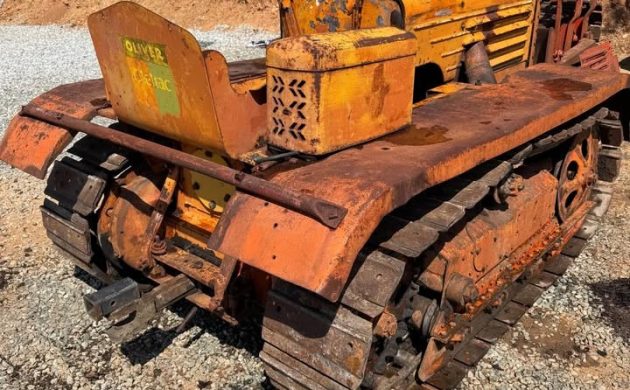
Just a year or two after this crawler was made, Oliver shifted to its trademark olive green paint for all Cleveland products. That makes this survivor still wearing Cleveland orange a bit special. If we want to keep an eye on the auction for a 1945 Oliver Cletrac HG, we’ll have an idea of where the AD should sell. My guess is a discount will be required to move this handsome crawler to a new home; what do you think?




Tip of the hat ( again) to the author, who was either born in a gravel pit or a shop of one. Wonderful lesson on dozers and I always enjoy researching these things further. For 1945, this was actually a very modern machine. Wasn’t cheap, I read a post war “Crawling Ollie” was over $2,000 new. A house was just over $3400. Hercules diesels practically ruled WW2. An amazing fact, the Canton Ohio plant turned out over 750,000 gas and diesel motors, 24/7 during the war! If they didn’t get installed in an army truck and get blown to smithereens, I bet there were literally warehouses full of Hercules motors. The 2 big issues on crawlers is the tracks, as mentioned, and the steering clutches. Tracks, which are a chore to remove and install, require new bushings and pins on the “shoes”, the dozers with the tracks that look like a “W”, are particularly worn. I remember outfits that had mobile track repairs, on site. The “fenders” are an unusual addition, perhaps orchard specific, I never saw a dozer with fenders, but must have had a purpose. I doubt this machine slogged through wilderness in the building of the AlCan highway. A cushy life as a orchard tractor. While I’ve been around these machines my entire working career, I always preferred the dump trucks for a job. Running a dozer is incredibly boring and that “clopping” of the tracks drove me nuts,,,moreso. I say, it’s working days are over, clean it up, paint it, and “clop” around the yard,,,OR,,,get that Mack lowboy spiffed up, and haul this on the trailer. Great find.
Thanks, Howard, for the compliment – because I consider it a compliment that anyone would think I was born in a gravel pit! – and the great background information. Really appreciate your additions to our posts.
There ya go Howard, I’ll tell JoAnn to start looking for a hood for the Mack! In the meantime, Zimmerman Oliver-Cletrac in Ephrata Pa. is the source for parts.
Cletrac built around 8,500 M-2 “high speed” tractors during WW II. Their primary role was to tow aircraft, especially heavy bombers, at Allied airfields. Some are still owned by military vehicle enthusiasts. Interestingly, they were equipped with generators and air compressors to serve as mobile repair vehicles. This tractor appears to share some of the “DNA” of its wartime predecessors.
Cletrac built around 8,500 M-2 “high speed” tractors during WW II. Their primary role was to tow aircraft, especially heavy bombers, at Allied airfields. Some are still owned by military vehicle enthusiasts. Interestingly, they were equipped with generators and air compressors to serve as mobile repair vehicles. This tractor appears to share some of the “DNA” of its wartime predecessors.
Two words Michelle…….
Bucket list lol……..
But seriously this really great!!! I actually know someone who bought a Cletrac years ago ( an Oliver version like this one).Until reading your write up and Scottys write up about that Pre Oliver Cletrac I really didnt know much about them. Great comments too Howard and Godzilla. Where we used to live there had been an Oliver dealer ( still there just no longer an Oliver dealer) so there were quite a few Oliver Row Crops around and I always figured the Cletrac must’ve been sold new there. I love this!!! Please keep yhe comments coming!! Great write up Michelle I really enjoyed it ( as usual)
That bucket is gonna have to turn into a ravine, to hold all these vehicles you like, ha!
You know Michelle…… You’re right…… But at least I’ve driven a Fiero so we can go ahead and knock that one off the list…… Somehow I don’t think it put much of a dent in it lol.
Hi Dave, I never knew this, but Oliver tractors were made not far from Studebaker in South Bend, IN. On a visit to the Studebaker museum, a must see by the way, all that remains of the factory is the restored chimney that says “Oliver” and a small museum, I think. It blows my feeble mind, to think what that city had at one time, Studebaker, Oliver, Bendix( was huge), and now, bupkis. Very similar to Milwaukee in many ways.
I didn’t know that either Howard, until now lol. I didn’t know anything about Olivers until I worked at that old gas station. They had an Oliver Row crop (77?) And the Cletrac.
This is just great again, thank you Michelle, Howard,Geomechs, Godzilla for the comments and the write up.
-Dave
our Springfield, MA very similar (the rifle same name, RollsR, Duryea, Indian, etc, etc). Dont think the Prez will ‘bring it all back’ needs $, planning, years of collaboration, etc…
Sure is great to have some variety! These old crawlers got around, albeit not as common as Cat or International. I wouldn’t know what to do with one other than use it to tow derelicts into the shop.
These came in different sizes. I’m not sure how bit they made it. Some in the hands of collectors out west. A guy brought the fuel system off one like this featured one to get overhauled. The guy was quite surprised to find out that parts were still available. I have to add that I was surprised as well…
That is beautifully restored Geomechs. It really gives you an idea of what perhaps not too much work needed to bring this one posted to look like that. It can be done by the right individuals.
-Dave
I did a little more research on the fenders and apparently, a lot of information came up. Orchard specific, especially vineyards and citrus with low hanging branches required streamlining to prevent crop damage. I bet that little piece on the air filter was added after farmer Brown got a branch in the face. :0
Howard, You hit the nail on the head!!! BUT you did not mention the it must have a pointed down stack/muffler for orchard work.. Who ever said the Hercules parts are easy to find has not tried to rebuild one!!! Today they are impossible to find. It took 3 engines to build two and one of them is in my Diamond T. Jasper engines were the last as Oliver used the 4 cylinder model in their self propelled combines.
Back when I was a pre-teen kid my dad had an orange Oliver Cletrac for his forestry work pulling logs down from the mountains. I wasn’t yet old enough to be trusted using it for such work so only got to drive it a few times down on the farm.
At some point the magneto failed and got sent somewhere for a rebuild. Once dad got it back it never ran right again so dad gave up and sold it. Not sure if it’s true or just a story but the way I remember it was that the buyer stopped by at a tractor wizard on his way home. The guy asked for 500sek ($50) upfront, then walked over and swapped the spark plug wires over and started it right up. Apparently the firing order cast on the engine block wasn’t correct! Perhaps someone here might know?
More than likely Dad forgot the rotation on the mag and had #2 and #3 wires swapped, happens more than anyone will admit to.
Yes, in all honesty dad was a man of many talents but his mechanical abilities were not among them. That’s why I have not been too certain about the details of the story. Now at 97 I’m not going to try to call him out on it!
Hey Beyfon, Dad’s 97, WOW! that’s so cool. My dad passed when I was in my 30s, wife’s Dad died when she was still in high school. Call him up, don’t mention the crawler, just say “Hi” and ask how he’s doing while you still can!
Yes, I’m blessed. Mom and dad are 90 and 97, sold the farm back in 2019 and live totally unassisted in an apartment in the small town near where I grew up. I will go to see them in 3 weeks, first time in over a year. It takes me 10 hours to go from DC to Stockholm Sweden, but then another 12 hours from Stockholm to their Northern Lapland town.
This just goes to show where the interest is, not even lunch time and there’s 15 hits.
Just adding my appreciation for this amazing machine and the history it conjures up. THX to Howard and Beyfon-living memory is a priceless asset!
Dad’s first dozer was an Oliver OC3 track loader. He said he didn’t want a Cletrac because they had three speeds. Fast. Faster. And Fastest.
Never know what you’ll find in a barn- or on Barnfinds. Good job as usual Michelle.
In a previous life I worked weekends on a farm. They had a 1930 Cletrac 100 with an angle plow abandoned behind one of the sheds. One winter weekend it snowed over 18″ and it was really hard to get around the farm and do our chores. My partner and I decided it would be great if we could plow out the barns with the Cletrac. Since there were no supervisors around we slogged back to the Cletrac, hoping that it had a pony motor starter, no luck there. It was a monster Wisconsin 6. So we took out the plugs and points, accessed the battery needs and retreated to a heated shop to clean things up. We found a tractor battery that would work, re-installed everything, put some fresh gas in to dilute the old, but NOT ethanol, gasoline, turned it over while spraying starter fluid and gas in the carb and, son of a gun it started. After a few minutes of rough heavy smoking it settled down running on 4-5 cylinders. As soon as we tried plowing we discovered that the blade angled to the right probably most of its life had fried the right clutch. We simply angled the blade to the left and we were in business.
The boss forgave us and we plowed the rest of the winter with the Cletrac and not the wimpy back blade on a Ford 600 series. I don’t know the displacement or horsepower but it ran better and better and was unstoppable. I have had a soft spot for old Cletracs ever since, especially the thundering 6 cylinders. Howard help me out here with the statistics. :)
Back in the ’50’s my dad came home with an Oliver OC3, not running. It tock a while to find parts, but we got it going. It was the best tractor we had on the farm. The only problem we ever had was keeping the tracks tight. In PA our farm was a little hilly and towing our baler one time I ran it out of the tracks. Had to walk home and get dad and another tractor to tow it back into the tracks. It had power up the gazow, used it one time to tow the Cat DC9 out of a swamp when it got stuck. After dad passed a neighbor bought it and now he passed and I think it’s still setting there. Sometime i think of getting it, but what would I do with it on my 50 by 150 ft lot.
By the way, our Oliver OC3 had fenders and I think they were just to keep you from getting splashed with mud and dirt and also a step to get in and out of the seat. It was a tight fit, it was smaller than this machine.
Used to be an Oliver dealer on I-5 just before SeaTac airport called Jerry’s Equipment. He specialized in OC3 models rebuilding and selling.
I’d love to have a Cletrac to put next to my Oliver RC-60, but I don’t have the room or the money right now. Nothing runs like a Deere when chased by an Oliver!
60, tricycle? cultivators? I’ve got an Oliver Hart-Parr 70 on rubber, used it to cultivate corn beans and taters till 2 years ago, mostly a chore tractor now.
RC-60 factory wide front end. My dad restored it to a point and it is at my cousins farm in Illinois being used for whatever he needs, probably pulling wagons.
This Oliver cletrac reminds me of Terrence the Tractor from Thomas the Tank Engine.