

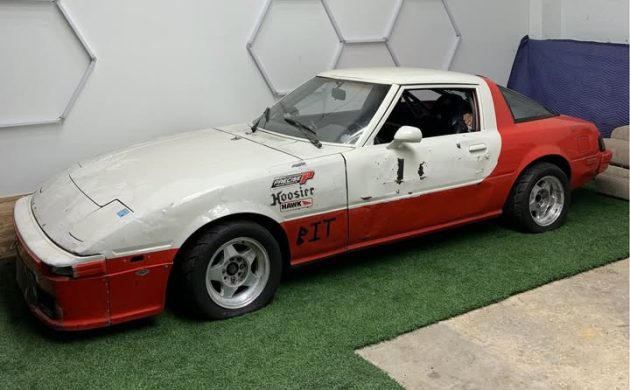
When you begin a hobby, it can often seem overwhelming when it comes to the gear that’s involved. If you want to become competitive cyclist, or an angler, or perhaps take up kite surfing, be prepared to start the process of piecing together the various pieces of equipment you’ll need to get underway. Autocrossing and track day events are much easier by comparison, as you can simply hop on Marketplace and pick up a nearly turnkey race car like this 1984 Mazda RX-7 listed here on Facebook Marketplace for $6,500.
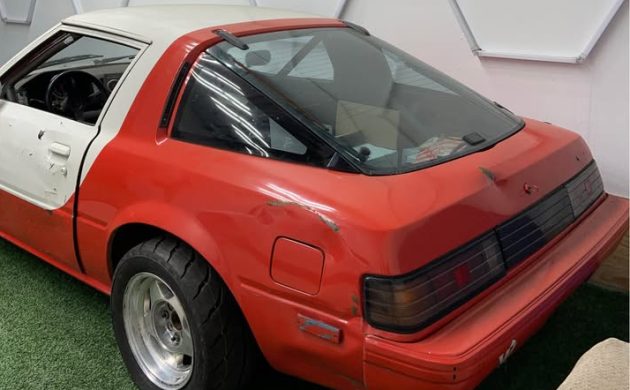
The seller has dropped the price from an initial ask of $10,000 for this track-prepped FB-chassis Mazda. When I was actively autocrossing, the FB was a regular sight at parking lots around the northeast. I knew more than one driver who was top of their class and piloted a high-revving RX-7 like the one shown here. You almost wanted to wear ear plugs at times because of the ear-piercing sound, but they were incredibly fun to watch. Lightweight and incredibly agile, it’s no surprise the seller of this RX-7 decided to go all-in on prepping one for track usage.
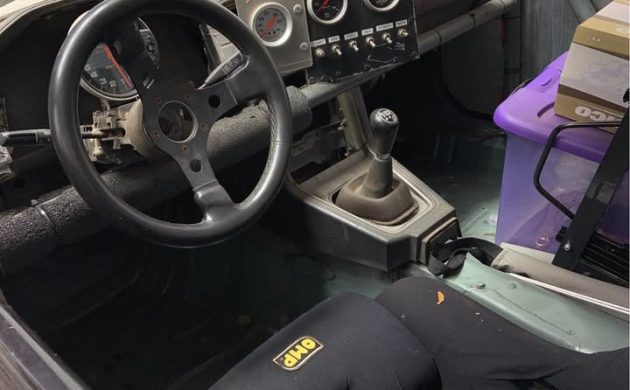
However, one challenge that comes with every track car is that the march of time doesn’t stop. Newer cars become more competitive, and certainly easier to buy parts for. The difficulty of keeping a vintage car repaired and in sound condition doesn’t get any easier, especially as parts support begins to dry up for all but the most popular models. While I suspect it’s still fairly easy to get into racing with an FB RX-7, it’s likely not as easy to do as with a Fox body Mustang or vintage 911. The seller notes all that needs to be done at this point is to install the passenger seat and finish the exhaust system.
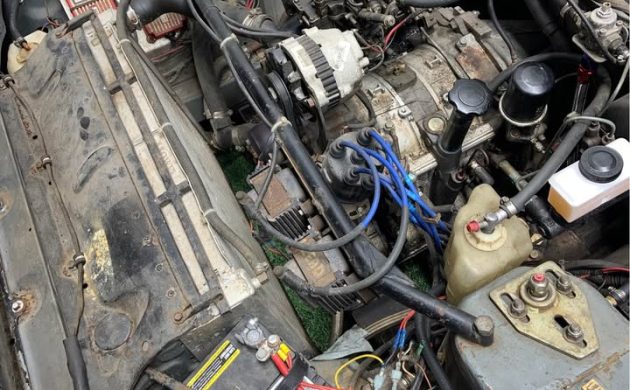
The listing notes that the RX-7 will come with “….brand new tires, harnesses, fuel lines, cooling lines, slave and master cylinder, header and a few other things…and two SCCA log books.” The Mazda is also running a limited-slip differential and has fresh fluids throughout. It will come with a variety of spare parts along with front and rear adjustable suspension, adjustable sway bars, a fuel cell, and a full cage. In stock form, an FB produced anywhere from 100 to 135 b.h.p. depending on the specific engine and, of course, any modifications. This looks like a blast to me, even it the little RX-7 would get hammered in the straights. Do you think these older track cars are a good value?

Still got a few of these in the south east that show up at Sebring and Daytona SCCA races. They are fast and the scream of those engines will get your attention.
If you’ve caught the racing bug, this looks to be a terrific deal-and it may be eligible for plates, depending on your state so you wouldn’t need to trailer it. An easily removable muffler might be a good addition once you get to the event, though, as it’s a good bet that it’s too loud for normal street use.
These have always been a favorite and this one is especially cool.
GLWTS!
Ok, I get that the exhaust on these can get expensive as usually requires stainless steel because of heat of the exhaust. But why does a track day car need a passenger seat? Could be a great track day car. But ad $2,500 or more for transportation costs. And most likely $1,000 or more for the exhaust system. Still a cool car and very tempting! Also remember that a track day car usually (depending on local rules) does not have a class to compete in. It’s the enjoyment of running the car hard on the track. And if you find another driver with a similar speed car, then it’s fun dicing back and forth. But usually it’s keeping track of your times and competing against yourself. Still can be very rewarding.
This is why it’s usually does not make sense to build a race car from scratch, especially for beginners or weekend hobbyists not running in advanced classes. Quality used race cars are generally inexpensive, make sure it’s been actively raced recently.
This looks like a good deal.
Steve R
Race cars are like boats. There is always someone tired of the costs and desperate to get out. That keeps prices low in the hobby classes.
You can get a turn-key deal, with the trailer, spare parts and tires, ready to go, often for less than $10k at most SCCA regional events.
You’ll have fun, but you’re not going to win, because winning is a very different financial calculation.
In most cases, the buyer is better off buying a genuine race car (like a used formula V or low level spec car or sports racer) instead of a converted production vehicle that was never meant to be raced in the first place.
Real race cars are usually much more basic, and unlike production cars, they were made to be abused. An engine, chassis, and suspension. Plus, if you wreck, you’re not scouring junkyards for production car parts like glass, trim, inner body panels, and the rest.
And real race cars usually go faster. Or at least, they seem to.
These cars often come up for sale not because the owner is “desperate to get out” but because they are switching classes. Production based cars outnumber number the purpose built race cars you are referring to. Hobbyists out number the type of races you are referring to, plus you didn’t consider the growing popularity of open track day style events where a car like this is often a better option than running their $50,000+ street car into a wall or tire barrier.
Steve R
Oh, I get it. Production cars are where the numbers are.
Guys want to run their “brand” on the track. Mazda, Subaru, Triumph, Camaro, Mustang, on and on, and also wear the gear with those patches. Like there’s some real connection between the highway car and a prepped race car.
From a practical perspective, a real race car, like a cheap formula or old sports racer, is just way easier to deal with, far more stable on the track, and they usually go faster for less money. And you’re racing against drivers who are more skilled, respect their equipment, and have far less of a “NASCAR” mentality out there.
Watch a multi-car pile up of street-legal class race cars diving into turn one, (some with license plates), and you’ll see tens of thousands of dollars in vehicle damage in a wink of an eye. I’ve seen it. Lots of sad faces afterward.
Older RX-7s didn’t have a rev limiter; just a warning chime. Easily disconnected…
I’d race that.
As for the sound, the 787 LMP is on youtube. What a racket!
These can be FUN especially if you scrape the 12A 70 cube engine & swap in a Built 13B 80 cube unit – plenty of speed parts available & it works well w/big Turbo.
Ran a built 13B in Rotary Pickup w/5th wheel big custom headers to giant muffler box I blew welds on constantly ZZZZRRRAAAPPP BANG!!
That was one fun street ride back in 1980s.
RX-7 we had race parts distribution thru Mazda HQ to our store & the Team racers frequently had their cars in our bays prepping.
What’s super interesting is if you can source it – the 323 GLX 4×4 rally race suspension it all bolts up and the Turbo 4cyl in race trim is a Ripper in an RX-7 body.
Actually was lucky enough to have the Factory Street trim version.
Must have been a good deal, the listing is no longer available. At $5k it probably is worth that in parts. Were there any underside photos or details about the suspension, intake and carburetor set-up? Honestly the main reason I wanted to look at details is that this car seems to have the same aftermarket air-dam that I have on my 1982 FB.