
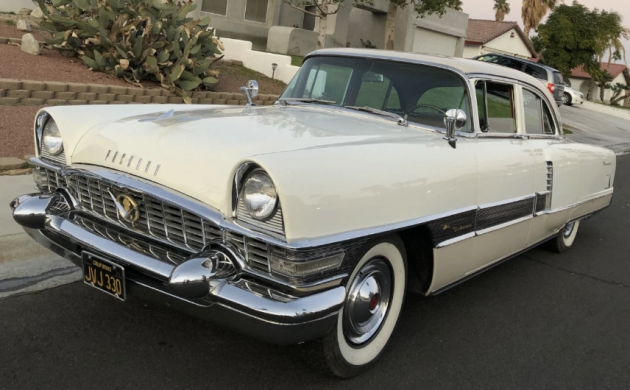
After Packard’s 1954 merger with Studebaker, the financial ramifications of this fusion began trickling into Dick Teague’s styling department: as the combined company continued to lose ground in the market, Teague was pressed to come up with something out of nearly nothing. He revised the entire 1955 Packard line on a shoestring budget, giving every model hooded headlamps, cathedral-arch tail lights, and new trim. Here on eBay is a 1955 Patrician, the company’s last “senior model,” described as a survivor. The asking price is $20,000 or best offer, and the car is located in Lakeland Highlands, Florida. Hey Curvette, as always – genius tip!
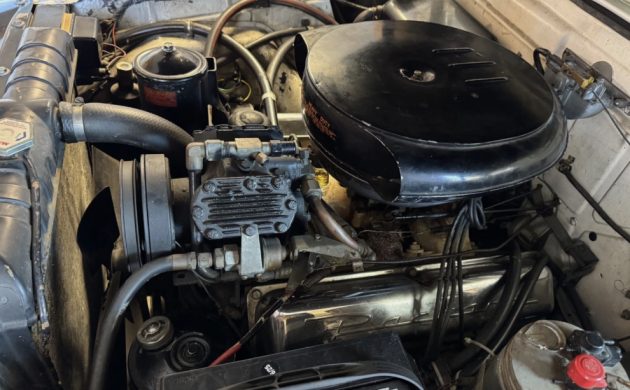
We’re looking at Packard’s first V8. That’s right, the company didn’t graduate from the straight-eight configuration until 1955 – and at that, it took eight years to develop this motor. Overbuilt with 5″ bore centers, a beefy crankshaft, and internal ribbing for strength, the engine offers potential for serious performance. The Patrician received the 352 cu. in. version, with a four-barrel Rochester and a compression ratio of 8.5:1 – good for 260 hp and 355 ft-lbs of torque at 2400 rpm. The standard transmission was the Twin Ultramatic, but the car’s main claim to fame was its Torsion-Level ride, which achieved a floating, level ride using torsion bars and an electric motor to eliminate pitch and control roll. This car’s odometer reads just 87k miles.
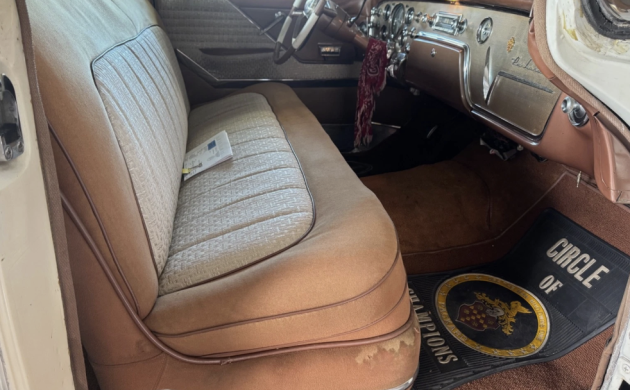
The Patrician offered a full slate of modern features for the day – power-assisted steering, brakes, seats, and windows, as well as a “signal-seeking radio”. Air conditioning was an option, along with a vanity mirror and wire wheel covers. The instrument panel showcases a centrally-located glove box, a clock, and snazzy brightwork; unfortunately, a couple of cracks mar the finish. The upholstery is decent, though also not perfect, with Packard’s trademark metallic thread jacquard inserts surrounded by “doeskin” vinyl.
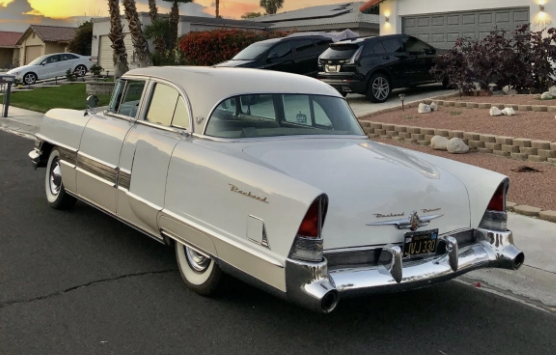
The Patrician was designed with a dual exhaust exiting from the rear bumper corners; this through-bumper arrangement was seen on other makes during the mid-50s, including Ford’s Thunderbird. Modest “Dagmars” up front also kept the Packard in the swim with the rest of the competition. That loooong trunk held plenty of luggage, sports equipment, or groceries. The Patrician undersold expectations, with only 9127 copies finding new owners; the following year was a disaster, as sales notched just 3375 units. Today, those slender production figures make this model somewhat rare, but as we know, rarity doesn’t always mean valuable. This very nice example boasting a single-family ownership history sold for just $12k six months ago. What do you think it will take to move this ’55 along to a new garage?




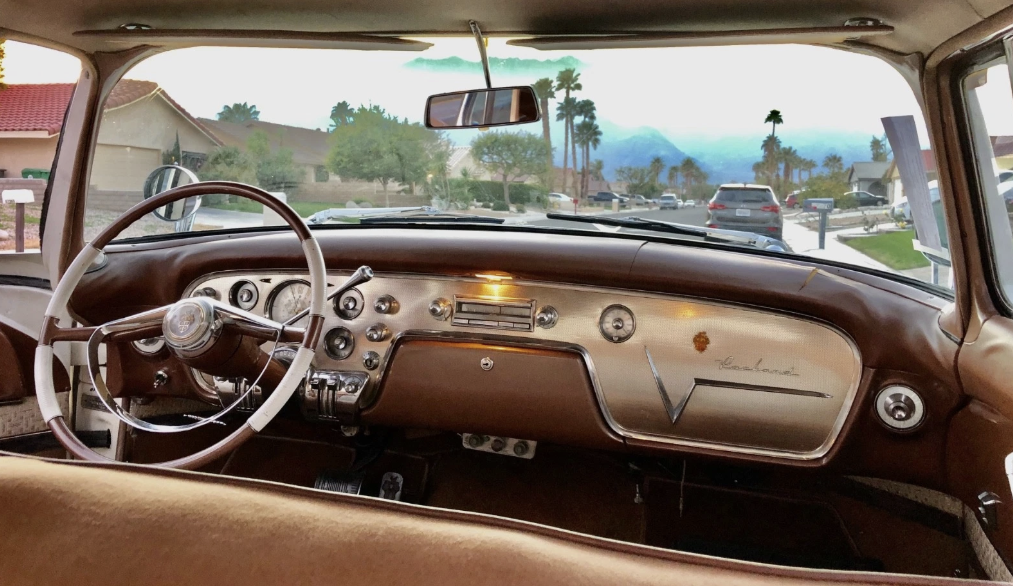
Some time ago walking around at a car and bike show in Minden (NV) we came across a couple guys standing in front of one of these, displayed next to a Hudson Hornet. The two of them were having an in depth discussion of the attributes and drawbacks of each, both having a great deal of experience with the cars.
I recognized the Hudson fan almost immediately as he was a Genoa (NV) resident who attended all events like these in the area though I’d first met him at the European Bike Show in San Jose a decade early and had gotten his autograph there.
Dick Mann obviously knew a great deal about the subject car and looked like he was having a good time so we kept walking slowly by as we took in every word..a class act.
Thank you, Michelle for prompting a great recollection.
I’m confused – was Dick Mann the guy that you got
the autograph from?
Yessir.
And as I wrote the above in a hurry the classy guy comment was about him. Good people, very down to earth, easy to talk with and more importantly listen to.
Dick Mann knew a lot about a lot, especially anything with tires and carburetors.
I too am confused.
Is this Dick Mann the motorcycle racer?
If it’s not, then I feel stupid.
You’re not and Yessir it was.
Every time I see a ’55 Packard. I just don’t understand why it didn’t give Cadillac and Lincoln more of a run for their money. Just looking at the styling, its on par with a Cadillac 4 door from the same time period. Maybe its just me. Michelle, thank you for highlighting that Packard 352 V8. I had no idea it took 8 years for them to develop. But, in true Packard fashion, was built to a high quality standard. I am always learning something new from your write ups and research. Curvette, this is a beautiful find and a beautiful Packard, once again you picked a winner.
People had the whole postwar period to get used to Packard falling behind Cadillac, especially, in style and innovation. The ’55s were a leap forward for them, but there were a few stumbles in that leap leading to a lot of warranty claims and a major knock on their reputation, when that was almost all they had left. 1955 was an okay sales year for Packard, but the problems with the ’55s led to a huge fall-off in ’56, even though the problems from the previous year were mostly fixed. And by then Studebaker and Curtiss-Wright had siphoned off any money they could have used for a comeback in ’57. I think the prices that ’55-56 Caribbeans get show that they’re appreciated more now than they were then, but hey, a ’56 Cadillac is a really nice car, too.
Driveinstile – Even the new Packard auto. trans. for 1955-56 was cutting edge in sophistication of design, in part because of a young engineer of great promise brought in at that time. His name – John Delorean.
Wouldn’t kick either one off my
parking space. And both cars are
really nice too. But what killed Packard boiled down to 2 things–
refusal to innovate by offering the
man who owns one all the modern things that he found on a
Cadillac of the same period. Things like a dependable automatic transmission and a really smooth V-8 to go with it. Yeah, I owned a ’50 8 passenger limo with a 356 cube straight 8
and Ultramatic drive, and it was a
wonderful vehicle. But compared
to say, a ’50 Cadillac series 62, the difference was like night and day. Compared to the Caddy, that
straight 8 was a real slug that couldn’t get out of its own way.
And second, Packard was cutting
it’s own throat by still offering a
cheap medium priced car when there really was no need for them
after WW2. Sure, the 110 and 120 saved Packard’s life during the Great Depression, but that time was long past. In order to get the buyer’s attention, you had to offer them something modern
and breath taking. Packard never did. And those medium priced cars? They cheapened the Packard name to the point that no one took them serious anymore. Hugh Ferry quite literally ran the company into the
ground before he retired in 1952.
By then, Packard was already a
shadow if its former self just scraping along trying to peddle a
car that was $750 cheaper than
the cheapest Cadillac and boy, did they pay dearly too. Had they
developed a V-8 engine in the late
’40s, and dumped their line of cheap cars in ’45, they might well
be around today. Now with all that said, I’d really like to have this car. I could just see my SIL
driving me to work in it while everyone watches us. But being
from Florida, there is no such place as Lakeland/Highlands, FL
our seller needs to correct their listing to tell us exactly which town the car is located in. Other than that, it’s a fine and classy
machine.
I’ll add that so many American makers kept their designers busy during the war, while Packard apparently did not. The pregnant elephants didn’t fool anyone, they were uglified ’41 Clippers, so Packard became the last factory to introduce an all-new body, for 1951. They spent the whole war making Rolls-Royce engines and who knows what their creative departments were doing. Financially, they came into 1946 in excellent shape, and squandered it all in a decade.
Most 1950s Packard writeups heap a lot of scorn on Studebaker’s management and finances, but I think the dowdy designs of Packards from 1948-1954 were a major factor. By the time they started modernizing the look in 1955, they were too far behind Cadillac, Ford had the Thunderbird, and Chrysler was coming out with its forward look cars. A real tragedy. Could you imagine if Packard had survived as a brand with separate designs until 1963, and they came out with the Packard Avanti?
I bought one of these when I was 30 years old. It was 30 years old too. He had 55,000 miles on it and air-conditioning . It was a blast to drive down the highway at 70 miles an hour. It truly was a time capsule. I’ve been in other cars from that period and this Packard literally blows them away. Unfortunately, the four wheel drum brakes used on all cars at the time were scary. This particular Packard seems to need some work. I thought the interior was slightly shabby. The engine compartment looks dirty.. It needs some work. And by the way, Studebaker had no influence on the design of this 55 Packard. Additionally, that merger was literally Packard buying Studebaker and all of its troubles. The new owner needs to be made aware that there are very few parts available for a Packard. He will need to have them remanufactured. Talk about expensive!
Beautiful Packard. Still a good year. Interesting that Packard didn’t come out with V8 until 1955. Their straight eights were certainly some of the best and they developed fully automatics before Lincoln, Ford or Chrysler. Wonder if the seller is open to any comparable, trades?
Why not ask the man who has one?
;-)
The American Mercedes. GLWTS.
Just curious- anyone know what that beefy- looking thing ahead of the air cleaner, with 8 bolts on it, is?
The 1948 “pregnant elephant” was not the best move, true; but neither was it all that far out-of-step with the rest of the industry at that time. And the ’48-’49 Packards sold well enough. By 1950, it truly did look “dated” — but far less so than the “step-down” Hudson looked in 1954! The totally new 1951 Packard was nowhere near “dowdy”! It was years ahead of the 1950-1953 Cadillac! The 1951 Packard predicted where the rest of the industry would be by 1954 — with flat profile hoods and trunk-lids which G.M. would not see until Cadillac, Buick, and Oldsmobile in 1954, and Pontiac and Chevrolet would finally get in 1955. And Packard managed to be tall enough to accomodate a hat (a specific aim of the 1949 Chrrysler designs), without retaining that quasi-1940s look. Where Packard went wrong, in my opinion, was in fronting “junior” models to compete between Buick and Oldsmobile on the one hand, and failing to see that the totally top-line luxury buyer wanted more than a formal sedan on the other. They were late to the game of convertibles and hardtop convertibles — one of the hottest trends starting in 1949. Their 1951 “greenhouse” was still too much of a late 1940s carry-over — and it showed. They finally put out a convertible and a hardtop as their 250 series, combining the junior 200 size with upscale trim and appointments. Both styles should also have been produced in 400 form, allowing those with a Cadillac budget and refined tastes to own the best of the best in both modern styles — but Packard failed to do it. Their straight eight was no problem at all (same with Buick): these were strong and reliable engines, and smoother-running than slmost anything else on the road. True, they were not “performance” cars — but that’s not why you purchased a luxury marque vehicle in 1951. They were certainly potent enough to drive at any legal speed all day long, and maintain up steep hills: what MORE could you ask? These cars were NOT under-powered. Who CARED how quickly they would go from 0 to 60? — they were built for motoring, not for drag-racing. As for how “modern” that Packard’s 1955 supposedly was: it was a thinly-disquised 1951 carry-over with a major face-lift to create crisper mid-1950s lines: the fact that Packard could bring that off so convincingly, is a testament to just how forward-looking their 1951 styling was! Ford also was way ahead of the game for 1952, such that they, too, could bring-off their up-to-minute 1955s as a major facenlift on their 1952, and not as an entirely new body shell.
Packard made another error in 1955 (so long as they were using the Clipper as an upper-mid-price way to own a Packard): The Clipper line should have had a more affordable alternative the the Caribbean, especially since convertibles and hard-tops were appealing mainly to younger buyers who might not yet be able to finance a Caribbean.
SO: why didn’t the fabulous 1955 do better in sales? I can tell you why, as one who was around and old enough to know these things in 1954. Before even the tragic quality-control problems in their 1955s had undernined the one reputational “ace” which Packard had left with buyers (that there was no finer car made); beginning in the summer of 1954, it was widely whispered that Packard was “on the rocks” almost as soon as they had acquired Studebaker. And car-buyers did not want to risk getting stuck with an “orphan” having no manufacturer left to support it with parts and dealers. So, especially in luxury prices-ranges, customers avoided Packard on stories that the company was going to soon be out of business. 1954 was a bad recession year, and Packard-Studebaker were among the hardest hit by the economic downturn. And it wasn’t Nance who pulled out of the deal with Nash. Briefly, as the price-wars heated-up after the Korean War, independents had a harder and harder time with competing. So it was planned that Nash would acquire Hudson. and Packard would buy Studebaker — then the four would merge to become a kin to General Motors, Ford, and Chrysler. But the leader of Nash died, leaving George Romney in charge — and he instantly backed out of the merger, and chose instead to phase Hudson out by re-badging an upscale version of Nash in place of it for a couple of years. This left Packard to deal with unexpected massive Studebaker red ink, sinking their resources. I believed then, and I still do, had Nance more firmly established Packard as the American “,Rolls Royce “(without all of the fussiness in both buying and maintaining an R-R, dropped the mid-priced Clipper (or else made it a separate high quality but more affordable offering without the Packard grille), and had purchased Briggs instead of Studebaker, we might have seen Packard as America’s premium automobile to this day. They came out of World War II in decent financial condition, but they forgot in the process who their true clientelle were. My father drove Packards (the senior models) from the 1920s and forward: he had plenty to say about the things Packad did between 1946 and 1954 which ruined the car-maker as they weee sinking over those years, and I heard all of it.
You make many excellent points; one thing I’m not as sure of is that their engines could carry the day. Buick started with straight eights almost as long, but Buick always had OHV heads, and when almost everyone else was going in that direction, it was a strategic gaffe to ask 1954 money for a 1934 configuration. Not so much because the Packard Eight couldn’t do the work, but because people wanted to keep up with the Joneses, and the Joneses had OHV. Packard came out of the war with more resources than any independent, and they made several crucial mistakes. I think waiting too long for a clean sheet restyle, buying Studebaker, signing with Curtiss-Wright, and not dropping the cheaper lines were the big ones.
Good knowledge, but your post is as long as a short story.
Looks like factory a/c compressor to me.
Thanks, that occurred to me too.
These are good cars fancy, pretty and reliable but unfortunately with 2 major expensive flaws: first one is the torsion suspension which is often problematic nice when it works correctly-but expensive to fix and maintain many people don’t know how to work on them. Secondly the transmission is also a problem I recently had a 1955 400 model and there was a problem with it going in park!! frustrating for sure and it is only a 2 speed automatic but the biggest concern is you can’t interchange other transmissions with the Packard motor, there are kits available but expensive, if you own one of these you will find out everything on these cars is expensive, these were luxury cars poor people could not afford them. Eventually i sold mine as it was too expensive to restore???
The 1951 Packard Ultramatic was highly reliable