
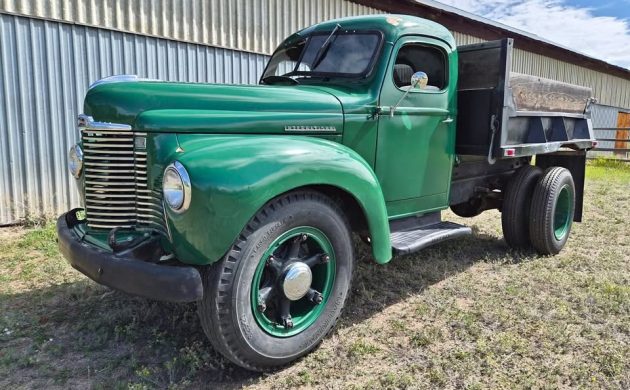
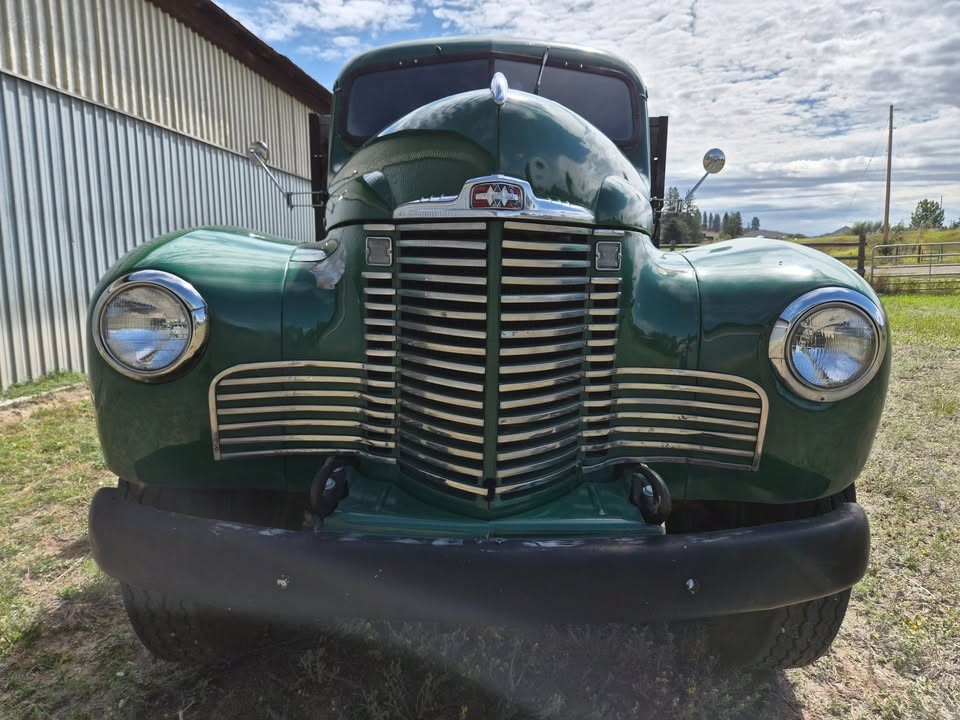
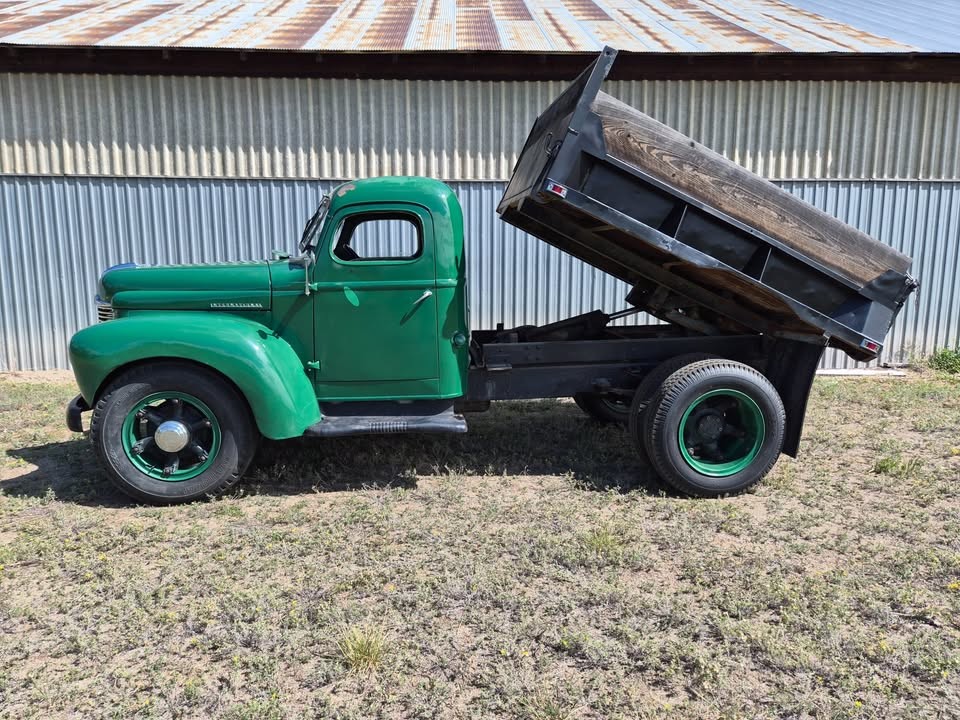
Just nine months from now, the American Truck Historical Society national convention will commence in Springfield, Missouri. We already profiled a Dodge D500 needing a bit of work but certainly acceptable as-is for ATHS. If you really want to stand out, though, here’s another shot at a truck that could take you all the way to Best in Class with minimal effort on your part: a 1947 International KB5 dump truck, restored about ten years ago. Find it here on facebook Marketplace, listed for $9000. This big guy is located in Missoula, Montana, and it’s been cared for and used by a knowledgeable owner. Thanks to T.J. for the tip, so we could profile this gorgeous truck.
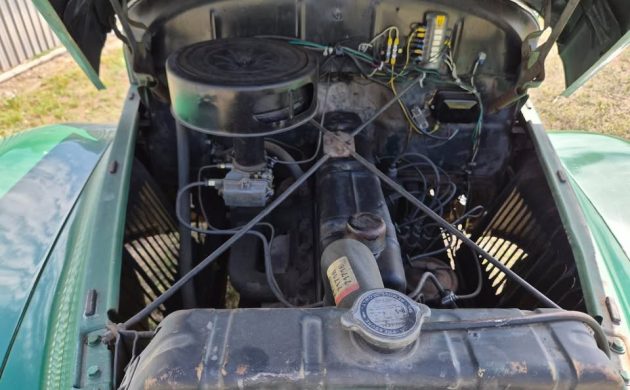
International Harvester was best-known for its agricultural equipment, but it carved a niche in the medium and heavy truck segment starting in the 1920s. The K series was introduced in 1940 and updated to the KB in 1947. Between the two series were more than 40 models ranging from 1/2 ton up to the KB14, in a variety of chassis and bed lengths, optioned with a dizzying array of job-related add-ons. International’s market share slipped during the late ’40s despite a keen population of buyers. Its theory of renovating its models is illustrated by the K to KB transition, which involved a new winged grille and badging – that’s it, and it wasn’t enough for the times. This truck is powered by a Green Diamond 233 cu. in. six-cylinder, capable of just over 90 hp. A floor-shift four-speed manual puts power to the wheels. The seller indicates he “went through the engine”, rebuilt several components, and converted the mechanicals to 12V. The truck has an electric fuel pump and always starts. The dump bed works well. The best news is that the truck has seen regular ranch use with the current owner.
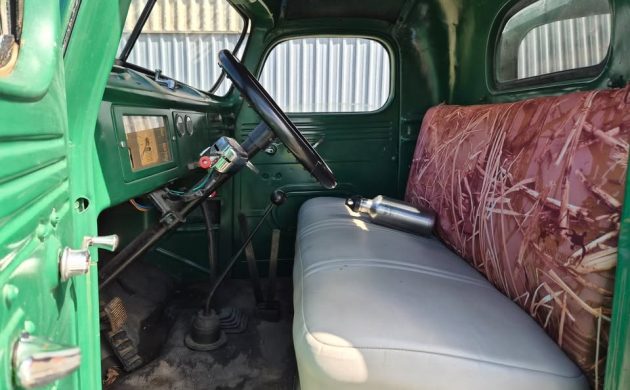
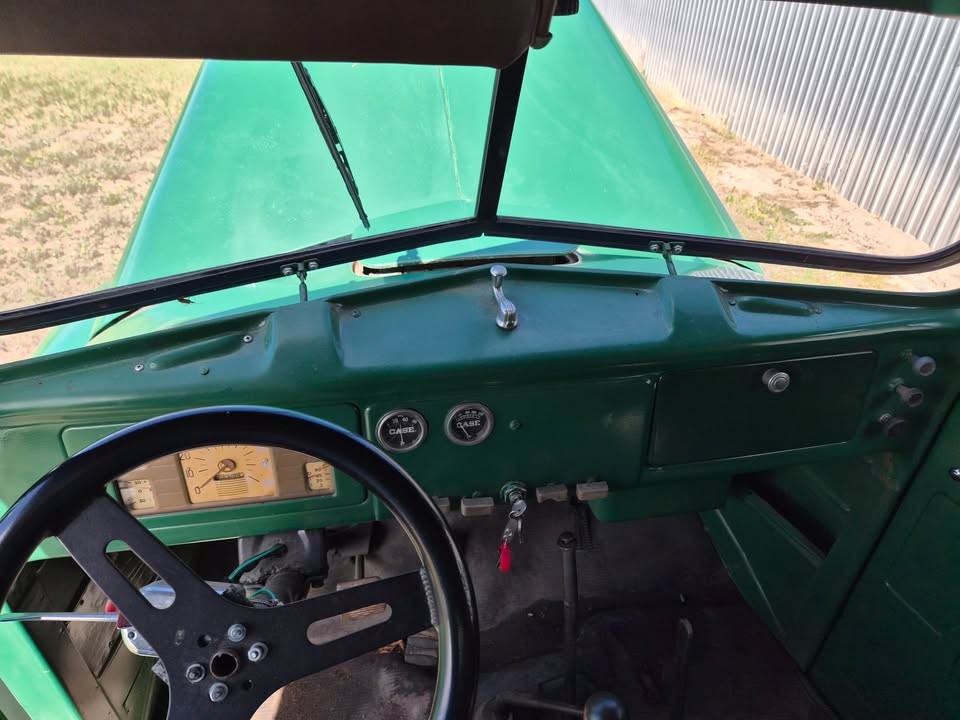
The interior isn’t plush, but this truck performs one of my favorite window tricks (other than opening rear vents): the windshield cranks out. Ok I know that millions of pre-war and just-post-war vehicles performed the same trick but it still wows me. The heater is said to work, but the gauges need an update to 12V to become functional again. Meanwhile, a couple of auxiliary instruments track oil pressure and water temp. I believe the original upholstery was green naugahyde – I might revert to the factory fabric and source an original steering wheel, but other than that, it looks great in here.
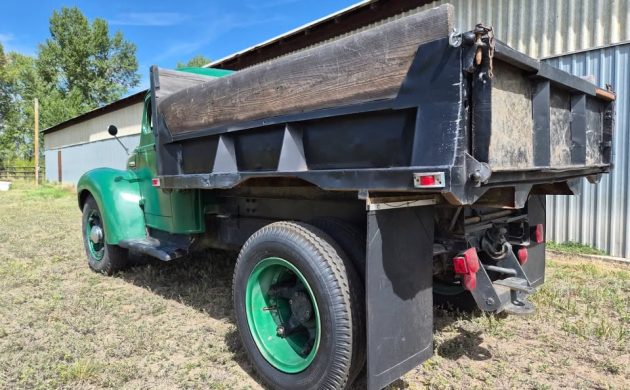
Those rear tires are brand new, and while the wheels were off, the seller rebuilt the brakes and cleaned out the differential. The KB5 is rated at 1.5 tons, so it’s not impossibly large…. What do you think, is this a good deal at the price? If it dropped in your driveway, would you change anything, or just drive it on out to ATHS as-is?




Ms. Rand, while I enjoy all the writers, even Jim O. :),,you are fast becoming my favorite writer( Scotty is busy with his day job), where were you 40 years ago? ( answer is optional)
It’s so important to see these workhorses of yesteryear, they built this country. Splitting hairs really, which was better, as all from this period benefited from the war. It’s tough to correct the author, who obviously wasn’t around then, and has to do a lot of research, and I’d have to bring out the big guns on this, but I believe the Green Diamond was a flathead, this probably is a Silver Diamond 220 that came out in 1950 and replaced the flattie at some point( Geo?). IH trucks were by far, the most popular trucks of that era, and well into the 70s, for that matter. None better.
I wouldn’t do a thing to it. I’m sort of put off when I see these in brand new condition, as they only looked like that once, pulling out of the dealer. They all led a rough life, but after the war, we still hadn’t got to BIG trucks, and since many of these were leftover war surplus, we used a jillion little trucks, instead of 1 big one today. My mentors drove trucks like this, and I never forgot that.
To be clear, I said those cracked tires on the Dodge were okay for around the yard, but common sense should dictate, with any road use, it’s best to have good tires, even if they are tubes. Old trucks are like old farm tractors, all business. No 2 speed indicates it was never meant for road use. Great find and you’ll find out real quick driving it, its limitations. One must be cautious.
Nice truck, for sure. The owner, or someone back an owner or so, repowered this, which wasn’t a bad idea. Not that the GRD engine wasn’t willing to work, it just left a lot to be desired power wise. I might add that the original GRD design was based on the engine that powered the Willys Whippet.
It became International’s baby after IH contracted Willys to build pickups from ’32 to ’33. IH eventually developed it into the Green Diamond and used it until 1949 in lighter trucks, and until 1954 in combines.
This engine is beyond a Silver Diamond, and has advanced into the “Tilt Valve” family, which is sometimes referred as the Black Diamond or Small Black Diamond (I’ll explain that in a little more detail sometime later). In 1955 IH decided to cant the valves over about 10 degrees to help the combustion chambers to breathe better. It did help and also widened the valve cover about an inch. This engine would be known as the BD220, BD240, BD264, BG241, and BG265 (more on that sometime later). Anyways, this would be one of the Tilt-Valve family, and can be identified by a stamping on the upper RH corner of the block, just under the head.
No doubt the GRD engine was either tired, shot, or a combination of the above. Or maybe the owner got tired of adjusting the tappets by either dropping down headfirst into the engine bay or removing the splash panel and going in through the RH side of the engine (to set them HOT? Seriously?). Anyways that’s a later ohv engine that graced IH engine bays from late 1955 to 1973. Looking at that Holley 1904 carburetor, I’d have to say the engine is from the early 60s. Whatever the case it will give the truck a lot faster ride than the old flathead six…
Hi geomechs, did they also continue the non tilt valves on the BD engines, or did they use up the engines they had. I’ve had 2 S120 trucks with narrow valve covers, I checked the one I still have and it’s a BD 240 with a narrow cover, my B120 has a wide cover. The listings for valve cover Gaskets at the Part Stores list with or without, for all mid 50’s trucks
The later 50s is where IH got rather hazy with its sixes. 1956 spelled the introduction of the BD 220 and 240. The BD 264 had been in production since ’53. About the only thing I could ever see with the first small BD engines is that they were no longer silver but black in color. They still had the vertical valves.
If you were running a Canadian truck you would likely encounter a B-240 or BD 264. Funny thing that they all (CDN and US) still used the vertical valve arrangement. Come somewhere in early 1956, after the S-Series was out and Binder changed to 12V, at almost the same time, introduced the “Tilt Valve” engine. BD-220/240/264 in the US and BD-240/BD-264 in Canada.
That arrangement remained the same until 1961 when the C-Series trucks came out. Someone decided they wanted to differentiate between the Canadian and American engines. The Canadian engines now had the designation of BD-240/264 and continued to be painted black. The Americans dropped the 220 and adopted the term, BG-241/265. They were essentially identical to the Canadian engines except that someone decided that the American engines should be painted a different color. And thus the BG engines should be painted a moldy green (I’m still not certain who lost the bet in that color choice). Enter the late 60s and early 70s and someone decided that the differences weren’t needed, so the engines were by then, down to the BD-264 (only) on both sides of the 49th, and joined all other automotive engines in being painted good ol’ #50, Harvester Red.
Rich, your B-120 would have the tilt-valve head so it would have the wide valve cover.
Geomechs. You are a true encyclopedia of old Internationals!! I always enjoy learning something new from all you folks.
Hi Driveinstile. I’ve always been a fan of old trucks, and engines go hand in hand with them. Today, being directly involved with old International trucks, I have access to a lot of information about them. I share information with customers on a daily basis and that’s one of the benefits of the job I have. But my entire career has dealt with sharing information, experiences and even a few unrelated stories. When I took the job with oldinternationaltrucks.com I told people that I would do my best to find them the parts they needed. If that didn’t work, I could always share a good story…
Michelle. This is absolutely awesome!!! I love it.. I’m with you about the interior. And especially the steering wheel. The larger diameter definitely would help with some leverage wheeling this old work horse around. Considering its worked for a living for decades it looks terrific!! I’m hoping it gets preserved in original condition. Thank you very much for writing this up. I enjoyed it!!!
Hey Dave, this is pretty cool, however, I’m not sure it is a 1947 dump body. I’m not sure they used a scissor lift like that, and the whole dump unit is mounted on a separate frame, then bolted to the truck frame. I had a friend who had a newer county dump truck with a severely rusted box, and we replaced it and was mounted just like this. It may have been a stake bed they replaced with a dump box.
One must remember, windshield cranks out, bugs come in. To coin an old KW phrase, “these trucks were so slow, bugs used to smash into the back window”,, :)
Hey Howard, good chance that’s a Garwood dump bed and for most lighter trucks (1.5 2ton) the bed, frame and hydraulics were a package, you just bolted to your truck frame. This is a sweet unit with little left to do but drive it.
I owned a 46 Dodge 1 ton pickup as my only vehicle in 1977 for a couple years. It too had the crank up windshield, a cowl vent that levered up and of course the vent windows. As long as I was moving in summer I was cool.
Howard, both you and Jim have a good point I didn’t think about. Isn’t Garwood the same manufacturer as the boats? My Grandfather and Great Uncle had one. ( the boat not the dump body lol)
My grandfather had 3 of these, were oil trucks, he cut off the back , made a steel form, poured 2000 pounds of cement in each, chains on rear tires, 9 foot manual snow plows, got around firing all blizzards. We still have one truck left.
This is a fantastic truck!!!!!!! YES, show it like this and/or refresher some small things. This is still small enough to drive to cars and coffee or a local car show. I doubt if it weighs much more than 12,000 lbs so could easily be toted on a dually with a gooseneck hitch flatbed trailer to get it home or to further away shows. If it comes east there is also the ATCA national show in Macungie PA. Jim, I have a 1955 F-600 Ford with a Heil hoist under the stake body which also has its own hoist frame and sits higher like this Binder.
Neophyte here, what’s the load carrying an dumping capacity of this truck?
The dump box capacity is a lot more than the chassis capacity!!! I would hazard a safe guess at between !0 & 15K lbs of gravel for your driveway??? Other items would weigh considerably less so your trip to Home Depot would be OK.. That Hitch on the back would handle a good sized tag along trailer IF IF IF The trailer had good brakes!!!!
The dump box capacity is a lot more than the chassis capacity!!! I would hazard a safe guess at between !0 & 15K lbs of gravel for your driveway??? Other items would weigh considerably less so your trip to Home Depot would be OK.. That Hitch on the back would handle a good sized tag along trailer IF IF IF The trailer had good brakes!!!!