
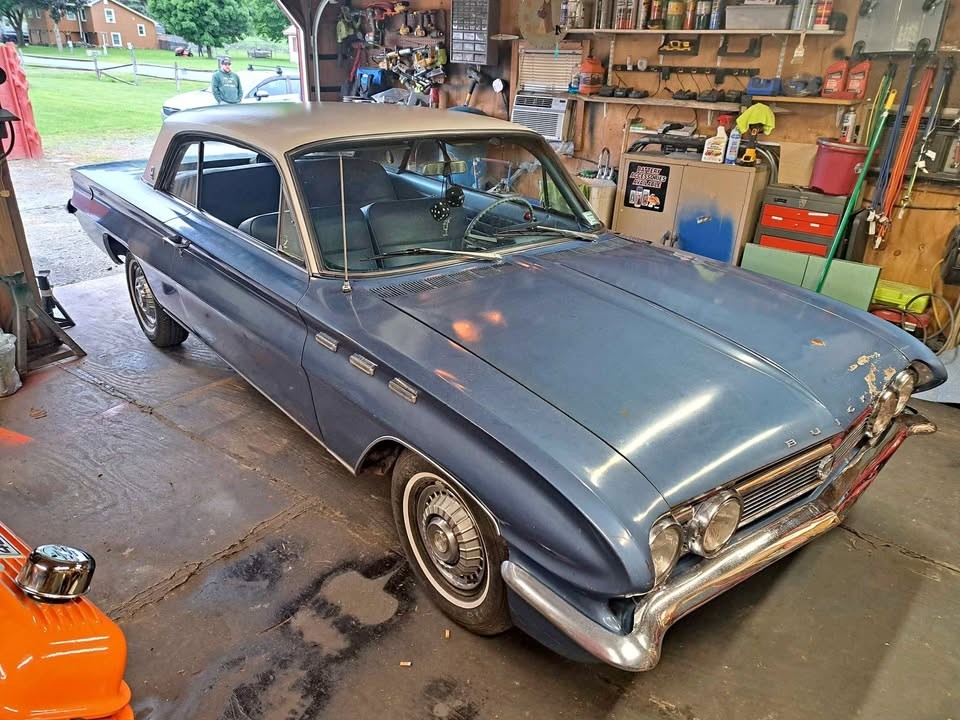
When I think of the Buick model known as a “Skylark”, I automatically swerve to the well-known and popular ’64-’72 variant. Prior to that model run, however, the Skylark badge was an upscale trim package available on the new for ’61 Special and then became its own model starting in ’62. For your review today, I have a very original (mostly) and sharp-looking 1962 Skylark. It’s located in Comstock, New York, and available here on Facebook Marketplace for $15,000, firm.
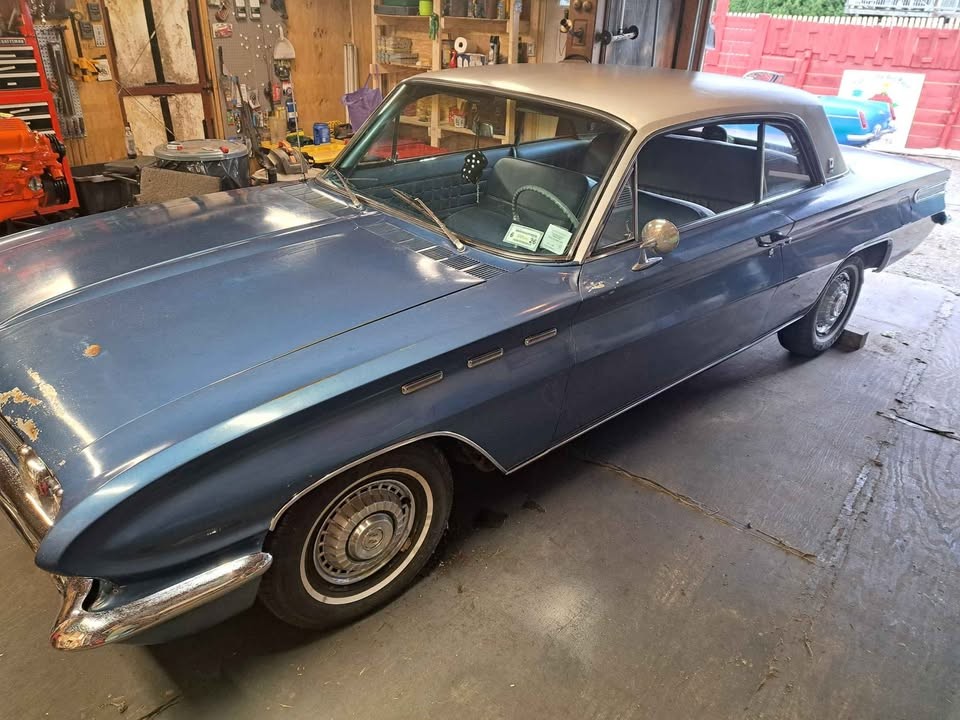
Introduced in ’61 as the Skylark Special, a two-door sedan was the only body style initially available. For ’62, Buick’s upscale compact morphed into both a two-door hardtop and a convertible. Sales were brisk, with 34K Skylark hardtops finding first-time homes in ’62. The seller states that this 93 K-mile example is all original, and it looks it. The Marlin Blue (?) lacquer finish is showing some fade, with just the leading edge of the driver’s side hood revealing any distress. Rust is not apparent, the Arctic White top seems fine, and the chrome bits are just a bit dull. Aesthetically, this Skylark appears to have been well cared for all these 63 years.
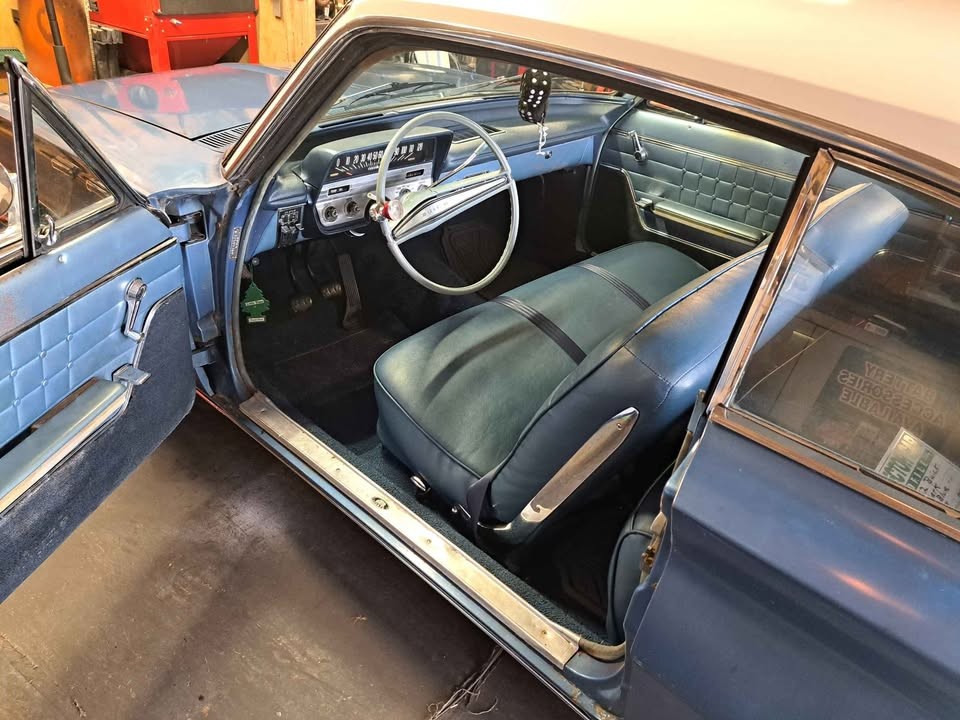
As goes the exterior, so does the interior. It’s a blue vinyl upholstered affair and is very GM-sixties in its presentation. From what can be spied, the upholstery, door panels, and carpet show well with just some arm wear on the top edge of the driver’s side door. That said, I don’t think the seating material is original. It almost seems to be too nice, considering its age and usage, but more importantly, the “no-pattern” upholstery doesn’t match the pleated button arrangement that is revealed in Buick promotional material from the era. Regardless, it’s nice to see the inclusion of seatbelts, at least for the front seat occupants.

This Skylark’s engine room is occupied by a 185 gross HP, 215 CI, aluminum, high compression (premium fuel required) V8 engine, which makes the rear-wheel connection via a three-speed manual transmission. A “Turbine-Drive” (Dynaflow) automatic and a four-speed manual gearbox were available options. “Runs good” is the lone description of this car’s running and driving aptitude.
What drove the Detroit Three to manufacture smaller cars starting in the ’60 model year is debatable. Perhaps it was Detroit’s fourth leg, AMC, with its sensibly sized Ramblers that served as an impetus, or maybe it was the Volkswagen Beetle, or maybe both. In Buick’s case, colossal was the only way they rolled, so some shrinkage was in order and appreciated. And, everyone’s small car formula seemed similar, except for Chevrolet’s Corvair, which was a different approach and seemed aimed, specifically, at VW. How popular a car like this ’62 Buick Skylark is in today’s world is not clear – I’d suggest it’s not what a later generation Skylark (’64-’72) will conjure. What about that firm price of $15,000? Priced right or not quite?




I had a friend that had 62 convertible, red with a black top.Black interior with bucket seats with the 215 v-8 and a 4spd.
It was a nice little car and that 215 was a nice running motor.
Years ago, their use to be a customer that had the same model & color. He would park and leave his dog in the car with all the windows rolled down. The dog would sit bolt upright on the passenger side ignoring everything and staring at the entrance the entire time his owner was in there.
Valve covers say Nailhead yes??
Actually, not. The 215 was a precursor to the 350. The Olds 215 and the Buick 215 used different design cylinder heads.
Yes, the Olds head used an extra bolt in each head, probably to provide a little extra clamping force to withstand the turbocharged version of this engine that Olds offered in the F-85 version in ’62.
No, Buick’s nailhead engines (264, 322, 364, 401, 425) had their distributors at the back of the block and the valves on the inside banks of the heads.
Beautiful looking car. I got to see one like this in person. The one I saw was red with a white roof. 1962 is my favourite year for the Buick Skylark until 1964.
Mike, In high school I had a ’55 Chev convert. My dog (a German Shepherd) did the same thing. I could even leave the keys in the car and no one even came close. She was supposed to be sitting in the back seat. But always jumped into the front seat to peer through the windshield.
I like this car alot. My first contact with one was a red convertible that was owned by my cross a street neighbor when I was in 1st grade. I thought it was alot cooler than my Dad’s Dauphine then, and I still do.
Nice car, but I suspect that it is equipped with the work a day lower compression/lower hp 215. I had a ‘62 Skylark back in the day with an automatic, buckets, and the “Ultra High Compression” 215. The air cleaner loudly proclaimed what lay beneath, and the valve covers don’t look right to me either. That would put the subject car’s hp at 145, as opposed to 185, if memory serves.
The UHC mill made for a quick baby Buick!
Note the attached; the 185 HP engine is all that was available in ’62.
JO
I think you’re right, the basic 215 had an 8.0:1 compression ratio with a two-barrel carburetor, the High Output version came with a four-barrel carburetor and a 10.0:1 C.R.. I saw a four-door version of one of these for sale in Hemmings, for $11k. It’s still available, IIRC. Here’s a link:
https://www.hemmings.com/classifieds/listing/1962-buick-special-englewood-co-2877132
Nice little car and a reasonable way to get into the collector car game.
3-speed stick shift on one of these is very, very rare. I have attended and judged national Buick Club meets for 40 years and never seen a 1961-1963 Skylark with 3-on-the-tree.
The bench seat is unusual, but I would say detracts from its value, especially with the wrong upholstery. Bucket seats were standard in these Skylarks from 1961-63.
“Old man” spec. Bench seat, painted roof and three on the tree in these years probably meant the original owner was a depression-era, frugal gentleman by the time the GM A-bodies rolled around. “Now get off my lawn!”
Note the attached; bucket seats were an option, not standard.
JO
A couple things to unpack with that advert. Looks like cloth inserts only, in the center of vinyl bucket seats. Never seen that on a factory car. Also, it appears the front door cards have a cross-hatched egg crate pattern while the rear only used horizontal lines.
I have owned a few of these. Paint color is Cadet Blue. The interior is not the original upholstery – it’s been recovered. For whatever reason, these cars are not that popular, but they should be. They are a great size – much smaller than most 60s cars, without being too small. Very maneuverable. Really nicely trimmed inside and out. Quite luxurious. What drove Detroit to produce smaller cars in the early 60s? The sales success of the Nash Rambler and the Studebaker Lark in the late 50s. This led to the 1960 Valiant, Falcon, and Corvair. In 1961 GM went a step further and Buick Oldsmobile and Pontiac began offering smaller cars that were a bit more luxurious. Dodge began offering the Lancer. Mercury began offering the Comet (though that may have come out in 62 or 63). GM decided to go to a larger body with body on frame construction in 1964. The 61-63 Specials and Skylarks are unibody. The transmission is NOT a Dynaflow. It’s called the Dual Path Turbine drive and it’s its own unique unit. It’s air cooled. It has 2 speeds. Oldsmobile and Pontiac offered different transmissions. Oldsmobile had a 3 speed unit and Pontiac had the transmission at the rear of the car. Is $15,000 fair? If the paint was a little nicer and if the interior was in the original pattern, maybe. I think it should be priced a little lower. These are great cars. It is too bad more people haven’t discovered them. You do have to be careful not to let the engine overheat in these since it’s aluminum – but if you can manage that you’ll be fine. Incidentally I have seen one of these with a 3 speed on the column before. A 4 speed on the floor was also an option. The great majority were automatics
The original paint has oxidized slightly, but that shouldn’t detract from the price as “It’s only original once!”. If the paint is thick enough, the oxidation can be buffed out with some light polishing compound, restoring the shine for almost no money and an afternoon of effort with a buffer. Otherwise that lacquer paint will be a major chore to repaint, as I’m not sure if the EPA still allows lacquer paint to be sold anymore! The “three on the tree” is very rare and worth the price of admission alone, IMHO! It reminds me of my Mom’s ’61 Special, which was this same shade of blue on the inside, but white on the outside. Mom’s was an automatic, though. GLWTS!
This 215 was bought by and in the Rover for years .
What a great piece of Buick’s History
Cute little car. I had the 1963 V6 version. Well made by the standards of the day but otherwise is a bit crude. Mine went 98K miles before I fell in love with a V8 Camaro.
Price might be better at $10-12K. Spoken as an expert on the value of old stuff.
Drove it’s plain-jane sister Special (’61 version) with the V-8 and Dynaflo (Powerglide) as my first car. Wish I still had it now.