

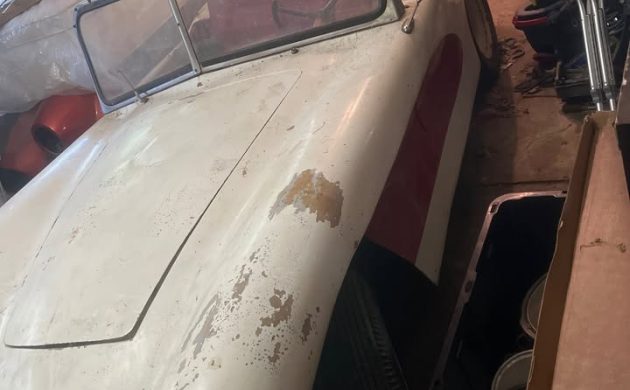
You don’t see one of these every day. In fact, most of us never will have seen one at all. It’s a 1948 Crosley Almquist, a tiny sports racer that was the result of mounting a fiberglass body designed by one person (Almquist, on whom more below) on a chassis that originated with someone else (Crosley, ditto). Terry is the tipster who found this one here on Facebook Marketplace, and if you’ve got a winter to spare, like the one coming up, you might be the person to bring this little roadster back to life. You’ll have to come within shouting distance of $7G’s, though, if the seller is serious about his asking price, which is $7400. You’ll then take a trailer to St. Peters, Missouri, to collect your project.
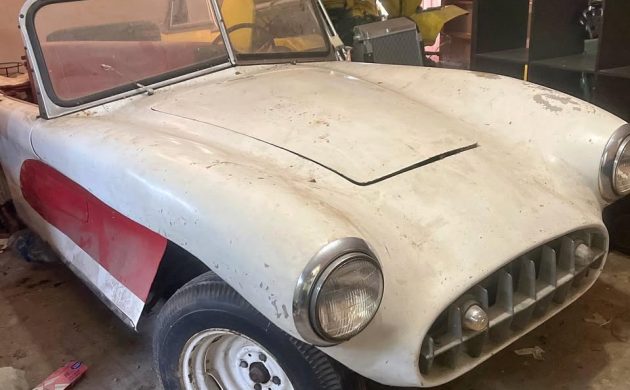
The Crosley Almquist sits at the intersection of two small manufacturers’ efforts to produce fun automobiles. Crosley was the brainchild of Powel Crosley, Jr., who earlier made his fortune in the auto parts business and later by making a line of portable, inexpensive radios. This put him in a rather financially advantageous position during the 1930s and the war years and after to manufacture automobiles. The trouble was, many Crosley models had kind of bulbous, non-streamlined body styling. You don’t see a Crosley and think “racing.” Enter Ed Almquist. He became known for designing and selling “go-fast” parts, starting in the immediate post-war year of 1946. It didn’t take him long to produce bolt-on bodies for chassis such as the Crosley, and thus the world was given the perfect blend–compact, proven chassis and drivetrains complemented with sleek and sporty sheet metal. Er, I mean fiberglass. Call these early Corvettes if you want to find a way to categorize them. Or just see them for what they were, when completed: “home-builts,” to use a term of the time, that would see a sports car enthusiast through a weekend of club racing and maybe even be his transportation home at the end of the meet.
So if you like that history, what about buying this car? The seller says this is one of the best barn finds in Missouri. How does one evaluate such a claim? Is Missouri a big state for such treasures? Maybe you should just go on instinct. There are some unknowns. What engine is actually in the car? Some basic research shows that original Crosley engines were sometimes displaced in favor of Ford Flathead V8s as owners endeavored to make these cars competitive for racing. This engine apparently has gone 1,111 miles, which should probably be read, “I’ve got to put a number in this miles field, and my finger is on the ‘1’ key right now.” So you’re kind of on your own there. A similar moment of delusion might have overtaken the ad writer when he said, “Me, personally, I’d keep it the way it is….” Huh? You mean in a pile of parts and non-running condition? I don’t get it.
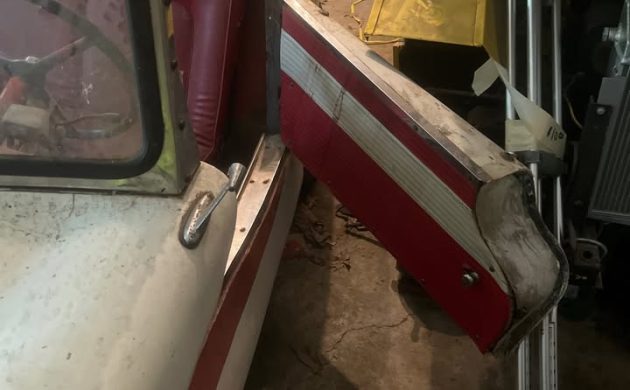
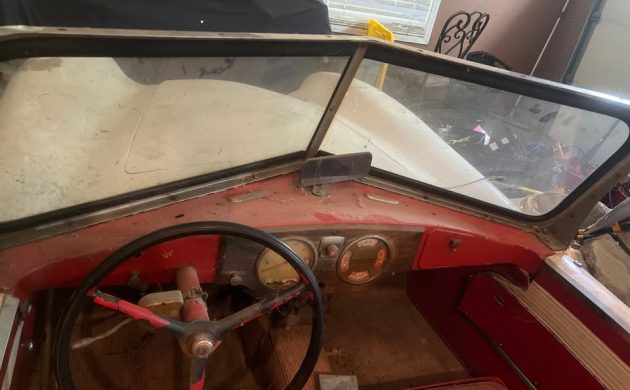
Look carefully at this ad. There’s not a lot of info offered, and the images are not terribly revealing. The fiberglass might or might not be all there. The interior is spartan at best and needs complete renewal. The engine–well, it would be nice to have an image of same. No dice. Do you feel like taking a risk? There are, as the seller might affirm, not many of these in the market. It looks like you could get a finished one in the mid-$20K range. That actually suggests that the present car is priced about right. Put some money into it without fearing getting in too far, and you can decide for yourself whether the red coves look is for you, or if a different livery is how you want to present this car to the world.

4 lousy pictures of a grungy car all for $7,400. What a deal!
Looks like it could be the car that was on Bring a trailer some 10 years ago. If so it was said to have the original CoBra engine.
Zora is turning over in his grave & weeping.
Ok, I’ll start this one off. The 1948 Crosley Almquist originally came with a 44-cubic-inch, 26.5-horsepower overhead-cam straight-four engine. I don’t think these cars were necessarily manufactured for speed and racing. What do you think?
I think they were no more made for speed or racing than the original Corvette of 1953, with its ‘Blue Flame’ six. Both were ‘halo cars’. I think this 1948 Crosley possibly inspired the design of Corvettes in that it not only has a fiberglass body, but the styling is too similar to early Corvettes to seemingly be a coincidence.
These engines were able to be upgraded to put out 100 hp at 10,000 rpm. They were built for race cars but a friend who helped me rebuild my ’49 had one of those engines in his street car. He let me drive it and it was amazing compared to my car.
Crosley’s were the Yugo’s of the late 40’s early 50’s.
The 1980 Yugo was manufactured with a 0.9-liter (903 cc) overhead-valve (OHV) four-cylinder engine that produced 45 horsepower.
Ron, What do you think is under the hood? V8?
https://crosleykook.blogspot.com/2012/02/look-at-almquist.html?m=1
The reversed wheel rims says it all. Looks like a massive project but if you like a challenge give it a go, bestow luck
To me, this has all the indications of, “My wife told me I have to many project cars. So I’m going to do the absolute minimum to be able to say, ‘See, no body wants it.'”
This car was listed for sale in Ohio in March of 2015 for $ 8900.00. Eleven years later, the person who bought it has lowered the price. If someone wants to restore and save this little historic toy and curiosity, I would recommend keeping it on private land, as it might prove a bit “vulnerable” on public roads and highways.
Brian, nice write up. I was Ed Almquist’s neighbor for many years in Pennsylvania. I grew up with his son, we were college roommates and still close friends. Ed died a few years ago in his 90s. I have many pieces of Almquist literature. He certainly was a pioneer and told me a highlight of his life was meeting Henry Ford. Ed was a brilliant engineer. His one downfall was he did not believe the small-block Chevy, introduced in 1955, would take off like it did. In the 70s, he was driven to improve fuel mileage and had a crystal ball about that. Maybe we would not be in the mess we are today burning millions of gallons of gas daily had car makers listened to him. He could get 35 mpg out is 1982 Buick Riviera. He showed me how to drive properly to conserve fuel. He hooked a vacuum gauge to my 1972 Pontiac in 1975 and made me learn how to drive like there was an egg on the accelerator pedal. This is a cool car and there are other cars Ed was involved in. One of his cars was just at Bonneville for speed run. Again, thank you for a great write up. As a side note, I was the editor of Hemmings Muscle Machines and wrote a column on Ed 20 years ago.
Ed reminds me of racer and designer/engineer Smokey Yunick. I followed his articles in Popular Science decades ago when he designed a way to reroute the exhaust on a V8 and cool it sufficiently so it could be sent back into the intake manifold and the unburned hydrocarbons would become fuel. As I recall he got around 40mpg or better with it, but unfortunately GM bought his patent and shelved it. Were it not for that we all could potentially be driving 60mpg V8 cars with no catalytic converter necessary.
Looks like a go- kart for the kiddies.
This crosley amlquist roadster would look perfect next to my hoyt-clagwell tractor.
Check out Geoff Hacker + Forgotten Fiberglass to see more of this beautiful classics family…..
Just a very cool little car. The reverse wheels kind of look cool also. I imagine a Hyabushi engine would really perk this up!
Not much effort to market or display this rare car. Just a little more effort might result in worth while money returns. Perhaps 30 minutes of more useful photos might produce a quick sale. Seldom see one of these available anywhere..
I guess we still don’t know what engine is under the hood. Lots of options, I suppose, concerning more powerful engines, but because of its history, I’d say let’s keep it the way Mr. Almquist made it
this is the modern sales technique if U ask me (dont unless wanting an earfill). “Dont phone, take my time, email, ask any Qs. Just give me the money (whatever is asked) and go away.” Worse? I belive pic lie
I thought I knew the 7 or 8 crosley models. Like 5 or 6 of them (not CoBra motor though). Pretty sure I never saw the ‘gen 1 vette’ copy. Year’s not over and U shown me 2 cars I’ve never seen (abt ‘par’ for any of my years here so far). Keep it up or bring back the ‘Metro wagon”, 4 wheel Isetta, Honda S600 (FB model) or one never seen here:
https://upload.wikimedia.org/wikipedia/commons/0/08/Autobianchi_Bianchina_Furgoncino_tetto_basso.JPG?utm_source=en.wikipedia.org&utm_campaign=imageinfo&utm_content=original
🎼 These R a few 🎶 of my favorite things 🎵
Might add this Y/M/M~
This thing is sitting on it’s drum and my wife is nagging me to get rid of it. I’ve had about 10 beers, I’ll throw a wheel on an take a coupla pictures, ask sevenny for hunnert fer it. That shuts her up.