

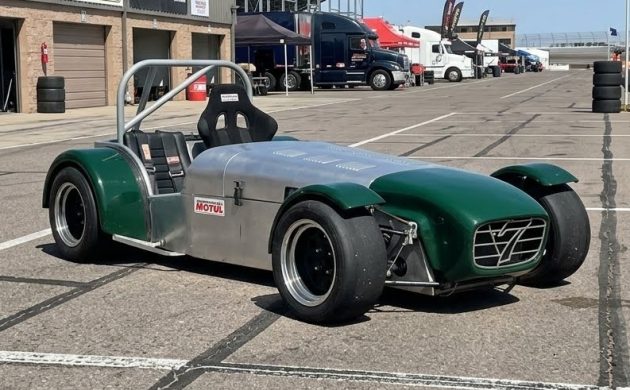
As some of my fellow Barn Finds writers will confirm, motorsport can be expensive. Building a car utilizing high-end components can cost a pretty penny, even if you adopt a DIY approach. However, this 1996 Locust Lotus 7 Replica could provide an affordable alternative. It is a turnkey proposition, allowing the buyer to hit the track immediately. In the Lotus tradition, its maintenance should be straightforward, allowing the new owner to spend more time on the track than in the pits or the workshop. The seller has listed the Locust here on eBay in Flagstaff, Arizona. They set their BIN at $14,900 with the option to make an offer.
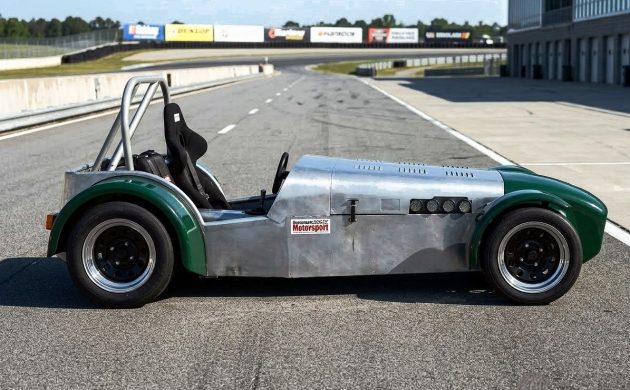
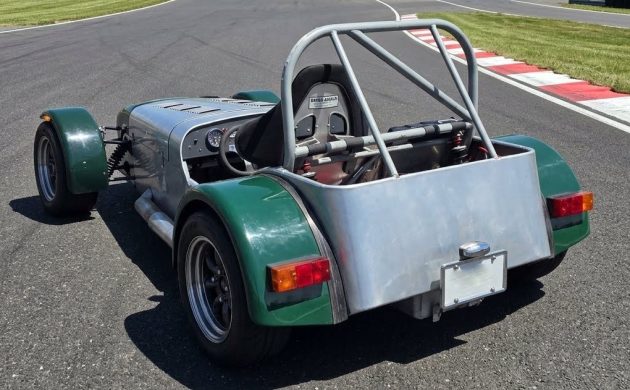
The brainchild of Moss Motors founder John Cowperthwaite, the Locust was a kit car that utilized elegantly simple design principles, mimicking Colin Chapman’s Lotus 7. The car features a tubular steel chassis with a 12mm marine-grade birch plywood body “tub” that is bolted and bonded to the steel frame. This process resulted in impressive torsional rigidity, allowing the suspension to work extremely effectively. Most of the exterior is wrapped in aluminum sheeting, while the builder utilized molded fiberglass for the nose and fenders. The car’s presentation is quite tidy, with the panels polished and the fiberglass components wearing iconic British Racing Green. The contrast is striking, but it allows scope for relatively straightforward personalization to cater to potential sponsors. The robust rollbar offers excellent protection should things go horribly wrong. It is worth noting that while the Locust is currently a Track Day Car, it does feature brake lights. The seller includes a headlamp and indicator kit, giving this beauty scope to become a roadworthy, legal road rocket.
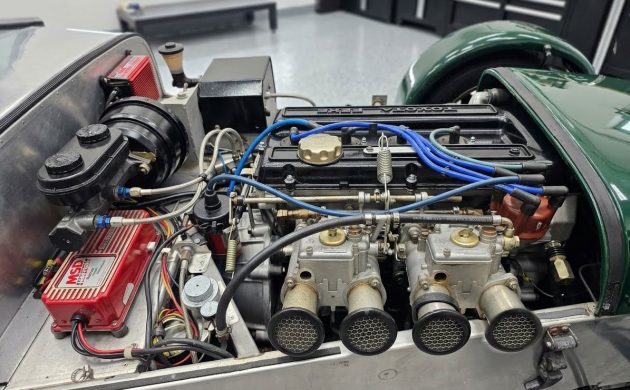
Power-to-weight is a crucial consideration when constructing a race car. The fewer pounds a motor needs to shift, the better the performance and handling should be. In the tradition of Lotus, this Locust weighs about the same as my left leg. Okay, that might be an exaggeration, but its curb weight will be exceptionally low. Locust typically utilized Ford mechanical components for these classics, but this car follows a different path. The 2.0-liter JDM Toyota DOHC four-cylinder engine inhales through a pair of Weber DCOE carburetors, with the spent gases exiting via headers and a custom Oceanside exhaust. The motor generates 175hp, which feeds to the live rear end via a five-speed Toyota T5 manual transmission. The driver will feel the impressive power figure when they floor the gas, with the Locust capable of accelerating from 0-60mph in around four seconds. That’s supercar territory at a fraction of the price. At the same time, the low ride height, double-wishbone front suspension, and the large, unassisted brakes mean that the Locust has handling and stopping power to match its outright performance. Potential buyers can consider this brutal beast a turnkey proposition.
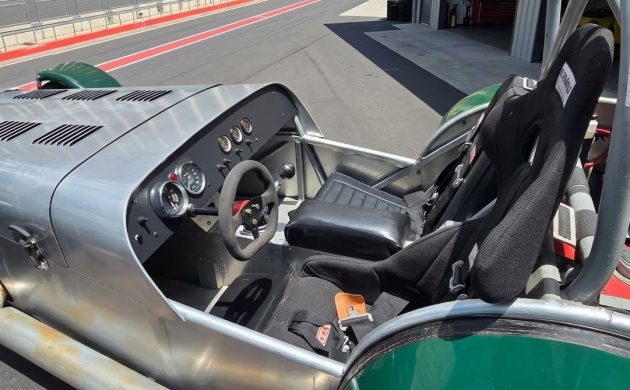
As a racing machine, the Locust is short on creature comforts. There’s no air conditioning or cruise control, and no stereo to drown out the bellow from the twin-cam beneath the hood. It is functional and designed to keep weight to a minimum. The driver is secured in the body-hugging racing seat with a six-point harness, while the passenger is secured in a less supportive seat with a four-point harness. The center armrest is the only comfort feature, with the dashboard housing the gauges crucial for monitoring the car’s mechanical health. The flat-bottom wheel is a practical consideration, and its suede covering will provide excellent grip. The interior is clean and tidy, and the buyer might choose to add a radio if this classic is destined to serve double duty on the road.
I built my last race car approximately twelve years ago, adopting a hands-on approach. Admittedly, I used high-quality components, but the parts bill reached $25,000 before I was finished. I could have reduced the cost by compromising, but that would have cast a shadow over reliability. This 1996 Locust Lotus 7 Replica is considerably cheaper than my last car, and the performance it promises would be eye-opening. It is ideal for someone wishing to dip their toe into the racing world, and with impressive listing statistics, I suspect it will easily find a new home. The big question is whether it could be yours. Are you tempted?

“Locust”? It’s a shame such an interesting car would be named after a destructive insect. Why not “Cockroach”? Nevertheless, I’d love to daily drive this. A lot of folks would notice, unfortunately so would the cops. I’ll have to pass or I’d lose my license.
I could sweat these are actually “Locost” Super 7s, but my recollection is a bit vague…
You are correct.
A buddy of mine built one of these back in the late 90’s. They are great fun on and off the track.
Owned a couple while living in the UK. My dad was friends with Colin Chapman, Founder of Lotus, so have fond memories and enjoyed the 7 often on country zid-zag narrow roads…….a blast going through the gears!!
Locost…
Yes, very tempted. But probably a little older than I need to be for this.
15 years ago? Maybe, though couldn’t afford racing then while raising 2 kids.
Now, I’d just get myself in trouble with this little rocket.
Get. Myself. In. Trouble. O doubt
These cars are also excellent autocrossers. No trailer and tow rig needed.
I am going to assume that these handle better than a Super 7 due to a little more weight in the front. I never get tired of watching Super 7s understeer out on the autocross course. They handled better than most “sports cars” but their real claim to fame is light weight for quick acceleration and serious braking. Luckily, in most cases, a track day car can be anything. No matter what you “brung” being out on the track is just a blast. The faster it is, the more likely you can “dice” with others out there. Which is part of the fun. But generally, as long as it’s safe and you meet the minimum safety gear. Go have some fun. So having the best equipment isn’t always needed for a track day experience. For me, the faster the better, so speed costs money how much you got to spend? But don’t feel you have to be super fast just to have fun.
Some clarification- there is Lotus, there is Locost, and there is Locust.
This is a Locust. If you can fit in it, this is a smoking deal on what looks to be a very well sorted out little weapon of a car. IF you can fit in it.
In the mid-nineties, Ron Champion created the plans and general instructions for the Locost that was offered in a book offered by Haynes. The Locost was a modernized iteration of the original Lotus 7 using modern, readily available parts on the dimensionally identical Lotus 7 square steel tube space frame. There was never a Locost kit although many one-man shops in the US and UK offer parts such as the fiberglass bits (www.kineticvehicles.com), windshield frame, etc. The plans are open source on the net and there is a huge online community supporting the care and feeding of the Locost and all its variants.
In the mid-1980s, John Cowperthwaite in the UK made available the JC Locust, a Lotus 7 inspired ‘kit car’ first presented around 1985 by his company J.C. Sports Cars / J.C. Auto Patterns in Sheffield. Only it wasn’t a kit, it was a set of plans based on Cowperthwaite’s ‘pattern’ principle he used on his earlier cars using full scale patterns for parts cuts. The biggest difference between the Locost/Lotus and the Locust was in the all steel space frame used in the Locost/Lotus versus that of the Locust- a tapering steel ladder frame that was then covered with plywood that was bonded with the aluminium skin, creating a very structurally rigid semi-monocoque structure. Very different. Better or worse? No idea. Like the Locost, the suspension and motor/trans bits were up to the builder.
So basically they’re the same but different, particularly in the construction of the frame. The Locust is dimensionally the same as the Lotus 7. Colin Chapman was at best 5’7″ tall and skinny as a whip. I’m 5’11” and… well let’s just say I’m big boned and will never fit in either the Locust or the 7 (I tried. It was not pretty.) so keep that in mind. Also, the pedal box is one of the smallest there is so even if you’ve got wee little girlie feet, racing shoes are necessary. All of this is why I am currently building a McSorley 442E- a Locost that is +4 longer, +4 wider, and +2 taller with a Ford Ecoboost 2.0 and a T5 5 speed.
Thanks for that; I’d forgotten about the Locust. Just went and looked up images, and the most obvious visual difference seems to be the nosecone; the Locust has that angled lower half join which the others don’t.
I agree about the shoes; I’m taller than you and have size tens – but I can fit in and drive a Lotus with my racing shoes on. I kept them and the gloves when I stopped racing; gave the rest away. Still got old overalls and helmet which’ll do for track days…
jason hinkle, thank you for that good info!
Ever since helping restore a Fomula Jr. and taking a few laps in the car at Blackhawk Farms. I have wanted to play with an open wheel race car. And I appreciate everything Colin Chapman. (even if it is a variation there of) I am currently undergoing track withdrawal ever since selling our Spec Racer. (illegal for spec racer class that we ran track days with) Which was not the fastest accelerating, but handling and braking had few equals. So looking for a new inexpensive track day car. This car looks like fun. But not cheap enough for me at this time.
The 750 motor club had (have?) a championship for these. One of my 2CV racing pals had one, but I don’t think he ever raced it.
Locost because they were cheaper than Caterhams and other 7s.