
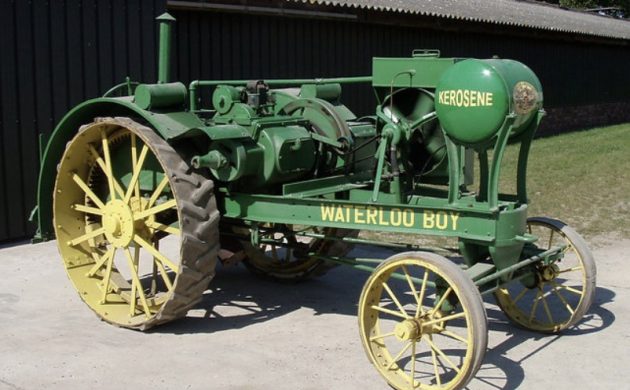
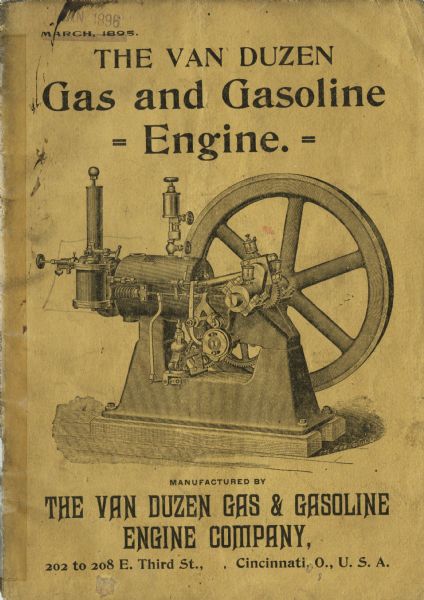
Today’s tractor is one of the rarest on the planet, entwining an early upstart with an established plow-maker to transform John Deere into what it is today – one of America’s premier manufacturers. The Waterloo Gasoline Engine Company was founded by John Froelich, who, with Louis Witry, cobbled together a Van Duzen gas engine with the drive shafts, running gear, and pulleys from a steam engine to create the first tractor the world had ever known. That machine did not enjoy commercial success, but after the sale of the company in 1895, the new owners revisited the tractor idea, finally launching the Waterloo Boy in 1913. The Waterloo Boy was smaller, cheaper, and more nimble than the giant steamers that farmers were coping with back then – so they sold like hotcakes. In 1918, John Deere came calling. Deere paid $2.25 million for the Waterloo company, retaining the brand name through 1923. Confession time: I so wanted to feature this gem of a tractor that after waiting for several weeks to find one for sale, I settled for a listing that may not be current, here at Happy Old Iron. Worse yet, this 1923 Waterloo Boy is located in the UK! Sorry about that…. anyway, the price is €95,000, which is about right for this unicorn.
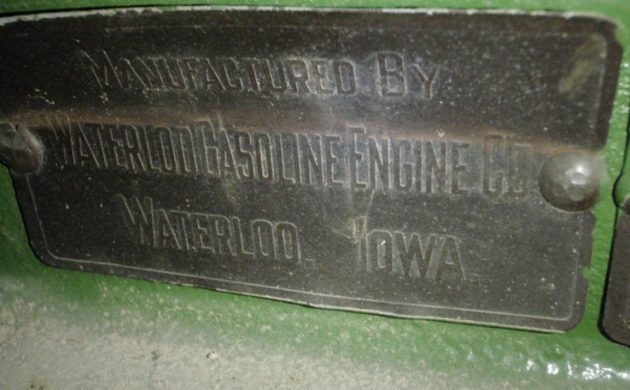
This tractor is a Model N, the last of the Waterloo brand before John Deere introduced the Model D. Though the branding changed, the paint colors remained – the green and yellow scheme epitomizes Deere today. Another comforting constant has been the Waterloo manufacturing site – John Deere’s largest, and the center of its tractor operations.
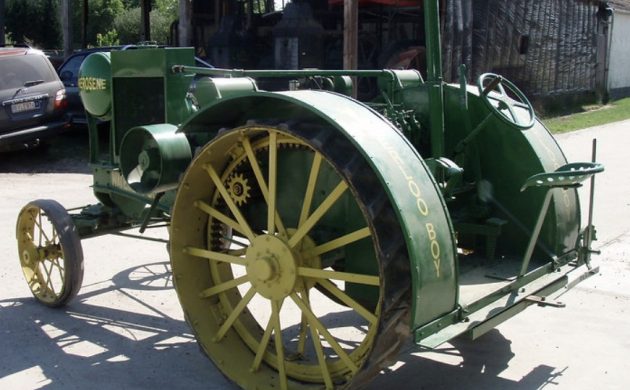
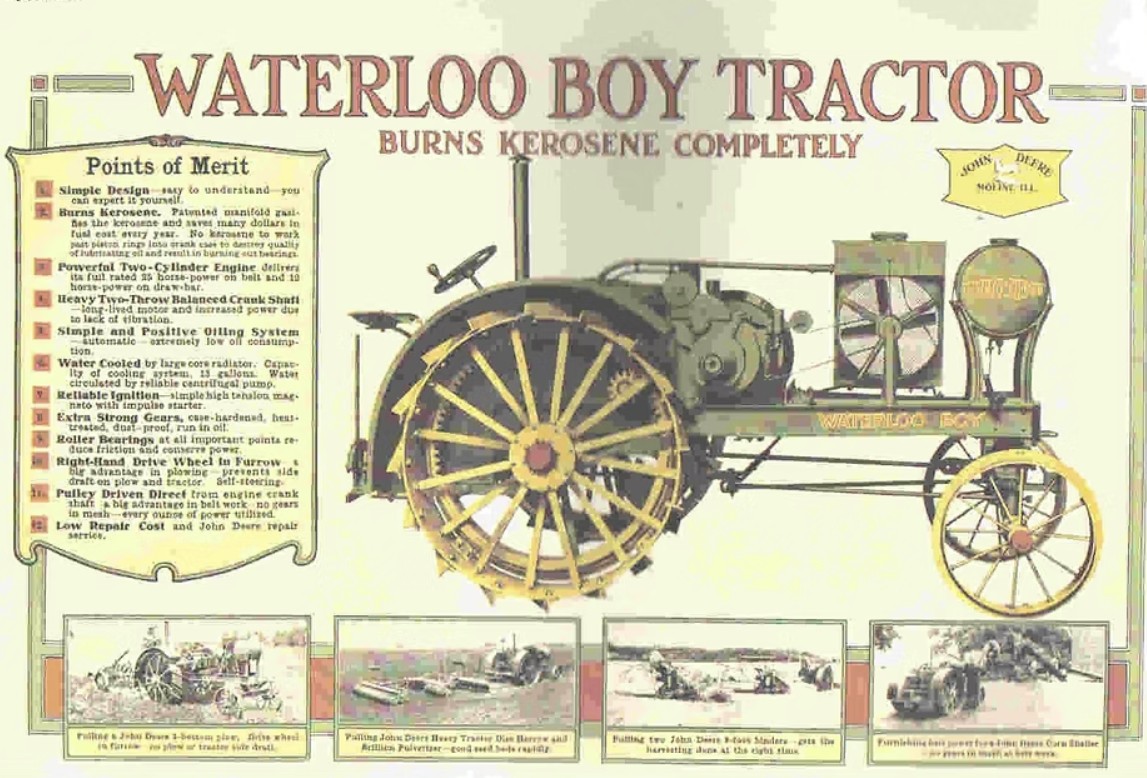
The Model N was an improvement over the older Model R. While the engine remained nearly the same – a horizontal two-cylinder cast en bloc with generously sized water jackets and capable of running on kerosene – the gearbox now offered two forward speeds (high gear=3 mph, low gear=2.25 mph) and reverse. Once John Deere arrived on the scene, the steering was switched from chain and roller to worm-and-gear. A force-fed lubrication system with sight glasses mounted on the engine kept the internals happy. The tractor was capable of 12 hp at the drawbar and 25 hp at the pulley. While the Model R could haul a two-bottom plow, the N was a three-bottom machine.
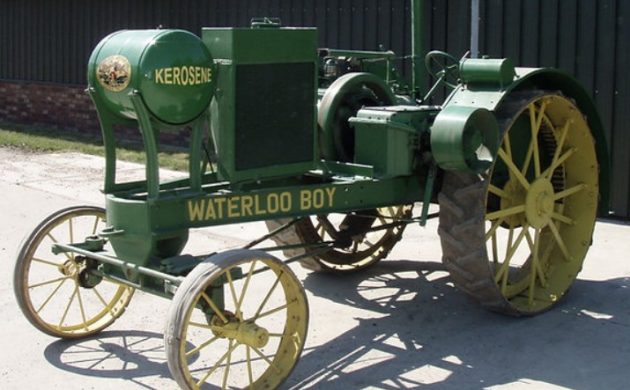
Note the kerosene tank – it’s set high to facilitate gravity-feed to the carburetor. And speaking of the pulley, the Model N was equipped with a 14-incher, vastly expanding the tractor’s usefulness. If you’ve ever been to a steam show, you know that a motorized pulley can make ice cream, saw logs, pump water, wash clothes, and grind grain – just a few of its hundreds of uses. When new, the Waterloo Boy was priced between offerings from International Harvester on the high end and Fordson on the low end. But thanks to ease of maintenance, durability, and its reliance on cheap kerosene rather than dear gasoline, a few tens of thousands of units were sold. As noted, that doesn’t make it easy to find one today. At least the infrequency of Waterloo appearances on the market serves to give prospective collectors time to save up for the bidding process: in October 2025, this 1917 example sold for $97,500. Have you ever seen a Waterloo Boy in action? Or even at a show?




Special thanks to the author for redirecting our interests away from $40,000 Pontiacs, to, um, well, something besides that, $40,000, Pontiacs, jeez,, and to the teacher, Ms. Rand, who needs this “Euro” jazz,, give it to us in YANKS,,,or 95,000 Euros is $109,746.38, plus shipping? Another $109,000. Sorry, they’re dreamin’ in Belgium too. It’s a disease, worldwide apparently,, as vintage tractors HAD a following, but like all these things, interest and capabilities are fading fast. Couple years back, I saw’r an auction for farm tractors, stuff like this, you could could the attendees on one hand, and seemed $5grand was about all these “other” no/gray hairs were willing to spend.
Looking at it, the only thing recognizable is the 4 wheels. It’s amazing to see the transition, and probably what the authors and this site do best, is show folks a little history, since we can’t afford it now. I read, this tractor had a list price of almost $1,000 new, however, one post said their grandfather bought one new for $470, so apparently they were willing to deal. This, as “corny” as it looks, revolutionized farming.
Absolutely appropriately said, Howard-thank you.
Another automotive icon-the tractor. It’s incredible the vastly different parts of our current existence that the tractor has touched and you’ve given us an excellent example of their origins, Michelle. Nice job.
Very interesting. Great write-up, Michelle.
I never knew the origins of JD.
More like this.
And it was very easy to plug Euros into google and get the equivalent, no rocket science needed.
These were a start and go power unit as opposed to the steam engines of the day. They transformed into the D in ’24, which had a 30 year production run. JD ran 2 cylinder engines ( both flat and upright) until the 10 series in ’60.
It is important to note that a “bottom” as a plow was referred to back then was the moldboard from a horse drawn plow. They scratched about 4″ deep and 6″ wide. Having walked behind one, I often wonder how they could plow a field at all fighting the twisting handles, especially needing to guide the horse as well. A farmer would work all season and possibly get enough ground tilled to supply food for the horse and a bit on the side for the family. It was really tough going.
Along came this Waterloo Boy, which began to change that dynamic. No longer did the product all go into horse feed.
But really it wasn’t until the John Deere B came along that tractors like this were able to not only make their payment, but also make food and money enough to plow more acreage. That was the beginning of the industrialized farming era.
It wasn’t until after WWII that power tractors out numbered horses. Think about that.
Modern “bottoms” are much bigger, and a 3 bottom plow takes over 100 hp to pull.
Cool to see write ups like this. These are historical artifacts and unless you have plowed behind a horse, you really cant imagine the relief these brought to the industry, even as crude, rough riding and cantankerous as they were.
I do wonder if the number of collectors is diminishing as us silverhairs pass on.
Well stated. I have not plowed behind a horse, but have a close friend who has. The success of plowing behind a horse or team of horses begins years beforehand. The care, training, and relationship a farmer develops with his team are critical. Observing Amish farmers, plowing a straight row is one level of success, but training a new horse to execute a proper turn at the end of a row is an entirely different level of success.
I would rather try to train a mule for plowing over a horse.
We had JI Case Model DC which if I recall correctly was 38HP at the bar and 42 on the pulley. We plowed with 3-12″s in heavy clay soil. We leased land which had sandy loam soli and could pull 3 -16″s. Dad had an older Case CC which was good for a two bottom plow mostly 2-14’s. Both engines had a lot of torque. Long stroke, low rpm.
Anyone know why tractors stopped using steel “tires”, and changed to rubber tires? I’m guessing cost, but is there a scientific reason as well?
The following AI summary is fundamentally correct. “Tractors adopted pneumatic rubber tires in the early 1930s primarily to improve efficiency, speed, and operator comfort over traditional steel wheels. Rubber tires increased fuel efficiency by up to 30%, enhanced traction, reduced soil compaction, allowed faster road speeds, and provided a smoother ride for farmers.”
Also, as roads became paved, steel wheels were prohibited because they destroyed the roads. I remember in Oklahoma the road signs: “tractors with lugs prohibited”. My grandfather used his tractor to haul his cotton a mile and a half to the gin–right down what is now I44.
I have operated the same JD B on steel and rubber. Aside from the practical as noted by JMB there is a far more noticeable issue. The ride was terrible! There is no suspension on the Johnny Poppers other than a sort of leaf spring under the steel seat. The jarring effect of solid steel wheels over dirt clods or windrows is severe. I think I spent the entire plowing time standing up to reduce the shock to my body.
Rubber tires were tall and soft and that made a huge difference. While I like the steel look, those wheels were for display only.
IIRC, Allis Chalmers was the first to offer rubber tires in 1932. Of course, during WWII, tractors went back to steel until hostilities ended
I’ve seen steel wheeled tractors in action at shows. The ride compares to using square wheels.
John Deere tried to develop their own tractors before this. One notable effort was the Dain tractor, a 3 wheeled, AWD affair. It was successful, but Joe Dain died unexpectedly after only 100 machines were built. Most Dains were bought back and scrapped, making a surviving Dain worth north of $250k. After that, Deere continued to buy successful companies rather than developing their own. A successful plan that worked out well for them.
Thank you Michelle, for another outstanding write up!
This is a another great write up Michelle!!! Thank you first off for all the time you spent hunting one down, and the time to research it. I think I may have seen one of these as a kid, but my memory is a bit fuzzy. The Kerosene is an interesting fuel of choice too. Sadly, just like old trucks, and railroad equipment, it seems the interest in older tractors may be sliding a bit. But again, great write up, thank you!!
That’s a good writeup, Michelle. Well done!
There’s a couple of Waterloo Boys that circulate the threshing shows out west. Quite popular with the people attending. It’s quite an education for the younger generation to actually pitch bundles into a threshing machine, and get some understanding of what it took back in the day.
I’ve posted a pic from the cover of Antique Power (I hope I don’t get shot for it) that featured the prototype that formed the link between the Waterloo Boy and the D, which started rolling off the assembly line in 1923. Apparently that tractor was disassembled and buried after the company was through testing it. Thanks to the combined efforts of a group of dedicated enthusiasts they restored the tractor in the picture.
Terrific followup, geomechs. Thank you for sharing stuff like this.
Great info, it’s a beautiful tractor. I’ll have to try to find that issue, I’m a subscriber. One thing I find curious is that sometime before 1923, JD stopped painting engines red and went to the green/yellow only motif. This one still has a red engine….
Hi Michelle. It’s the September/October 2017; Vol 29 Issue 6. I’m sure you could get it directly from Ertel’s website. It’s quite a feature; I would like to see the restoration sequence on that tractor. I can’t imagine what it would take to dig something up that has been buried for 75 years then restored, and especially to the quality of this one.
I went to a show a few years back where a couple of guys dug up a huge One-Lung engine out of a sand bar in the Milk River, in Northern Montana, and restored it. I even got some video of it running…
If napoleon had 10 of these the battle of Waterloo would be over in an hour, lol.
Cool old tractor here.