
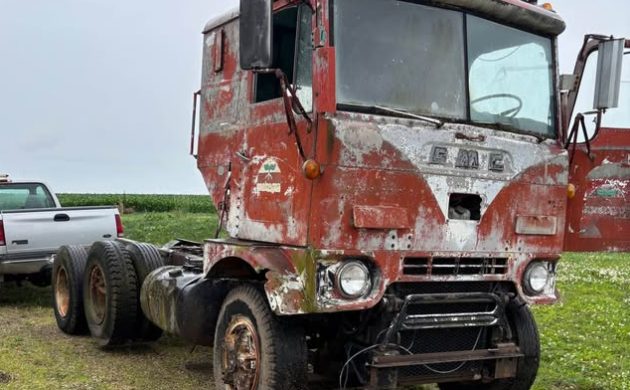
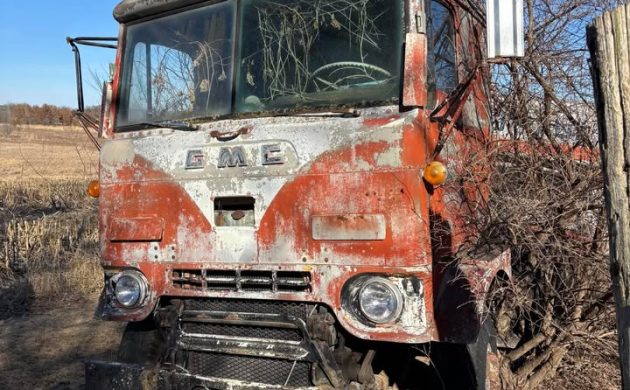
In the not-so-distant past, over-the-road trucking was very, very different. Interstate highways were still snaking their way across our great nation, and multi-day trips were fairly rare. The trucks back then were thus very different than what we see today. Take, for example, this 1966 GMC DLR/DFR-8000 cabover for sale on Facebook Marketplace in Monroe, Wisconsin. This unusually designed cabover truck was once a popular choice for trucking companies maximizing profits, but was despised by the brave souls tasked with driving them. Do you have a soft enough spot in your heart to fork over $1,500 to add an example of the famous “crackerjack” to your collection? Thanks to Hans H. for tipping us off on this neat old truck.
General Motors had a significant presence in nearly every transportation market following World War II. The giant of a company manufactured locomotives, buses, over-the-road trucks, and a dizzying array of engines for other manufacturers in addition to its bread-and-butter car and light truck lines. The company gained market share in each of those marketplaces by relentlessly innovating and using the company’s financial power to offer vehicles at a lower price.
In the heavy truck market, General Motors introduced a very unconventional product in 1959. The GMC DLR 8000 and DFR 8000 were cabover trucks that were designed to take advantage of laws restricting the length of a truck and trailer in commercial service. The cabs on these highly customizable trucks measured a scant 48 inches in length. Later, sleeper cab versions added a place for the driver to bed down in the rear. These versions provided a driver with a miserly 24-inch-wide platform to bed down on. To save weight, the cabs were made primarily of aluminum. This weight savings allowed roughly another ton of payload to be carried legally. Buyers could also opt for single or dual axle configurations, and the engine options were plenty.
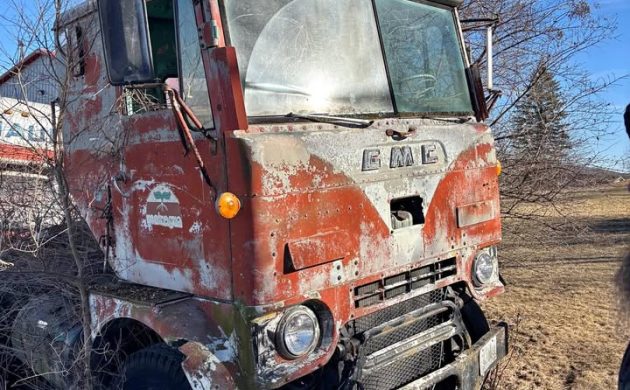
To a company wanting to maximize the amount of freight hauled, these cabovers were a godsend. Drivers, however, took a very dim view of them. These trucks were derisively nicknamed “crackerboxes” due to their upright metal box shape, much like the packaging saltine crackers were sold in at the time. Driver complaints about the lack of room in the cab, the rough ride they had with the cab directly over the front axle, and the obvious safety concerns. To their benefit, these trucks did come with innovations such as an independent front end, power steering, and air ride.
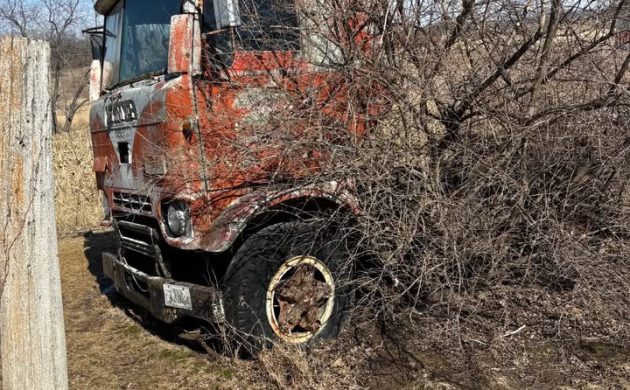
Production of these trucks soldiered on until 1968. The model seen here is a 1966 model that has sat in the seller’s yard for fifteen long years. There is no mention of the drivetrain combination in the ad. The seller had plans for the truck, but has reached a point where having the space is more important than keeping the truck. It is advertised as needing restoration. It is also suggested that it could be sold for parts as well.
With a $1,500 asking price, this one may be worth a phone call if you fancy such vehicles. Hopefully, someone will find a way to restore this crackerbox and display it occasionally. Compared to the behemoths we see on the highways today, this truck is an interesting look back at just how tough truckers had to be back in the day.
Do you have memories of these distinctive trucks? If so, please share them in the comments.



Deserves a starring role in some post-apocalyptic movie…
These were a reasonably good seller because back in the day, there were lots of them around. GMC wasn’t the only one trying to get in on the 48 inch BBC. International came out with its Sightliner which was something to behold.
GMC had a strong presence of these right through the 70s. It seemed there was always something going by on the highway that was pulled by one of these and occasionally some broke and ended up in our shop. I do have to say that I saw two in a single week in early November when we had a cold snap and most of the trucks driving down the freeway were still trying to burn #2 Diesel, which clouded up at freezing and started to solidify below that.
I heard people talk about these being powered by 6V-71 engines, but most of what I saw were 6-71s and a couple of 8V-71s. I did see one in the mid 70s with a 6-71T (265 hp), and it could challenge a few V8s.
But all too soon, they made their mark and were replaced by something more hospitable to sore backs and hips (read pansy-ass? Just kidding; I know how much drivers suffered by days in a row in these and trucks like them).
Here’s an example at how IH handled the super short cab trucking riddle. I think they were all V8 gaspots; I’ve never seen one with a diesel. Actually, these worked pretty well except for some drivers suffering burnt knees…
The “Sightliner”, or ACO shown here, was the answer to the question nobody asked. It was supposed to eliminate that front blind spot mentioned on cabovers, but if you ask me, you shouldn’t be following that close anyway. It was poorly received, and only saw 1 at a show. Vintage ads show a diesel was not available. They did offer a 3 axle and sleeper, but no diesel. Generally, most drivers hated cabovers, but drove what the boss said to. We made up funny names for these, including, but not limited to: These were the “Flying Fishbowls”, of course, the “Crackerbox”, saltine crackers came in a metal tin, the “Trashstar”, the “2 story Falcon”, H series Ford, the “Japanese Frightliner”, the White 7400, the “Freightshaker”, the White “Road Commode”, the Road Commander, which was actually a nice truck, and of course, can’t forget, the most famous of all cabovers, the Ford CL9000 that “Large Marge” drove in Pee Wee Hermans Greatest Adventure,,”Tell ’em Large Marge sent ya’,,
Oh, the truck nicknames! We called a Ford cabover a 2-Storey Edsel; an Astro/Titan, a 2-Storey Vega. Frightliner and Road Commode were always good ones. One of my favorites will always be the “Hare-Lipped Duck.” “Mack-Mack.”
K Whopper. Peter Car.
Ok….. So…… I’m just going to point out my picture…… I’ve had it for some time…..
Just sayin’….. LOL.
A Crackerbox is on my bucket list. Ever since I was a little kid, watching them working, I’ve liked them. The one picture Geomechs posted is absolutely beautifully done. These were everywhere, then there was the GMC Astro Cabovers after these. Same thing, I liked them too as a kid ( still do) but I’d love to have one of these.
Thank you so much for writting this up Jeff. I’m enjoying all these trucks as of late. And all the comments too as well. Also I liked Geomechs photo of the International Cabover also. All these old trucks are an important part of our history. And I strongly believe in preserving them as best as possible. Who know??? This old GMC just might have some life left in it. You never know.
Neat trucks geo. Does the one in your pic have a little sleeper back there Dave ?
Amazing how even a short snooze, can refresh a driver. 👍
Thanks for the article Bennett
Believe it or not, yes. Thats the sleeper. They have Condo Cabs today, those sleepers are more like a…… Well…… A garden shed??? Lol.
We called those small sleepers, the “coffin”, and about as much room as one. That truck sleeper was a Godsend, as previously, before my time, sleeper compartments were located in the front of the trailers, and stories of groggy drivers climbing out while the truck was moving, were common. Trying to nap in a day cab has got to be the most uncomfortable thing, Over the years, I saw some creative solutions, a board across the seats, a box in the middle of the seats, but most over the steering wheel, and a backward Ford oval in their forehead. The sleeper changed all that.
That Astro was quite an abrupt change to these, wasn’t it? I remember the first Astro I got into; I couldn’t believe the luxurious control panel, compared to the spartan accommodations of the Crackerbox. Of course, then, the mechanic in me kicked in and said, “You’ll have to work on one of these someday.” I was immediately pulled out of my reverie and dreaded the day I would be summoned out to the freeway, or the scales, in miserable weather conditions, to fix one.
Moral of story: Don’t ever leave your business card on the bulletin board at the scales, and don’t have scales personnel as customers…
Well, my friend, I’m going to say it again, and to all reading this, the unsung heroes to this madness, were the mechanics that worked on these contraptions. Uhp, uhp, uhp, let me finish,,,I couldn’t have done MY job, without the competent knowledge of the mechanics. They are just as responsible for this countries way of life. These were the people that skinned the knuckles, bumped their heads, risking life and limb under these tilted cabs, burnt their hands, got fuel and coolant baths, tires were an everyday thing, working on those darn Detroits, in all weather, so we drivers could do our job. My job had plenty of gripes, but a good mechanic wasn’t one of them. Thanks, man!
Many thanks, Howard. I have few regrets from the repair business. Some drivers were hard to deal with but then, some mechanics (I know one in particular) could get pretty crusty too. Although I got super deep-fried by one, I got burned by very few.
When I got turned out to pasture it really took the wind out of my sails. I suffered from depression and still have spells of it. But it’s sites like this and the job I now have, supplying hard-to-find parts, that keep me sane–sort of. I love the stories, both listening and telling. And I think I will WRITE that book.
HAPPY NEW YEAR, ALL OF YOU!!!!!
Howard, my oldest sister was a nurse, a good one and made good money. She always thought her job was way more important than anybody’s. One day she kinda pissed me off, and I told her ,” next time you’re on the interstate next to a truck right where the trailer is hooked up, think about the guy that had a fight with his wife then went to work and put those tires on,- – – if you make a mistake you lose one guy with one foot in the grave and the other on a banana peel, if those wheels come off how many people will be involved? Now who’s job is more important?” Never had that conversation again!
Not unless I write that book 1st, you know my kid is in the movie biz,,I can see it now, “The Howard A——- Story”, with Jerry Reed as Howard,,,what? He did? When? Wait,,,I know, we’ll write it together, cover both ends of the rainbow, it would. You are right, seeing this stuff does stir up a lot of ghosts, things I never thought I would get a chance to talk about again. I suppose to folks not familiar with that era, and compared to today, it was an adventure. It was trucks like this that made it so, breakdowns were frequent, and part of the job was getting it back to the yard, so people like you could repair it, while I sat and drank that lousy coffee in the breakroom. Like I say, if we wanted attention, we would have gone into politics, but we didn’t need that, and the best part? Quittin’ time!
Jim: I know Geo gets all the thunder, but I believe you are equally a qualified wrench, and glad you both add that knowledge to the site. When we’re gone, I doubt you’ll hear much about Crackerbox GMCs in the BFs future.
Inexpensive for good reason.
Steve R
Oh, oh, “pending”, in Mikes ( leiniedude) back yard. If this truck is in Monroe, it probably hauled one thing,,,cheese. Monroe is the cheese capital, or was. Most people that were TV junkies in the 70s, combined with the allure of trucking, saw shows produced like Movin’ On. In it, Sonny Pruitt( Claude Akins) had 2 trucking buddies, Moose( Art Metrano) and Benjy( Rosie Greer) and they ran a GMC Crackerbox. It was the joke of the series considering what Sonny drove.
This is a tired old gal, no question Detroit power, or maybe even the mighty Thunder V-12 I read was used,,,and looks like it may be a single screw with a tag rear. Not many trucks were full twin screw at this time. I’ve heard these used an independent front instead of a straight axle, but can’t find any diagrams showing that. Like the Transtar replaced the Emeryville, the Astro replaced these, and never looked back.
Thanks to Jeff, did a remarkable job, as usual, and I can’t add much, except WAY TO GO, BARNFINDS,,,sorry, gonna be a while before they unload me, I’m taking a nap, and that sleeper was mighty welcome.
Well, at least it still rolls! These old beasts had mostly been put out to pasture by the time I got started, replaced by the Astro. Worked on a few though with a mix of drive lines, the one thing in common was the 238 (6-71) Detroit. If I remember correctly, the cabs, although spartan, held up fairly well, didn’t have to worry about rust! If I needed another project, I’d give $1500 just to see if I could get it running again! I’ve got a dirt digger buddy with one that’s been setting a few years with a burnt piston, if I run out of projects maybe I’ll go get it. (I should live so long!)
My goodness is all I can say
So, nobody clicked the link?
Marketplace:
This listing is no longer available
makes good yard art
BJ and the bear… he was a purdy boy trucker
There were lots of covers in the 1950s. In the White I remember the huge warm dog house in the middle of the cab. It was great in the winter, not so much in the summer. Have a look at some pictures I took of some cool old trucks.
https://www.icloud.com/sharedalbum/#B2W5VaUrzBIFwe
In 2013 Dalton Trucking stopped by on their way to a truck show and parked their collection of cool old tractors in the museum parking lot overnight, They including Whites, Petes, Diamonds, Freightliners and more.
Thanks for the pictures of Terry Klenske’s collection.. I have seen many of them in person.
Well, that went pretty quick!
Another entry to the antique/historical truck hobby.. $1500 is a very good price for a restorable vehicle. Another of the era trucks not mentioned yet. The Diamond T 921C nicknames “China Closet”, here is the one I used to own.
What’s the truck behind it and how many have you got left?
Hi Brocky, I was hoping to hear from you. That Diamond T was a rare truck. I remember UPS had Diamond Reo cabovers, but not many like that. Before my time, it was considered a high class truck at the time, right up there with KW and Pete.
Jim: I think that truck may be a mid 30s Brockway?
An interior shot?
Jim and Howard, The DT 921C is a 1959 and it was the first new truck Wrangler Blue Jeans bought, in Feb 1959, after starting their inhouse fleet in 1955. This one is a 220 Cummins, R96 RR 10 speed trans, and 4:11 single axle. They then bought 18 more that were “Rubber Band” Tag axles. I sold it to a man in Atlanta who is refurbishing it for local shows. With A couple of fresh batterys and plugging up some air leaks we drove it up on the trailer to leave. The truck behind it is a 1960 Brockway 128 van straight truck. Really Rough!! I also sold the 1971 Brockway 358LL long twin screw straight truck, double frame, 504 V8 Cummins, 5X3, air locking rears. I sold both Brockways to a Brockway restorer in North Carolina as a package deal with many extra parts: two 555 V8 Cummins engines, 75 gal fuel tank, 10 20 inch tubeless rims, new corner windows, ETC
Thanks pal, but we were wondering about the older truck next to the DT?
That is the 1960 Brockway 128..
Well I’ll be darned, I thought that would have been a lot older truck. A Brockway site confirms, it’s a 1960 128WX-20. Sorry to doubt you.
We have to push for the site to have a message system, off the record. Think us old gearjammers would have something to talk about?
‘Rubber Band” tag axle, HA! Who but the guys here would even know what the hell you were talking about!
I doubt if many of the BF viewers know what it is either??? Hopefully this picture will help explain.
Trying again
That rubber band drive is a real novelty. I heard of them but never actually saw one in the flesh until maybe 15 years ago. I’ve got a friend in OH who’s restoring a ‘51 IH LDT405 that originally had that system. It was stripped off over the years and he’s been dedicated to getting it all back on and functioning.
Some people might scoff at that setup but they obviously haven’t tried to navigate a soft field or slippery surface with a tag-axle. Without some assistance like the belt rear drive, an empty tag is about as useless as a milk bucket under a bull…
u guys r awesome
MAN i wish I could have an old screaming jimmy