
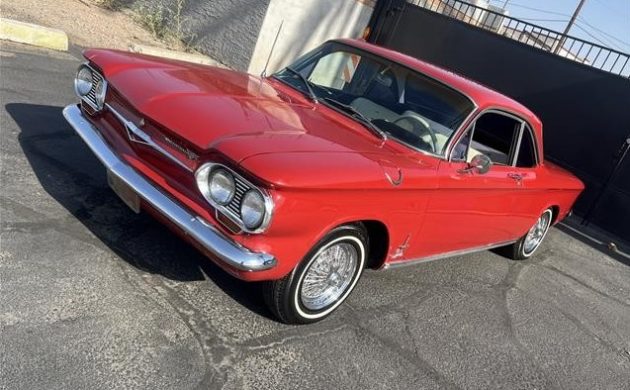
Although introduced as a compact model, Chevrolet didn’t take long to add some performance credentials to its groundbreaking Corvair range. This 1963 example is a Monza Spyder, featuring a turbocharged engine under the hood. It presents extremely well for its age and is a turnkey classic in need of a new home. I must say a big thank you to Barn Finder Curvette for spotting the Corvair listed here on eBay in Phoenix, Arizona. The seller set their price at $24,995 OBO.
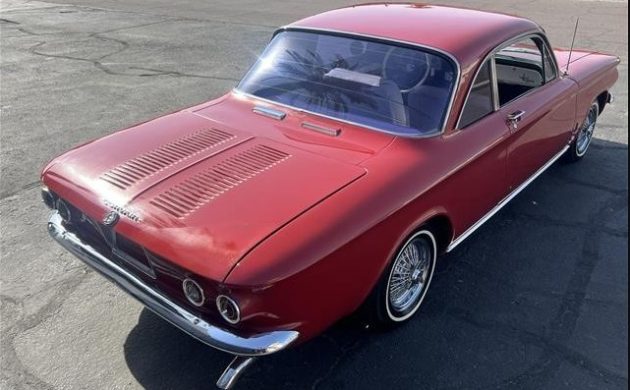
The Corvair was one of the most radical American vehicles of the post-war era. It is unusual for a manufacturer to commence a design process with a clean sheet of paper, but that is precisely what Chevrolet did when creating its latest compact model. Introduced in 1960, the First Generation Corvair underwent evolutionary changes until 1965, when a significantly restyled Second Generation hit showroom floors. This 1963 Corvair is the Monza Spyder variant, ordered by its first owner in Ember Red. Its presentation is consistent with a classic that has been treated respectfully. The paint holds a warm glow, the panels are straight, and any cosmetic imperfections are comfortably acceptable for a survivor-grade classic. Rust was the mortal enemy of the Corvair, though life in Arizona has left this car rock-solid. The trim and glass are in good condition for their age, and the wire wheels suit the Corvair’s character perfectly.
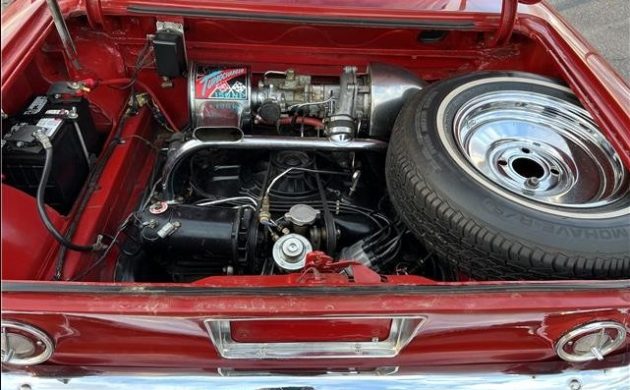
With a few notable exceptions, Detroit’s design philosophy had traditionally revolved around a front-engine/rear-drive mechanical configuration. However, Chevrolet scrutinized Volkswagen’s rear-engine approach and chose to follow that path with the Corvair. Performance was considered pretty acceptable, but the introduction of the Monza Spyder variant upped the ante. The air-cooled 140ci six received a turbocharger, boosting power and torque to 150hp and 210 ft/lbs. This car feeds the ponies to the rear wheels via a four-speed manual transaxle, which should provide an entertaining motoring experience. Potential buyers can consider this a turnkey proposition that runs and drives exceptionally well. The seller quotes an odometer reading of 21,500 genuine miles without mentioning verifying evidence. Therefore, that figure must be taken on face value.
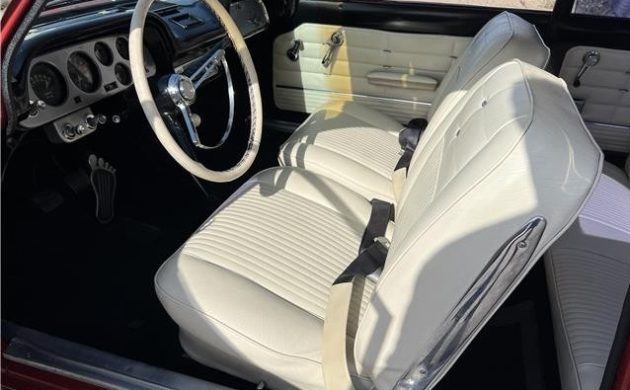
The same Arizona sun that protects classic steel often exacts a heavy toll on trim and plastic. It is common to see older classics with baked upholstery and crumbling plastic. However, this Corvair has avoided that fate. Its White vinyl looks exceptional, with no visible stains or other problems. The dash is crack-free, and the carpet is excellent. The only visible aftermarket addition is the gas pedal, and I’m not a fan! The gauge cluster features a factory tachometer, and the original AM radio occupies its rightful place in the dash.
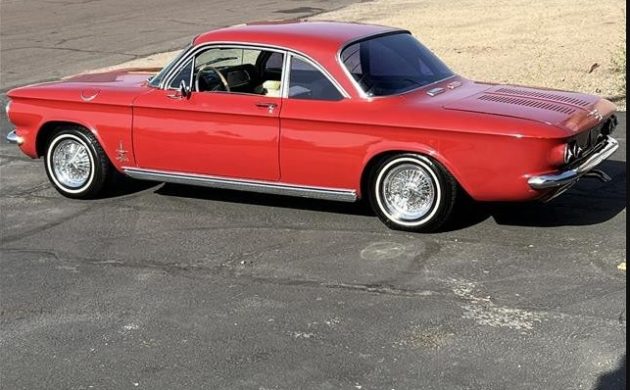
The Chevrolet Corvair has suffered significant negative press, with certain segments of the media criticizing its lively handling. The fact is that if people drive these cars with due care and attention, they are no more dangerous than any other rear-engined swing-axle car from the era. In fact, with the turbocharged six providing additional power, a 1963 Monza Spyder can offer an entertaining driving experience. This one isn’t perfect, but its condition is above-average for a survivor-grade vehicle of this vintage. The seller’s BIN figure sits at the top end of the market at a time when values have fallen steadily. Do you think the price is realistic, or will they need to compromise to find this classic a new home?




The Corvair market is somewhat different than that of other era compacts due to the True Believer factor, although I imagine they’re aging out too.
Kim, I’m a “True Believer” and even I think the sellers’ ask is bananas!
I don’t know anything about the Corvair market, but I always liked Corvairs. A clean 4 speed Spyder for $25k might be a fair price. I believe the rear suspension received an update for 1964. I wonder if this one could be updated to the 64 config?
The update in ’64 was a transverse leaf spring (called a “camber compensator”) and softer coil springs.
Nice example, but ambitious price. Experienced many of these in my youth. Corvairs were the type of thing the domestic automakers used to do: develop adventurous, sometimes quirky and enigmatic designs to push beyond the boundaries of mainstream thinking and advance new technologies, some great and some not so much. That was part of why many of us found the industry so fascinating and became lifelong automotive addicts. Yes the modern day offerings are far more competent appliances to deliver our transportation needs, but they no longer possess much if any of the character and personality so common in the previous century. Permanently ensconced in my memory is the muffled mechanical drone of the flat air-cooled six coming from the backside of the Corvairs owned by many family and friends. I always jumped at the chance to drive them and enjoyed their odd idiosyncrasies. Hope to own one before my body assumes room temperature.
Amazing! My first car was a new 63 like this except blue, in and out. I paid the princely sum of $2400.00 for it in November of 62. It listed for $2600.00. That was a lot of money for a 16-year-old grocery store bag boy. But the tips paid for it. I still love that car.
I jumped too fast. Didn’t notice the Spyder badge. Mine was a Monza 900.
It looks like the front “grille” emblem is from a 1961 Corvair not a 1963.
The 1963 emblem is a simple stamped stainless bar with a black-painted, horizontal indentation.
The 1961 is a chromed casting with a triangular, plastic insert (missing from this car’s incorrect emblem).
You’re right. That is a 61 grille. That’s a Spyder engine and instrument panel though. As the Spyder didn’t come out until spring 1962 it’s clearly not a 61. But why the change?
This guy hasn’t priced Vairs ! Even the best restored examples bring about 10k less then his ask…
You don’t know a lot about Corvairs, now do you?
I can assure you that this vehicle is, without anything unseen, worth about 18-20K.
Restored Rampside Trucks have gone for 30K.
Go with what’s true, not what you think you know.
I’ve been an owner and restorer for 39 years.
No pics of underbody, suspension rubber front and back. Paint looks aged.
Still too ambitious on price.
Not enough 411 to make accurate appraisal
What’s this world coming to when sellers think their Corvairs are worth 25K?
The world is coming to 2025. and immaculate cars with hot engines, 4 wheel independent suspensions, and advanced technology for its day go for 25k. Especially when it has a cult following like the Corvair. Do you see a national Chevy II society or a Ford Falcon society? I’ll get off your lawn now.
I realize that there is an avid following for the Corvair and it has existed for years. Yet, the cars were always attainable and allowed people to join the enthusiast community without breaking the bank.
It just stinks to see where prices are heading in this hobby. But I guess it’s true for everything. Sigh.
My Pop had owned a few of the turbo cars and a dozen of all the different models that Chevrolet produced. His last car was a 63 and I always never understood his fascination with them. No matter the base color of the car red steel wheels is what it rode on with the biggest snow tire that would fit. Between the VW and the Corvair for winter is what he drove. The trucks would be parked and the Corvair is what would climb the hills covered with snow.
I had a 1963 Spyder. Great car. Would go in the snow too. A lot of fun and mine was very reliable.
What are the two knobs below the gauges to the left of the steering wheel? They look to be factory installed.
I remember a friend of mine back in the 1980s bought a 61 Corvair. it had a bad battery and it was a very weird long battery cost over $150 so I wired in three garden tractor batteries. He drove it with those batteries for over three years.