
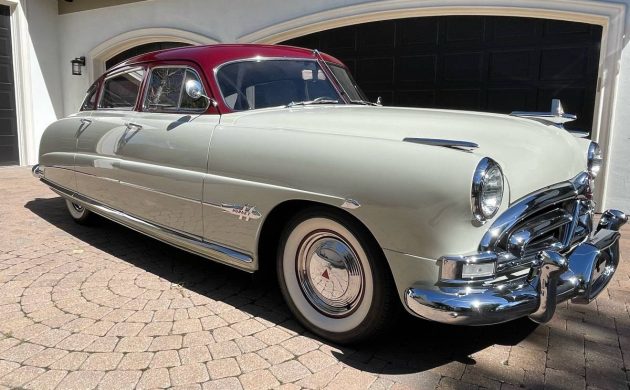
When we begin to assess some of the marques that have long passed into automotive history, some deserved greater success than they ultimately achieved. One such brand is Hudson, which broke new ground when it introduced its “step-down” design philosophy with the 1948 Commodore. It continued that trend with this 1951 Hornet, a car that presents beautifully following a total restoration. Its only apparent need is a new home, and I must say a big thank you to Barn Finder Mike F. for spotting this beauty listed here on Craigslist in Denver, Colorado. The seller set their price at $33,500, stating that potential buyers won’t be disappointed with this classic.
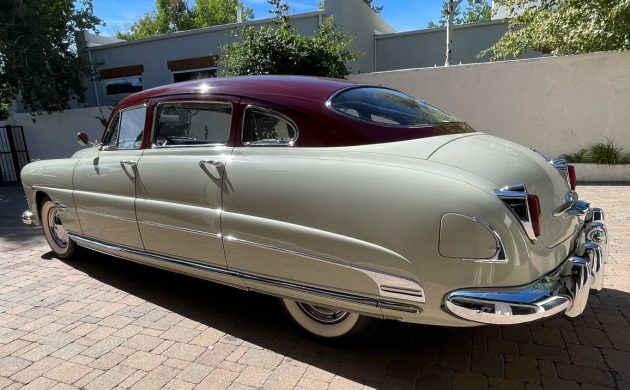
The early post-war years saw American manufacturers marketing vehicles that were little more than lightly refreshed versions of cars that had rolled off the line before the country found itself dragged into World War II. Such was the overwhelming buyer demand that few people objected to this approach. However, the scene changed at the close of the 1940s as various manufacturers introduced entirely new models. Hudson introduced the Hornet in 1951, utilizing its “step-down” design philosophy that lowered the overall center of gravity. When combined with sleek body lines, the company’s latest model couldn’t help but to stand out in any crowd. This 1951 example has undergone a thorough restoration, presenting beautifully in a winning combination of French Gray and Revue Red. The seller has been the Hudson’s custodian for over twenty years, holding documentation tracing every aspect of its restoration history. Its presentation is all that you might expect from a build with a focus on perfection. The panels are as straight as an arrow, the gaps are tight and consistent, and there is no evidence of rust. With sparkling chrome and crystal-clear glass, this Hornet promises much to potential buyers.
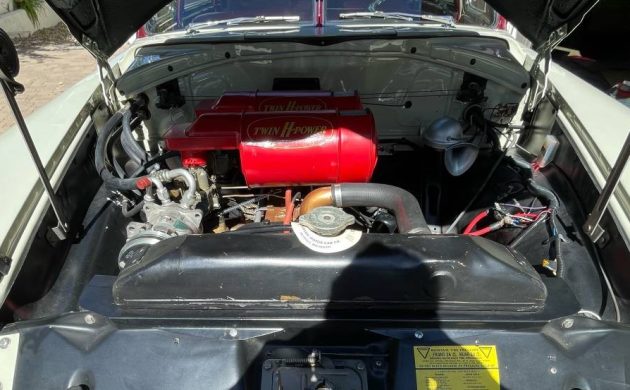
Hudson introduced a larger, high-compression version of its flathead six for the latest offering in 1951, with the engine stretched from 262ci to 308ci. It offered a dealer-installed “Twin H-Power” induction system during the first model year before this became a factory option the following year. This Hornet features that combination, sending 145hp and 257 ft/lbs of torque to the rear wheels via an overdrive manual transmission. The engine’s power was considered fairly impressive by the standards of the day, but the fact that it delivered its maximum torque at around 2,000rpm made it exceptionally flexible. The seller indicates that, apart from an upgrade to a 12-volt electrical system, this Hornet is mechanically standard. It is also in exceptional health, running and driving perfectly. If a Colorado vacation is on your agenda, making the return journey aboard this Hudson is a viable option.
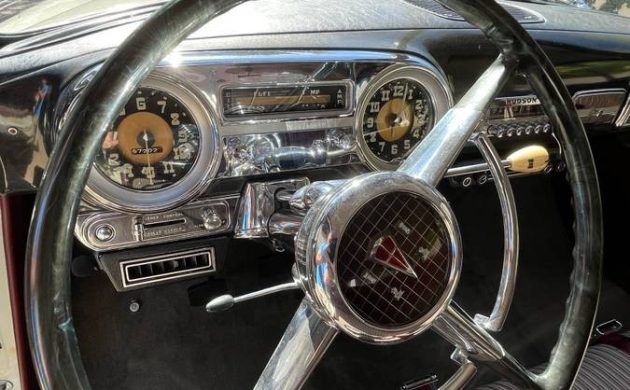
This Hudson’s restoration included an interior retrim, and the results justified the cost and effort. I’ve always considered the dash as a work of modern art, with stunning plated components that make a striking visual statement. These items are in good condition, while the cloth and vinyl upholstery look perfect. There is no wheel wear or other problems to detract from the positive impression. The seller added air conditioning to an interior featuring a clock and a factory pushbutton radio.
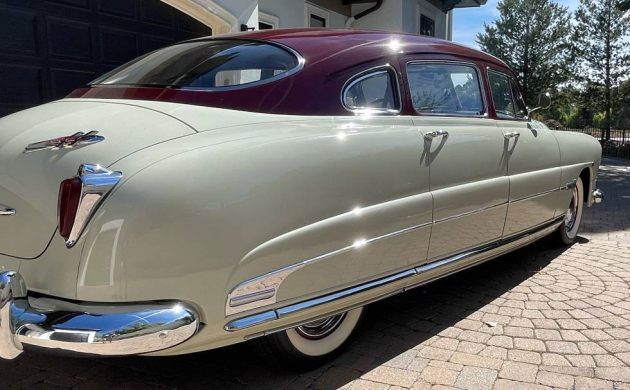
Founded in 1909, Hudson merged with Nash-Kelvinator to create American Motors Corporation (AMC) in 1954. It signalled the beginning of the end for a standalone marque that changed the face of automotive design. No longer did cars need to be upright, with vehicles like the 1951 Hornet demonstrating that the way forward lay in low and sleek styling that improved appearance and dynamics. This is a stunning example of the breed that can be enjoyed immediately. I hope that it finds a home with someone who will continue to treat it respectfully, and I love to think that the ideal candidate will be one of our loyal Barn Finds readers. Do we have any takers?



I just learned that these were unitized body autos. Always thought the step down was body around the frame. Hudson had some great ideas but the cash strapped company wasn’t able to survive.
You are correct. These are fabulous looking cars, although the 1952 is that little bit nicer with the longer rear quarter windows. IMO
This car is beautiful. I truly have no idea of its actual value, and I normally bemoan the price of classic cars these days, but this one’s asking price seems like a bargain to me.
I grew up with these cars. Uncle Smitty (Norris Smith, known nationwide by the Hudson club) always had several of these at a time. The first time I “rode” over 100 MPH was in one of these. Uncle Smitty got pulled over by the cops too! But convinced the young cop, that his radar was malfunctioning because this OLD car could never go that fast. These look ponderous, but they actually ride and handle very well. These are a pleasure to drive and I wish I had one today.
I agree that these cars look ponderous. And I usually don’t like that weighty, unwieldy look, which characterized the Nash and Packard of the era. But on these Hudsons for some reason,”ponderous” works just fine for me (and of course, their performance was anything but ponderous).
Beautiful automobile. I always loved these even as a kid. Unfortunately the automakers who formed AMC were doomed by the big three
I love these cars and this one is a beautiful example! The only imperfection that I could see is some wear on the edge of the front driver’s seat surround.
These Hudsons torn up the race tracks around the country in the early 1950s winning numerous major races. This is a great looking Hudson that will offer the new owner many pleasurable driving hours!
They were indeed fast, consistently beating even the vaunted early Oldsmobile V8s.
I have heard the explanations on why Hudson, Packard, Studebaker and Nash disappeared many times. Most are undeniably correct. However, they were all in the same boat though. Their time had come. Their styling was slightly out of step with the big three, as was their engineering. Their advertising wasn’t plentiful or significant. They all needed more cash to operate and plan for the future. You have to have research and development to survive. They didn’t have it because of too many terrible management decisions, all around. The future had come and they were not a part of it. It’s grand to see excellent examples of these cars today, such as the one featured here. Why can’t Ford, GM and Stellantis see this cautionary tale? Will any of them survive?
Can’t blame these companies for not having a crystal ball to foresee the future, they did the best they could at the time, with the information and financing they had available. You didn’t like their “engineering”? Hudson had the best handling cars of all. Studebaker was first out with their automatic transmission and first V-8. Packard shook the industry with their torsion bar, self leveling suspension as well as their first class V-8 engine. Nash was first with advanced aerodynamics, superior fuel economy, and a top class smaller car, the Nash Rambler. I could go on, but the independents at times had more new technology, advanced styling, better features, than the big 3.
That’s why the big 3 got rid of them. The big 3 didn’t like being overshadowed or outdone by an independent.
Look at Tucker. Forced out by the big 3. And Tucker had lots of innovations.
You had better go watch the new documentary The Last Independent Auto Maker on PBS. You have a lot of wrong ideas on the subject. At least where American Motors is conserned.
What a beautiful Hornet! I love the colors inside and out. I would love to buy this beauty and enjoy driving every mile. The asking price leaves me out but I feel it’s a fair price for what you’re getting.
By the mid 1950’s, GM had about 50% of the auto market share. GM had enough cash that it could have cut its prices in half for a year, and taken the whole market on price alone. But the Anti-Trust people at DOJ were active and GM knew it would be broken up if it did. But, between GM, Ford which was primarily family owned at the time, and Chrysler, they could offer a product of the quality of the independents, at a lower price, and did. And they could change the sheet metal and trim every year, the stamping machines for the sheet metal wore out anyway so changing was not a big burden, which it was for the independents.
And, the independents had issues, by reputation, whether deserved or not, Studebakers burned oil, Hudsons rusted out, Packards were expensive, Nashes were underpowered. The basic engines in GM, Ford, and Chrysler cars were reliable and powerful enough. They all rusted, but not as quickly as Hudsons, and they changed their looks, although keeping an “identity” from year to year.
I’m old enough to remember when these cars were fairy commonplace. Growing fairly knowledgeable about cars (my family had several commercial automotive interests), I recall that Hudsons were recognized as high-performing, well-engineered cars. Yet they were considered an “off” brand, like Studebaker, Kaiser, etc. Perhaps the explanation you offer, about their tendency to rust relatively quickly, is responsible for their second-tier status.
The worst rusting cars in that era, Chevy and Ford
It’s a myth that Tucker was forced out by the big 3. It was the US government, the SEC, prosecuted Tucker. Months of the trial, Tucker was completely exonerated, but the damage was done. Tucker was zero threat to the big 3, the same as the other independents were no threat. The big 3 were happy to sell their transmissions, axles, and electrical components to all the independents.
Of course Tucker was forced out by the big 3. They just got the government to do their dirty work. Oh no, I forgot, there’s no corruption in government Is there.
If you think the big 3 felt they were “threatened” by Tucker, then I have a bridge to sell you. The complete story is in the book, “The Indomitable Tin Goose”. If you’re relying on the Tucker movie, then be aware that Hollywood doesn’t follow any facts and puts together what they feel is “entertainment” I can’t begin to add up all the incorrect events the movie portrayed. By the way, the government went after the 3 wheel Davis car also.
@Duaney
It could be the movie speaking but with all the innovations Tucker had on his cars and probably more to come in future cars, wouldn’t it have cost millions (at the time, billions now) for the big 3 to retool to catch up to Tuckers safety features? Which by the way, all three insisted cars were safe and didn’t need padded dashes, seat belts, popout windows, etc, etc. Which ended up on cars later anyway, via the government. Ford even made commercials on how safe their cars were in the mid 50s.
I agree the government went after Preston, but I still think the 3 had a hand in it as well. “Its not every day you see a position with his hands in his own pockets.”
This takes me back to the days when I was just a little kid. My Dad had a 1953 Chevy and one of his friends had one of these. Car crazy little me was fascinated with the Hornet and riding in the back seat was really big deal to me. I can still remember Dad’s friend pointing out that he had the Twin H power. I couldn’t tell Dad but I thought the Hudson was neater than his Chevy. Nice car here. GLWTS.
I know the model year isn’t right, but I have to believe Miss Daisy would approve. “Get ready to turn.”
Somebody above commented that their first experience riding over 100 mph was in one of these Hudsons. Same here. My brother-in-law’s family had a ’50 Commodore eight, which his father had swapped for a ’52 six with twin H-power, a high-compression head and an alcohol tank (the purpose of which escapes me – but I think it was one of the fond early-50s go-fast options). I remember on one ride, my bro-in-law had it indicating 110, IIRC. It was so smooth and quiet, you couldn’t guess the speed without looking at the speedo.
I’ve read somewhere that the way these step-down Hudsons were designed and over-built that just about every panel on the car was structural. So integrated was it that while the big three managed to do striking annual restyles on the same body shells, Hudson had far too much invested in this design, could not afford to even tweak it much due to the interdependence of all the original panels.
Recall what became of this beautifully integrated design – google a 1954 Hudson Hornet and see what a disaster it was when they tried to restyle it to keep up with Big Three trends in styling.
Also, recall the magic of the “V8” concept in the mid-50s. Hudson’s six with Twin H-power, at 170 hp was comparable to most mid-50s V8s, but it wasn’t a V8 and it didn’t sound like one. Wedded to a once-innovative 1949 body-shell and a six-cylinder engine in 1954 was the kiss of death.
This is one of the most beautiful restored examples I’ve ever seen!