

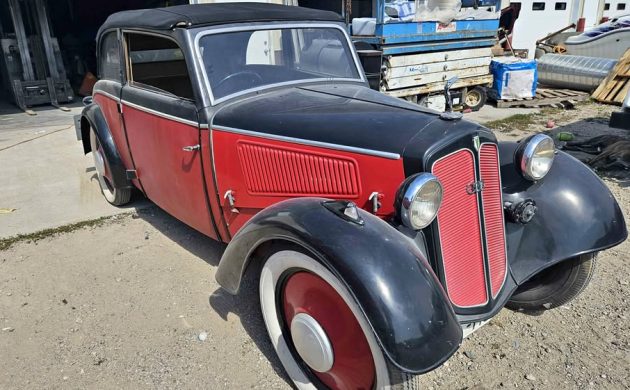
DKW was launched in 1916 to make steam fittings, but its founder, Jørgen Skafte Rasmussen, was inspired more by the automotive industry than remaining a cog in the industrial economy. He attempted to sell a steam-powered car – the Dampfkraftwagen – but it was a commercial failure. Rasmussen shifted gears, designing a two-stroke engine, which he sold as a toy, calling it Des Knaben Wunsch (the boy’s wish). Installing the engine onto a bike called the Das Kleine Wunder (the little wonder) brought the company its greatest success, and for a brief shining moment, DKW became the world’s largest motorcycle maker. From there, the company entered the automotive sector, buying Slaby-Beringer out of bankruptcy, and eventually merging with Horch, Audi, and Wanderer to form Auto Union in 1932. DKW-branded cars were made until the mid-1960s. Today’s 1937 F7 cabriolet, found here on facebook Marketplace, has not run in some time. It is located in Cedar Springs, Michigan, and the seller has it priced at $5,500. Thanks to Zappenduster for the tip!
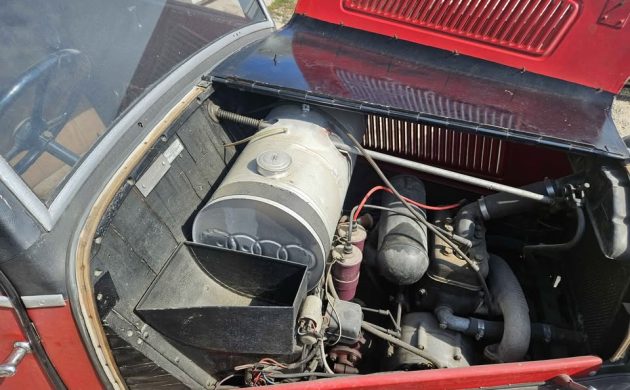
All DKWs motored with two-stroke engines, most of them mounted transversely in front, with a gearbox driving the front wheels. This car has a three-speed manual, and the gearshift lever protrudes from the dash. A six-volt electrical system runs the switches, gauges, and recharges the battery. Two trim levels were available – the Reichsklasse with an 18 hp 584 cc engine, or the Meisterklasse, with a 690 cc engine and a whopping 20 hp. The cabriolet body style was available in both trims. The Meisterklasse sometimes sported wire wheels and fancier brightwork.
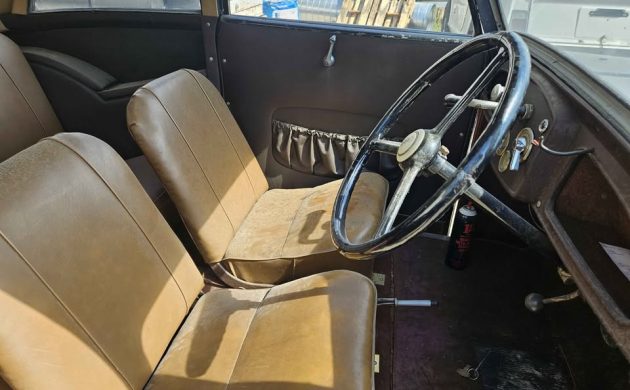
This car is right-hand drive, and despite the passage of time and its long slumber, it’s in pretty good shape! As long ago as these cars were made, wind-up windows were standard equipment. The canvas top is decent condition; when down, it sits on the rear cowl, just about eliminating rear vision. Semaphores signal changes in direction – good luck repairing those, if need be!
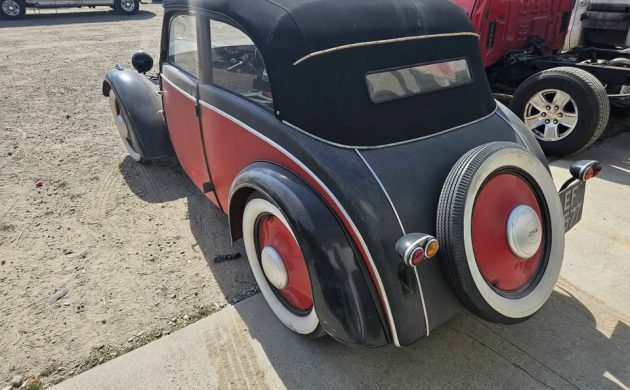
Early DKW bodies were made of leatherette and metal stretched over wood framing. The seller notes that his car retains its original leatherette-covered hindquarters. Only the Luxus cabriolet – an altogether more majestic model with a landau top and standard wire wheels – was made of steel. A fair number of early DKWs were made, but the new owner will need diligence, persistence and luck to resurrect this example. What do you think of this German oddball?
Ahoi Zappendusterand hello pitch dark
(yes, I understand your nickname…)
a really beautiful Deutscher Kraft Wagen – DKW
this German car only survived World War II because it’s a two-stroke
and definitely has a striking color scheme..
I’m firmly convinced that these wheels are not the original ones.
and it’s not an IFA, it’s a DKW…
fair price
respectfully, Till J.