
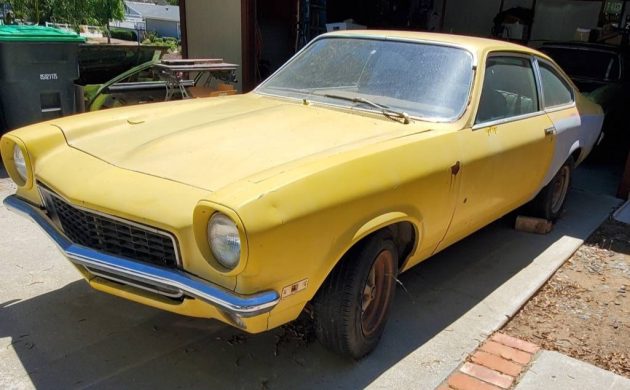
Both Chevrolet and Ford got into the U.S. subcompact car market at the same time, in 1971. The Chevy Vega was well thought out but poorly executed, with persistent engine troubles and premature corrosion. The seller has a pair of Vegas (including a GT, the sporty edition), one from 1971 and the other from 1973. The ’71 is interesting because it has had a V8 swap. Both autos are projects, and you can either restore both or make one good car from everything in the sale. Located in Elsinore, California, this dynamic duo is available here on craigslist for $6,800 OBO. This tip was given to us by Jack M.!
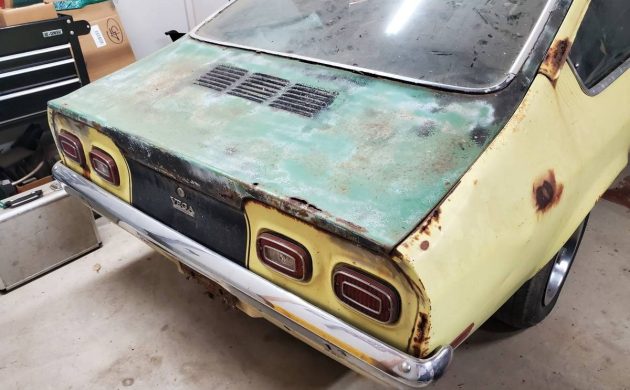
Though it had some teething problems, the Vega remained in production for seven years and sales of more than two million copies. Sedans, hatchbacks, and wagons made up the mix, and the Vega’s platform served other GM products like the Pontiac Sunbird. The seller has been working on both of these yellow-painted Chevies, but changes in health have prompted a stoppage of the work and the sale of the cars as a package deal with a bunch of parts included.
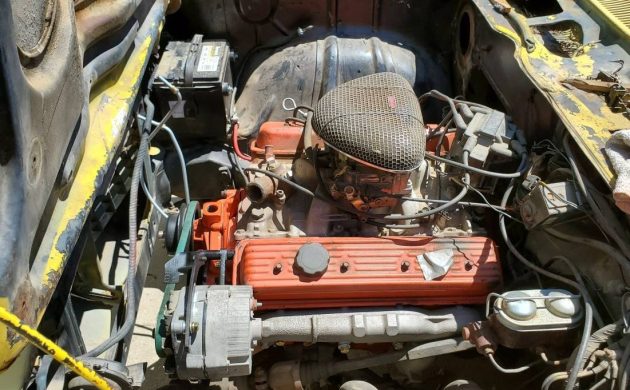
1971 Vega
The once-troublesome Vega inline-4 is long gone, replaced by a 350 cubic inch V8 paired with a TH-350 automatic transmission. Whatever work was needed, the seller says the effort is three-quarters complete. You can tell this Vega apart from the other because it has no black stripes. No mention is made of whether this Chevrolet runs. The rust, which was typical of the Vega, is almost non-existent here.
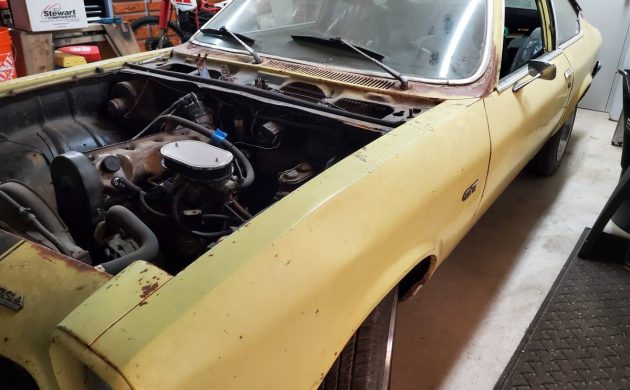
1973 Vega GT
This example is stock right down to the 4-cylinder motor and 4-speed tranny. It runs and drives, but has some corrosion that the buyer will need to address. Parts for this unit include an Offenhauser intake manifold and a whole spare engine, which has been rebuilt with headers. Perhaps restoring both of these Chevies is the way to go after all.


If you live in or near LA and like Vega’s, especially V8 conversions it’s worth a few hours of your day to check these out in person. This is the sort of thing potential buyers need to see in person to know for sure what’s there and the cars true condition. This is the sort of seller that is likely to respond more favorably to an in person offer than the message “what’s your best price”. I think you build the better body into a V8 and sell the other and all of the extra parts. There is potential for someone to eventually wind up with one inexpensive project.
Steve R
I have sold many vehicles (Besides other things) on Craigslist. I will not deal over the phone or text. You are more than welcome to come see what you may desire. But trying to do that over the phone (in my opinion) is rude and lazy. ( an auction is an entirely different scenario) How can you really know the actual condition and quality of the vehicle by not seeing it in person? My response to those people that ask “what’s your best price, or will you accept $###? Is I won’t deal over the phone,it’s disrespectful of the people driving out to see it and IF you are really interested, when you come out, make sure that you bring the asking amount. Because you WILL want this vehicle when you see and drive it.
You are right, a friend put it this way, if you negotiate on the phone, text or email all you have accomplished is resetting your asking price.
Steve R
With the valve covers that’s on it it’s an 87 to 95 350 .
The “Father of Pro Stock” Grumpy Jenkins raced Vegas for many racing seasons (see Grumpy’s Toy). Of course those were not anywhere near stock, but “win on Sunday, sell on Monday was true. You could buy V8 Vega conversion kits everywhere including JC Whitney. Motor & tranny mounts, radiators, headers, front springs, and cheap too. Easy to make a fast street racer and dead Vegas were commonplace and also cheap. To get serious one had to do something about the rear end. My dear brother Dale had a Cosworth Vega for years. :-) Terry J
Steve are you serious! I Am quoting “Wind up with one inexpensive project” Steve I always thought you were wiser than to say something like that! Maybe I am truly becoming senile in my old age, I didn’t think there was such a thing.
There are ways to be frugal. I’d always buy the same make and model parts car as a project I was working on. Keep the best parts, sell what I didn’t need to fund my project. That’s what I see with this. Assuming the small block will run, even if it doesn’t Craigslist and Facebook are full of inexpensive, running mild small blocks. The market for vintage speed equipment can be quite strong, especially if they are new. I wouldn’t be surprised if a buyer could recoupe a majority of what they paid for both by selling one and the parts separately. Put the keeper together, have fun with it and drive it with the paint blemishes.
Also take advantage of swapmeets. Buyers are getting lazy and a lot of older enthusiasts are clearing out their garages. Last month me and a buddy went to the first day of a Goodguys show, we got there when the gate opened, 7:00am, and were the first people at the ticket booth. It wasn’t long ago the traffic would have been backed onto the freeway at 5:30am. We both filled up our wagons twice, got some great deals, one being a large plastic crate with 6 complete Hurst shifters and an early-1960’s factory 4spd shifter that we haven’t researched yet for $400. If you haven’t done so lately look up the price of a new Hurst shifter and installation kit. Hunting down deals to flip is a way to help offset the cost of a project.
Steve R
Too many ” sixes” in the price
The Vegas and Mavericks were such good looking cars. Millions made, and I believe that the last time I saw a Vega on the road was maybe 5 years ago, and probably 15-20+ years before that, and and but for the fact that there’s a guy who brings a survivor Maverick (IIRC, it was literally owned by a little old lady) to Pastieners on Saturday mornings, I cannot recall seeing one on the road in the past 15-20 years…
Funny thing – in Downtown Birmingham, MI, they have a lot of high end restaurants, which are usually full of guys with Lambos and Ferraris, etc., and the women who want to meet them. A few months ago, I was riding my 1970 Honda CT90 (which we call “the Minion”, as it’s yellow, has one eye, and is indestructible) and in front of a restaurant, were three nearly identical Lambos, and people were oohing and ahhing. I told my son, who was all excited about it, and I said “What’s the big deal, there are three of them, how special is that? When was the last time anyone saw a CT90?”
Remember when these were shipped by the boxcar load?
They were stacked vertically, too!
My experience with V8 Vega’s is they are about as expensive to build as any other hot rod project. The attractive thing about them was the purchase price for them was fairly low.
Unfortunately it came time to sell your V8 Vega build the interest was also low, and it was tough to get your money out of it. I imagine that’s why V8 Vega rollers are a common find.
The 71 in this sale has the important hard to find parts on it ( maybe the 73 does to the pictures don’t show them) which are the almost always broken front and rear plastic lower valences. I’m thinking if the seller get’s an offer between $3500 & $4000, he’d be wise to accept it.
Right now in my area there a couple of very very well done V8 Vega’s priced in the low $20,000’s They’ve been on the market for quite a while….
I always liked the looks of these. The saying back then was : “ Good body, bad Motor”!
I remember Vegas coming into our Goodyear stores for alignment. There were many a time where the “normal ” adjustments were not enough. (And the aftermarket parts were not available at that time) So we had very long and study “pry bars” to bend the chassis back into compliance with a no guarantee disclaimer that the alignment would hold. (Very bad and deep pot holes in the Chicago area in the late ’70s and early ’80s) My tire guys could tell what road(s) the customer had been driving down by the bends in the wheels and would make bets on the same. So part of the game was to ask the customer where they drive. So that bet payments could be secured. I have been gone from the Chicago area since 1983 so I don’t know about road conditions now.
If Chicago is anything like Oregon, then those same pot holes you remember from the 70s are still there. :-) Terry J
I never had much use for a Vega of any flavor, but I will admit that there was a time when I seriously considered throwing together a small block wagon just because I thought that the wagons were actually pretty cool looking. (Still kinda’ due.)
The longer wheelbase on the wagons made them a bit less squirrelly to drive down the track. There was one around here built as the Wonderbread wagon.
The Vega engine was very sophisticated. As it was being developed, the same metallurgy was used in the 430 – 510 cu in McClaren Can Am race cars (not to be confused with the 427 aluminum engine that used cast iron cylinder liners). The silicone aluminum alloy by Reynolds Aluminum created an engine that when finished with specialized bore honing techniques and equipment created a bore surface that was extremely hard, similar to diamonds. What worked very well in the McClaren race engines was a flop in a daily grocery getter. It required serious attention to owner maintenance especially in regards to the cooling system. Mechanics and dealers had no way to rebuild these engines. :-) Terry J