

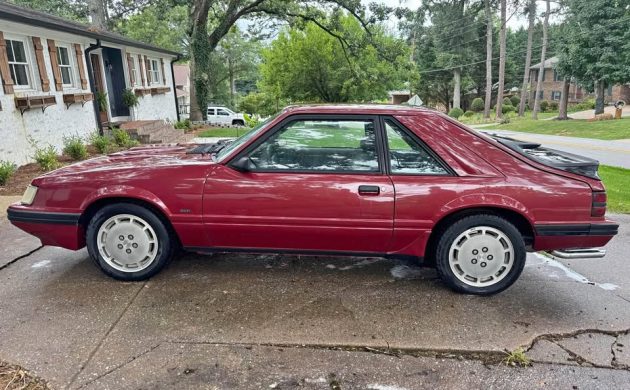
The Ford Mustang SVO combines a variety of attributes that make it a wonderful choice for an entry-level hobby vehicle. A few years ago, I wouldn’t have said that, as it seemed like prices were on the upswing. Indeed, a preservation-grade SVO would set you back $25,000 or more, and while those cars and sale prices are still out there, it seems silly to spend that much on a vehicle you can buy for safely under $10,000 in running condition – such as this one here on Facebook Marketplace. The seller is asking $5,000 or best offer.
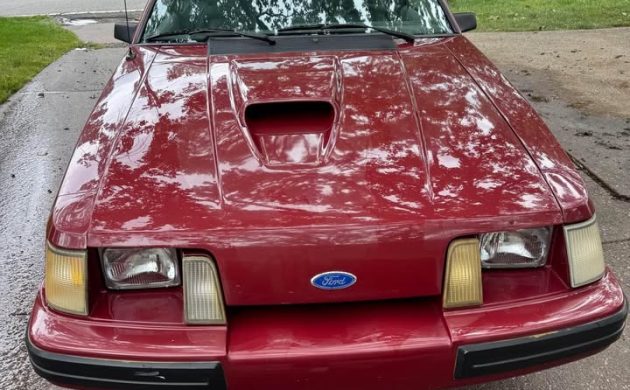
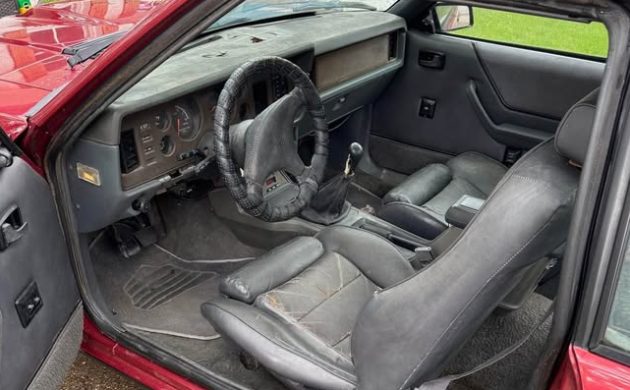
The early SVO is easy to spot with its recessed headlights. While the flush-mounted lenses look more modern, I dig the early version of any enthusiast car. The SVO didn’t get much of a shot to evolve past “early” and “late”, with production ending in 1986. With improved handling over the V8 cars and acceleration that almost kept up with the GT, the SVO seemingly had a lot going for it. It also sported trick Koni suspension bits, slick 5-lug alloy wheels, sport seats, and upgraded trimmings like the 3-spoke steering wheel. There was a lot to like about the SVO.
The market wasn’t ready for the SVO, however. I suspect in the 1980s, the concept of turbocharging sounded exciting, but it was expected to be better than the incumbent naturally-aspirated V8. The SVO was really just a victim of technology, rather than poor packaging. Ford was eager to showcase the potential of forced induction, just as Porsche wanted to promote a 911 replacement with a V8-powered, front-engined coupe and Pontiac proved it could build a Corvette-beating V6 two-door with an engine in the middle of the chassis. It’s amazing how bold manufacturers were at the time, in retrospect.
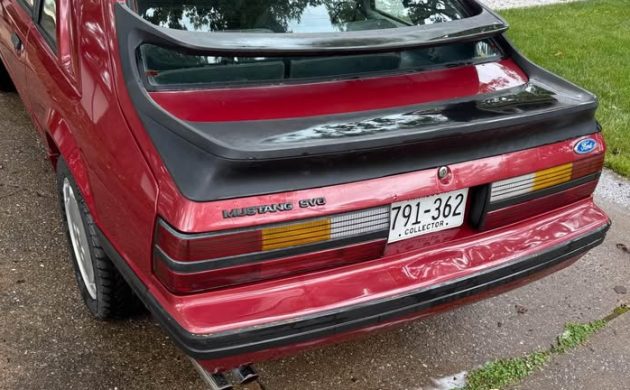
The seller notes his SVO is not perfect, hence the reasonable asking price. It needs tires and brake lines, and it does have some rust issues to contend with. The chassis is said to be solid but rust repair is needed in the battery tray area and some surface spots. A battery tray is a fairly straightforward replacement, so it shouldn’t be a big deal to get this cheap SVO back in fighting form. With 175 b.h.p. and 210 lb.-ft. of torque, the SVO is a terrific choice for a sporting driver, and this color combo is a nice change of pace from the standard reds and blacks as well. Thanks to Barn Finds reader Jack M. for the tip.

Never driven, or been in an SVO as a passenger. More of an LX 5.0 fan myself, but the sweet interiors, torquey turbo 4 pot, aggressive gearing and mandatory 5sp…always wanted to catch a ride in one. 👍🏁
Excellent write-up Jeff. These were interesting and reasonably well-done cars. And arguably, given how common turbo fours are today, ahead of its time. Other than certain models, low-mileage examples, and certain colors (the few painted Shadow Blue are desired), they don’t bring big bucks. So this one’s future is probably to make the desired improvements, and enjoy it as a driver.
These were big sellers during my time in AK when they came out at the Cal Worthington Dealership in Anchorage.
The car actually had a lot going for it; unique styling; the turbo; manual transmission and just the overall sense that this was something different! One of my younger solders actually purchased one and I remember him letting me take it for a test drive. The car was a bit of a “rocket ship” on the straight away (Seward Highway) as we “almost got pulled over” by an Alaskan State Trooper!
This car definitely brings back some great memories. An excellent write up as always so thanks for that too!
Hopefully someone purchases this and puts it back on the road. As I remember these got pretty good gas mileage as well!
The SVO’s original MSRP was $15,585. A Mustang GT with the 5.0 was $9,578. That’s $50,300 v. $30,900 in adjusted dollars. The SVO had 175 HP. A 5-speed manual GT had 205 HP. By 1984, gas prices had seriously declined from their 1981 peak. This is why the SVO never sold in large numbers.
“The SVO had 175 HP. A 5-speed manual GT had 205 HO.”
The 1984 5.0 GT with the 5-speed manual had 175 hp, not 205. It was the 1985.5 and 1986 SVOs that had 205. Even if the SVO was comparable to the GT in HP, though, the 5.0 had more torque, didn’t suffer from turbo lag and of course was a lot cheaper. So not much reason for many to go with the SVO.
The torque of the GT was “slightly” quicker off the line but the SVO had a higher top end, handled much better, smoother ride and generally would track down the GT around 80/90 MPH.
The 1984 had 205 HP. The now commonly cited 175 HP number for ’84 is not correct.
They hate it when you posts links here and would probably delete this post if I did that. But look up the 1984 Mustang brochure on the Old Car Manual Project – Page 3 (“the improved engine design includes refinements that result in a 30-horsepower increase”).
Ford did not directly say “205” in the brochure for some odd reason, which is perhaps why there is now confusion. But before it got lost to history, it was common knowledge that the 1982 had 157 HP, the 1983 had 175 HP, the 1984 had 205 HP, the 1985 had 210 horsepower, and the 1986 had 200 HP. In 1987, it went up to 225 HP, where it stayed through 1993. .
@2010CayenneGTS:
Yes, I see what you are referring to. Problem is the ’84 never got that engine. I refer you to “Mustang Buyer’s Guide” by Peter C. Sessler (Motorbooks International, 1989) re the ’84 GT: “The Mustang GT continued sporting the 175 hp version of the 302 HO….Factory literature also listed a 205 hp version with dual exhausts, but this particular engine never appeared that year.” Exactly. The planned performance mods and resulting power increase was delayed until ’85. If you look up the specs for the cam, exhaust, etc., the ’83 and ’84 are the same — the ’84 has none of the changes mentioned in the brochure. The changes came with the ’85 (roller cam, tubular headers, etc). This was simply a case of the brochure getting ahead of reality.
Interesting. ChatGTP says you’re right! As does automobile_catalog.com. So looks like I had the wrong belief for over 40 years lol!
That near $16k price tag of the SVO vs the GTs price is a bit misleading. The SVO came with nearly every option. If you equipped the GT similarly, the price was around $12-13K. Still more, but not as drastic.
I remember reading about the promise of that 205hp in 1984. They even had prototypes available for magazine testing, and listed it in sales literature. Sadly, it was held off until 1985 due to some fuel or coolant issues.
The older I get, the more I like these. As a younger man, I preferred the aggressive look/stance of the GTs, but there’s something, I dunno, “agile” about these special ‘Stangs. I’d be inclined, if I acquired a ruined one, to stick a modern EcoBoost drivetrain from an F150 into it.
Will the Mach-E age the same way? I kinda doubt, it seems more like an SUV with the the Mustang designation tacked to it.
I test drove a 84′ SVO. Meh. I test drove an 86′ GT. Nice. I bought a 86′ SVO new. Wow. The difference between the 84′ and 86′ was the addition of the intercooler. Waaay more oomph off the line. If a GT driver, knew what they were doing in a straight line, it was a contest up until around 100, after that, see ya’ GT. Now, when it came to a twisty back road in New England, the suspension (Konis), wheels, and tires (factory ZR-rated Goodyears), the SVO was no contest. Bear in mind, Ford built this car from the factory for autocross racing. By 86′, there were very few options on them. With the balance of weight, these weren’t nose-heavy cars. Great car.
I think that is what a lot of people forget now is that these cars were marketed towards a different segment of enthusiasts. The go-fast-in-a-straight-line crowd had the GT while the road racers had the SVO.
Admittedly, the first group was bigger and so a lot more GTs were sold. But for those in the know that wanted something unique, there was the SVO.
Just because they both carry the Mustang name doesn’t mean they are the same car.
Having owned several V8s and turbo 4s, I can say that the type of driving I do (where handling counts as much as HP), the turbos are a lot more fun.
The 84 SVO also had an intercooler.
I would like to drive one of these one day. I can certainly appreciate a car that handles but would be interesting to drive one of these and then road test a V8 Mustang of the same vintage. I don’t know what these sound like, but I know the V-8 cars just sound so nice. I do love the double spoiler outback and the front end treatment is very unique. Wheels as well we’re cool.
I have a friend that has two of these. Maybe he needs a third…
I’ve had a lot of nimble quick cars in my younger days. Now that I’m an empty nester and have the cash, I daily a 22 GT.
There’s something to be said about the old “driving a slow car fast” but still “ain’t no replacement for displacement”
I find it odd that the seller didn’t post one photo of the engine, because that’s all we can talk about. Todays turbos are more efficient and off shore units are downright cheap. An upgrade would be easy, and modern electronics can can control it all.
Just for clarity, the comparable year GT to the SVO was always faster. 0-60 and 1/4 mile. Usually by about a half a second. In handling and braking, the SVO was superior, but not in speed.
I’m a Mopar guy but I always liked the SVO’s. If I was to have any 80’s fox body I’d want one of these.