
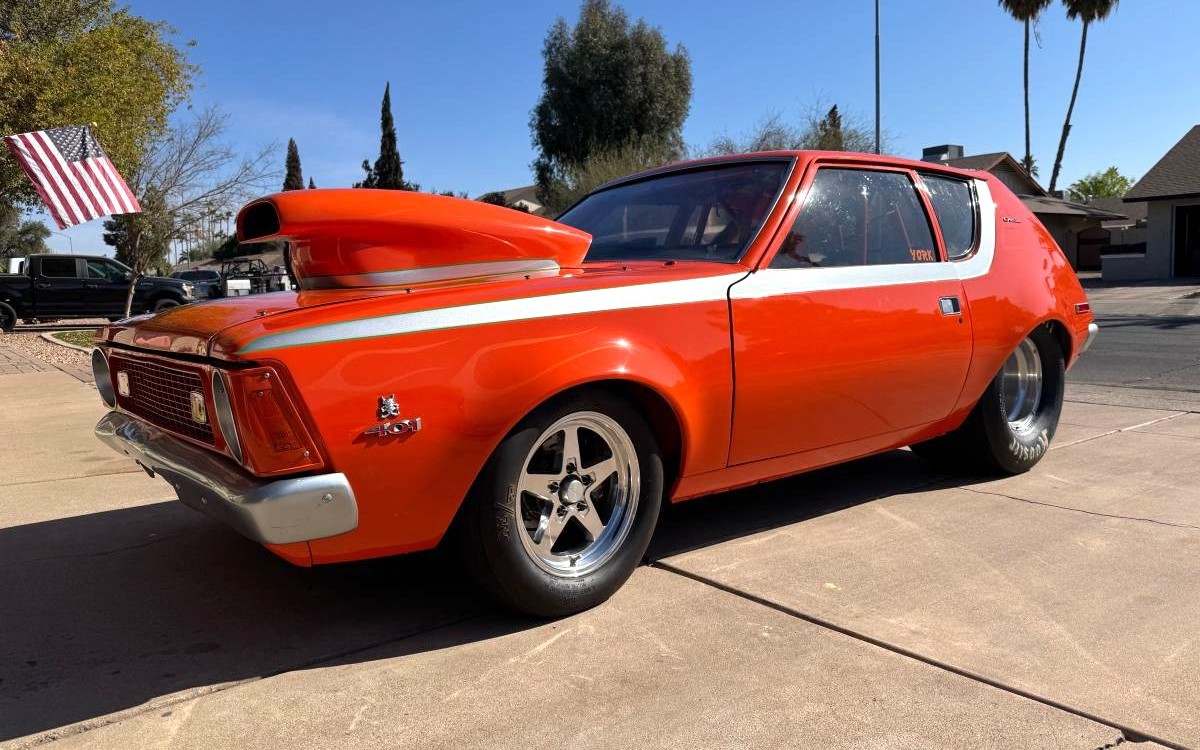
AMC rolled out the Gremlin in 1970 as their response to the rise in subcompact automobile sales spurred by the imports. The Gremlin was a shortened Hornet with a hatchback and the company sold some 671,000 of them in eight years. This first year Gremlin was transformed into a full-fledged drag car using AMC’s top 1970s engine, the 401 cubic inch V8. If you are looking to go racing, this one can turn the quarter mile in under 11 seconds. Located in Mesa, Arizona, the pint-sized beast is available here on craigslist for $19,000. Thanks for the heads up on this tip, Tony Primo!
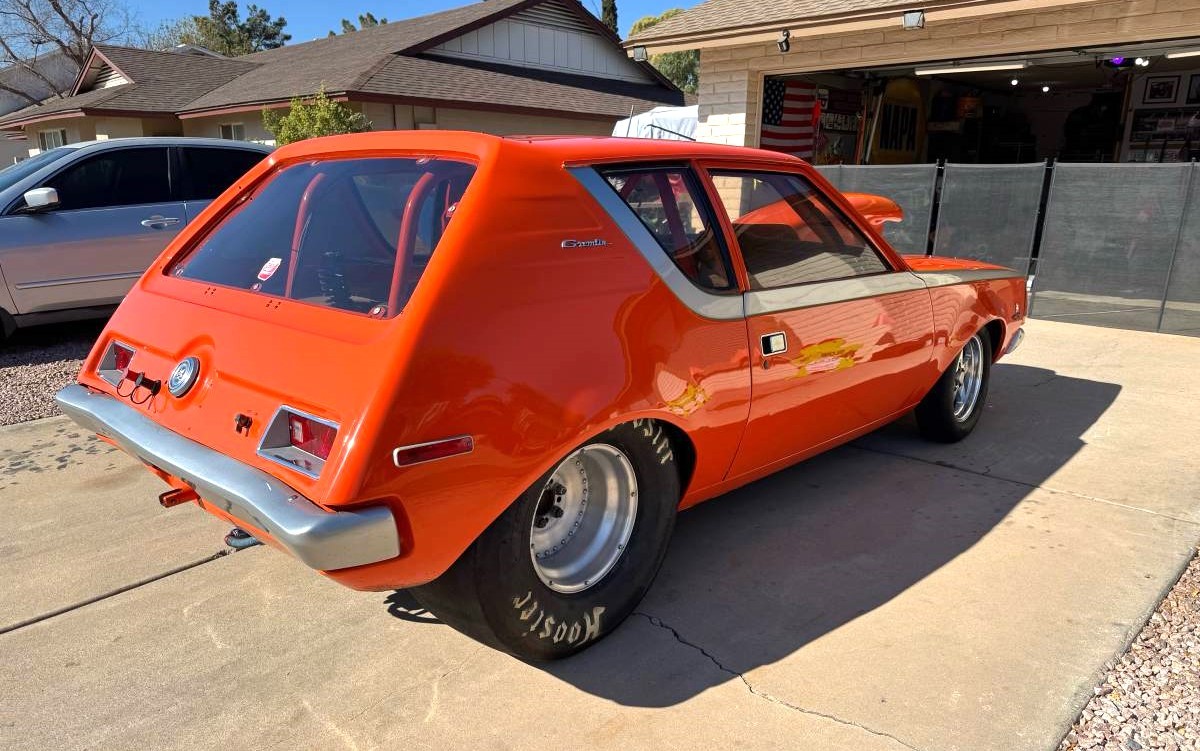
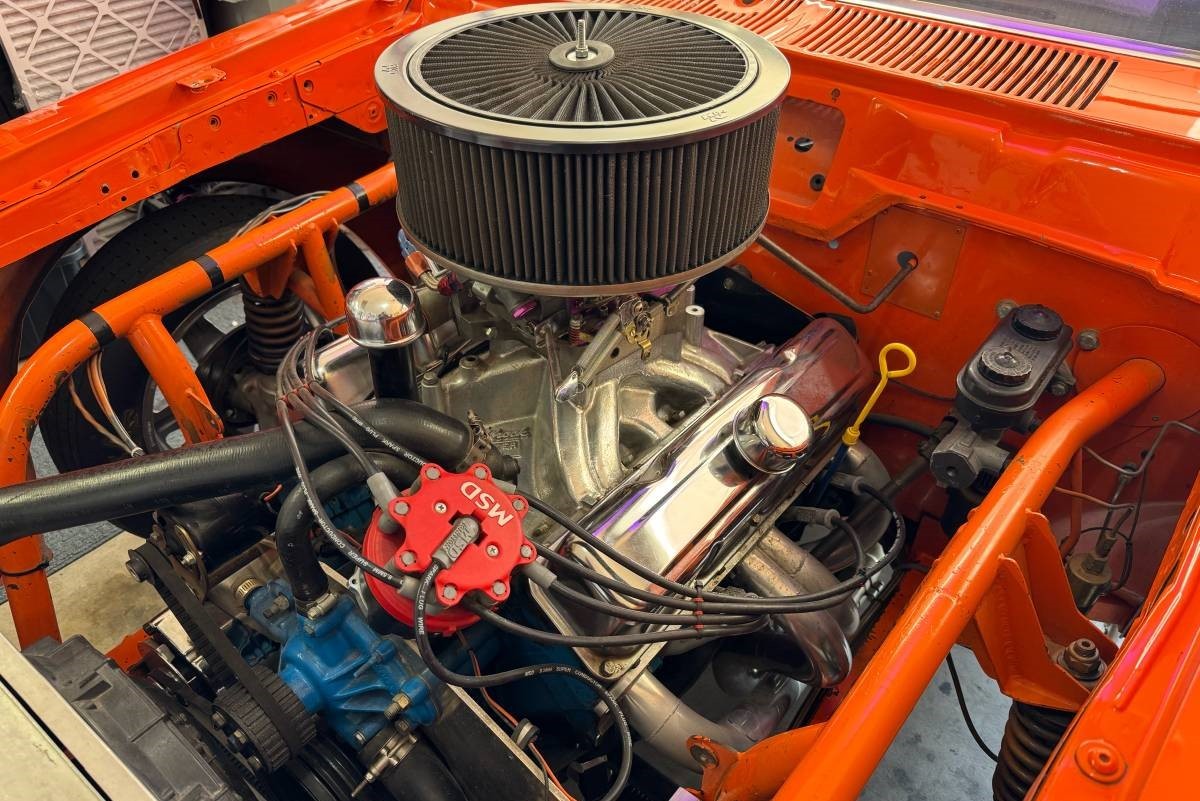
Not many of this Gremlin’s original parts and pieces are likely left besides sheet metal. These cars were mostly powered by inline-six engines, though a small-block V8 was added to the mix. That’s all gone, replaced by the 401 paired with a 727 TorqueFlite automatic transmission. A tube chassis resides underneath, and the rear has been tubbed to accommodate wide racing slicks. A humongous air scoop sticks out of the hood, and you have to wonder what visibility is like looking to the right.
This Gremlin has a NHRA Super Street pedigree, running for many years in Division 7 events. But it’s not a retiree still performing in 5 to 10 races a year. When you fill this thing up with go juice (not that this machine is remotely street-legal), you’ll need to spring for 110-octane fuel. The odometer is said to read 300 miles, but that must be from the transformation point. In quarter-mile increments that could be 1,200 runs!
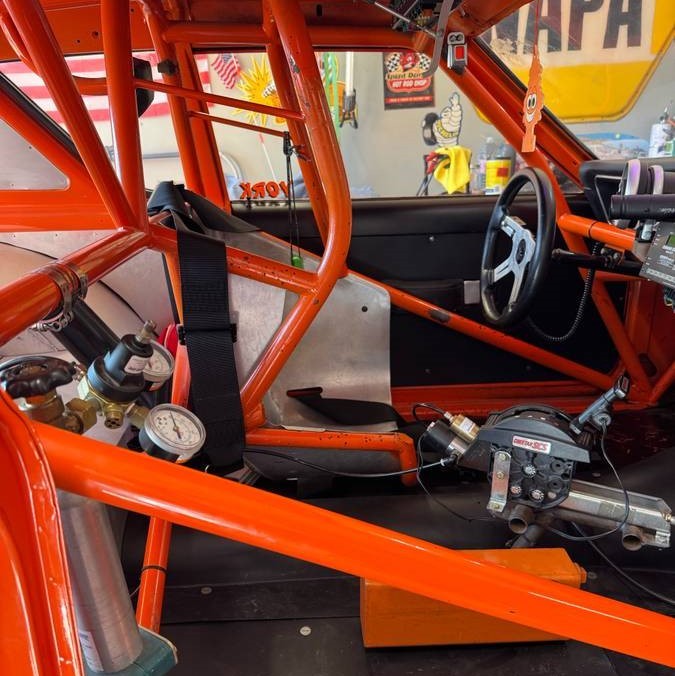
We’re told this race car is turn-key, so presumably you could take it to your local drag strip next week. It should pass any qualifications test that may be thrown at it with all Lexan windows (no glass), an NHRA-certified roll cage, and probably more. Who wants to go racing?




shut up and take my money!!
Mitchell, after you buy it, maybe Howard could pilot this down the 1/4 😎 🇺🇸 for all his fans here.
401, Torq-flite, 4.11s, Cheetah 🐆 shifter. 🚀 🏁
Anyone from the Midwest knows the name Brian Ambrosini. Mr. Ambrosini lives(d) in Kenosha, and was hailed as the “Wheelie KIng” several years in a row at Byron Dragstrip, near Rockford, Ill. He had a similar orange Gremlin, and you can look up his antics. Unfortunately for him, he worked at Snap-On Tools, and was charged with a million dollar theft ring, and pretty sure his wheelie days are done.
This is cool, and I think 300 miles is 600 runs, a 1/4 mile back? Anyway, someone did an outstanding job, I think it’s “tubbed” too, and this is one badazz AMC that made Camaro, Chevelle and Mustangs nervous. Chrysler not so much. Cool car..
Howard’s math is correct; 600 runs not 1,200, as you still have to drive it back from the far end…
Each run is well over a mile, probably closer to 1 1/2 miles if not more. Race distance is 1/4 mile, the shut down area is generally another 1/2 mile to the turn off, then you’ve got to add the return road (which doubles the distance from the starting line to the turnoff), plus however far out if the way it is to your pit (at a national or divisional event that can be a considerable distance) then the back to the staging lanes and the burnout.
Even though it had a chassis certification, it expired in 1999, and will need significant upgrades to get recertification. That won’t matter as long as it runs brackets and doesn’t run quicker than 10.0 or faster than 135. This will make a good bracket car for someone, it’s days if running any NHRA divisional or national event are likely over.
The price is right for a clean low-10 second car. Race car pricing is not comparable to street cars.
Steve R
Steve R: Thanks for the explanation on bracket racing. I was watching an episode of Roadkill where they were trying to get their car kicked out for going too fast.
I didn’t understand how that worked at the time, but I figured it must be that the old junker would be too unsafe at that speed.
Was he the guy that had the hemi powered gremlin? I remember someone had one back in the day somewhere in the vicinity of Milwaukee
Nice piece with a decent price. That big intake scoop isn’t a problem as the driver is only concentrating on the straight ahead view and keeping the car as straight as possible. We try to catch the National events when we can on TV and it’s amazing to watch, especially when they rebuild or replace engines in 30 minutes and tick off 335 mph runs.
Those big hood scoops were on Pro Stock cars when they ran carburetors. Now with fuel injection, those hood scoops aren’t needed. The fuel cars run an average of 90 seconds, including warm up, burnout and run. They cost on average $50-$60 grand PER RUN, unless it blows sky high, then over $100,000. This 1,000 foot baloney has old Wally spinning in his grave. Watching vintage racing, a lot of races were won or lost in that final 320 feet.
Went to 1000′ because cars got too fast and most tracks shut down area was too short for the high mph these days. If top fuel keeps it up they might go to 800′! Not enough tracks have long enough shut down areas. That’s reality!
Steve H, you are right about the shut down area. Wally Parks was an advocate for safe racing, the Safety Safari’s logo is “dedicated to safety”, he would likely have approved.
Most fans wouldn’t know the difference in distance unless you told them, grandstands rarely extend to the 1/8th mile (660ft), even with a finish line at 1,000 feet it’s more than a football field away. I go to the national event held at the local track every year, me and my friends will watch the fuel cars run Friday nights, we stand along the fence on the pit side about 30 feet from the track on an elevated area just beyond of the 1/8 mile, you can still get a decent view at the 1,000ft finish line, but wouldn’t be able to see much of anything if they were running the full 1/4 mile.
Steve R
Much prefer the 1/4 mile also Howard. 🏁
So…. I know one can’t feed after dark but can it be raced? :-)
…And don’t get it wet even though it did that to a few here.
So one knows it can’t feed after midnight… but can it be raced :-). Looks like a fun runner!
Kudos for running a AMC big Block.401.
I saw a TV show build of a cool early 1950’s Ford truck and a Chevrolet Engine shoved underneath and scratched my head and stated why not put a Coyote?… just a pet peeve of mind…
It would be like building a cool 1968 Charger and saying well why not….
I should but a 454 Chevrolet under this thing to complete my Mopar…. (NOT). :-).
Good Luck with sale! I luv it!
Jeff, AMC did not have small or big blocks. They had one block with different bores and strokes. In 1970 AMC had the 304, 360 and 390 cu in. In 1971 the 390 became the 401 by changing the bore and stroke.
390 was stroked .140 inches to make the 401. Bore is the same at 4.165″
Looks like there’s only room for Starsky in there. And he’s had to give up on hood slides.
AMC did not build small blocks. AMC did not build big blocks. All AMC V8s were the same block. They were bored, stroked, etc, to get the various displacements. As AMC guys, we dont use terms like big or small block. we also aren’t big on ‘numbers matching’ and terms like that. They do not apply.
Pontiac never made a “big block” either.
Compared to other motors, the Pontiac V8 is the size and weight of engines that are called big blocks. IIRC, the Pontiac 389 is close to 100 lbs heavier than an AMC 390.
The only way us AMCers can come close to number’s matching is to have an engine with a build date within a couple weeks prior to the car build date. AMC did not have a stock of engines built and on shelves waiting for cars, they were built as needed.
Except that the engine’s build date was not stamped on the actual block or heads. Only on a removable tag screwed to the valve cover. Like you mention, the engine tag should indicate production as about one week before the car was made. The best is to have original PO and delivery papers that will have the engine date and VIN on the same piece of paper.
Sweet!!
Nice car! This the kind of car I like!
Definitely tubbed to get those fatsos under it.
Best looking Gremlin I’ve ever seen.
This car reminds me of the nerdy school kid that people mocked who then grew up to be an Olympic athlete.
I agree with Steve R; this could make somebody a pretty cool bracket car. Appears to be fairly well built and the asking price isn’t out of hand. Neat car.