

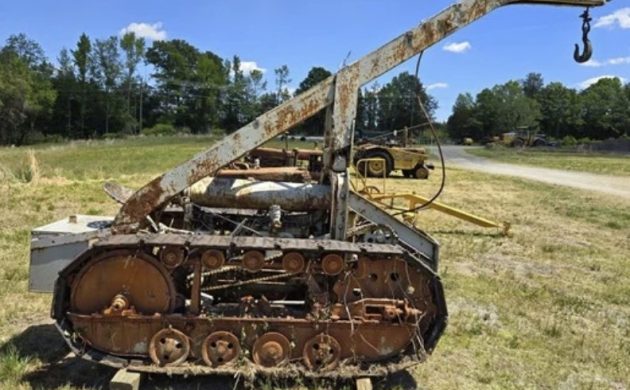
This contraption is just one of the thousands of Fordson tractors that could perform specialty work around your factory, farm, or, in this case, your loading dock. A previous owner has installed what is likely a Trackson kit to add tracks to the wheels – that’s a great vintage attribute on its own, but this Fordson F also features a crane run by a Hyster winch. It’s for sale here at Auction Time with bidding at $900 (up from $300 when I started writing this article a couple of hours ago!). Tow this gem home from Rockville, Virginia.
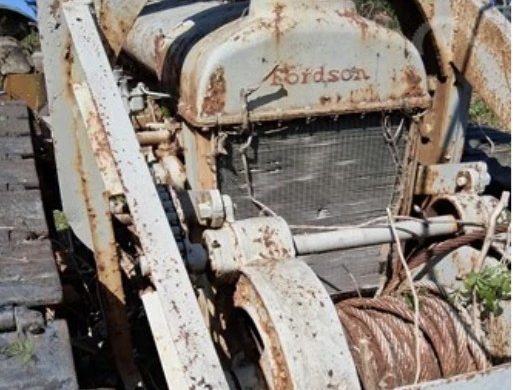
Henry Ford wasn’t the inventor of the tractor – that honor belongs to John Froelich, who created an engine that could be driven way back in 1892. But the mass-produced Fordson tractor was a miracle in its day. Introduced in 1917, the Fordson reduced both the time and cost associated with farming using animals. The mechanized solution to farm labor was a cause near and dear to Henry’s heart: he had grown up on a farm and disliked the daily, backbreaking chores. But the Model T inspired Henry too, as he saw owners transform their cars into plows, snowmobiles, vegetable trucks, and even rudimentary RVs. After tinkering with his cars to equip them with farming implements, Ford decided a specialized vehicle would work better, and the Fordson was born. It was manufactured by a separately organized company – Henry Ford & Son.
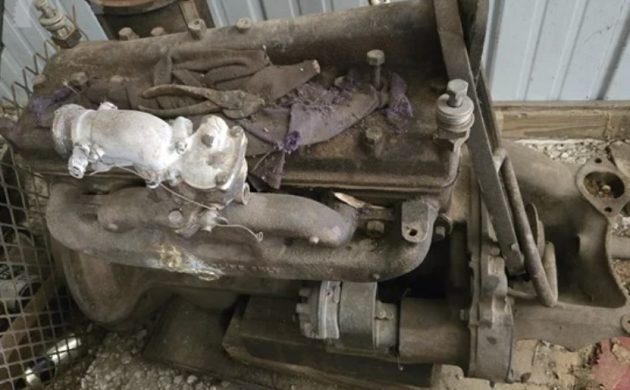
The engine was similar to the Model T’s four-cylinder, though early Fordsons used Hercules motors. Almost any fuel could be used for running, but gasoline was needed as a starter. The engines were reluctant to turn over in the cold weather, ran hot, and were unreliable, but the Fordson tractor was still cheaper than a horse. Output was about 20 hp. This example comes with the engine that was installed when it was acquired, which is stuck, and another that’s a spare.
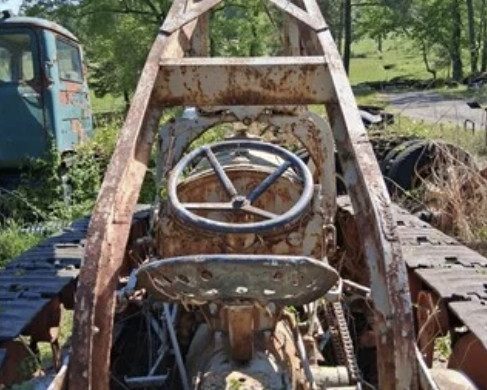
No plush interior here! The seat, metal tracks, and lack of suspension will beat up the driver, but that’s to be expected from a 1921 tractor. In fact, it wasn’t until the 1960s that farmers got a break: aftermarket makers finally offered enclosed cabs and rudimentary heating systems. Suspensions took another couple of decades to perfect.
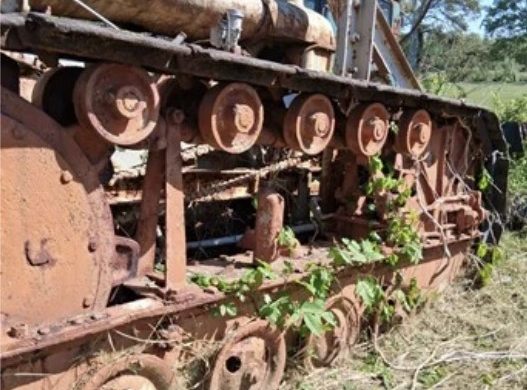
Most likely, this tractor was converted to a crawler using a set of Trackson tracks. Trackson was founded in Milwaukee, Wisconsin in 1922, providing after-market conversions mostly for Fordson. It merged with lift-maker Lessman Manufacturing in the 1930s and subsequently introduced its own shovels and loaders. In the late 1930s, a much larger customer came knocking – Caterpillar. By 1951, Cat had purchased Trackson, capturing its product ingenuity for Cat alone. This crane-bearing Fordson F is about as rare as they come, for so many reasons. Asking prices for early Fordson F tractors in decent condition range up to almost $5000, but this one, once restored, could surpass that on the merits of its unusual features.

Did you ever wonder why,,,(oh, Andy we miss ye) you’d see old timers with fingers or limbs missing? Right here. This thing looks to be right out of WW1, like some early bomb squad machine, only not radio controlled. Some poor guy had to actually drive it. We must remember, this was pre-hydraulics, and pretty crude, but took the place of 10 stout men, it did. Amazing, all that winch hardware replaced by 1 hydraulic ram. Not sure what you are going to need to move it, probably weighs a lot. I’d be interested in “runs on any fuel”, as not sure how that would work. I’ve worked with machines that were a gas/diesel, but a complicated ordeal switching from one to another. I’m really not too sure what, if anything, you would do with it. I bet this pulled a motor or 2 in its life. Cool find.
Back in the 60’s during my first real summer job after being a golf caddie for a few years, I worked for a builder. They had a pickup truck that ran on kerosene, I remember, just off road and smoked a lot. My MB 300SD ran well on filtered cooking oil about 25 years ago, but that was a simpler transition.
I have had a1918 Fordson and still have a1937 Fordson that both started on gasoline and than buy just moving a switch valve ran on kerosine or a few other fuels. I would like to have this in my collection if it were closer to me.
This is really neat. I’ve never heard of Trackson. This must’ve been some significant upgrade when it was new. It would probably take a heap of hours and work and no doubt it would be a labor of love, but it would be nice to see this old workhorse restored and in a museum somewhere.
Well, I imagine it will keep you busy for some time. I don’t know what you would do with it but it might be a worthwhile project for some. Personally, I would give it a wide berth and let someone else take it on. If I was to tackle a challenging project from the industrial world I might be tempted to take on something like that John Deere 840 in the distance. Just looking at it, I can hear the sound of that V-4 pony engine cranking up that 2 cylinder diesel…
Rockville isn’t too far from here, must be cleaning out before it turns into subdivision. That’s some contraption, you’d be amazed what guys would do to eliminate muscle power. I see another Fordson in the background and what about the B and U model Macks?
You find some very interesting industrial machinery, Michelle. As Howard said you can bet that at some point in time someone yanked an engine out and transplanted it into a needed donor machinery.
Your deep historical research that you do is always appreciated as it makes it all the more interesting.
Turns out this is part of an auction held by Howco Auctions, Matt Howell is the auctioneer, he’s just a few miles from here. The auction lists 85 trucks, tractors and machines. Check it out if you have time, there might be something else that may be of interest.
Geez Jim, I thought that by now you would have made your way to the auction site, crawled under the fence and given us a full report.
Seems like anything with wheels, or tracks, is showing up on BF, lately! Who would buy this rusting hulk?
Same was said in February about a ’30 6speed IH truck, 3 weeks later there were pictures of the same truck after being pulled from the barn and cleaned up with a very happy new owner standing next to it. One man’s trash…
Hey Jim, don’t feed into this Jack fella, he’s been a buzzkill for several years now. I’m not exactly sure why he’s even here except as an agitator. Odd, some of us can’t enough of this stuff, and others say it’s a rusting hulk. No wonder our country is in such turmoil.
Thanks to the author(s) who work hard to bring us this, only to have someone trash their work. I’m proud of all the authors that put up with that.
It’s going home with someone. Bidding has been frisky.
Wow! A Hoyt-Clagwell with tracks and a boom! Mr. Douglas would be envious- if only he could get his garden-variety tractor functioning. (See what I did there?)
I had to chuckle when Michelle mentioned the foibles of the Hoyt…er, Fordson.
I wonder if this may have been WWI equipment?
Great write up on a unique “vehicle” Michelle.
Jim Randall, I would have been very surprised not to hear from you on this listing! I saw this and thought this is right up Jim’s alley/dirt road. This is a very cool piece and I could see me using this thing regularly. It definitely has attributes over my 1958 Massey Ferguson 65. I don’t know which would be worse. Climbing into the “driver’s seat” multiple times in a day. Or just performing regular maintenance!
Hey Wayne, once you manage to get into the operator’s seat, you definitely want a lumper there to hook and unhook!!
Hi Jim,
Yes I concur completely! Never heard the term lumper!
I guess I’ve lived a protected (from a lumper?) life!
Good to hear from you!
Never heard the term “lumper”? Loosely translated, means a helper, but in the trucking world, if you were too lazy to unload your trailer, you could hire people that hung around the loading docks, usually unaffiliated with the company, much like construction helpers at Lowes, and they would unload your trailer for a fee, typically out of pocket. Not many bosses would pay a lumper fee. May sound silly, but these guys would unload 2 or 3 trucks a day, and take home $500 CASH! I’m proud to say, in all my trucking, I never once paid a lumper to unload my trailer.
Cool lawn art
That’s one of the things I really like about Barn Finds: Almost anything could turn up! As always, great research & write up, Michelle!