
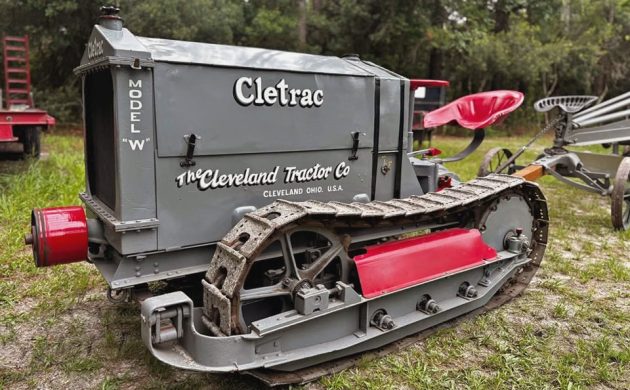
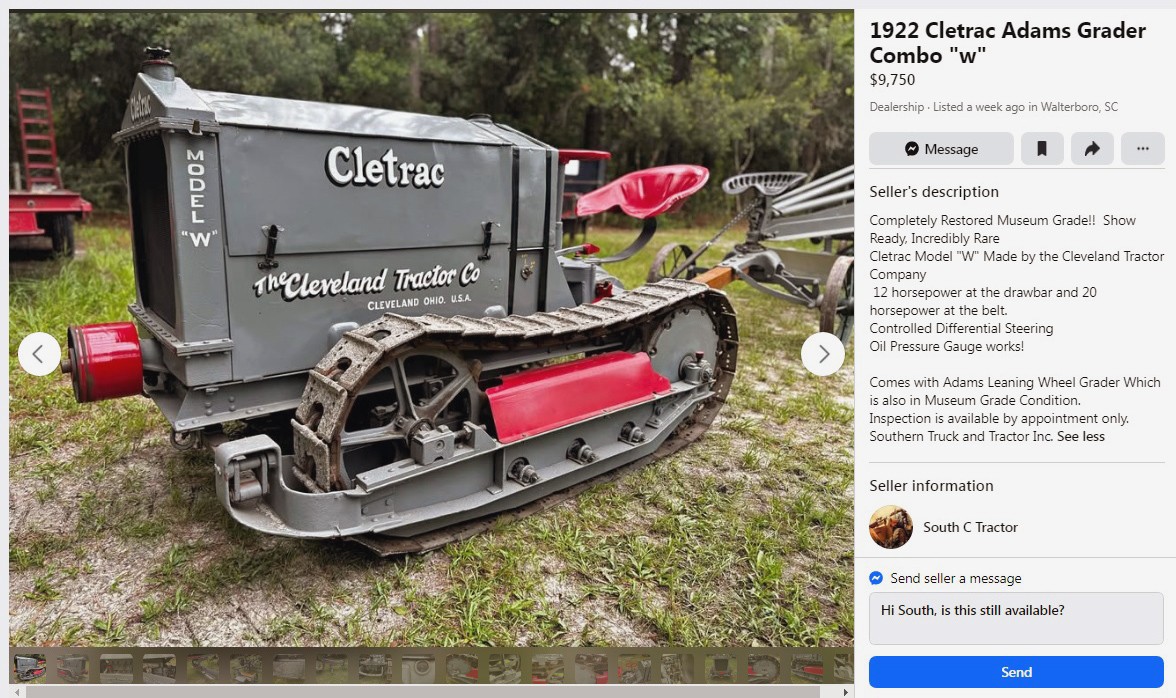
The more I drive on America’s freeways, the more I think something like a bulldozer might be the way to go to take care of those left lane hoarders and texting drivers. This 1922 Cletrac Model W 12-20 Bulldozer would do the trick! This restored bulldozer and grader package is listed here on Facebook Marketplace in Walterboro, South Carolina, and the seller is asking $9,750. Here is the original listing, and thanks to T.J. for the tip!
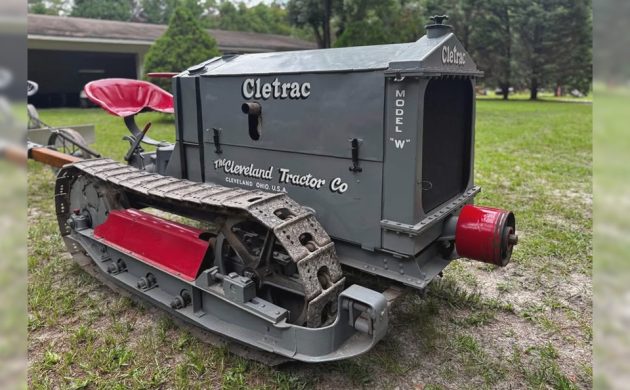
Take a guess where the name Cletrac comes from, no fair looking at the photo above. Yes, the Cleveland Tractor Company grew out of the Cleveland Motor Plow Company and was founded by Mr. Rollin White, the founder of White Motor Company. The White Company was bought out by Volvo in 1980, and most of you probably know the company made cars, trucks, tractors, and other vehicles. Cleveland Tractor Co. was founded in 1916 and hung around until just before the end of the Second World War, shutting down in 1944.
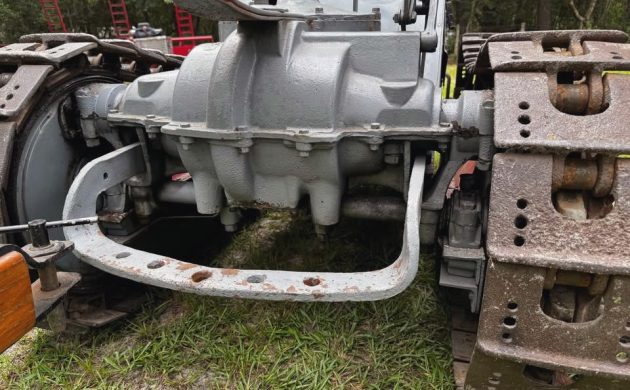
This bulldozer is a Model W 12-20, as in having 12 horsepower at the drawbar and 20 horsepower at the belt. The seller says it’s completely restored and “museum grade”, and it sure looks great overall. It’s impossible to keep every square inch of a 3,455-pound bulldozer looking like new unless you drive it over velvet and never operate it at all, even to poke around on grassy fields at vintage tractor shows. The tracks are going to wear off their paint in no time, but otherwise, this looks like a ring-dinger of a dozer.
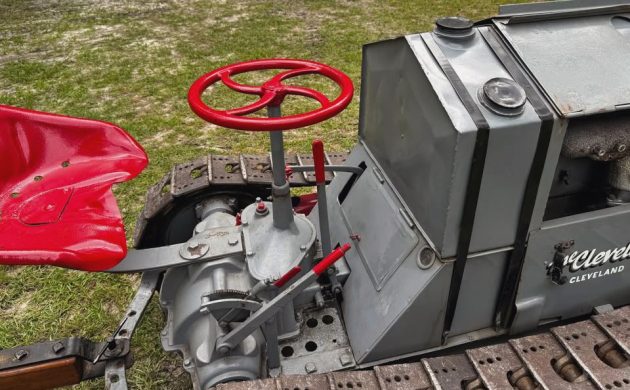
There’s no heated steering wheel here; this is one tough, tracked tractor. By 1917, the company was called Cleveland Tractor Company, and they sold 40,000 tractors in the U.S. and in about 70 countries around the world by the end of their first decade. They had success through the tough days of the early 1930s and into WWII, selling tractors to government agencies and the military. Sadly, the profit margin for those sales wasn’t enough for Mr. White, who sold the company to Oliver Corporation in 1944.
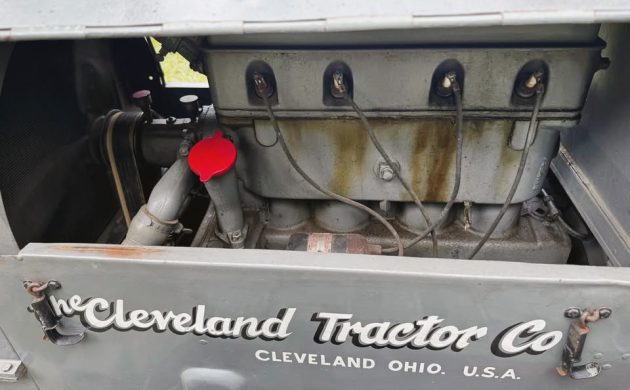
This W 12-20 is powered by a 4.5-liter (276.5-cu.in.) liquid-cooled inline-four cylinder, and it was rated at 12 horsepower, although that’s a bit low given tested ratings of 15 horsepower. It’s backed up by a single-speed transmission with reverse, and I’m assuming it runs well as it’s shown in various locations in the photos, along with a few others at shows on the internet.
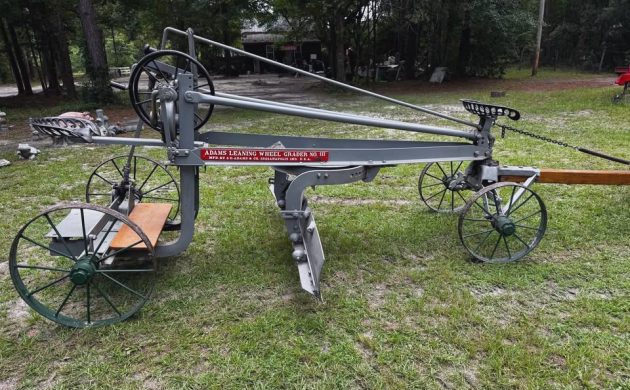
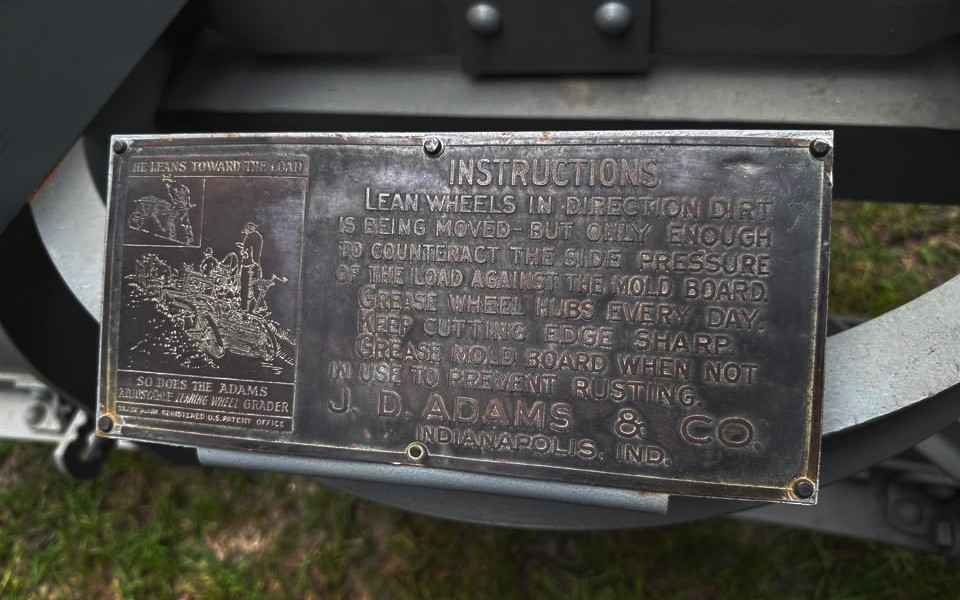
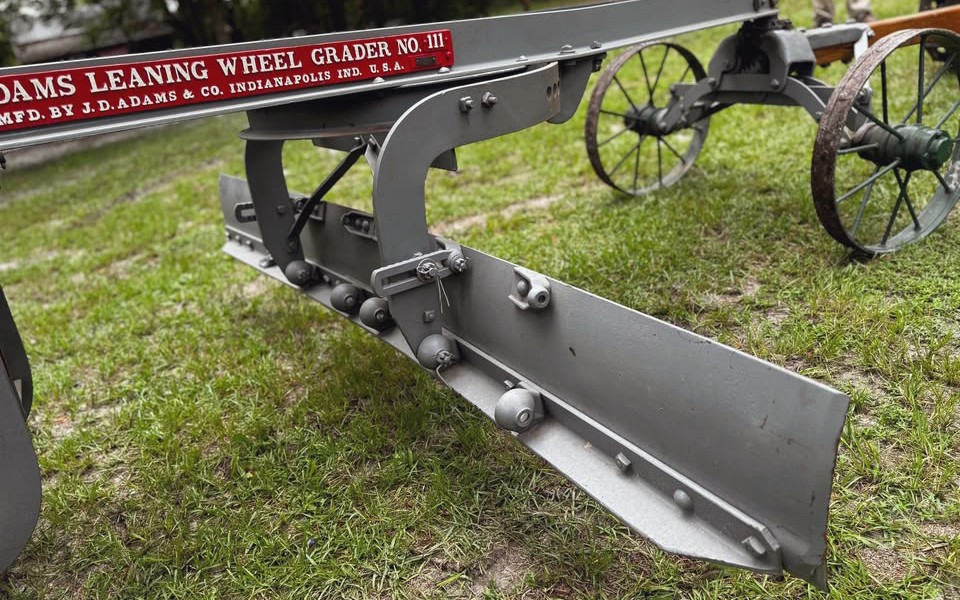
The kicker is that this beautiful beast comes with a restored Adams Leaning Wheel Grader No. 111 to pull behind! “What the heck is a leaning grader, SG?” I’m glad you asked. Just like you lean into your work to get more power, such as shoveling or other back-breaking tasks, Mr. Joseph D. Adams wondered by a road grader couldn’t lean into its work to keep the gravel roads and ditches in better condition. This was the late 1800s, and Mr. Adams was one of many individuals contracted by cities and other jurisdictions around the U.S. to maintain the roads. Here’s a plate on the Adams Grader showing how to operate it.
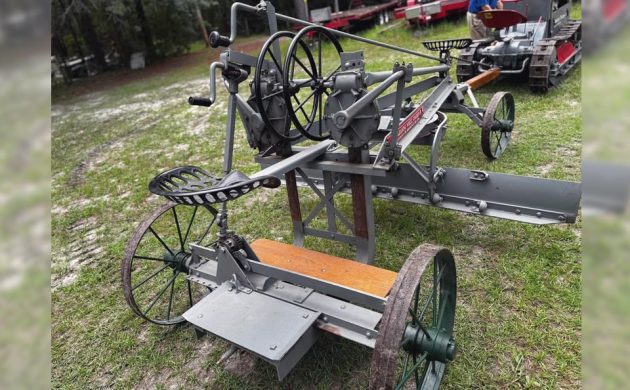
You have probably seen road graders and wondered by the front wheels leaned; it’s so roads could be graded and plowed better than if the extra leverage wasn’t available. Here’s a short video on YouTube showing a modern grader in action. By 1897, Mr. Adams had a big factory in Indianapolis, and the company remained in business until 1960. So here you go, with change back from that $10,000 bill you’ve been holding onto since 1969 when they were withdrawn from circulation, you can have both of these restored workhorses and be the star at almost any vintage tractor show!



Awesome stuff SG. That’s a hefty displacement 4cyl. Big pistons 💪
Very interesting Scotty. I like to see old machinery like this, and to take in the innovations they came up with, which are still in use and important today.
I got a chuckle out of the vintage photo with the four guys “supervising.” Wearing their fancy suits and hats, the attire of the day. Kind of like when Andy and Barney get dressed up to go down to the diner. I guess today’s equivalent would be nice jeans with polo shirts.
This is just really neat Scotty. I’m really glad to see this here. If anyone remembers the old gas station I posted a picture of that I worked at, one of relatives had a newer Cletrac from maybe the late 40’s that was an Oliver based Cletrac. It was a bit different than this one. The steering wheel on this one is unique to have instead of the typical 2 levers. I am guessing it doesn’t have power steering. ( I hope everyone knows I’m kidding). I never knew why the wheels leaned on a grader until I read this. The individuals who thought all these different things out and made them work over a hundred years ago is just impressive to me. I may be wrong, it’s been ages since I saw the Oliver version but I think the one I saw had an Oliver 6 cylinder and multi speed transmission. There was an Oliver dealer in the area we used to live in from many years ago, but if you carefully looked in many of the old barns in the area, there was a pretty good chance you’d see an Oliver Row Crop in there. True Barnfinds for sure. To go with what Bob said about the suits and ties, it really is something how differently people dressed all those years ago. Great write up and find Scotty and T.J. I enjoyed it!!!
I seem to remember Oliver Cletracs with 4 cylinders.
Yeah, I took a bit of a hiatus, I’m just not finding the interest here, but simply can’t pass up one of Scottys posts. Always a treat. Now, to show you this guys professionalism, and all the writers, for that matter, I know full well, Scotty isn’t an expert on Cletracs or graders, so an ample amount of research had to go into this. A tip of the hat.
In my Wisconsin hometown, Lake Mills( near Madison) there was/is an outfit called the “Muck Farms”, that grew potatoes, of all things. They had a fleet of these type of Oliver tractors, and the 1st time I ever saw these. Their low profile and wide stance make them perfect for”Muck”. For 1922, this was an incredibly advanced machine, and design hasn’t changed much. While 2500ft/min. is about 28 mph, a bit optimistic as I read, this machine would do about 5.25 mph, but still beats Old Dobbin by a mile. Also, 15 hp sounds lean, but had torque up the ying yang.
Speaking of Old Dobbin, before the Cletrac, graders like these were pulled by horses. I’m familiar with road building, and roads need a “crown” for drainage, and the tilting wheels help accomplish that. Also, todays “motor” graders are techno whizzes with hydraulics and lazer guided grades, but I worked for a construction machine outfit, trenchers, skid steers, loaders and graders. The boss took in on trade an old Galion motor grader, I think, with the PTO and the 10 levers with dog clutches a spinning and 50 U joints, that took some skill. I could sure use that grader in the hills. The Forestry Dept, who used to grade the roads, somehow can’t find the money to do that today, the graders in their yards have flat tires, and the roads get worse and worse. Heck, I’d do it for free, oh well, great find, and why I stay connected here. Where else would one see this, AND, a well written description, to boot.
Nice step off to the side, Scotty. I run into vintage crawlers at some of the old tractor/thresher shows but finding one with an actual steering wheel is somewhat rare. No doubt it works as well as a tiller. Cletracs made it out west although I think that Caterpillar made a deeper mark. I try to imagine operating one of these back in the day. Sure couldn’t run this and operate the grader by yourself…
It says $8,750 now.
WOW! What a rare treat! Guy I worked for when I was in high school had a later model Cletrac he used around the farm. It had burnt a valve many years prior and sat under a shed with the head off. I told him one day I’d come out and help him get it running again. Fast forward 5 years, high school, trade school, working nights at a KW dealer, time to make good on my promise. Under a tarp was a big flathead Hercules 6 cylinder, everything greased up to prevent rust, coffee cans full of nuts and bolts, let’s get started! 6 new exhaust valves from Mack Boring and Parts in Union NJ, got my Dad to make a new set of keepers, a friend who did heads owed me a favor and ground the seats. A day or two of cleanup and back together it went. When it came time to fire it up the old cloth-coat spark-plug wires had given it up. While Tony went for a new set I cleaned the cap, points, etc. New set of wires and it fired right up! That big 6 with a straight pipe really barked! This unit had a 3 speed transmission, 2 stick steering and hydraulic blade, it was a beast! The place belongs to his grandson now and it’s been more than 20 years since I’ve been back, but I told him don’t junk anything, all that old equipment had value.
I apologise for the long, off topic post, but the flashback of Tony on that old dozer is as clear as if it was today!
No apology needed there pal, love to hear it. In the 70s, I worked for an asphalt company, and the yard (way in the back) had all kinds of equipment from his fathers business from the 40s and 50s. Most sunk into the ground. B model Macks, REOs, BB Ford flatbed ( that I wanted) asphalt grinders with flathead Chrysler 6s. I went back several( many?) years later to see about the Ford, and it was all gone.
“barked”! That’s a good way to describe my ATC Terratrac 656 crawler loader with 320?” continental 6. Collected some literature and saw that a muffler was an option.
It was the first crawler with torque converter drive. All others either declutched or braked one track. You can have one track drive in low and the other in high and push dirt and turn with power to both tracks.
It was so great that Case bought ATC.
I ran a grader in my early 20’s clearing snow and was never informed about the reason for the front tire lean (except for reducing the turning radius). So I learned from the video something I never knew! Ill put that to use on the one I use to plow snow these days! Thanks Scotty.
So the fuel tank just in front of the “steering wheel ” has two caps. Now days when going to antique tractor shows. The “dozers” have 2 caps. One for gasoline and the other for diesel fuel. You start the engine on gasoline and then when it warms up, you switch over to diesel operation. Some tractors the same thing. So on this particular unit, what is the second cap for? Hydraulic oil? Water? I love the PTO drive drum out the front instead of out the side. Direct drive off the crankshaft? This would be interesting to peer into it’s mechanicals!
Wayne, This is a great writ up!! Thanks!! I think the two caps are the same as you described.. The second fuel was called Distalite” closer to being kerosene than diesel but a lot cheaper to buy before WW II.. Was very common on farm tractors.
I think the horsepower rating is for “drawbar horsepower” not engine. It’s a much more useful rating than engine horsepower. I think Cletrac and Holt & Best merged to become Caterpillar, but I may be wrong. Yes Brocky, John Deeres were “dual fuel” They started on gasoline and were switched to distillate after warm up. My dad worked for farmers during the war (he was too young to go to war). He said more than once, he forgot to switch and had to walk a half mile back to farm for more gasoline (they wouldn’t start on distillate).
You are 100% correct, sir, that was my dumb mistake, as was the MPH, which relates to the belt/pulley.
https://www.tractordata.com/farm-tractors/007/9/8/7985-cletrac-w-12-20.html