

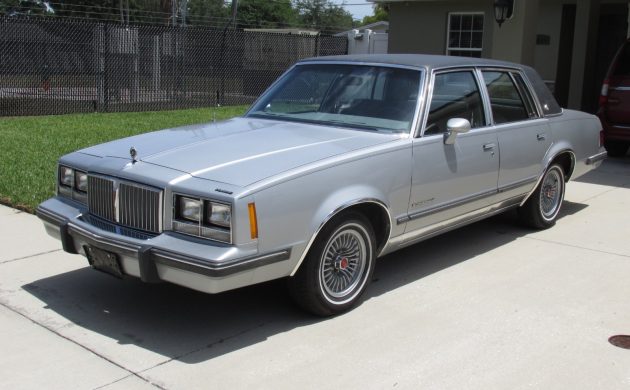
Even a relatively “pedestrian” vehicle can turn heads if its appearance is good enough. Take this 1986 Pontiac Bonneville as an example. It is not the most desirable classic on the planet, but with 19,000 miles on the clock and excellent presentation, it could still turn heads at almost any Cars & Coffee. It needs nothing, and could be ideal for someone dipping their toe into the water of classic ownership for the first time. I must say a big thank you to Barn Finder T.J. for spotting this beautiful Bonneville listed here on eBay in Lakeland, Florida. The seller set their auction to open at $7,500, but has received no bids at the time of writing.
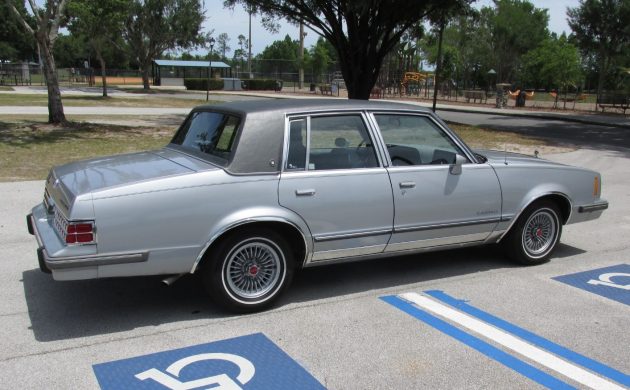
Pontiac marketed the Seventh Generation Bonneville from 1982 to 1986. Its latest offering was significantly smaller than its predecessor, reflecting an overall market move towards downsizing to improve performance and efficiency. This final-year example presents nicely in Silver with a Charcoal vinyl top. The exterior shines nicely, and my research reveals that a previous owner applied a ceramic coating in 2024. Close inspection will reveal minor chips, but none are severe enough to detract from the car’s appearance. The vinyl top isn’t split or faded, and this classic is rust-free. The trim and glass are excellent, and the Bonneville rolls on what Pontiac described as its 14″ Turbo-Finned aluminum wheels.
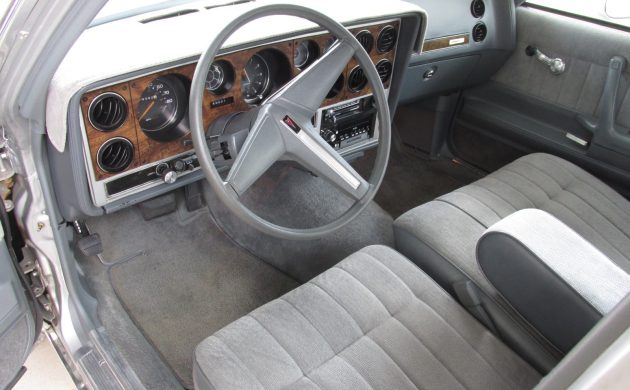
There isn’t much to criticize about this Pontiac’s interior. I was worried about the molded dash cover. However, the seller states that it is purely a protective measure and that the pad is crack-free. The Gray cloth chosen by the first owner is pale, leaving it prone to dirty marks and stains. I can spot no such problems here, and there is no evidence of wear or other physical damage. The carpet looks surprisingly good, and there are no issues with the faux woodgrain. The first owner equipped the Bonneville with air conditioning, cruise control, a tilt wheel, and a four-speaker AM/FM radio with a power antenna. The previous owner converted the A/C to R134a refrigerant, and the seller confirms that it blows ice-cold. The power antenna doesn’t function, but can be raised and lowered manually. Otherwise, everything inside this classic works as it should.
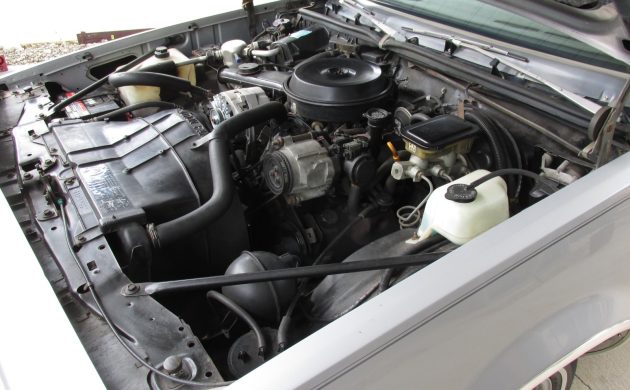
The first owner ordered this Bonneville with the entry-level 3.8-liter V6, producing 110hp and 190 ft/lbs of torque. The V6 sends its power to the road via a three-speed automatic transmission, bringing us to an interesting point to ponder. Selecting the optional 5.0-liter V8 would have included the four-speed 200-R4 automatic as standard. The smaller motor would have undoubtedly performed better with an additional ratio, but it seems that Pontiac had its eye on the bottom line and kept sticker prices low by making the three-speed the default feature. The seller doesn’t mention evidence verifying the mileage claim, but it may be amongst the enormous selection of included documentation. The seller confirms that the Bonneville runs and drives extremely well, ready to provide the winning bidder with immediate classic motoring gratification.
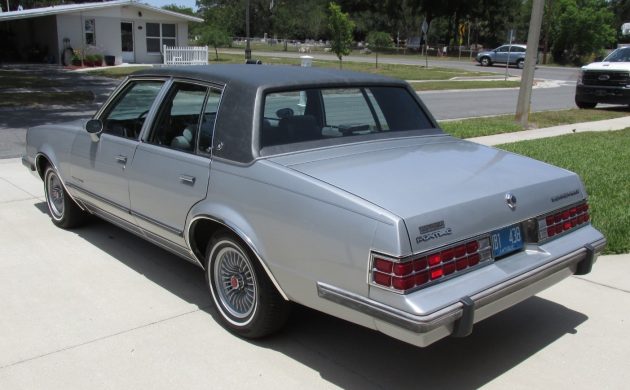
This 1986 Pontiac Bonneville presents nicely and has no apparent needs beyond the non-functioning power antenna. The seller’s opening bid figure is above average, but this car also demonstrates why research can be important when considering a classic purchase. I located a previous sale for this Pontiac in January 2025. The Bonneville received thirty-three bids, changing hands for $9,500. That may provide some insight into the seller’s expectations this time, but is that a price you would consider paying for this Pontiac?

Yessir ✔️ love em.
That’s not a real Bonneville. Pontiac tarted up the former LeMans and tried to pass it off as a Bonneville from 1982 to 1986. It didn’t sell well at all.
They finally realized their blunder and brought back a full-size Pontiac in the Parisienne. Which was a just a nice Chevy Caprice.
In Canada, the full sized Bonnevilles were always the Parisienne, same car with slightly different trim. When they offered the Parisienne here, like you mentioned, it was a gussied Caprice. Its base engine was the 4.3 V6, a terrible choice for the car.
For 1982 and 1983 GM of Canada did not offer a Bonneville. It was called Gran LeMans instead. The Bonneville and Canada with brought back for 1984.
I think Pontiac knew this, officially naming this a “Bonneville G” in reference to the G Body. I remember riding in a friend’s Bonneville G, and he thought the big speedometer and equally big clock was an underwhelming design…
When the 1982 model lineup was being planned (during, or just after the 1979 disruption that brought back rapidly increasing gas prices), GM was convinced that there would be another upheaval in the oil markets that would bring yet another round of gas price increases in late 1981 into 1982, severe enough to reduce demand for full-sized cars. Pontiac aggressively placed a big bet on the accuracy of that forecast, dropping their B-body models and moving the Bonneville name to their G-body line. GM of Canada, being largely autonomous and having their own B-body assembly plant in Oshawa, Ontario, hedged that bet by bringing back the Parisienne name and putting it on an Oshawa-built Caprice sedan with a grille reminiscent of the ’79 Bonneville for their Pontiac/Buick dealers to offer, using Caprice Classic interior trim for the base model and Oldsmobile 88 Royale Brougham trim for the Parisienne Brougham.
Instead of rising, the price of gas fell in 1982 into 1983, and demand for full-sized cars was strong. Single line Pontiac dealers were furious, some even threatening GM with litigation over the lack of full-sized models to offer their customers. Pontiac hastily made arrangements to import the Parisienne during the last half of the ’83 model year — so hastily, in fact, that all 1983 Parisiennes sold in the States bore a GM of Canada VIN (beginning with 2G7), not a Pontiac VIN (beginning with 2G2). The 1984 Parisienne was unchanged from the ’83s, other than the VIN indicating that it was a Pontiac, but for 1985-86 it once again became a true Pontiac, regaining the exterior appearance of the 1981 Bonneville, other than the retention of the Caprice front clip, and the ’81 Bonneville interior trims, with the exception of the Caprice instrument panel.
Oh Bonneville, look what they reduced you to. Not to put down the car itself, I had the 4 door Cutlass counterpart. Great car, one of the few the ex couldn’t kill, but I never for a second thought it was on the same caliber as say, a ’62-’67 Bonne. For shame. I think real Pontiac followers began to worry when these cars came out. The next gen with FWD was the final nail. Again, great cars, but hardly worthy of the great Bonneville name.
I remember as a mid teens car crazy kid when Pontiac did this hiarchy change. I always wondered, why didn’t they name this one the Parisienne, and the Parisienne Bonneville. That would have made more sense to me. I’m with Howard on that thought.
As for this “Bonneville “, I’m going to go out of a limb here and say I think this has got to be the nicest one yet we’ve seen here on Barnfinds. I used to see these around quite a bit because there was a Pontiac / GMC / DeLorean dealer in our town. But these were never as popular as the Buick and Olds versions. One thing thats interesting is that steering wheel is absolutely got to be original, its the mid 70’s design though. I don’t remember seeing that style wheel, always the newer 3 spoke version. I think that if the paints original, this is a 19000 mile original garage kept car. Nice find T.J., I enjoyed your write up Adam thank you for the memories, I’ve forgotten about these.
In case youre interested this is the steering wheel I meant.
Years ago, I saw a Bonneville Brougham like your picture, except it had the very rare option of leather. Dark brown in & out. Loaded up like your picture. 3.8 V6. You even have the fancy radio & right hand remote mirror. Did you own this car at one time?
No, I got the image straight out of the ’86 Pontiac full lineup catalog. I should’ve been a little clearer there.
Prior to 1983, the Parisienne nameplate never appeared outside of Canada. Before the automotive free trade treaty era, GM of Canada didn’t import Pontiacs into Canada from the US, instead building Pontiac-appearing models built on a Chevrolet chassis, using Chevy-designed engines produced in Canada by their McKinnon business unit. The top of the full-sized Canadian Pontiac lineup was the Parisienne.
When Pontiac dropped their B-body models for 1982 in anticipation of rising gas prices and moved the Bonneville nameplate to the G-body models, GM of Canada chose to retain a B-body in their Pontiac lineup in 1982 by reintroducing the Parisienne for their Pontiac/Buick dealers to offer. That’s why, when demand for full-sized cars rose instead of fell and Pontiac needed to quickly reintroduce B-body models, they did so by importing the Parisienne from GM of Canada. With a mid-year introduction and the Bonneville models already in the lineup, a nameplate swap wasn’t in the cards.
Unfortunately for this version of the Bonneville, it has all the panache of a loaf of bread. It was certainly no head turner. And while this car may have a great engine (who doesn’t like the 3.8?), teaming it with a three speed saps some power. And one can’t deny the Poncho is in beautiful shape, though I wonder what the seller was smoking when he paid $9500 for it. At least the vehicle will be as reliable as it is boring. Which reminds me, Pontiac’s slogan was “we build excitement”. With this car it’s “what was that we used to build?”
Mike’s dad in Stranger Things drives one (although it’s only seen parked outside the house in the first 3 seasons). Brilliant car casting. I can imagine the salesman had shown him a 6000STE but Ted Wheeler wasn’t ready to move on from the Brougham Era and for those of us who know what a Pontiac Bonneville had been 20 years before, it added an element of “I used to be cool” to his character.
GM’s original plan for 1982 was to discontinue the big B-body cars and transfer their names to updated G-body cars. That’s why the 1982 G-body cars got facelifts that made them look more like the bigger cars. In the end, only Pontiac executed the plan, and they almost immediately regretted it, bringing in the Parisienne from Canada in mid-1983.
This is a perfect example of why GM dropped Pontiac. This is about as much of a Bonneville as is a Model A ford. This is a cheap ride that drove like a cheap ride and looked like a cheap ride. It is a disgrace to all us true Pontiac fans worldwide.
Even the Gran Prix back in those days were hard to find with a V8. To go from the days of the ’62 Catalina Super Duty and the 2+2s and the GTOs to this mess was despicable. They did away with Pontiac and Oldsmobile and what is left, Buicks that nobody wants.
I went and looked at the pictures in the eBay ad and, a few things. Like cars in eighty six still had rear seat ashtrays in the back of the front seats? And what looks like a gauge face with a single warning light in it? And why do these late stage Pontiacs have such busy looking dashboards? I do like the wheels though. I wonder what it rides like, because I rode in a fwd Bonneville back in the early aughts and it was pretty luxe.
My ’84 Cutlass Brougham coupe had ash trays on both front seat backs.
I thought mine rode pretty nice and looked good.
I’ve always been a luxury guy over performance. My 3.8 V6 was part of 19 trophies in 10 years of car shows.
It’s an “old” ’86, most of the interior dates to the ’78 model and there hadn’t been any money put into it at all since the 1982 model year. Chevy and Buick had already dropped their versions and this was the Pontiac’s last year.
starting bid at 7500.00 w/ reserve which most likely close to 20k and its a 231 v6. mice but no thanks. maybe with a v8
not quite up to what the original 1958 Bonneville was and as a 4-door. Ordered a LeMans as a company car in 1979, part of this series of GM cars at the time. Not a bad car but had no idea the back door windows did not roll down until taking delivery of the car. That was discovered by my 10 year old when he got in the back seat, was it cost cutting or poor door design by those engineers at GM?
Both. With a bit of considering the numbers more important than livability – those cutouts in the back doors counted towards the elbow room dimension.
In 1982, my future brother in law rented a new Regal Sedan (G body like this). He was driving, my sister was in the back looking for a widow crank or switch and asked him if he had a switch up by the driver. The wing windows were manual, and you had to order front power windows and back power windows. Some were built with just power front windows.
Fixed back windows
This car looks very boxy, as did many GM models from the 1980’s.
That steering wheel was the base wheel for the base cars, the NON-LEs or broughams in both the Bonneville and Grand Prix. That steering wheel ran from 1975 through 87 and was last in the G-bodies.