

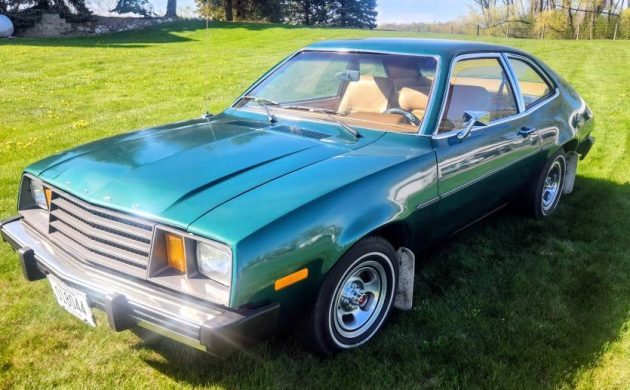
I acknowledge that the 1979 Ford Pinto Runabout is unlikely to appear on many people’s list of the ten most popular classics in automotive history. However, most readers will agree that even the most mundane vehicles can draw attention if the condition is good enough. That’s where this Pinto comes into its own. The seller states that it is a true barn find with a genuine 31,000 miles on the clock. Its presentation, especially the interior, supports that claim. I must say a big thank you to Barn Finder JDC for spotting the Pinto listed here on Craigslist in Maple Grove, Minnesota. The seller set their price for this amazing survivor at $9,200. They state that they may consider offers, but only after an in-person inspection.
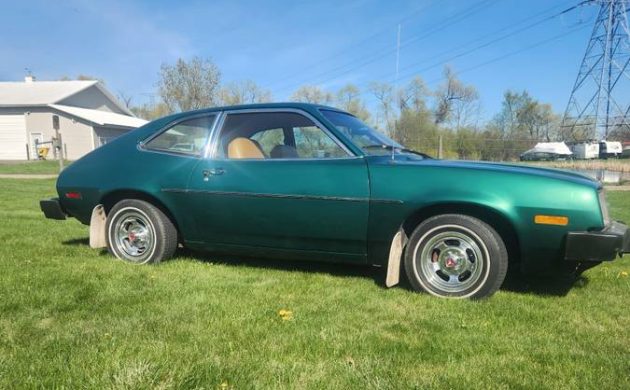
Ford released the Pinto for the 1971 model year, fulfilling Lee Iacocca’s desire to produce an extremely low-cost sub-compact model to rival European vehicles that were selling strongly. I’ve always considered the Pinto a slightly odd decision, because Ford already had a sub-compact in the European Escort. Reengineering the existing platform and updating the styling to appeal to North American buyers would have been far cheaper than starting with a clean sheet of paper. Some critics suggest that the Pinto was born from the swelling Iacocca ego, and that is certainly possible. This Runabout rolled off the line in 1979, and its condition is pretty astonishing. The seller states that it recently emerged from a South Dakota barn, but doesn’t indicate when its hibernation commenced. The storage environment must have been favorable, because there is no evidence of rust or other structural problems. Close inspection will probably reveal flaws in its Dark Jade Metallic paint, but the pictures paint a positive story. The glass is clear, the trim looks exceptional, and the Pinto rolls on its factory alloy wheels.
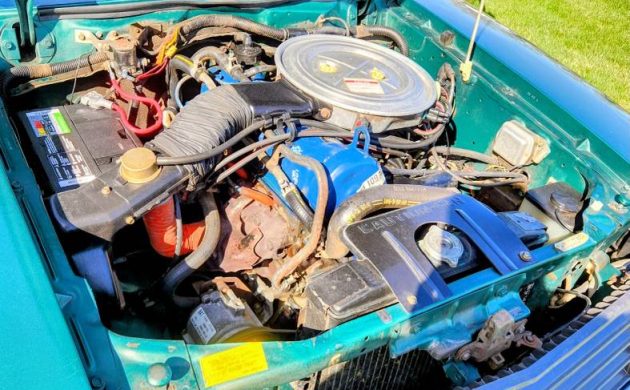
From a mechanical perspective, this Pinto was as basic as they came in 1979. Its 2.3-liter four-cylinder engine sent 88hp and 118 ft/lbs of torque to the rear wheels via a four-speed manual transmission. The buyer didn’t tick the boxes beside power steering or power brakes, suggesting they may have been on a relatively tight budget. The power and torque figures are modest, but outright performance was never the aim of the exercise. What this Pinto offered was excellent maneuverability, tiny exterior dimensions, and exceptional fuel economy. It should cruise at seventy on the open road, but its true home would be in heavy city traffic, functioning as an effective daily driver. The seller doesn’t indicate when they revived this classic. We’re also in the dark about the hibernation period, or whether they hold evidence verifying the mileage claim. Potential buyers can consider it a turnkey proposition, and with the seller encouraging in-person inspections, it suggests they have total confidence in this beauty.
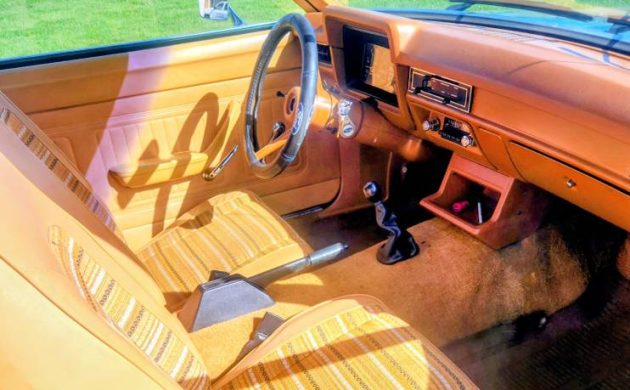
If this Pinto has a genuine highlight, its interior scores that honor. If this car is an unrestored survivor, the presentation certainly supports the mileage claim. The color combination won’t appeal to all tastes, but there is seemingly nothing about the appearance that warrants criticism. The cloth and vinyl are excellent, with no wear or stains. The same is true of the carpet, while I don’t believe the back seat has ever seen occupants. The dash is immaculate, and the only visible aftermarket addition is the wheel cover. My belief that the first owner ordered the car with one eye on their wallet is supported by the fact that the only interior option beyond the cloth trim is the AM radio.
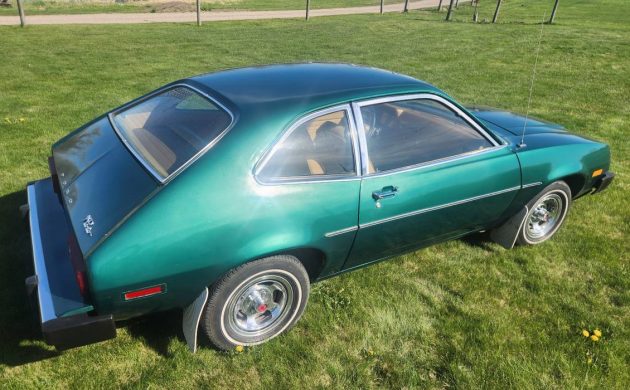
Ford sold over three million Pintos during its production run. Volumes dropped toward the end of the 1970s, but rallied slightly in 1979 when 199,018 buyers took a Pinto home. Many cars reached the end of their personal road years ago, and only the strong have survived. This 1979 Runabout falls into that category, courtesy of its rust-free status and overall condition. The seller’s price is at the top end of the market, but could be justified if its history and odometer reading are verifiable. They say that the buyer could hit the show circuit this weekend, and I tend to agree. If everything checks out, would you consider arranging that in-person inspection?

Well Adam, you did it again… I forgot about my older sisters friend Sue, her Dad bought her an either brand new or very slighly used brown Pinto for her graduating high school. I think her Dad drove it more than her!!! But I remember that nose design clearly. The rear bumpers were so big on these as you can see in the photos. I’m not going to comment to the mileage claim, but this sure looks like it had very favorable storage conditions, and that interior looks to be in great condition, something thats kind of rare with a “Barn find”. It could very well be legit. The only thing that’s out of place, but adds to the look that I like are those rims. My sisters friends just had the plain wheel covers. I would have thought these rims were optional, but again, a nice option that dressed it up a bit. I can understand why the previous owner installed mud flaps, and that may have actually helped preserve the lower panels, but maybe they’d go if this were mine. Nice one Adam. Thank you.
I prefer the early small-bumper Pintos (as most of us do), but it is good to see any Pinto which has survived. Looks to be in good shape. The wheels do dress it up. Dig that cool upholstery.
As long as speed/ flashiness/ “mainstream popularity” aren’t priorities for your collector car, this could be fun to own.
When I was a 3 or 4 year old a neighbor had a silver one next door. With gas prices the way they are this is really a great car even if the reputation precedes it. I love the color and interior combination too.
I had a ‘74 with the 2300 and 4 speed. Maybe 22 mpg on the highway on a good day with a tailwind.
Nice looking Pinto but this is a sedan. The runabout was the hatchback.
Coupe. For the most part, sedans are 4 doors. But, yes, this is not a hatchback. Regardless, this is one of the nicest Pintos I’ve seen since the early 80s.
It’s a sedan, due to the center roof pillar. Can be 2door or 4, makes no difference.
Coupes can have or not have b-pillars. Sedans have a three box configuration while coupes usually have more of a sloping roof line…. such as a Pinto.
Ford always marketed it as a “2-Door Sedan” in their literature even though “coupe” would’ve been more accurate given the way the rear seat was compromised for lowness in these.
My high school girl friend who later became my wife, had a 71 with the 2.0 and 4 speed and A-70×13 Goodyear poly glass tires that her dad bought new for her. It was simple, easy to work on, good on gas and fun to drive. Perfect during the 74 energy crisis. It was yellow with a black cloth interior. These days a simple RWD playform is appealing as a daily driver.
Similar story here.
Dad traded his ’65 Chevy Carryall as downpayment on a ’71 Pinto “Dealer Demonstrator”.
I had to pay it off myself. But man-o-man, did I love that little Ford!
It had the 1600cc Kent and a 4-speed. Being one of the early ones, it was a rolling-inferno death trap, but who knew back then?
I would love to have one today, but only if pre-1974 bumpers! Those things were hideous.
And I actually prefer the non-hatchback model. Or better still, a Wagon.
I had a 73 notch back with that drive train. Only problem I had was for some reason it ate clutches. I worked at a auto shop and even the most seasoned mechanics could never figure out why.
I bought my powder blue 79 off the lot in May of 79. These wheels were from the fancier models, don’t believe they were an option on a base model. Mine had a/c p/s and p/b. It came with full hubcaps and whitewall tires. A buddy had a 77 station wagon made like a “Goodtimes” van. Had a multicolored paint job and it came with these wheels. It also was a v6 automatic.
The back bumper was excellent for tailgating. You could set your cold snacks, plate of ribs, and yourself on it.
It’s cool but still is just a stripped down mustang II sports back.
😁
So does this make a ’65 Falcon just a stripped-down 1965 Mustang K-code?
Not true.
The Mustang II had surprisingly little Pinto in its underpinnings.
After fixing all the mistakes made on the ill-fated Vega, GM eventually gave America the fabulous…Chevette!
And, by the way, those Mustang II’s were solid little economy cars. Musclecar purists never approved of them, of course.
But in their debut year, way more than twice as many Mustang II’s were sold as Camaros.
The Mustang II was perfectly-timed for the mid-seventies market. Made Ford a ton of money too.
GM was caught flat-footed for the third time in a decade.
Mockery often belies envy.
One of my best buys in 1981 was a used 80′ Pinto 4-speed with 12k miles and in 86′ with now 93 k trouble free miles traded it in on a 86′ Ranger.I also had small chrome mudflaps,they worked good in NJ keeping the salt off the body.
overpriced.
The Good: Condition, colors and a stick shift. The Bad: Not a hatchback, wagon or Crusin’ Wagon! The Ugly: Nothing, even the price is reasonable, given the condition! The Verdict: Just get in it and drive it! GLWTS! Heathens might consider an upgrade to to a five-speed gearbox and/or an engine swap for more power (Turbo 2.3L or Ecoboost 2.3L), but this one is too nice to mess with! Those alloy rims look like optional factory rims for the Pinto, but if not, they’re good copies of the optional Pinto originals.
Is that a running board on the back? Or a place to sit and have a conversation?
It’s a park bench that decided to use instead of a bumper.
It is highly debatable that adapting the European Escort would’ve been better and cheaper than building the all-American Pinto
Iacocca , who supervised the project, was not actually stupid and would’ve been well aware of the differences.
If the Escort was metric spec, that’s a huge obstacle and might even require a new factory. That’s why Cadillac built the Seville on a Nova platform instead of a far superior Opel platform.
A really good example is the recent second generation Ford focus. Europe got a new car and Ford North America re-engineered the old one. It turned out that didn’t save any money.
True. Iacocca mentioned that possibility in his autobiography, IIRC, and the reason that Ford didn’t simply Federalize the European Escort was it would actually have cost more than developing the Pinto from scratch. It took the shift to Front Wheel Drive (FWD) in the Escort to force a change. Granted, the Pinto wasn’t an entirely clean sheet of paper, most of the parts came from the Ford parts bin, only the body was really new. Remember, in the early seventies, the conversion to metric hardware was just beginning, and the European Escort would have incurred huge costs in stocking all of the metric fasteners and other metric measure hardware at every North American Ford dealer! It wasn’t until the Pinto’s replacement, the so-called “World Car” version of the Escort that debuted in North America in the 1980 model year, did Ford really begin to bite the bullet and “Go Metric”, but even so, many legacy parts remained for decades. The Mustang, with its 302/5.0L V8, labored for years with an odd mix of metric and SAE, a.k.a. “English” fasteners. It made working on a Mustang a real adventure, needing both sets of tools from your toolbox, both metric and SAE to complete almost every job!
In the first couple of years, the Pinto’s engine choices were “international”. You had a choice of three.. the 1.6 was from England, the 2.0 was from Germany and the 2.3 was from right here in ‘Murica. They shared no parts with each other.
Exactly.
My 71 Vega had the distinction of having bolts with imperial heads and metric threads.
The Pinto used running gear from that same Escort, the 1.6 Kent engine, transmission, and I believe brakes. It also used the rear floor of the European Ford Capri, which is the origin of the gas filler neck problem.
One thing I have learned in compulsively photographing and documenting a lot of cars is that in fact, the automobile executives were smarter than you think, and were dealing with costs of production and making a profit, something that we often don’t consider.
It’s also true that the needs of European buyers have important differences from those are North American buyers and I’m sure that was a big factor in the decision.
If you’ve ever driven a Pinto with a 1600? You’ll understand the difference between European and American customers. Not really made for our expressways.
Very interesting, enlightening.
Thanks for some excellent background!
So true about 1/2 SAE and 1/2 metric. After about 30 Fox body Mustangs you get used to mix.
Between adding that huge back bumper and that “restyled” front end, Ford managed to thoroughly change a handsome vehicle into something fugly. Still, this car is one I wouldn’t mind having mainly because it has 3 pedals and doesn’t look ready for the crusher.
I only paid $2995.00 for my pinto. I can’t quite remember the year,but it was cheap for a brand new car. I drove roughly 70 miles to work and back. Then from Maine to San Diego and back with it. Good little car. I find it hard to justify the price on it now. After all, it’s just a Ford!!! (not a ford fan anymore) I think it was a 1978.
I seem to recall that Ford’s advertising in 1970 touted that the new Pinto started at $1995.
Or was that the Maverick price when IT was introduced a year earlier?
Not sure.
All I know for sure is that my brand new 1980 Fiesta cost well north of 6-grand, thanks to ’70’s inflation!
I didn’t quite remember this either….. so after some poking around, I found a print ad on ebay showing the base price at $1919.
Both. For one (1) year only, Ford would advertise a base price of $1995 for either a Pinto or a Maverick in 1970 as a 1971 model when the Pinto debuted. The Pinto, being Ford’s first sub-compact car in North America, had improved handling over the twice recycled, but larger Maverick, with rack & pinion steering gear, disk brakes and Mac Pherson struts up front, in place of the Maverick’s utterly conventional wishbone suspension with shock absorbers and drum brakes up front and recirculating ball steering. Both prices were for “base” or “stripper” models. In the Maverick, that meant a 170 cubic-inch “straight” six and a three-on-the-tree handing the shifting duties. The Pinto started with a 1.6L four, but I don’t know if the base transmission was a three-speed or a four-speed manual, but the shifter was always on the floor in a Pinto, regardless of the transmission chosen, either the manual or the automatic.
My ’71 Pinto was a 4-spd., and yes, on the floor.
I am pretty sure the Maverick was introduced as a 1970 model.
And the first Pinto was definitely a 1971model, I had one…I’m thinking that the Pinto “Runabout”, a true hatchback, first appeared during the ’72 model year.
Before that, those Pinto trunks were almost useless. The rear seats didn’t fold-down so access was only through the ridiculously small trunk-lid.
I remember having to haul my outboard motor in the back seat because it wouldn’t fit through the trunk opening. All the way to Canada and back, three or four times each summer.
Ah, to be young and foolish again, eh?
Uh, the Pinto never had McPherson struts. Always had “wishbone” upper and lower control arms. Same as Mustang II. But the crossmember/subframe on the Mustang unbolted. Where that portion of the Pinto was part of the chassis. Yes the Pinto handled better because of rack and pinion steering AND the main reason was lower center of gravity and somewhat shorter wheelbase.
Seattle Ford dealer advertised new 1970 Mavericks for $1970, and new 1971 Pintos for $1971 as a come on.
My ’71 Pinto was a 4-spd., and yes, on the floor.
I am pretty sure the Maverick was introduced as a 1970 model.
And the first Pinto was definitely a 1971model, I had one…I’m thinking that the Pinto “Runabout”, a true hatchback, first appeared during the ’72 model year.
Before that, those Pinto trunks were almost useless. The rear seats didn’t fold-down so access was only through the ridiculously small trunk-lid.
I remember having to haul my outboard motor in the back seat because it wouldn’t fit through the trunk opening. All the way to Canada and back, three or four times each summer.
Ah, to be young and foolish again, eh?
Yes, you are correct, Sir! The Maverick predated the Pinto by a single model year, debuting in the fall of 1969 as a 1970 model. The Pinto followed along just one (1) year later, in the fall of 1970 as a 1971 model. The initial offering was the coupe, the “Runabout” (hatchback) and wagon came later. Also somewhat later, Mercury got a version of each, the Comet was the Maverick clone, while the Bobcat catered to subcompact car customers as the Pinto clone in Mercury dealer’s showrooms.
…and I have always felt that the “Comet”- clone was one of the better executions of brand engineering. The “Bobcat”, not so much.
To bad Lincoln didn’t join in !
This car to me screams “dealer stock” order for the lot. With the pretty wheels parked out on the front line with a “stripper” price on the windshield. I can’t imagine a “customer” ordering a “stripo” and then splurging on the wheels. Most would have opted for the automatic transmission option first before sinking extra money on the wheels. This was ordered for dealer stock.
‘Couldn’t get an automatic in the Pinto initially. They were strictly manuals. The automatics followed pretty quickly though.
I love the car, love the color and even love that obnoxious back bumper! I would be a buyer but the barn is full!
My cousin bought a 72 with an automatic and a/c. It was green everywhere you looked.
I purchased a New ‘78 Pinto, had it rustproofed (Ind.) and had a 36 mo payment of $100. Just the plain jane coupe with no options. Found someone and traded my oem tires and wheelcovers even up for a nice set of 4 lug SS Cragar mags with WL tires. Best improvement to the exterior for sure. The 2.3 was good on gas but no power house for sure. Nice to see one on here!