

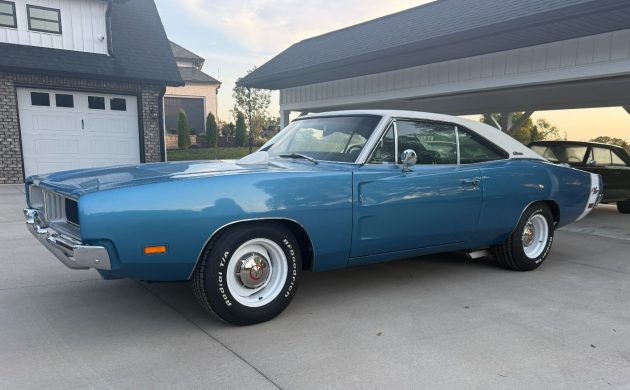
One thing I sometimes do when writing Barn Finds articles is to venture out on a limb. I don’t do so to be controversial, but to spark debate about one aspect of the classic in question. The results often vary, and there are moments when I find life at the end of that limb pretty lonely. That brings us to this 1969 Dodge Charger White Hat Special. The seller makes claims about its rarity, which is supported by documentation. However, since the car has undergone many changes throughout its life, I wonder whether those claims are valid in the Charger’s current form. Whatever your thoughts, you will find the Charger listed here on eBay in Knoxville, Tennessee. The seller set their auction to open at $75,000, but has received no bids at the time of writing.
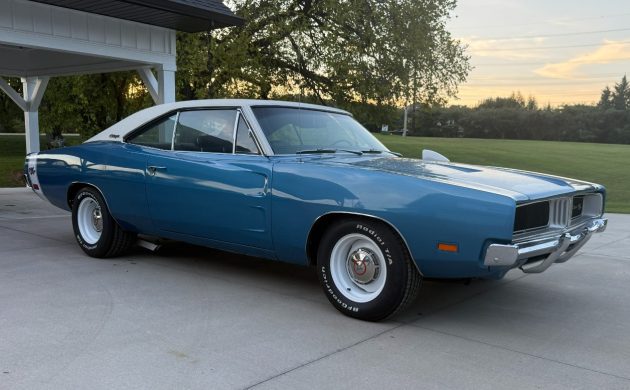
If you were contemplating a muscle car buy in 1969, you were spoiled for choice. You could walk into almost any dealership and drive away in a vehicle with enough power and torque to make adults weep with joy. Dodge was no exception, with the Second Generation Charger available with motors that confirmed its muscle car credentials. The biggest challenge facing manufacturers was the traditional mid-year sales slump, which is where special package deals offered excellent value for money. Dodge followed that practice with the 1969 White Hat Special, which was available on the Coronet, Dart, Monaco, Polara, and, of course, the Charger. The Broadcast Sheet and reproduction Window Sticker confirm that our featured car is the real deal, but much has changed since it rolled off the lot. It retains its correct Code B5 Bright Blue paint, and presents superbly. The paint holds a mirror shine, the panels are as straight as an arrow, and the seller states that the underside is as impressive as the exterior. However, the Window Sticker and Fender Tag confirm that the White vinyl is incorrect; the first owner ordered the car with a Black top. The hood tach doesn’t rate a mention on the documentation, and the wider wheels are a later addition. One saving grace is that the seller includes the correct wheels, caps, and tires. Therefore, that is one change that is easily reversed.
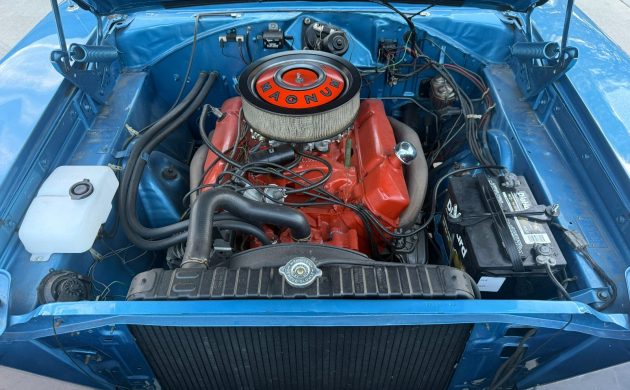
Powering this Charger is the 383ci “Magnum” V8, which the first owner teamed with a four-speed manual transmission and a 3.90 rear end. The Magnum was an impressive motor, delivering 335hp and 425 ft/lbs of torque. Unsurprisingly, the performance definitely slotted this Charger into muscle car territory. The seller doesn’t indicate whether this car is numbers-matching, but we’ve reached the point where we must assess their rarity claims. The seller supplies images of documentation from the Chrysler Registry, confirming that this car is #61 of 69 known Chargers built to these specifications. If the car is mechanically original and returned to its factory form, I would consider the claim of rarity valid. Otherwise, I question how much they will impact the car’s potential value. Whatever the truth, the seller states that the Charger runs and drives exceptionally well, and is a turnkey proposition.
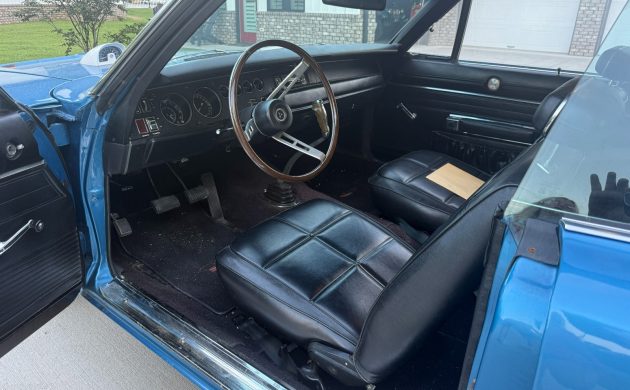
Trimmed in Black vinyl, with bucket seats, a pistol-grip shifter, and an AM/FM radio, this Charger’s interior is as nice as the exterior. There are no genuine problems or shortcomings, although the seller acknowledges that it needs a clean. The upholstered surfaces are excellent, there is no carpet wear, and the dash and pad are spotless. The seller includes the original shifter in the deal, while the Charger retains the remote driver’s mirror and timber wheel from the White Hat Special package.
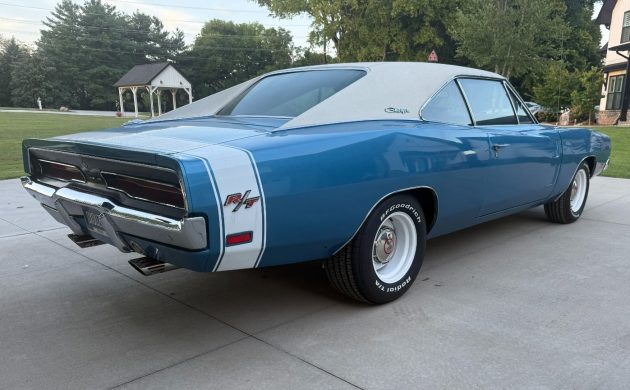
The opening figure makes it unsurprising that the seller has received no bids on this 1969 Dodge Charger White Hat Special. The reality is that $75,000 is a high starting point for any motor vehicle auction, meaning that the pool of potential buyers could be quite restricted. However, the listing statistics suggest the Charger has generated plenty of interest. That brings me back to the rarity claims, and whether the obvious changes may have compromised them. Do you think that they remain valid, or would returning the car to its factory form be required for that to be the case? It will be fascinating to gauge your feedback on the subject.

“The Dodge Rebellion wants YOU!” My old man hated those commercials, or any “rebellion”, for that matter. Her name was Pamela Austin in ’66 and ’67, that was replaced by Joan Parker in ’68 because top brass felt Austin attracted more attention than the cars. Parker led the White Hat schpiel through ’69, lost it’s zing after that. While Austin didn’t do much for sales( old man gloating), during Parkers years, sales were better, but not all because of her. Amazing, must be one of the few ’69 Chargers that “Dukes” producers must have missed.
Sounds like he needs to run it through Barret Jackson Auto Auction. He wants that for a starting bid, dang.
I figured that it was a former big auction purchase, but can’t find any record of previous sales under that VIN.
Beautiful Charger manual steering and brakes. No AC with a 4 speed. This is a real Muscle car. Your going need your muscles to drive it!! 😂 … kidding aside I never understand why people put traction bars on Mopars with leaf springs. You dont need them if you go to a spring shop. They can add extra springs to tighten up rear. That would plant that rear down and take off. Did that to our 70 Challenger RT. This is the best White Hat special I seen in a long time. B5 blue and white accents really show this Charger. I also like it has documents with it. I bet the frame looks good as the body. I will not be surprised if it sold for north of $60gs. Good luck to the next owner.. 🇺🇸🐻
His starting bid was $75K
Agree, the pinion snubber did that for you! Or get Direct Connection Super Stock Springs! (Eaton). 69 my fave as my dad had onesame time I was in my 68 Roadrunner, both in B5!
That tach: Lose that ridiculous, value-hurting eyesore that was never OEM and keep that beautiful stretch of hood clean.
I learned something new today. I always thought the “White Hat Special” commercials were just a sales drive. I never knew there were actual White Hat Special cars. Even so. I don’t think what was essentially a sales gimmick deserves 75k. However it is a true muscle car that presents beautifully and I don’t know what something like this goes for these days.
Hold your shorts honey….
They ain’t cheap. I watch Barret Jackson Auto Auction….
BIG MONEY.
I have seen vehs go for up to 1 MILLION DOLLARS.
I’m sorry, but if you don’t have 15 minutes to run a vacuum through a “$75,000 car, what other “things” did you not have time for?
Ha ha ha ha,
“All those changes…”
With all due respect Adam ,that would take about 10 minutes and 20bucks in the grand scheme of things .But Why ?
I’m not a fan of dog dishes (except for feeding my dogs ) ,but these wide ones look great.I would probably rotate them with some 17” magnum 500’s .The white top suits the car .
Interesting and related story; I bought my Petty Blue on white Superbird from marque specialist Mike Hill in Carolina in 2007.I had him switch the Black vinyl for white to match the large Plymouth graphics and interior .He protested loudly saying “the Mopar guys will crucify you “.The car was in his shop for a month while waiting to ship to me ,and guess what ? Everyone that came in agreed that it looked better and Plymouth should have offered them that way.I sold the Bird at BJ Scottsdale in 2015 , and it has been sold at public auctions several times since often .It’s easy to track -the top is still white !!
This Charger is priced competitively.
With those colors, it looks like something Herb Tarlek, wearing a matching leisure suit and white shoes, may have driven to work at the radio station.
well, somebody bit. 1 bid. i would vacuum out the interior rip that ridiculous hood tach off and paint the wheels body color. my guess is the reserve is north of 100k.
Shill bid.
Beautiful car ! The pistol grip shifter is a nice added touch even though they where not available in the 69 models . My 70 road runner bench seat 4 spd pistol grip along with the air grabber hood was a couple of the very cool things bought the car. Glwts peace!
According to the window sticker this is a White Hat Charger Coupe. It is not an R/T. Apparently the seller has added the R/T badges and rear stripes to this car.
Okay, having owned a beautiful, original ’69 Charger R/T pardon my rant.
What is it with the urge to slap R/T emblems on anything old Mopar these days? So did they drill holes in those factory quarters just to put those emblems on? Keeping the original black vinyl roof and wheels would have been a much better move. For the love of God, deep six that hidous aftermarket hood tach. You’re selling a car and you can’t take 10 minutes just to vacuum out the interior? Obviously looking in the background he must be a Mopar lover. Certainly looking at a top shelf opening bid.
R/T tacked onto a Charger means more $$, whether the car deserves it or not.
Only a idiot would be paying a R/T premium price for a non R/T. It’s not even a 440 to boot. A fool and his money are soon parted.
Unfortunately, people lose their minds when it comes to those two little letters.
He’s got 5 MOPARs currently listed on evilbay. This car is nice, but the outside tach would need to go inside before I’d consider it. These days, my 69th birthday was yesterday making me a junior dinosaur, I’d pick his Royal Lancer for car shows, cruising and coffee.
I recall sitting on the driver’s seat of these Chargers back in the day. The cushion was hard enough and the vinyl slick enough that without the seat belt on, a hard left would slide me between the seats. Granted, I’ve never weighed more than 165 and back then I was 145.
There was a MOPAR dealer just across the border into SD in a town of 400. It was Harry Miller Garage. He locally sold three Plymouth Super Birds. The buyers still own them; one moved to Sioux Falls since. The other two still live in Hudson. The garage is long gone but many of the cars bought there are held by local collectors. It’s fun to reminisce.
Any relation to Harry Miller the auto racer and engine builder?
$75,000.00 for a Dodge. NEVER! A straight line runner.
First time seeing a 2nd Gen Charger for sale?
R/T imposter
A good candidate to be “THE GENERAL GRANT”! Already has the blue paint. Enough with the unpatriotic general Lee nonsense
If my memory serves me correctly, the only 383 magnum with 335 hp was in the road runner and the superbee. This should have rolled out with the 330 hp
If my memory serves me correctly, the only 383 magnum with 335 hp was in the road runner and the superbee. This should have rolled out with the 330 hp
Hopefully once he sells this car he can afford a vacuum cleaner!
The Seller made the following statement on one of his other cars listed for sale on eBay.
“YES I know it is dirty, I’m not cleaning it I’m selling it.”
Apparently he is too lazy to clean the car, and/or doesn’t think the car needs to be clean in order to sell.
Missing the driver side door sill plate .for that kind of money shouldn’t that be included? Lol.
Totally non-original and needs a lot of “de-f***ing” to be a nice car. Pistol Grip Shifter wasn’t even around in ’69, silly R/T badges, white wheels that are too wide, on, and on…hard pass at that kind of number. Maybe, if it was ALL numbers matching and restored correctly, it would be worth that.