
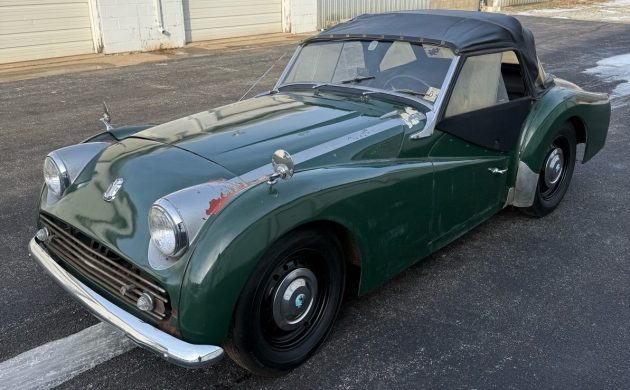
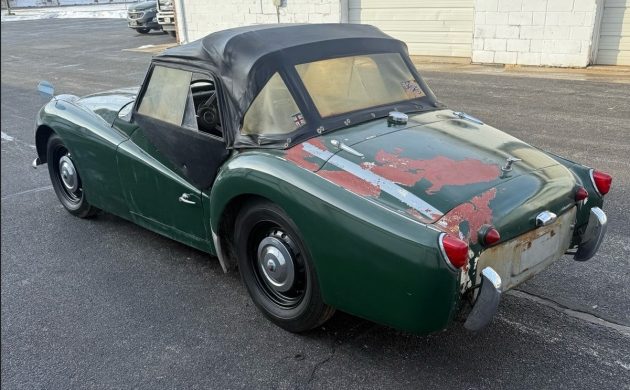
This 1959 Triumph TR3 proves that there are still wonderful classics hidden in barns and sheds, waiting for liberation and a chance to return to our roads. It spent forty years in storage, recently emerging into the light of day. The seller coaxed its engine back to life, confirming that it runs and drives. It needs work to become roadworthy, but the TR3 is worth more than a passing glance. The seller has listed this gem here on eBay in Demotte, Indiana. Bidding sits below the reserve at $2,550, with time remaining for interested parties to stake their claim.
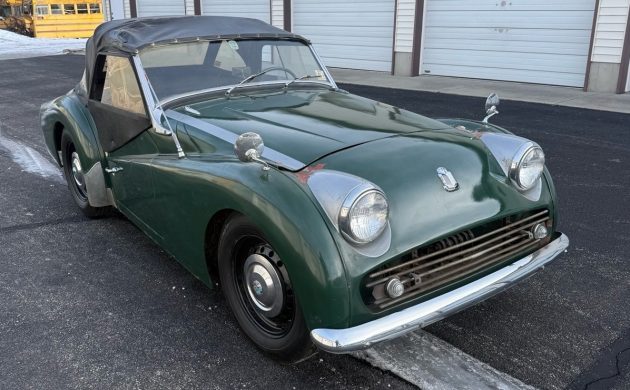
Triumph released the TR3 in 1955 as its successor to the TR2. Although the styling wasn’t radically different from its predecessor, various mechanical improvements guaranteed its success at a time when North American buyers were keen to get their hands on classic British sports cars. An updated version, unofficially referred to as the TR3A, rolled off the Coventry line in 1957 and remained on sale until 1962. This TR3 emerged in 1959, and there is something inherently “right” about finding these cars wearing British Racing Green. The seller confirms that it received a repaint before entering storage four decades ago. The paint exhibits deterioration, meaning it is set for a repeat performance. The storage environment must have been favorable, as rust is confined to a specific area in the trunk pan. Otherwise, this TR3 is rock-solid. The top is torn. However, the side curtains are intact. Some trim pieces may require restoration, but the glass is clear.
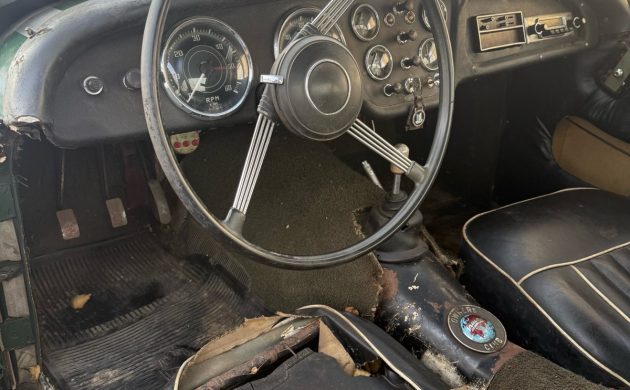
One aspect of this TR3 requiring TLC is its interior. It retains its iconic banjo-style wheel, along with the correct gauges and switches. However, the upholstered surfaces have succumbed to age, meaning a retrim is on the cards. It isn’t the end of the world, because kits are readily available and very affordable. Companies like Moss Motors stock everything required, although some enthusiasts prefer to shop around to see what is available to suit their budget and standards. Whatever the path chosen, retrimming this interior is a satisfying task that will reward the new owner if they are hands-on.
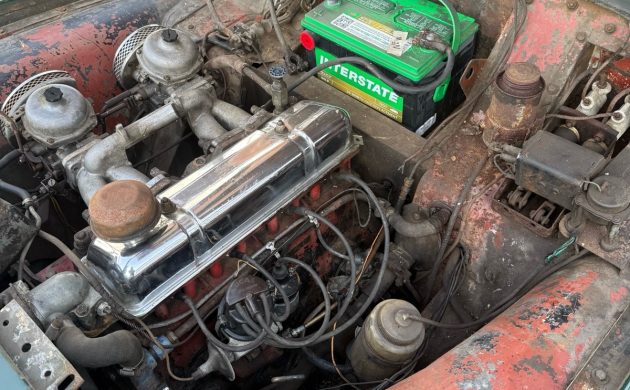
The engineering employed by companies like Triumph when producing sports cars was elegantly simple. These cars are hand-built. That means that almost everything was bolted together by humans. Therefore, the same process can be employed when dismantling a TR3 for restoration. The company dipped into the Parts Bin for many mechanical components, sourcing the 1,991cc four-cylinder engine from Standard. By upgrading the cylinder head and manifold, and bolting on a pair of SU H-6 carburetors, Triumph squeezed a healthy 100hp from this motor. The four sends its power to the rear wheels via a four-speed manual transmission, although an overdrive was available that gave the TR3 “longer legs” on the open road. The seller confirms that after its extended slumber, they have coaxed this Triumph back to life. It runs and drives, but needs brake and hydraulic work to become genuinely roadworthy.
Although never considered a standalone model in its own right, the “TR3A” was the third most successful vehicle to wear Triumph’s iconic TR badge. The TR6 and TR7 outsold it, but its achievement is noteworthy given how much more powerful and refined the various TR4 and TR5 models were. This little Triumph has spent decades hibernating and deserves to find its rightful place on our roads. These classics make fantastic project candidates because the company employed elegantly simple design and engineering techniques during development and construction. If that sounds appealing, perhaps you should consider submitting a bid. This TR3 would seem worth the effort.




Talk about a time capsule-this is a perfect example. You can see the little modifications made throughout its lifetime on the body and under the hood, but exemplified by the CLASSIC “Learjet Stereo” mounted in the dash (An original 4 track, maybe???)!!!
Peter Egan, automotive archeologist extraordinaire, once wrote about discovering the different owners (of a bike or car) as he dissembled one for repairs or restoration. This is a perfect example of how that would play out!
Terrific article, Adam, as always.
Very well said Nevadahalfrack. Its hard to think about any objects like this, but going through life, we are caretakers. Whether its an old home, an old car, a grandfather clock, anything old. We take care of them, and then they move on to the next caretaker. And being an archeologist restoring an older vehicle is spot on.
Love this Triumph and a Learjet 4 tract???? Awesome!!! That would stay right there.
And you said it better. Nicely said, sir.
It’s a nice starting point for someone to restore and even upgrade to improve the driving experience. As the author mentioned these are simple cars and just about anyone who is mechanically inclined will have little trouble with these early English automobiles. They are a hoot to drive as the sensation of speed is amplified many times. Hoping it goes to an appropriate new owner that will appreciate it’s value in Britains auto history.
I hope the buyer will be able to find a replacement, original, grill for this wonderful little gem. I had a 1955 Austin Healey BN1 in 1955 and a TR 3a in 1991 and I preferred the driving experience of the TR 3a as the Healey was very refined in comparison to the TR which was more “manly”.
Agree with most, but to call the Healey ‘refined’ made me smile. My 65 3000 Mk III looked refined, but it drove as anything but. Muscular, heavy, noisy (the good kind), hot (like really toasty especially in the southern summers), and not particularly comfortable, but at speed a real thrill. I guess it was more refined than my 59 MGA (with its plywood floors and plastic side curtains) but not by much.
Great find!! The Grill is a AMCO grill called a Vista Grill. Fairly rare and was sold by Triumph dealers as a option under the V system
WOW! 100hp, my 79 Spitfire only put out about 60, lol
The only problem owning this type of car is that everyone drives a truck and can’t/won’t look down to see you.
I noticed the small switch, on the far left of the dashboard. Next to the heater blower motor control.
That’s where the OD Switch is usually installed. More than few OD TR3s replaced the less than reliable Lucas “egg” shaped switch for a more reliable plain off/on switch.
Could be an OD trans under there?
I had one of these back in the late 70s before most everyone drove a truck (high up SUV, etc). One time after working 2nd shift there appeared to be no one on the main drag after midnight. I stopped at a red light, saw no cars then proceeded. There were red lights behind me. The cop said he did see me stop. The only reason he was there was a coincidental stake out. Friendly but ticket.
This has Stromberg carbs, not SU.
Tom: you are correct. They are Zenith-Stromberg carbs. Triumph decided to sponsor their development because they were angry at SU for giving MG too good a deal on their SUs. Most people tend to think of Zenith-Strombergs negatively as anti-pollution carburettors, but that it not how they started out. They became the carburettor de rigeur on English sports cars during the late ’60s, 70s and into the eighties, because they could be adapted to meet emissions requirements, as they atomised the fuel more finely than conventional SUs and were also thermostatic,,,which allowed them to let in as much oxygen as the motor required when running hot.
I had a TR3, BRG like this one. What a fun car. You could reach out and touch the pavement. Drove to work the first time and a guy said “Hey cool, I used to have one. I still have the hardtop from it. Do you want it?” HECK YES! :-) Terry J
Dad taught me to drive in one exactly like this , then sold it. That was in 1984. I’ve wanted one ever since. Just doesn’t ever seem to work out for one reason or another. Agree about the grille. Dad’s also had a very similar “custom” grile. Never got around to finding a correct one , long before the internet then
What is that disc with the Triumph globe sitting on the transmission tunnel?
Saw that too , kinda looks like a club plaque or something. But not sure myself
That is cloisonne enamel that, I believe, is from original Triumph logo on hub caps or elsewhere, then placed inside bronze or brass round. Very decorative addition. I had them on my TR3A back in the 70’s.
Way back in 1964-1965 I had exactly this model loved it more than anything. Got married (the kiss of death) and even though she had never objected to it, suddenly it was uncomfortable and primitive and ¨¨ you got to get rid of this ¨thing¨¨ . Well, being love-struck ( she was a gorgeous Southern Bell) I sold it with a heavy heart and wouldn.t you know it, divorced her 8 months later; she had turned into a certified nightmare, Dr. Jekyll and Mr. Hyde –THAT bad. Now to the car – why did they screw with the grill:? The original had a hole in the lower center for the handcrank in case the Lucas electric starter decided to go on strike. Being young and broke at the time I never repaired the starter. The handcrank worked like a charm.
Yes, I had a 58 TR3A with an earlier TR2 front apron (front metal that includes headlights and grille) “small mouth” with cast piece to support the hand crank. I too sold it due to marriage, along with some other cars. When I sold it in 1979 it was ugly in red oxide primer, but it ran very well. I had replaced the apron with the correct wide mouth aluminum grille, sold for $500. Still married to same woman. Actually, she was more attracted to one old vehicle that I did keep for a few more years, a 46 Dodge 1 ton pickup.
She’s a keeper Dave. My missus (of 30 years) hated my ’46 Dodge 1 ton pickup. :-) Terry J
Terry, it was the opposite, she loved the truck when she first saw it. She was disappointed when she saw me and was told I was the owner.
And I thought that my ex-wife only had1 prior husband to me.
Ha Eric, if you´d only knew!