
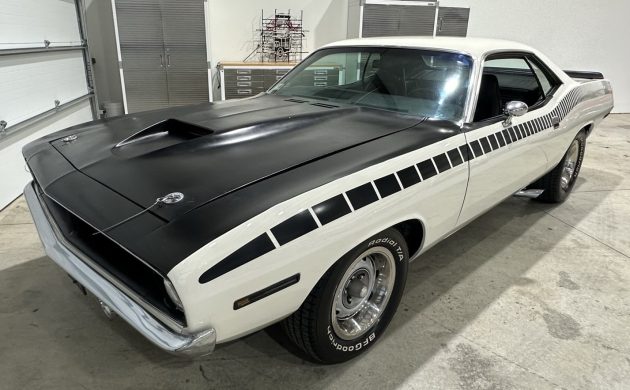
Many enthusiasts consider a known history crucial when searching for a classic to park in their garage. This 1970 Plymouth AAR ‘Cuda ticks that box comfortably, having had only two owners throughout its life. The seller has been its custodian for five years, but feels the time is right for it to head to a new home. I must say a big thank you to Barn Finder T.J. for spotting the ‘Cuda listed here on eBay in Bloomington, Illinois. Handing the seller $99,900 could allow you to drive this low-mile classic home, though they may consider offers.
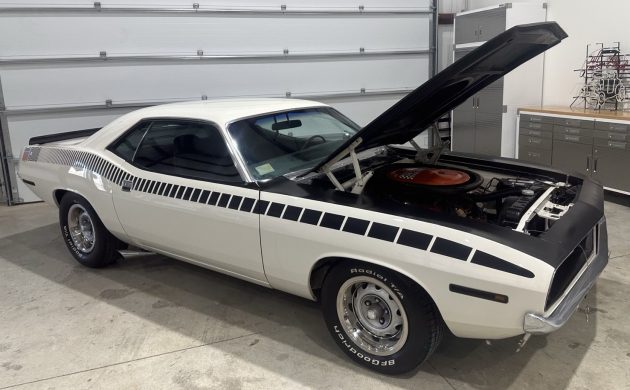
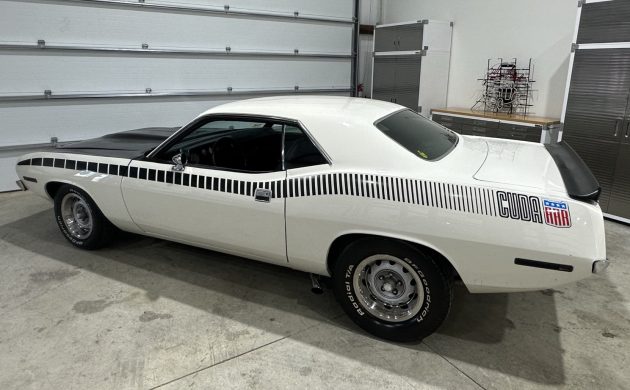
Sadly, vehicle manufacturers have moved away from the “win on Sunday, sell on Monday” marketing mentality. It only took one manufacturer to leverage sales from racing success, and others would soon follow. It is this approach that gave us the Mustang Boss 302, the Camaro Z28, and the Plymouth AAR ‘Cuda. All were homologation specials for the Trans Am series and were thinly disguised rod-going race cars. Plymouth produced the AAR only for the 1970 model year, with a total of 2,724 cars built. Many of these vehicles led a hard life, while others fell victim to rust. Therefore, it is unclear exactly how many survive to prowl the nation’s roads. This ‘Cuda is a two-owner classic that received a repaint in its original Code W1 Alpine at some point. Beyond that, it is claimed to be an unrestored and rust-free survivor. The paint is in good condition, the panels are straight, and the distinctive decals look crisp and clean. Interestingly, this beauty retains its rear spoiler, but the front Dive Plain (or Chin Whisker) spoilers are missing. That isn’t the end of the world, because high-quality reproductions retail for around $100 per pair. The ‘Cuda rolls on its correct Rally wheels, and the exhaust exits in the proper location on both sides.
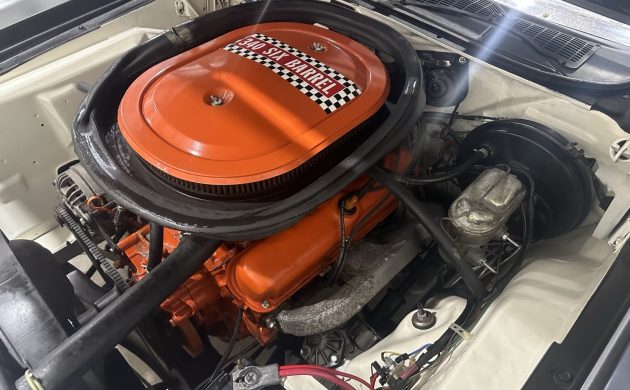
Plymouth adopted an interesting approach with the AAR ‘Cuda. While Ford and Chevrolet produced their road-going Trans Am homologation specials with engines that fell below the 5.0-liter class limit, Plymouth equipped the AAR ‘Cuda with a 340ci V8. Cubic inches count, and the company equipped the V8 with a “Six-Barrel” induction system to generate a factory-quoted 290hp and 345 ft/lbs of torque. This classic emerged during a time when companies often understated engine performance, and there is widespread belief that this motor actually produced power well beyond 300hp. This beauty also features the optional three-speed A-727 TorqueFlite automatic transmission, an 8¾” rear end with 3.91 gears, and power front disc brakes. The seller claims this Plymouth has a genuine 63,000 miles on the odometer, but doesn’t mention verifying evidence. However, the vehicle’s overall condition and the included documentation may erase any lingering doubts. Potential buyers can consider this a turnkey classic with no known mechanical shortcomings.
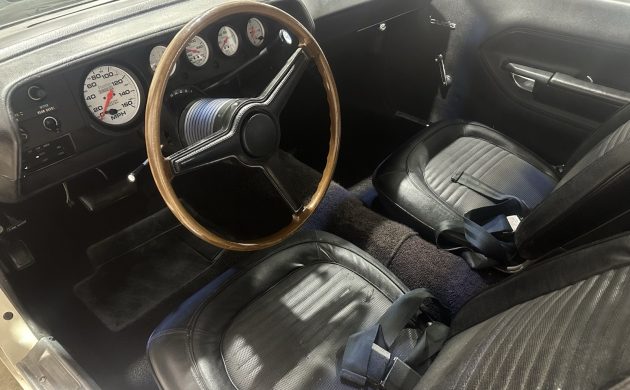
The first thing that caught my attention inside this ‘Cuda was the AutoMeter gauge cluster. Placing my cards on the table, I am not a fan. Thankfully, the seller retained the factory setup, which I would reinstall ASAP. The other distinctive feature is the column shift for the TorqueFlite, with the seller stating that only around three hundred of these classics were so equipped. That increases this car’s rarity, especially if the claim can be proven. The rest of the interior is standard ‘Cuda fare, trimmed in Black vinyl. Its condition is everything you would rightly expect from a low-mileage survivor. There are no signs of wear or abuse, and no crumbling plastic. The pad is crack-free, and the carpet is excellent.
If you rely solely on the fine folks at Hagerty, the seller’s BIN figure for this 1970 Plymouth AAR ‘Cuda looks realistic. That is despite values falling marginally in 2025. However, I don’t accept everything the company says as undeniably true, preferring to rely on recent successful sales results as a more realistic guide. That leads me to believe the seller’s price is pretty competitive, particularly if the odometer reading is verifiable. I would definitely reinstall the original gauge cluster and source a set of Dive Plains to give the car a more “complete” look. Do you agree?


Years ago, probably around 1980, a friend and I climbed up a stack of cars in a salvage yard to check out a t-boned AAR balanced at the top. It was red with black vinyl and a red interior. When we saw that it was a column shift auto with a bench seat, and not knowing much, we assumed an owner had probably added the stripe to a plain barracuda, so we kept moving. Not only was it probably authentic, but very likely one of one with that combo.
My uncle bought one new back in 1970. He traded in his Superbird Roadrunner on it. His was a four speed with console. Very very purple. Seemed fast to me, but I was like 13 at the time. In later years he told me that at some point while he owned it, he swapped the “six pack” out for a single four barrel manifold and carb, and that it performed better at the drag strip then.
Six Pack setups were/are hard to keep dialed in. Owners either pay someone who knows what their doing or usually people who bought these were pretty good at tuning. My neighbor had a 70 hemi challenger, all original, original paint and I loved growing up hearing it running while he tinkered and tuned the dual quads. He was a mechanic at Randall Chrysler Plymouth and he owned stock cars so he knew what he was doing. He bought it new in 70 and was a bachelor his entire life. Kept the car until he finally got married in 2011, he sold it to a collector in Philadelphia to buy a house. Sadly his new wife died in less than a year. He’s living in the old house he grew up in. Cars breed interesting stories
I’ll have to disagree with you. I’ve owned three over the years and once they are setup you never had to mess with the outboard carbs and the center requires no more “dialing than any other carb.
I’m with Don on this. I’m also on my third six pack car, currently a 340-ish small block. Only the center carb has to be tuned, the outboards have no jets or adjustments except for float level, so they take care of themselves. Only issue I’ve ever had was due to adding fuel from a dirty fuel jug, which forced me to clean everything and rebuild all the carbs.
Where they get messed up is when people decide to outsmart the folks at Holley by rigging up mechanical linkage on the vacuum outboards. I’ve never seen good results from that. Holley did make special ‘pumper’ carbs for that, and they work well; better than stock if you have deep enough gears, but the stock Mopar set ups were all vacuum.
Don and Melton are correct. Never a problem on my ’70 6bbl GTX.
I own a highly restored AAR B5 blue, Brilliant blue interior, original sheet metal car. With the six barrel set up, mine is faster than my Mach1 390 4 speed. Besides the horrible dash gauges, this one is missing the compact spare tire, bottle and jack ($2K). The heater box fan is wrong and someone has played around with the master brake cylinder. I suspect on further examination one would find more things askew. The 3 on the tree is relatively rare but not desirable compared to the console. Also rare is the lack of a vinyl roof, if that is substantiated by the build sheet.
However if this is an all original sheet metal, matching numbers car it’s worth the ask. One could correct the minor things. Most of the restored AARs have very little original sheet metal remaining.
Seems an AAR ordered for the dragstrip 🏁 with the autoloader Torq-flite and steep 3.91s.
I’m jealous lol you definitely have cool toys my friend!
Agree….this one’s far far and away from a survivor……and priced to high !
When this one popped up I thought, wow, holy grail. Low miles, Love the color. But the respray is disappointing. This would have been a blast to drive on am AAR style course, but the column shift comb on these are very inexact and would not be much fun to drive smoothly as it is very easy to over shift. The gears suggest drag racing, but that isn’t really its wheelhouse.
The 6 figure price is for a superior car and I’m not sure this lives up to it billing.
Anyways it is all conjecture on my part as high dollar cars are a fantasy land for me as I would be to concerned to thrash it and that is the only point of owning one.
I remember back in the late 70’s there was a AAR the same color setting in the front yard of a home in my town, the front end was up high so I figured the motor was removed for some reason. I never stopped to ask about it and lost track of it but I was in my early 20’s back then and the craze had not hit then, also car prices were not in the ceiling then either.
Back in 79 I remember 2 brothers found a Cuda that was totalled. Front end was trashed. They found a Cuda in Carlisle trashed in the rear end and fused the halves together and made a beautiful car like this. Not sure one of them was really an AAR but they did the stripes. Maybe a clone, tribute or whatever the newest name is but it was damn nice! These guys owned a collision shop and did a beautiful job. Car has disappeared??
why on such a rare car would you install those clown gauges? seller says they still have the o/e s. i sure hope so for 100k they should be in there. save the other stuff for a race car not a rare collector such as this
I agree with hairyolds68, the none OE gauges ruin the presentation of the car. The question is, was the original wiring harness doctored to suit the aftermarket gauges or not? What other none OE stuff was done to the car?
I agree about the guages here why and the hood I do not think is original.
The hood appears to me to be original, including the “rise” in the middle due to pressure from the hinges. I don’t know if AAR hoods are being reproduced, but it’s either original or a decent reproduction, as it would need to be to seal against the air cleaner assembly that was used on the 340 Six Barrel.
Dive plane, if you care.
That auto on the column looks ridiculous!!! Never should of had that for an option in any 70-74 cuda.
My 70 Hemicuda had bench/buckets with column shift…never had a problem with it.
Very nice AAR Cuda. Do not see them in white very often.
Another columns shifted muscle car? LOL I don’t know how anyone could buy a column shifted car like that or Hemi Cuda anything with a column check on a muscle car should be outlawed LOL hahaha sorry just my opinion
Bought my first AAR in ’71. Still have it with original paint and stripes and original 3.91 gear, fine for the street as far as I’m concerned. I was wondering about the hose from the 6bbl base plate down past the master cylinder. They had water drains, but they were short pieces of hose out just over the rocker covers. Mine are still factory, as is the hood which had humped up on both sides as mentioned by someone else. Springs off and weight on both sides for years and it now matches the fenders. I now have 2 AAR’s, both console torqueflites, and my brother has one with column shift.