

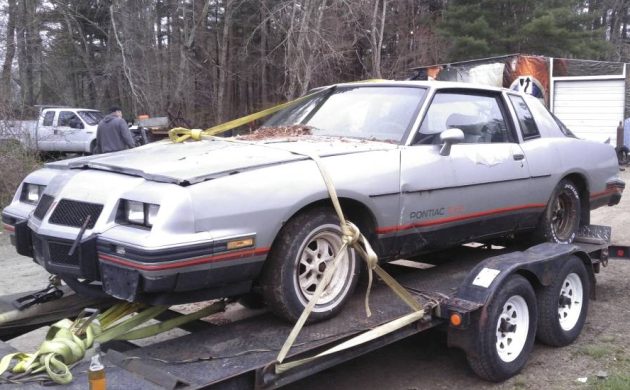
Yesterday, I covered this 1985 Pontiac Grand Prix Brougham, or “Bro-ham” as they are often called, and today I’m going to move forward one year and review this 1986 Grand Prix 2+2 Aerocoupe – so similar, but oh so different! This GP, residing in East Freetown, Massachusetts, is one of only 1,225 “homologation” specials offered up by the Tin Indian in ’86. Yes, it has issues, but it’s still worth a looksee. Here on craigslist is where you can find it, and it’s available for $2,500. Zen gets credit for this discovery!
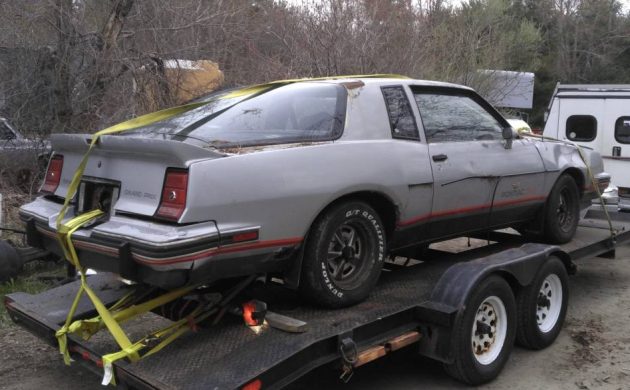
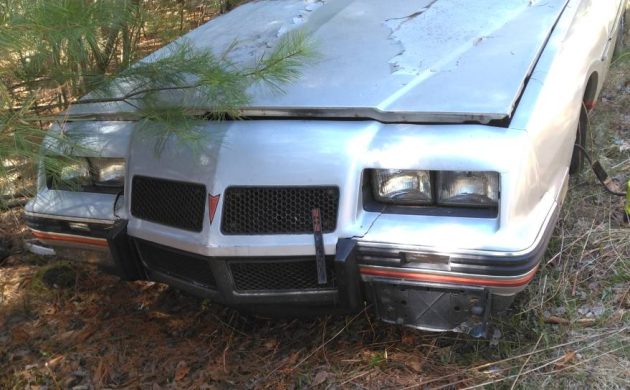
As the story goes, back in the eighties, Pontiac and Chevrolet were seeing a lot of Thunderbird rear ends on NASCAR tracks because the Grand Prix and Monte Carlo’s formal roofline with its nearly vertical rear window didn’t provide enough down force to compete with the ‘Bird. Sooo, a sloped rear window was created to help with the aero effects, and while it would work on the high banks of Talladega and Daytona, it was not allowed unless it was an actual production piece – in other words, homologated by being available on actual production cars. Enter the Aerocoupe; Pontiac’s version was produced only for the ’86 model year, while Chevrolet’s Monte Carlo continued the availability into ’87. Besides the first-gen Barracuda-styled rear window, the Grand Prix’s trunk lid and fiberglass package tray were modified to accommodate the new glass as well as to integrate into the reduced drag coefficient design. Beyond that, the GP’s nose piece was “enhanced” as well to help with the svelteness and to support the revised backlight treatment.
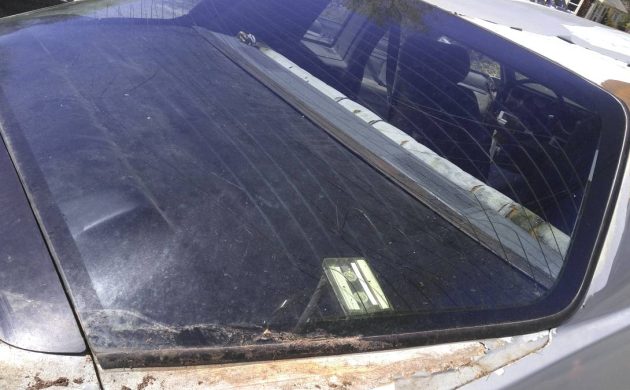
Admittedly, this example doesn’t illustrate the Aerocoupe in its best light. The seller tells us, “Rear Window intact, rear trunk lid in excellent condition, and roof, etc. in very good condition… The front bumper cover was cracked recently, but wasn’t a year ago- it wasn’t hit or backed into, and the rest of the nose supports / special 2+2 parts are all there…The rear frame rails are rotted out, and the bumper is hanging down.” That frame business is gonna be a problem, and the included images show that the deterioration has crept into the floors. As far as the finish is concerned, and it’s significantly deteriorated, all Aerocoupes were produced in “silver, with charcoal-colored lower body trim accented by a red stripe,” according to Motor Trend.
Always a mistake, there’s no image of the engine included in the listing. All the seller has to say about the Chevrolet-sourced 165 net HP, 305 CI V8 engine is, “The rest of the engine/drivetrain is all there and in stock form, although the engine was supposedly rebuilt or replaced.” The transmission is a four-speed automatic O/D, likely a Turbo-Hydramatic 200-4R unit, not one of GM’s more stellar pieces.
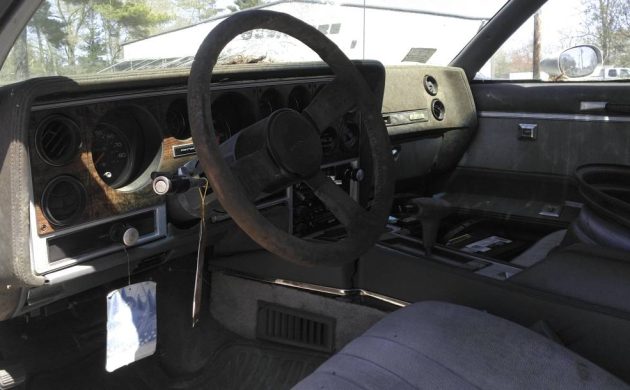
The interior’s representation is limited to one image, and it’s not very telling. The seller, however, states, “The interior is unaltered but in bad condition, but maybe could be cleaned up,” whatever “cleaned up” means. The odometer reads 120K miles, so that tells you a bit more about how long this Poncho was run hard before it was put away wet.
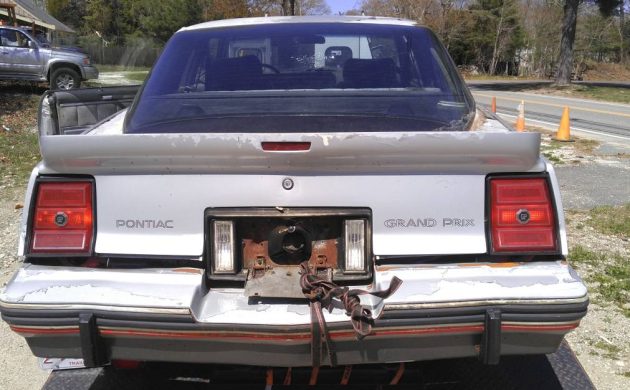
I find it interesting that GM was still interested in homologation specials this late in the game – apparently, that NASCAR adage of “Win on Sunday, sell on Monday” still resonated within the depths of the Pontiac and Chevrolet marketing departments. But, this Aerocoupe isn’t like a ’68 Charger 500, or a Dodge Daytona/Plymouth Superbird. Yeah, it has a unique look, as ungainly as it is, but it’s really just an aesthetically modified Grand Prix. Still, I give kudos to Pontiac for taking on the modifications – it had to be expensive all in all, when you count up only 1,225 copies. So, what to do? I’d pass on this example and look for something better. Even the seller suggests, “It could be restored with a bunch of work and a rust-free G Body parts car…” That’s my thought, what’s yours?


I’d forgotten ( or maybe forgot altogether) that Pontiac had this when Chevy had their Monte Carlo Aerocoupe SS. It’s truly a shame this was allowed to become as deteriorated as it has become. It may not be a Superbird, TalladegaTorino or something as recognizably similar but it’s still very unique especially to NASCAR fans.
What this needs, as Robert Plant once sang, is “a whole lotta love”.
Shame it’s only 20 min from me .
Floors are done
Crusty spent frame
It’s a parts car at best
You reach a point of no return with some cars
Yes while rare , not one to restore . You would be out a lot of money doing this one .
They were not particularly quick at all.
The glass, possibly nose if repairable , rear lid with spoiler – rest is spent , cashed out and done .
oddly , i thought the rear window ONLY came clear (had 2 of them which is VERY rare in canada)…. and here is one with a defroster grid… THAT in itself is VERY rare since then they were making TWO different oddball rear glass units..
A rare but decrepit car being offered by a lazy seller. Go figure. One could probably buy that unit for parts and sell just the rear glass for more than they paid for the whole car.
it’s done. the bottom looks like it was with the titanic. good for parts. it will take a while, but you will make your money back. lot of Pontiac specific parts only.
” The transmission is a four-speed automatic O/D, likely a Turbo-Hydramatic 200-4R unit, not one of GM’s more stellar pieces.”
……………………………………………………………………………………………….
The 200 4R sure did a fine job in the Gran National/T-Types during that same time.
“The most desirable TH-200-4Rs for performance enthusiasts are the units manufactured for Buick Grand National, Olds 4-4-2 and Chevy Monte Carlo SS in 1986-’87. These units used a special valve body. They also had a larger reverse boost valve, second to third intermediate servo, and a specially designed governor assembly. Their BQ, OZ, CZF, KZF or BRF transmission codes can identify these more desirable units.”
From Hemmings, the Gran National unit is not a typical 200-4R.
JO
Very sad condition for sure and these don’t bring the same money as a Monte SS aero coupe unfortunately. GM really did Pontiac dirty on this one (I’m blaming corporate anyway) by not allowing them the same 5.0 HO that the Monte had. What a shame too.
Little known trivia fact about these cars. The Monte aero coupe was built based off of a studio design and turned into a production car and adapted to NASCAR. The Grand Prix 2+2 was based off of a race car design and was adapted for production cars. It’s one of those cars that people either love or hate but props to Pontiac for doing something different at least. I’m sure there’s very few left in really nice condition out of the 1,225 built but prices have always been behind the other famous G bodies of that era.
One final note. The GM 200-4R transmission was a LOT better than the average person thinks. Art Carr has built many of them that could handle 1,000 HP with just a few (yes I said just a few) upgraded internal parts. The 700-R4 can only do about 500 HP in comparison. Ask an old transmission guy that truly knows his stuff and he’ll tell you.
“Art Carr has built many of them that could handle 1,000 HP with just a few (yes I said just a few) upgraded internal parts.”
Still, that’s not a stock unit, it’s a modified one. Perhaps GM should have considered the inclusion of those few upgraded internal parts. And they did in some instances, notice my response to the Grand National Unit – all 200-R4s were not the same. However, if all 200-4Rs had been modified a bit, they would have likely escaped their dodgy reputation.
JO
Check out Art and see what he does and says about them. It may not be 100% stock but it’s only a few small items and tweaks that he does. Close to 95% stock if I’m not mistaken so that’s not too shabby in my book.
OK, will do.
JO
Part out what you can and crush it Soon because its losing weight every year
Terrible this car ended up this way but would be good for parts.