
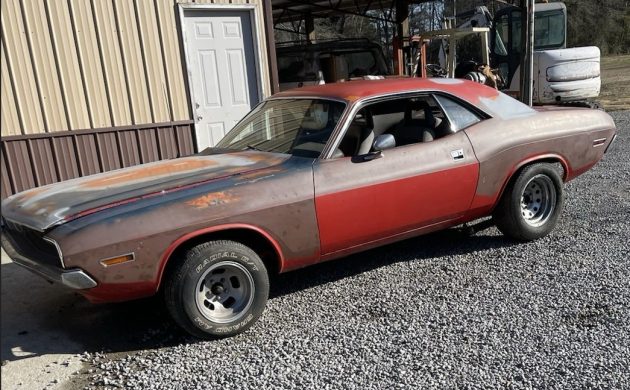
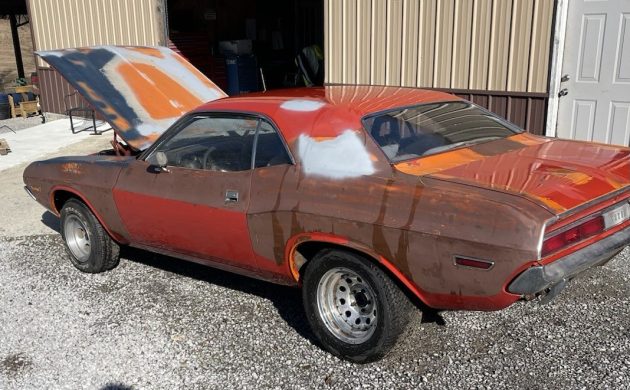
If this 1970 Dodge Challenger demonstrates nothing else, it is that there are still some excellent and desirable classics hiding in dark shed corners, waiting for their moment of liberation. The seller claims this Dodge is a genuine barn find and shows enormous potential as a project candidate. It hasn’t been lumbered with the rust that often plagues Challengers of this vintage, and it features a 440ci V8 under the hood. I must say a big thank you to Barn Finder Mitchell G. for spotting this wonderful discovery listed here on eBay in Vinemont, Alabama. The seller set their auction to open at $15,000, but has received no bids at the time of writing.
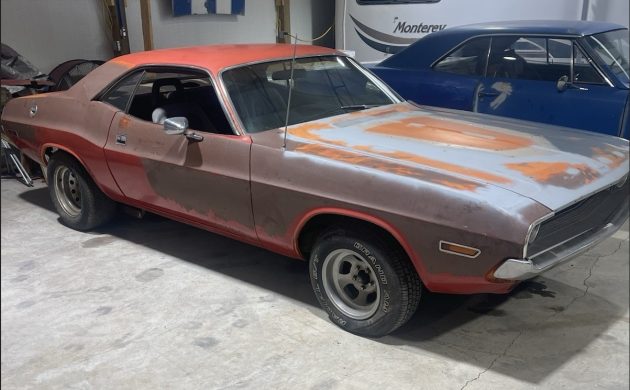
This Challenger emerged during the first year of Chrysler’s E-Body production run. I have always believed that the company hit a sweet spot with both the Challenger and its Plymouth Barracuda cousins, creating two of the most attractive vehicles to emerge during the 1970s. The history of this car is unclear, but the listing indicates it has been in storage for over three decades. It appears to be a stalled project, with glimpses of its original Hemi Orange paint amongst the primer and visible surface corrosion. Encouragingly, there is no evidence of exterior penetrating rust, and the seller states that the floors are solid. If accurate, this Dodge is a sound project candidate requiring minimal cutting and welding. The photos suggest that most of the trim is present and that the glass is in good condition.
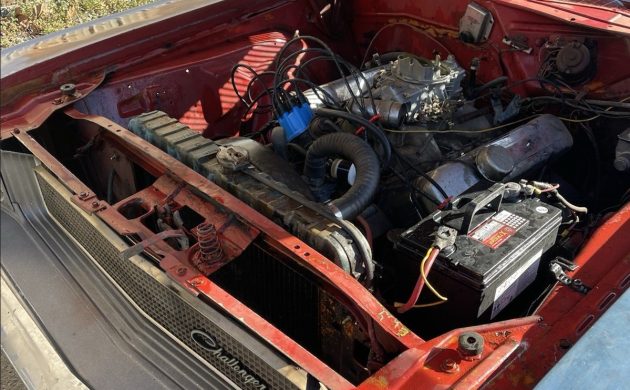
The seller states that this Challenger is a “big-block” car, and that the engine bay houses a 440ci V8. If the last fact is true, this classic can’t be numbers-matching. Dodge’s 1970 sales literature states that the 440 was available only in the Challenger R/T, and that the 383 was the largest motor buyers could select in a base model. The 383 was still a pretty handy proposition, delivering a factory-quoted 335hp and 425 ft/lbs of torque. This car also features a three-speed TorqueFlite transmission and power steering. The health of this car’s 440 and the remaining mechanical components is unclear, and a thorough inspection and fluid change would be the starting point if the winning bidder intends to coax the motor to life. However, after three decades of inactivity, budgeting for a mechanical rebuild would be wise.
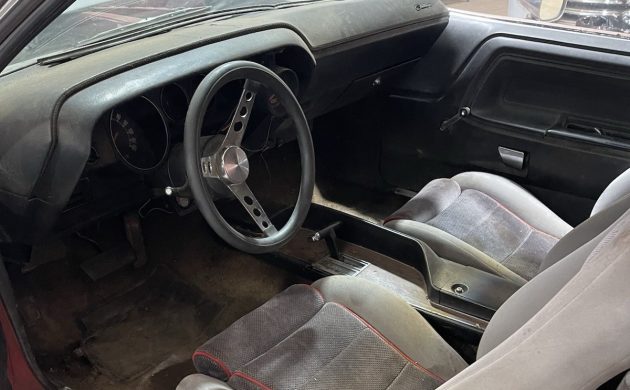
The seller’s photos are pretty limited, but they paint a genuinely positive picture of this Challenger’s interior. The bucket seats aren’t original, and I believe that they may have started life in a Chevrolet Camaro. That’s an educated guess, and I am happy to be corrected if I’m wrong. However, the dash, pad, console, and door trims look surprisingly good. The headliner is an unknown quantity, but I suspect that with a new carpet set, the correct seats, and a deep clean, this interior would present acceptably for a driver-grade build.
This 1970 Dodge Challenger is a fantastic find that deserves to return to its rightful place on our roads. Its lack of significant rust makes it an excellent restoration prospect, and the 440ci V8 should provide the muscle its inherently aggressive styling suggests. The opening bid figure means it isn’t the cheapest project candidate on the planet, but that’s offset by the fact that the buyer won’t need to spend hundreds of hours and potentially thousands of dollars to ensure the body is structurally sound. Are you tempted to pursue this Challenger further, or will you sit back as an interested observer to discover whether it finds a new home?




Could be a factory L code car; 383, 2 barrel. They only came with auto trans and usually with 2.93 gears, making it the worst possible drivetrain combination available at the time, IMHO. All the disadvantages of a big block, with less spunk than a 318/3speed.
Ok.. since its a Challenger not a RT. It can be fix up for fun into a Hotrod. The engine i would look at the distributor pad for the marks to see if its a 440 or 383. Then to see if it has a stamp HP for High Performance. So you hope its a 440 HP. Then look at the transmission pan to make sure its a 727. The torsion bars if not replaced to a 440 most likely has a 318 set up. The shifter console has a 71 handle on it. The front seats are from a Mustang GT I would say from the 80s. If the engine checks out and transmission this can be a fun project. The rear end could be a 8 3/4 with 3.23 posi or not. My cousin had a 70 with a 318 and the rear as I said. Also like Mooney said it could be a L engine 383-2 which is not worth fixing up that motor. If it is pull it and put in a early 440… Stock dash is not bad I just hope it goes to a good home that knows Mopars. 🇺🇸🐻
I would try to restomod with a Hellcat with a hellcrate or a 5.7 hemi gen 3 if you want to do faster less complicated restomod.
Would want to see more pictures such as under carriage. Seats and steering wheel would have to go.
I would try to restomod with a Hellcat with a hellcrate or a 5.7 hemi gen 3 if you want to do faster less complicated restomod.
lot of info in that eBay listing. NOT!
The seats look like they came out of a Mustang GT.
My 1320 in 20 years.
Ma Mopar didn’t put a 904 behind a big block
Ended at $15,300.
Reserve Not Met.
5 bids.