

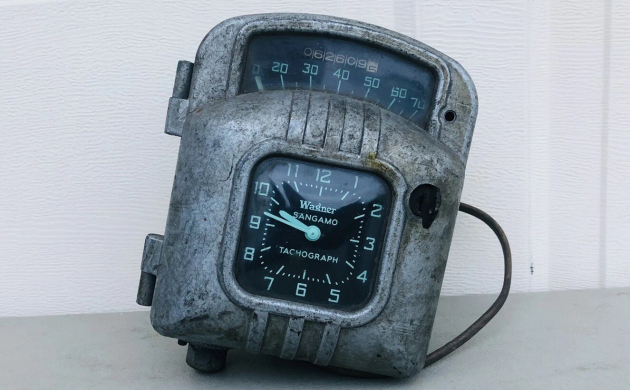
Back before we had all the digital instruments we have today, trucking companies kept track of driver activities via tachographs. These were mechanical devices that could track vehicle speed, total miles, hours, and more using analog gauges in a box like this one made by Wagner/Sangamo. Whether it works or not remains to be seen, but the clock is ticking! Located in Chambersburg, Pennsylvania, this 1940s piece of technology is available here on eBay for $95. Thanks to our buddy, Howard A, for the tip!
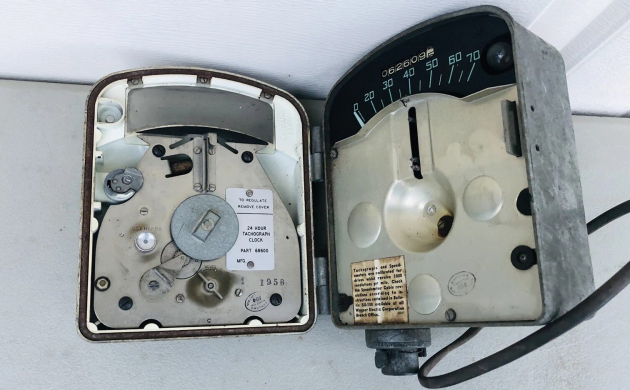
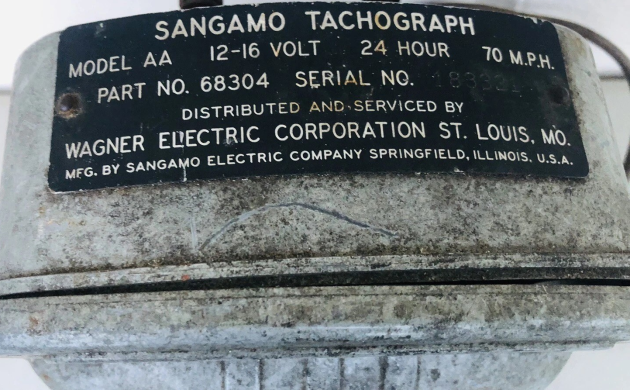
We don’t know the various sources that made these devices, but one of them was Wagner Electric Corp., which marketed its tachograph under the Sangamo brand. These boxes of tricks were generally sold to truck companies and bus operators to find out what their drivers were up to and to adhere to whatever safety standards existed in the mid-20th Century. Wagner’s device had a speedometer, odometer, and clock built into a single piece of hardware.
When used properly, you could determine a driver’s habits in terms of speed and time, and paper charts were produced inside the sealed and lockable boxes that came with a key (which the seller’s unit has). This was old-school by today’s standards, with internal styluses making marks on rotating paper. We don’t know how effective they were, but in the post-1950s era, what else could you do? We’re told this unit has normal wear and tear, has a clicking clock that may or may not keep time, and has not been tested. But for 95 bucks, what the heck?

Cool piece of history here. And a tip of the hat to Howard A AND Russ Dixon for the write up too. Its so funny. My company has an app from a company called Samsara. We are on a two way camera and every move is tracked. Speeding, running stop signs, agressive moves, all tracked and reported back to our managers. What a long way companies have come. For the price, I think its well worth it.
A genuine, for-real “Stool Pigeon!” Can you imagine, someone wanting to buy something that used to cause them so much grief? For years I had drivers coming to me, wanting to have their tach-o-graphs disabled, or rather, to make it so they could turn them off then right back on when it was convenient. I’m sure these were despised worse than the scales, the highway patrol, or at least a flat tire in the dead of winter. There were more than a few drivers lost their jobs because of one of these. But they told the bad news in all readable misery.
But these were only the beginning. Enter the late 80s and ECM/ECU controlled engines. Fleet owners loved the computer controls; they could map out the truck’s performance curve, program it into the ECM and seal it with a password.
I remember one crude hauler company that had over 50 trucks. They were all cloned to limit rpm to 1850 and road speed to 65mph, plus restricted maximum rpm between upper shifts until high range. Drivers all stopped in asking us to remove the restrictions. I knew the back doors to some systems but I would’ve gotten the firing squad (literally) if I ever caved in.
There was a driver persuaded a mechanic at a Cat/TEPS dealer about a hundred miles away, to remove the limits. For a brief period, he enjoyed travelling 75+ mph empty. Well, his truck started showing excessive tire wear and when it came in for service they plugged in the ECAP.
Unbeknown to him, the Cat ECM had a stool pigeon of its own; it showed the dealer code of the last place the system was analyzed/modified at, plus the ID of the ECAP itself. The driver was immediately terminated and the mechanic that found the back door and programmed the changes got himself in a lot of trouble as well.
You couldn’t program more horsepower but you could change the rated speed from, say, 1800 to 2100 rpm; you could remove the road speed limits, allowing vehicle speed to be limited only by engine rpm. And you could remove the rpm limits for most of the lower speeds except low range. In short, you could give a 3406 CAT PEEC 460 some long legs.
Well, guys, if I was still at my last place of employment and I dared to display that device it would’ve gotten used for target practice. I can’t think of anyone who would look at one of them and feel nostalgic.
You reminded me of a company I hauled medical gas cylinders for back in the 90’s. My truck had a Cummins M11. It could go 60 if you stood on it and kept your foot to the floor. 58 top speed with the cruise control. When they started bumping the speed limits from the Double Nickel to 65 I begged the repair facility to bump it up. Unfortunately whoever set it up, and made a password was no longer with the company and no one knew how to change it. So that was it. Very frustrating for sure. Thanks Geomechs, more memories!!!
Last time I saw one of these was 50 years ago on a bunch of fleet trade-ins. Now it’s all tied to the truck’s computer systems (plural) and GPS. Hey! Don’t be pickin’ your nose while driving!
From a trucking outsider’s perspective I’m reminded of how the trucker shortage we’ve has for going on 15 years now started when the (long planned) complete phaseout of paper logbooks finally happened and ELBs were mandatory. Turns out there’d been mass fudging of logbooks, probably going back decades.
Happened at the worst time too, just as Big Tech started hyping self driving, putting a severe crimp in the number of people willing to train for a job the robots were already coming for.
Your first sentence speaks volumes. There have been driver shortages, and gluts, for years. A lot of that depends on the economy. ELDs (not ELBs) were first used back in the 1980’s. They started as an on-board recording device and progressed from there. By 1990 drivers knew something was coming. In 2010 FMCSA tried, unsuccessfully, to make the rule final. It wasn’t until 2019 that it became final.
Was there a ‘mass fudging’ of logbooks? Hardly. Yes, there was ‘creative’ logging but nothing of mass proportions. Paper logs allowed the driver to pull over when tired and not lose hours. ELD’s virtually insist the driver, tired or not, run the full 11 hours (after 10 consecutive off duty) with at least a 30 minute break after 8 hours driving.
Truck drivers used to be known as ‘Knights of the Hiway’. Folks got into driving for the adventure and comradery. They enjoyed being on the road. Today trucks, and the drivers, are looked at as an impediment on the road.
Did ELDs cause some drivers to quit? Certainly. So did rearward facing cameras as did the general attitude the public has toward truck drivers.
Say ‘thank you’ the next time you see a trucker.
Put this in your teenagers car.
I remember using them. Some of our trucks had both a speedo and tacho units. The boss could compare the two and see while at 70mph the engine was at 650rpm…Georgia overdrive. Quite a few drivers messed with toothpicks and/or rubber bands to limit indicated rpm or speed. There was a little red light that came on when you were over speed or over rpm.
I just might have to buy it!
During most of my 30-year career (1978-2008) as a police officer, I specialized in commercial vehicle enforcement and collision investigation. Tachographs were widely used in the areas I worked, especially with large fleets, carriers hauling hazardous materials, and emergency vehicles. Early on, I received training on how they worked, how to read tach-cards, and identify fraud/tampering. I was issued a master key, and had it on my key-ring for at over 25 years.
Some drivers hated them, and would “forget” to load the paper card or try to sabotage the unit. I soon developed a habit at crash-scenes of checking the tachograph quickly , before the card “disappeared”. Some clever drivers thought they could beat the system by bending the stylus to record speeds by 10MPH ……But when they stopped, the card show they were going minus10 MPH! Back then, most truckers were among the best drivers , so the tachograph evidence exonerated them in the majority of crashes. While you could read a card by eye to get a general speed etc, close examination with a magnifying glass would reveal much more. The card typically reported time, speed, distance, and engine RPM with options for other data like PTO engagement or lights & siren activation on an emergency vehicle. By examining records of a trip or two, you could get a good indication of the drivers style and competence. Over-revving, bad shifting, hard braking, and speeding, could be clearly seen. It was also handy for “hours of work”, verifying log-books and fatigue investigations. In collisions, the force of the impact would actually be transmitted through the stylus and show on the card.
That was important, especially in rollovers where the wheels might keep spinning for a while after the crash. Defence lawyers would often try to claim their clients were driving slowly as per the last readings on the card, and I would prove to the court that the low speeds were from after they rolled.
I was also a partner in a large “picture vehicle” business for 20+ years and owned many tachograph-equipped ambulances. While my prop ambulances (staffed by off-duty paramedics) were not legally required to have tachographs, I always made sure they were working. One of my ambulances was involved in a rollover crash returning from set, and the tach exonerated the driver. In several other incidents I could prove that film companies used my ambulances for unauthorized activity or stunts. A stuntman used my prized Freightliner ambulance to ram a “zombie” when it was supposed to be parked!
In my mancave/garage I have a wall of (working) emergency lights, sirens, radios…… and a tachograph.
:),, thanks to the site and Russ, you know, I try and find the most universal memories, the drivers simulator, the terlet, and this, it takes up my time, ( and wearing out laptops, #4 on the way tomorrow), and I even logged out/in to insure comment approval,,,,
The tattletale, the narc, the snitch, the stoolie, the rat fink, the whistleblower,,,we had a lot of names for these. I’m not sure why it’s called a “tachogragh”, when they had a similar device for rpm. I don’t recall these recording rpms, just speed and time, but it’s been a while. The early ones were hand wound clock, but these were 12V, and several ways were tried to foil them. I heard of drivers drilling a hole in the speedo part at 55mph, insert a drill bit or nail, to prevent the recording of higher speed. Or a good zeitz might scramble the disc, but they were pretty tough. You would replace the paper disc every trip, and hand it in with your logs. It wasn’t considered gospel, but gave a good account of the vehicles operation.
This is considered byzantine by recording standards. This is considered the grandfather of ELDs, (electronic logging device) and merely to be hung on a wall. Today modern ELDs are the pinnacle of electronic wizardry, and ironically one reason I stopped driving a truck. I had 1(one) trucking job with a computer ELD, one. It was a union job, and they are actually quite handy,, if nothing to hide, that is. They eliminated paper logs, which was total BS anyway, my 1st boss, “you can get it real close with a pencil” on paper logs, but ELDs probably would require Steve Jobs, they are incredibly accurate, AND, all the info goes right to the Pentagon,,,,maybe, but I never had an officer look at my paper disc on these, but they can take your computer “card” and download your past. I heard, they can even monitor you on their cruiser laptops, without even stopping you. Yeah,,,we’ve come a long ways in that regard, and consequently why I have no interest in that job anymore. I’m not alone, as so many old timers have left the industry, it’s scary who is replacing them.
The “tattle tale”, Big Brother indeed,,,thanks all for your comments,,,,
Yay, the comment took, ( I just jinxed it), quick tachograph story, I had a run from around Madison, Wis. to Bloominton, Ill. about 3 hours. Normally, a piece of cake, but not this night. Left Madison, dry roads, I get about 1/2 hour from Bloomington, starts to snow. It was about 2am, nobody out, no real concern, I get to the store, back in, unload my eggies, about 20 minutes, I come out, WOW, there was about 4 inches of snow on the hood. Oh boy, going to be a slow ride back. I left the store, still had half a load, so had some traction, never stopped at the stoplights, got to the interstate, it was white knuckles. The only way I knew I was on the road, was the reflectors at the side. 20mph, tops. I catch up to a “SilverDog”( Greyhound) I figure, they will slog on, nope, the bus gets off, I’m on my own. I was about to stop too, when the snow cleared a bit, I could see trucks coming the other way had no snow. Trusty old CB radio, “hey southbound, what’s it like behind you”? “Dry roads, hammer down”,, I said, sorry, not for you. The CB was literally a life saver in those conditions.
SO,,,long story, sorry, I ( finally) get back, the dispatcher asked why I was late, looks at my tachograph disc, “oh, I see you were going 20 mph for almost an hour”,,,I almost punched him and walked out. So when you reach for that dozen eggs or whatever, many don’t realize what it takes sometimes. Honestly, I found, nobody really cares.
I will say this, that Louisville Ford L8000, hopefully one will be featured here someday, got me through thick and thin, they were the best trucks, and I proved it that night.
Many people don’t truly appreciate what it takes to get food from farm to fridge until they read about it like you’ve done here, Howard. Thank you for the recollection, sir.
Well, I’ll be darn, never thought I’d see a good ol ‘tach-chart’ again. I worked for Total Petroleum (Vickers back then) hauling gasoline out of Denver CO starting in 1978. They had 8 or 9 tractor trailer sets and every truck had a tach chart in it. The boss thought those were the greatest things, he had his little chart reader with the magnifying glass right there on his desk. Speed limit was 55 but he let us do 60, if he found a chart going over 60 you got called in on the carpet. I wonder if you can still buy the paper charts for these things. So thanks for the bad memories Howard A.
Any time, pal, besides, this pales in comparison to what a driver today has to endure. I don’t recall speeding being an issue then, as most of the trucks I drove didn’t do 55 mph anyway. These were more for when a truck was sitting and for how long. Oh, I’m sure there are discs somewhere, it really was a much simpler time.
I doubt that the Monfort trucks had these…..
On a lonely stretch of highway, east of Omaha, late one night I was struggling along in my R model Mack, lucky to get “double nickel”, headlights coming up fast behind me in the left lane. I hear on the CB, “Don’t move”, and this Monfort KWhopper, blows my doors off, had to be going 100. :0
In case some may not know the reference, Monfort Meat Packing in Greeley, Co. had a fleet of trucks, Kenworth mostly, and they made an agreement to have swingin’ meat to the east coast in like 2 days. They had teams and trucks geared for 3 digits. They had 4 fuel tanks and never stopped. It was said the company “bought the left lane”, meaning they paid all tickets, but that was never proven. Monfort quit trucking in 1987, but left behind a legacy we’ll never hear of again. And you are right, I doubt they had tachographs that went up to 100.
Monfort, now that’s a name I haven’t heard in many years. Skuttlebutt says you never get in front of them…
Thought you were starting to sing like Bob Seger for a moment. I started trucking in 1978 and remember the Monfort trucks and the left lane was always referred to as the Monfort lane. Always heard the same thing company paid the tickets. I drove U model Macks before I ever drove a R model Mack those were a trip. I worked for a company that had a fleet of worn-out Ruan cab over International 4070 also a fun time.
I remember these tachographs very well, if you bounced it off a curb while driving it would throw it out of whack, the employers complained to the
Manufacturer and they built them a little better!
Well it wasn’t too long when somebody came up with the idea of using a magnet as the whole thing was made of steel, after that they made them of plastic except for the hands on the clock were still metal so you couldn’t cheat until someone came up with the idea to tape a magnet to the face and that stopped the hands from moving! Finally the employers gave up on them and didn’t use them anymore.
At my high school as a student, my school-bus driver could be seen regularly taking the little paper disc out of his, and using a pencil to erase any speed or RPMs that went out of bounds.
Russ, What an interesting find and write up. Yes, They bring back many memories!! Matlack Tank Lines had them in all their trucks. Mack trucks even built a special dashboard for the R model so that these Tachographs fit in the space originally designed for the speedometer. As Howard described, us drivers devised many ways to alter their recording abilities. Foam in the top of the needle slot, the magnets, remove the glass so you could move the clock needles by hand, and many more. The most sure fire way if you were going to make a multiday trip, was to crack the door open a little bit and pour some Coke Cola in!! It was done for until the mechanics had to replace it. I am glad I retired just as the ELD’s were being forced on us. Today this unit is only good for a wall hanging conversation piece unless someone is restoring an R model Mack with the dash built for it.
I was never a trucker. (Be that good or bad) But I sold commercial vehicles. (Mostly 1.5 ton and down) Since I sold to businesses, they were always concerned about what their drivers were doing. So I started selling a monitor system that plugged into the data port. It also had a GPS that recorded and reported the location of the vehicle and where it had been. The owner at anytime could log in and see where his vehicles where and the speed they were driving. I stopped in his office one day just to touch base and asked his opinion of the monitoring system. He mentioned that he was pleased and had just turned it on. I was looking over his shoulder and noticed that one of his 3/4 trucks was out in the desert going 98 mph. I said that the monitor must be malfunction ing as the vehicles computer will shut off the fuel at 92,mph because of the 10 ply tires are not rated for any speeds above that. So later in the week the truck was back at the home base. And I swapped out the monitor for a new one. A week later I stopped in again and we pulled up the program and that same truck was running 105 mph.I said that the driver must have changed out the cpu chip. He gave me the extra set of keys so that I could “steal” the truck the next time it was back at base. I did that brought it back to the dealership and had it checked out. The driver had indeed “chipped ” the computer and the stock chip was in the glove box. I brought back the truck “un chipped” and the driver was still in the bosses office. I tossed the chip on his desk and provided the explanation as to the speed. The driver right there lost his job. Driving a company vehicle at that speed with tires not rated for those speeds in the hot desert is a recipe for an accident. And if involved with another vehicle would guarantee a healthy lawsuit.
We had them in our Fire Department Aid Cars in the 60’ and 70’s. Seattle. But they were set to MPH instead of RPM. DODGE Vans. If your cornered tight the outside tire would lift and spiking the Graph to like 90 mph.
I know of one Medic Unit on a long response, the Medic ripped it off the dash and threw it out the window. Reported it stolen while they were in a house tending to a patient. Haha. Hated them.
That would be the inside rear tire. Ask someone who autocrossed a ’65 Baracuda without limited slip!
That is how I wrote it first changed thinking about it. Inside is correct.
I worked in the transit bus industry for fourty years we had some old GM busses with these in them. Wish I grabbed some when we scrapped the busses, always thought they were kind of cool
In the 80’s and the 90’s, I worked for a large (10,000+ vehicle) private, nationwide company, who’s last name ended in Cola. We had these tachographs in our 70’s model Freightliner’s. The company discontinued use of them in any newer models. Basically, tampering, related to anything from the rubber band thing, to bent needles, to drivers bashing the housing with tire billy’s (hey, we were a union barn). Between the rattling of those cabs and the incessant ticking of the tampered ‘clocks’, the company discontinued them. Besides, the newer administrators, had no clue of how to read them, anyway. Well, there’s a buyer for everything, somebody, will get this one. !
SOLD.